Deregistering a Car for Export in Singapore: The 2026 Complete Guide

What if your aging vehicle is worth more in a different country than it is on the streets of Singapore? Many owners view the end of a COE as a financial loss, but deregistering a car for export is actually a strategic arbitrage opportunity to maximize your final return. It's an effective way to turn a local liability into a global asset.
It's natural to feel some anxiety about the revised 2026 PARF rebate caps or the strict one-month LTA disposal deadlines. You've likely heard stories of owners being lowballed by exporters or missing paperwork windows, leading to lost rebates. You deserve a transparent process that ensures you get every cent your car is worth, including the correct PARF and COE percentages based on the latest February 2026 regulations.
This guide will help you master the LTA deregistration process and secure the highest possible export price for your vehicle through our expert step-by-step framework. We'll clarify the new rebate calculations, provide a clear timeline for your returns, and show you how to handle the documentation with total confidence. By the end, you'll have a clear path to a seamless transaction and a maximized payout.
Key Takeaways
- Understand the legal distinction between scrapping and exporting to ensure you choose the path that maximizes your car's residual value.
- Follow a clear, step-by-step guide to deregistering a car for export using the OneMotoring portal and Singpass for a secure digital submission.
- Learn to accurately calculate your total financial return by combining the latest 2026 PARF and COE rebate structures with your vehicle's international body value.
- Identify why Singaporean vehicles are highly prized in global markets and how this demand translates to higher payouts compared to local scrap metal prices.
- Simplify the entire logistical process, from LTA paperwork to EPZ handling, with the support of the experienced team at Carz World.
Understanding the Deregistration and Export Process in Singapore
Deregistration is the formal process of ending a vehicle's legal status in Singapore. Once this happens, your car cannot be driven on public roads. It's a necessary step whether you're sending the car to a scrapyard or preparing for the more profitable route of deregistering a car for export. Understanding this distinction is the first step toward reclaiming your financial investment and ensuring you don't leave money on the table.
While scrapping involves the physical destruction of the vehicle for its metal content, exporting allows your car to find a second life in another country. In 2026, many owners are finding that international buyers are willing to pay a premium for Singapore's well-maintained vehicles. This global demand often makes exporting a much more attractive option than simply crushing the car for its scrap value, especially for popular Japanese and European models.
To better understand how this process works in a global context, watch this helpful video:
When you prepare to sell, you'll encounter two distinct types of value: "Paper Value" and "Body Value." Paper value consists of your PARF and COE rebates, which are state-guaranteed returns. Body value is the actual market price an exporter will pay for the physical machine. By choosing specialized car export services, you can often secure a body value that significantly exceeds what a local scrapyard would offer for the raw materials.
The 10-Year COE Dilemma: Why Exporting is Trending
2026 has become a pivotal year for car owners. High prices within the Certificate of Entitlement (COE) system make renewing a 10-year-old car's life financially challenging. Instead of committing to another decade of high costs, many owners are choosing to capitalize on the current export surge. Cars reaching the 9 or 10-year mark are the primary candidates for this. These vehicles are often in excellent mechanical shape due to Singapore's strict inspection standards. This makes them highly desirable in overseas markets where buyers value reliability over local brand-new options.
Legal Requirements for Exporting Your Vehicle
The Land Transport Authority (LTA) maintains strict oversight to ensure all transactions are transparent and legitimate. Before you begin deregistering a car for export, you must ensure your vehicle's record is entirely clean. This means paying off any outstanding bank loans, clearing all traffic fines, and ensuring your road tax is fully settled up to the date of deregistration. Once the car is deregistered, the process moves quickly. You must export the vehicle and submit the required proof of disposal to the LTA within 30 days. Meeting this strict deadline is essential if you want to keep your rebates and avoid fines.
Step-by-Step Guide to Deregistering Your Car for Export via LTA
The process of deregistering a car for export has become significantly more streamlined with the 2026 digital updates to the OneMotoring platform. While the system is efficient, it requires strict adherence to a specific sequence to ensure your rebates are processed correctly. Following these steps carefully will help you avoid common pitfalls that could delay your payout or result in LTA penalties.
1. Singpass Login: Access the OneMotoring portal using your Singpass 2FA. This is the only secure way to initiate the process for privately owned vehicles. For corporate-registered cars, you'll need to use CorpPass.
2. Submit Application: Navigate to the "Deregister Vehicle" section. It's vital to select "Export" as your primary reason. This choice triggers the specific documentation requirements needed for international shipping rather than local scrapping.
3. Settle Liabilities: The system won't grant final approval if there are outstanding road tax arrears, traffic fines, or active bank loans. You must ensure your financier has released the vehicle's interest before you click submit.
4. Confirmation Letter: Once approved, download and print your Deregistration Confirmation Letter. This document is your "golden ticket" for the next phase. You'll need it to move the car and to facilitate the shipping process.
5. Move to EPZ: Your vehicle must be delivered to an LTA-authorized Export Processing Zone (EPZ) within the stipulated timeframe. This is a secure facility where your car is stored and verified before leaving Singapore.
Navigating the OneMotoring Portal in 2026
The 2026 UI update features a more intuitive dashboard that highlights your estimated returns immediately. Before you finalize the deregistration, use the built-in calculator to verify your PARF rebate calculation. This ensures the system reflects the 2026 sliding scale accurately, especially the S$30,000 cap for newer registrations. If you encounter a "pending validation" error, it's usually due to an uncleared fine or a delay in bank processing. Refreshing the status after 24 hours often resolves these digital sync issues.
The Role of Export Processing Zones (EPZ)
An EPZ serves as a bonded warehouse where the LTA verifies that the car being exported matches the registered records. When you drop off your car, you must provide your NRIC, the Deregistration Confirmation Letter, and proof of valid insurance for the transit. EPZ staff will physically inspect and verify the chassis and engine numbers. This step is critical because it officially records the vehicle's exit from the local market. If you'd rather have professionals manage these logistical hurdles, you can explore our car export services for a stress-free experience.
Remember that the clock starts ticking the moment you deregister. You have exactly one month to export the car and submit the disposal documents to the LTA. Failure to meet this deadline is a serious offense. It can lead to the forfeiture of your rebates and potential prosecution. Being organized with your paperwork from day one is the best way to protect your financial interests.
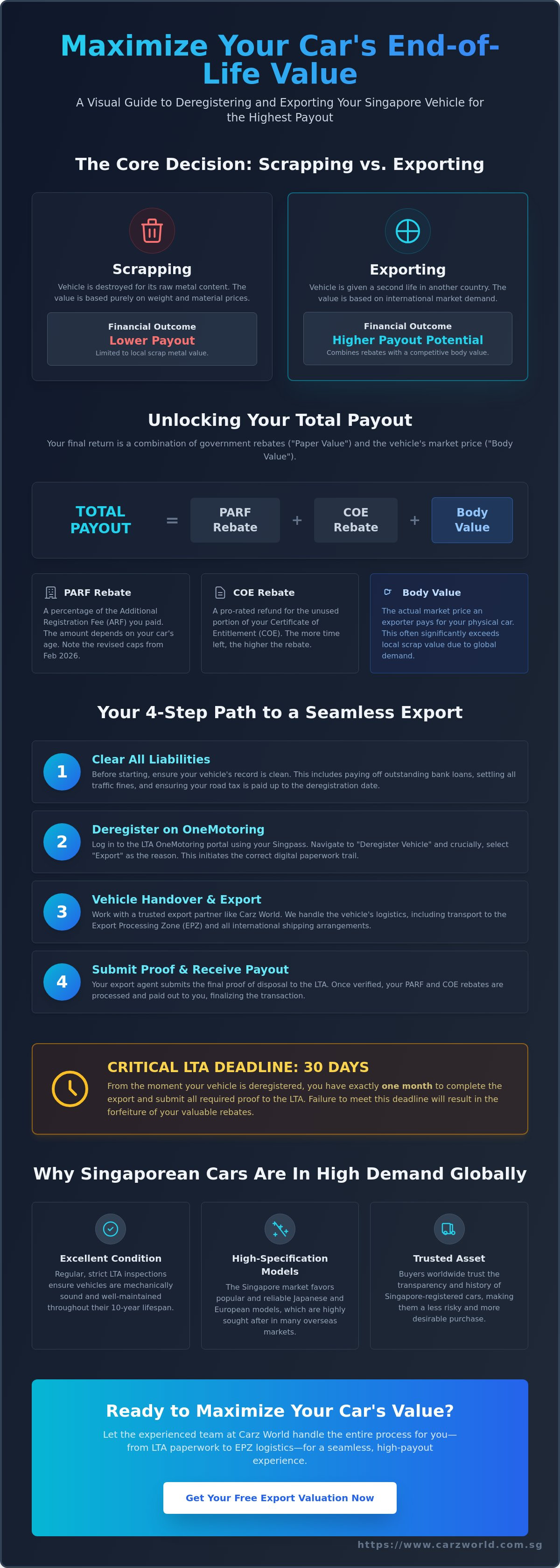
Calculating Your Payout: PARF Rebates, COE Rebates, and Body Value
Understanding the math behind your payout is essential for a successful transaction. When deregistering a car for export, your final cheque isn't just a single figure. It's a combination of three distinct financial streams that reflect both the government's rebates and the global market's demand for your vehicle. Getting these calculations right ensures you don't leave money on the table when saying goodbye to your car.
The first component is the Preferential Additional Registration Fee (PARF) rebate. This is a return of a portion of the Additional Registration Fee (ARF) paid at the time of the car's first registration. The second component is the Certificate of Entitlement (COE) rebate. This represents the pro-rated value of the unused time left on your COE, calculated using the formula: (Quota Premium paid x months remaining) / 120. Finally, there's the Body Value, which is the cash price an exporter pays for the physical machine itself. Your Total Payout is the sum of these three components.
To ensure you're following the correct legal procedures to secure these funds, you should consult the LTA's official guide to exporting a vehicle. This resource outlines the mandatory steps to protect your rebate eligibility and avoid costly clerical errors.
Understanding PARF Eligibility and Deadlines
Timing is the most critical factor in maximizing your PARF return. For cars registered with COEs from February 2026 onwards, the rebate follows a sliding scale that starts at 30% of the ARF paid for cars under 5 years old. This percentage decreases annually, reaching just 5% for cars between 9 and 10 years. These rebates are now capped at S$30,000 for newer registrations. If a vehicle passes the 10-year mark, the PARF rebate is completely forfeited. Deregistering even a single day late can cost you thousands of dollars in lost rebates. You must monitor your registration date closely as you approach the decade milestone.
How Exporters Determine Your Car’s Body Value
The body value is where you can often negotiate for a higher return. Unlike the fixed government rebates, this figure depends on international market demand. Exporters look at brand prestige, mileage, and the general condition of the engine and interior. Japanese SUVs and certain Continental sedans typically fetch higher premiums because they're highly sought after in developing markets. International currency fluctuations also play a significant role in your 2026 quote. A stronger foreign currency against the Singapore Dollar can lead to a higher offer for your vehicle. If you want to see how these factors apply to your specific model, you can browse our current car export services to gauge market interest.
Why Exporting Often Beats Scrapping for High-Demand Models
Many owners assume that once a car reaches the end of its COE, its only destination is a local scrapyard. This is a common misconception that can lead to significant financial loss. While scrapping calculates value based on raw metal weight, deregistering a car for export treats your vehicle as a functioning machine with resale potential in global markets. Singapore's vehicles are highly prized overseas. Our strict maintenance regimes and relatively low mileage make these cars premium options for buyers in other countries.
The "Export Premium" is particularly visible for specific brands. Toyota, BMW, and Mercedes-Benz models often fetch prices far above their local scrap value. For a high-demand SUV or a well-kept continental sedan, the difference can amount to thousands of dollars. You might wonder if the extra paperwork is worth the higher price. The reality is that the administrative steps are quite manageable when you understand the process, and the financial gain often far outweighs the time spent on documentation.
Top International Markets for Singapore Cars
Your car likely has a waiting buyer in a "Right-Hand Drive" market. African nations like Nigeria and Kenya have a massive appetite for durable Japanese models. They value the reliability of the Toyota and Honda fleets found on our roads. Meanwhile, high-end European cars often find new homes in New Zealand and Australia. These buyers seek out Singaporean exports because they know the vehicles haven't been subjected to harsh winter conditions or salt-covered roads, which preserves the chassis and undercarriage.
Evaluating Your Car’s Export Potential
Not every vehicle is a prime candidate for the international market. To determine if your car qualifies for an export premium rather than just being scrap material, consider this checklist:
- Service History: A complete record from authorized workshops significantly boosts buyer confidence.
- Original Parts: Vehicles with original engines and major components are much easier to clear through foreign customs.
- Interior Condition: Well-preserved leather and electronics suggest a car that has been cared for.
- Mileage: Lower-than-average mileage is a major selling point in Oceania markets.
If your car meets these criteria, it's worth pursuing a professional valuation. You can use Carz World Export Services to get a fair assessment of your vehicle's global market value. We specialize in identifying the models that will perform best overseas, ensuring you don't settle for local scrap prices when a better offer is available. If you're ready to see what your car is truly worth, contact our team today for a transparent quote.
Seamless Car Export Solutions with Carz World
Choosing the right partner makes all the difference when you're ready to move on from your current vehicle. While the technical steps of deregistering a car for export are straightforward, the logistics of finding a buyer and managing the Export Processing Zone (EPZ) requirements can be time-consuming. Our dedicated export division is designed to take these tasks off your plate. We provide a streamlined experience that ensures you receive the maximum value for your car without the typical administrative headaches.
Our team specializes in managing every technical detail from the initial Singpass login to the final submission of disposal documents to the LTA. We've built an extensive network of international buyers across Africa and Oceania, which allows us to provide more competitive quotes than many local scrap yards. When you work with us, you benefit from transparent pricing and immediate settlement of your car's body value. You don't have to wait for the car to be shipped to receive your payment.
Why Choose Carz World for Your Car Export
Our clients frequently praise our professional staff in their testimonials, highlighting the individual care they receive during the transaction. We believe in a methodical and honest approach. This means no high-pressure tactics and a clear explanation of every step. Whether you're selling a luxury continental sedan or a fleet of commercial vehicles, our team has the expertise to handle the specific requirements of each category. We focus on making complex logistical processes feel like a seamless experience for you.
Get Started: Your Export Journey Begins Here
Starting the process is simple and requires very little from your side. You can request a free, no-obligation valuation today to see how your car's body value compares to local scrap offers. Once you're ready, just bring the necessary documents to our showrooms in Ubi or Alexandra. Our team will guide you through the final steps with efficiency and competence.
To ensure a smooth visit, please have these items ready:
- Your NRIC or passport for identity verification.
- A copy of your vehicle's log card (available via OneMotoring).
- All sets of car keys and the original service booklet if available.
- Outstanding loan details if the vehicle isn't fully paid off yet.
We're committed to maintaining our long-term reputation by providing a service that's both dependable and highly organized. If you're looking for a partner that values transparency and customer satisfaction, we're here to help. Sell your car for export with Carz World and experience a professional transition that maximizes your financial return.
Secure Your Maximum Vehicle Return Today
Turning your vehicle's end-of-life into a financial success starts with understanding the global demand for Singaporean cars. By choosing to pursue deregistering a car for export, you can unlock a body value that often far exceeds local scrap prices. Timing is essential. Staying ahead of the 30-day LTA submission deadline ensures your PARF and COE rebates remain protected. Whether you drive a durable Japanese SUV or a luxury continental sedan, the international market is ready to offer a premium for your well-maintained machine.
Carz World is trusted by thousands of Singaporean car owners to provide transparent, LTA-compliant processes. Our global network of buyers allows us to secure the maximum body value for your vehicle with immediate settlement. We focus on making the entire logistical journey feel seamless and stress-free. Take the first step toward a higher payout by requesting a professional valuation from our experienced team.
Get the Best Export Quote for Your Car Today
We're here to help you navigate the 2026 regulations with total confidence. Let's make your next car transition a rewarding experience.
Frequently Asked Questions
Can I export my car if I still have an outstanding car loan?
No, you cannot deregister or export your car until your outstanding bank loan is fully settled. The Land Transport Authority (LTA) will only approve the application once the financier has released their interest in the vehicle. You should contact your bank to obtain a final settlement amount and clear the balance before beginning the digital application on the OneMotoring portal.
How long does the entire deregistration and export process take?
The administrative part of deregistering a car for export typically takes a few business days once your liabilities are cleared. However, the physical process of moving the car to an Export Processing Zone (EPZ) and shipping it overseas varies based on vessel availability. You must complete the entire process and submit disposal documents to the LTA within 30 days of the deregistration date.
Will I get a refund for my unused car insurance and road tax?
Yes, you are entitled to a pro-rated refund for both your unused road tax and car insurance. Once the LTA approves your deregistration, the road tax refund is automatically processed and sent to the registered owner. For insurance, you must contact your provider directly to cancel the policy and request a refund based on the remaining coverage period left on your contract.
What happens if I deregister my car but fail to export it within 30 days?
Failing to export your vehicle within 30 days of deregistration is a serious offense under LTA regulations. You risk losing your PARF and COE rebates entirely. Additionally, you may face heavy fines or potential imprisonment. It's vital to have your shipping logistics or an agreement with an exporter confirmed before you initiate the process to ensure you meet this strict deadline.
Is it better to scrap or export a car that has been in an accident?
Scrapping is generally the preferred option for vehicles with significant structural damage or deployed airbags. International buyers prioritize mechanical reliability and aesthetic condition. If the accident was minor and the car is professionally repaired, it may still hold export value. However, severe accidents often reduce the body value to the point where local scrap metal prices become more financially favorable.
Can I deregister my car for export myself, or do I need an agent?
You can complete the initial step of deregistering a car for export yourself through the OneMotoring website using your Singpass 2FA. While the digital application is accessible to owners, many choose to engage an export agent to handle the complex logistics. Agents manage the transport to the EPZ, shipping documentation, and foreign buyer negotiations, which can save you significant time and effort.
Do I need to remove my IU (In-vehicle Unit) before exporting?
You should remove your In-vehicle Unit (IU) before the car is sent to the Export Processing Zone. The IU is your property and can be kept for use in your next vehicle or returned to an authorized center. Exporters generally don't require the IU. It has no function outside of Singapore's ERP and parking systems, so removing it prevents any unnecessary loss of your equipment.
What is the "Deregistration Value" and how is it paid out?
The deregistration value is the total amount of your PARF and COE rebates as calculated by the LTA. This "paper value" is paid out by the government to the registered owner, usually via a cheque or direct bank transfer within a few weeks. This is separate from the "body value" cash payment, which is the price paid by the exporter for the physical vehicle.
In Same Category
- Toyota Prius in Singapore: A Practical Buyer’s Guide for 2026
- Best Cars for Home-Based Businesses in Singapore: 2026 Guide
- Risks of Buying a Car with 1 Year of COE Left in Singapore (2026 Guide)
- Best Second Hand Cars for Malaysia: Singapore Buyer's Guide
- Buying a Used Lorry in Singapore: 2026 Buyer’s Guide
Related by Tags
- Scrapping Your Car Before 10 Years in Singapore: What Happens?
- Used Cars for Sale in Tampines: 2026 Buyer's Guide
- Car Downpayment vs Monthly Instalment in Singapore: The 2026 Budgeting Guide
- Car Loan Singapore: The Complete 2026 Guide to Financing Your Vehicle
- How Much Salary to Afford a Car in Singapore: 2026 Affordability Guide
- Buying a Used Car in Singapore: 2026 Ultimate Guide
- What is PARF? The Ultimate Guide to Singapore’s Car Rebate System
- Mercedes-Benz EQB 250+ Review: The Ultimate 7-Seater Family EV in Singapore
- Long Term Car Rental Singapore: 2026 Definitive Guide
- How to Buy a Car in Singapore: The Ultimate 2026 Step-by-Step Guide
- Second Hand Hybrid Cars Singapore: The 2026 Value & Inspection Guide
- Cheapest Car in Singapore: The 2026 Guide to Affordable Ownership
- Parallel Import Cars Singapore: 2026 Buyer’s Guide
- Toyota Harrier Singapore: The Definitive 2026 Buyer’s Guide
- Honda Civic Singapore: 2026 New & Pre-Owned Guide