Buying Chinese Cars in Singapore: The Ultimate 2026 Buying Guide
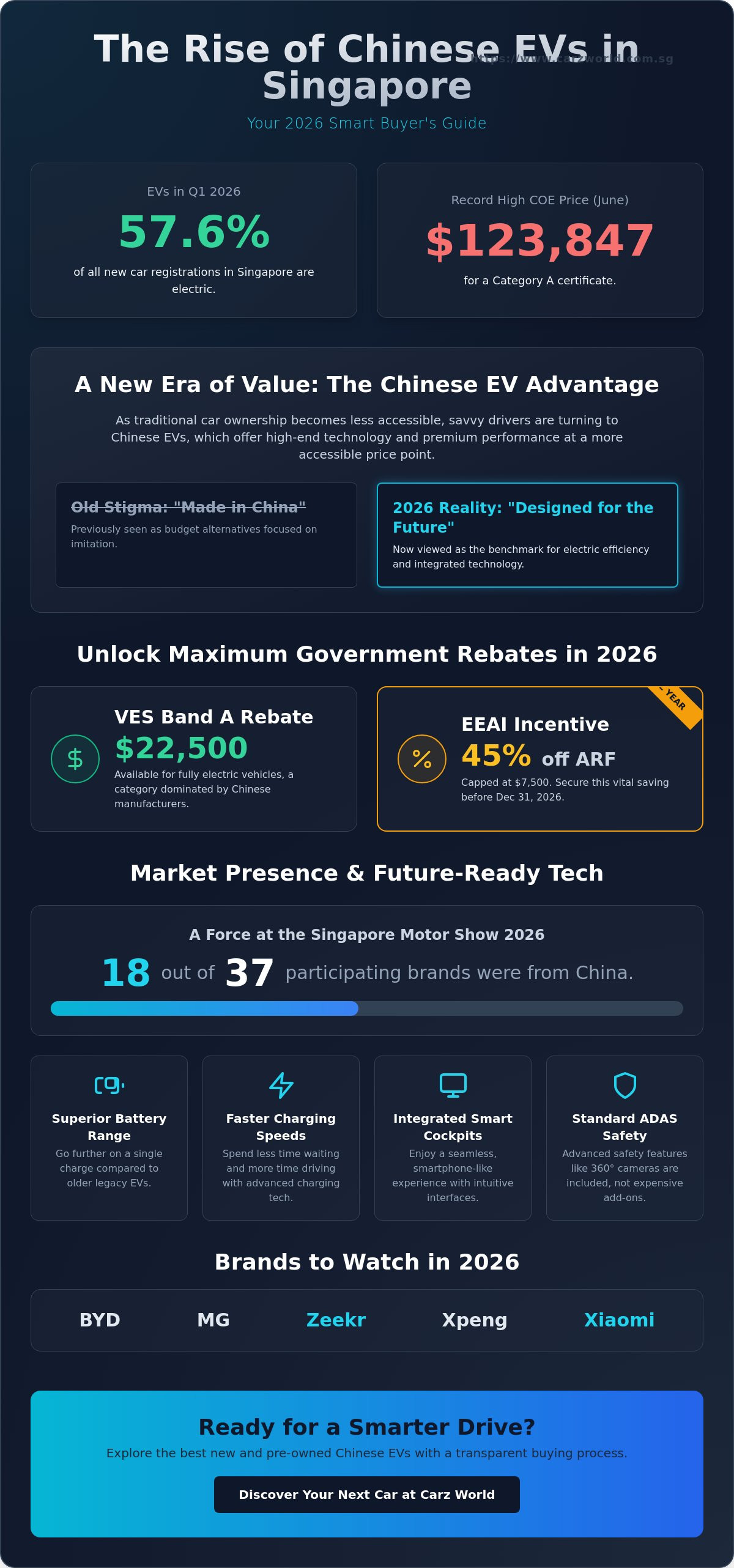
Did you know that in the first quarter of 2026, electric vehicles accounted for 57.6% of all new car registrations in Singapore? With Category A COE prices reaching $123,847 in June, the traditional path to car ownership feels increasingly out of reach for many families. It's natural to feel frustrated by these rising costs. You might also worry about the transition to electric charging and how your vehicle's value will hold up over time.
Many savvy drivers are finding a solution in chinese cars. These vehicles now offer a strategic way to secure high-end technology and premium performance at a more accessible price point. This guide will show you how to find the best value in this rapidly shifting market. You'll learn how to maximize the $22,500 VES Band A rebate and take advantage of the final year of the EEAI incentive. We will also preview the latest models from brands like Zeekr, Xpeng, and BYD. Our goal is to ensure your next purchase is a smart financial move that results in a seamless, high-quality driving experience.
Key Takeaways
- Understand why Chinese manufacturers have transitioned from imitation to high-tech innovation in the 2026 Singapore market.
- Learn how to optimize your budget by navigating the latest VES rebates and COE categories for chinese cars.
- Identify the standout features of 2026 models from market leaders like BYD and MG to find the right fit for your lifestyle.
- Gain clear insights into the reality of battery health and resale value trends to ensure a confident long-term investment.
- Discover how a transparent buying process for brand new or pre-owned vehicles can make your next car purchase seamless and efficient.
The Rise of Chinese Cars in Singapore: Why the Shift in 2026?
In 2026, the Singaporean automotive market looks fundamentally different than it did just five years ago. The long-standing dominance of traditional Japanese and Continental brands has been challenged by the rapid ascent of China as a global automotive powerhouse. This shift isn't just about offering a cheaper alternative; it's about a complete transformation in how vehicles are designed and manufactured. Many buyers now view chinese cars as the benchmark for electric efficiency and integrated technology.
The old "Made in China" stigma has been replaced by a "Designed for the Future" reputation. Younger Singaporean buyers are particularly drawn to software-defined vehicles (SDVs). These cars function more like high-performance smartphones on wheels, offering over-the-air updates that improve the car's features long after you've driven it off the lot. The disruption of the traditional duopoly is evident in the numbers. At the Singapore Motor Show 2026, 18 out of the 37 participating car brands were from China, signaling a clear change in consumer preference. This massive scale of production is supported by sophisticated logistics; to understand how international firms manage manufacturing and procurement in the region, check out Buying Office Asia.
To see these innovations in action, watch this review of a modern Chinese electric sedan:
From Budget to Premium: The Brand Evolution
Brands like BYD and MG have become household names in Singapore, successfully moving from budget-friendly options to respected mainstream contenders. They've paved the way for high-end marques like Zeekr and Xiaomi to enter the local market, offering luxury experiences that rival established European brands. 2026 is the tipping point for mainstream adoption because these manufacturers have proven their reliability over several years of local use. Whether you're looking for brand new electric SUVs or sleek city runabouts, the variety available today ensures there's a premium option for every budget level.
The Tech Advantage: Why Singaporeans are Switching
Technology is the primary driver behind the switch to chinese cars. These vehicles often feature superior battery range and significantly faster charging speeds compared to older legacy brands. Inside, you'll find integrated smart cockpits that mirror the smartphone experience with zero lag and intuitive interfaces. Safety is also a major factor. Advanced Driver Assistance Systems (ADAS), such as 360-degree cameras and automated parking, are typically included as standard features rather than expensive add-ons. This commitment to including high-end tech in every model has made these cars incredibly attractive to tech-savvy drivers in Singapore.
Key Factors to Evaluate When Choosing a Chinese Car in SG
Buying a car in Singapore is a financial calculation as much as it is a lifestyle choice. While the technology in chinese cars is impressive, the real value lies in how these vehicles interact with our unique tax and certificate systems. In 2026, the landscape has shifted significantly. Government incentives now favor pure electric models, which is where Chinese manufacturers currently lead the market. Understanding these fiscal levers is essential for any buyer looking to maximize their investment.
Beyond the initial price, you must consider the long-term support and reliability. Recent data on Vehicle Dependability in China shows that top-tier brands are now matching or exceeding legacy manufacturers in build quality. However, in Singapore, this must be paired with a strong local service presence. You should prioritize brands that have established high service center density to ensure that maintenance and software updates remain efficient and stress-free.
Maximizing Tax Rebates (VES and ARF)
In 2026, the Vehicular Emissions Scheme (VES) has become more exclusive. Only fully electric vehicles qualify for the Band A rebate of $22,500. Since most Chinese manufacturers focus on pure EVs, their models often land in this top-tier rebate category. When you combine this with the Electric Vehicle Early Adoption Incentive (EEAI), which offers a 45% rebate on the Additional Registration Fee (ARF) capped at $7,500, the savings are substantial. It's the final year for the EEAI, so securing a car before December 31, 2026, is a vital part of a smart buying strategy.
COE Strategy: Choosing the Right Category
The price gap between Category A and Category B COEs has narrowed dramatically. In June 2026, Category A stood at $123,847, while Category B was actually slightly cheaper at $123,502. Many Chinese brands de-tune their motors to fit under the 110kW limit for Category A. However, with the current price parity, it's often worth looking at Category B models. You can get significantly more power and performance for a nearly identical COE cost. If you are unsure which category suits your daily commute, you might want to explore our current inventory to compare the performance specs of both categories in person.
Finally, calculate your Total Cost of Ownership (TCO). While the road tax for EVs includes a $700 annual Additional Flat Component (AFC), the savings on "fuel" are immense. Charging an EV in Singapore typically costs about one-third of the price of petrol for the same distance. When you factor in lower maintenance requirements for electric drivetrains, the long-term math heavily favors the modern Chinese electric fleet.
Standout Chinese Models and Brands to Watch
The sheer variety of chinese cars available in Singapore today is a testament to how quickly the market has matured. While BYD once stood alone as the primary choice, the 2026 market now features a deep bench of manufacturers. Each brand has carved out a specific niche to meet the needs of different Singaporean driver profiles, from the daily school run to the executive commute. This diversity ensures that buyers no longer have to compromise on their specific requirements to enjoy the benefits of modern electric vehicle technology.
The Family Favorites: SUVs and MPVs
The BYD Atto 3 remains the definitive benchmark for Singaporean families. It's a practical choice that fits comfortably into the Category A COE segment while offering a spacious, well-built interior. This model has proven its reliability over several years of local use. For those who prefer a more compact footprint, the MG ZS EV is a strong alternative. It successfully blends a familiar European aesthetic with modern electric efficiency, making it an easy transition for those moving away from petrol cars.
We're also seeing a surge in electric MPVs designed for larger households. Brands like GAC AION and Chery are catering to multi-generational Singaporean families who need more than five seats. These vehicles provide seven or eight seats without the high running costs of traditional petrol-powered vans. If you're looking for a vehicle that fits the whole family, you can browse our latest brand new cars to see these spacious models in person.
The Executive Choice: Performance and Range
For the professional segment, the competition has intensified. The BYD Seal and MG4 are now serious challengers to established players like the Tesla Model 3. They offer comparable range and acceleration but often come with more comprehensive standard features. The Xiaomi SU7 has also made a massive impact in 2026. It appeals to tech-heavy professionals who want a car that integrates perfectly with their existing digital ecosystem and mobile devices. To discover how you can bring this same level of connectivity to your residence, learn more about professional home automation and networking integration.
Zeekr has redefined expectations for interior quality in this segment. Their models feature materials and finishes that directly compete with traditional European luxury brands. It's no longer just about the battery; it's about the tactile experience. Hongqi is another brand making waves in the first half of 2026. Their E-HS9 SUV brings a level of presence and luxury that was previously only found in high-end Continental marques. These brands prove that choosing a Chinese vehicle can be a statement of style and sophistication.
Choosing between these brands depends on your specific priorities. Whether you value software integration, sheer cabin space, or high-performance specs, the current 2026 lineup offers a solution. It's a great time to explore how these manufacturers have raised the bar for everyone in the industry.
Addressing the Skeptics: Reliability, Resale, and Maintenance
Skepticism is a natural response when a market evolves as quickly as the one for chinese cars has in Singapore. Many drivers worry about how these high-tech vehicles will perform after five years of exposure to our tropical humidity and stop-start traffic. The reality in 2026 is that battery thermal management systems have advanced significantly. Most manufacturers now provide eight-year warranties on battery health, which offers peace of mind for the first decade of ownership. These systems are specifically designed to handle high ambient temperatures without significant range degradation.
Another common concern involves the "smart" features of these vehicles. Since modern electric cars are essentially software-defined, there is a fear they might become obsolete like an old smartphone. However, the industry has shifted toward continuous improvement. Regular software updates ensure that your car's interface and safety systems remain current long after you drive it home. This digital longevity is a key reason why adoption rates continue to climb among tech-savvy professionals.
Maintenance and After-Sales Support
One of the biggest advantages of switching to an electric model is the simplified maintenance schedule. Electric drivetrains have fewer moving parts than traditional internal combustion engines. You won't need to worry about oil changes, spark plugs, or timing belts. This results in significantly lower servicing costs over the life of the vehicle. To ensure your car receives the best care, it's vital to choose a partner with a dedicated workshop and a reliable supply of genuine spare parts. Authorized support channels are essential for handling complex software calibrations that independent workshops may not yet be equipped to manage.
Solving the Depreciation Puzzle
Depreciation in Singapore is unique because of our high COE prices. In June 2026, with Category A and B COEs hovering around $123,000, the COE component makes up the bulk of your vehicle's value. This acts as a financial floor. Even if the "car body" value of a Chinese brand fluctuates, the impact on your annual depreciation is often comparable to that of a Japanese or European car. It's also important to remember the new PARF rebate cap of $30,000, which was implemented in February 2026. This cap applies to all cars, leveling the playing field for resale value across different brands. If you're looking for a vehicle with a proven track record of value retention, you can browse our certified pre-owned selection to see how these models hold up in the secondary market.
Maintaining high resale value is straightforward if you keep meticulous service records. Buyers in the second-hand market prioritize cars with a transparent history and healthy battery reports. By following the manufacturer's recommended service intervals and utilizing official updates, you protect your investment and ensure a smoother exit when it's time to upgrade.
Why Buy Your Chinese Car from Carz World?
Choosing the right vehicle is only half the battle. Finding a dealership that understands the nuances of the 2026 market is equally important. At Carz World, we've built a reputation as a dependable partner for drivers looking to transition to chinese cars. Our approach is methodical and honest. We provide a curated selection of brand new models alongside high-quality pre-owned options. This variety allows you to compare different technology levels and price points in one convenient location.
Transparency is the core of our business model. You won't encounter hidden "admin fees" or unexpected "COE top-up" surprises when you review a quote with us. We believe that a fluid transaction process builds long-term trust. To make your transition even smoother, we offer a seamless trade-in process. You can sell your current car at a competitive market rate, which can then be applied directly toward your new purchase. Our financing and insurance solutions are also specifically tailored for electric vehicle buyers, ensuring you get the best possible terms for your budget.
The Carz World Advantage
Our commitment to quality starts with a rigorous inspection process. Every one of our used Chinese cars undergoes a thorough health check, with a particular focus on battery condition and software stability. We know that choosing between Category A and Category B models can be confusing given the current COE parity we've seen in June 2026. Our experienced staff members provide personalized consultations to help you weigh the performance benefits against your daily driving needs. This detail-oriented service is why so many of our clients recommend us to their peers in their testimonials.
Ready to Make the Switch?
The 2026 automotive landscape offers incredible opportunities for value and innovation. If you're ready to see how chinese cars can transform your daily commute, we invite you to visit our showrooms. You can experience the latest technology firsthand and speak with our knowledgeable team about the best incentives currently available. We are here to make complex logistical processes feel like a simple, positive experience for every customer.
- Browse our extensive inventory online to find your next vehicle.
- Book a test drive at our Ubi or Alexandra showrooms today.
- Experience a professional, pressure-free buying environment.
- Consult with our experts on maximizing your VES and EEAI rebates.
Embrace the New Era of Singaporean Motoring
The automotive landscape in Singapore has reached a significant turning point. Choosing chinese cars isn't just about finding a budget-friendly option. It's a strategic decision to embrace superior battery technology, integrated smart cockpits, and advanced safety features. As the 2026 market shows, these vehicles offer a clear path to maximizing government rebates while securing a car that's truly built for the future. You can move forward with confidence knowing that quality and innovation are now standard across the board.
At Carz World, we're dedicated to making this transition effortless and reliable. Our team provides comprehensive financing and insurance support to ensure your purchase fits your financial goals perfectly. With over 100+ positive client testimonials, we have a proven track record of delivering excellence in every transaction. You can visit our dual showroom locations in Ubi and Alexandra to experience these innovations firsthand. Our staff is ready to provide the personalized advice you need to make an informed choice for your family or business.
Your next car should offer more than just a commute; it should provide a seamless digital experience and long-term value. Explore our full collection of high-tech Chinese Cars today and discover how we can help you drive into the future. We look forward to helping you find the perfect vehicle for your lifestyle.
Frequently Asked Questions
Are Chinese cars safe for Singaporean roads?
Yes, modern Chinese vehicles are engineered to meet stringent global safety standards, including Euro NCAP and C-NCAP requirements. Many models featured at the Singapore Motor Show 2026 come equipped with advanced safety suites like autonomous emergency braking and lane-keeping assist as standard features. These systems are designed to protect you and your family on busy Singaporean roads. You can trust that these vehicles provide a high level of protection comparable to established European and Japanese brands.
How long does the battery last in a Chinese electric car?
Most Chinese electric car batteries are designed to last between 8 to 10 years with minimal degradation. Manufacturers like BYD utilize advanced Blade Battery technology which is specifically tested for durability and safety in high-temperature environments. In Singapore, you can typically expect your battery to maintain over 80% of its original capacity throughout the duration of your 10-year COE. This longevity ensures that your daily commute remains consistent and reliable over the long term.
Can I get a loan for a Chinese car in Singapore?
You can absolutely secure financing for chinese cars through major local banks and specialized automotive finance companies. Loan terms in Singapore generally follow MAS guidelines, allowing you to borrow up to 60% or 70% of the purchase price depending on the vehicle's Open Market Value (OMV). At Carz World, we provide comprehensive financing support to help you navigate these options. This ensures your buying process is as efficient and straightforward as possible.
Do Chinese cars have good resale value compared to Toyota or Honda?
Resale values for Chinese brands are becoming increasingly competitive as market adoption grows in 2026. While traditional brands like Toyota and Honda still hold a slight edge in body value, the high COE component in Singapore acts as a financial floor for all vehicles. As more buyers recognize the reliability of these new electric models, the depreciation gap is narrowing. Maintaining a full service history is the best way to protect your vehicle's future market value.
Where can I service my Chinese car in Singapore?
You can service your vehicle at dedicated brand workshops or independent service centers that specialize in electric vehicles. It's important to choose a provider that has the specific diagnostic tools required for modern software-defined vehicles. At Carz World, we recommend using workshops that offer genuine spare parts and regular firmware updates. This proactive approach ensures your car remains in peak condition and continues to benefit from the latest manufacturer improvements.
What is the difference between an authorized dealer and a parallel importer for Chinese cars?
An authorized dealer is the official representative of the brand, offering factory-backed warranties and specialized technical support. Parallel importers bring in vehicles from other markets, which can sometimes result in a lower initial purchase price. You should always verify the level of after-sales support and warranty coverage provided by a parallel importer. Choosing a reputable partner ensures you have access to the necessary software updates and specialized parts throughout your ownership period.
Are there enough charging points in Singapore for my new Chinese EV?
Singapore's charging infrastructure has expanded significantly, with thousands of points available across HDB carparks, shopping malls, and office buildings. The government's push for a comprehensive nation-wide network means that range anxiety is largely a thing of the past for 2026 drivers. Most modern EVs offer a range that exceeds 400km on a single charge, which is more than enough for a week of typical driving in Singapore. Charging is now convenient and accessible for everyone.
Which Chinese car brand is the most reliable in 2026?
BYD is widely considered one of the most reliable manufacturers of chinese cars in 2026 due to its extensive history and large local user base. Their vertical integration of battery technology and vehicle software results in a highly cohesive and dependable product. Other brands like MG and Zeekr also show strong reliability scores in recent industry studies. When choosing, look for brands with a significant local presence and a history of positive feedback from Singaporean owners.
Disclaimer
This content is provided for general informational purposes only. Readers are encouraged to independently verify important information.
In Same Category
- Scrapping Your Car Before 10 Years in Singapore: What Happens?
- Calculating the Breakeven Point for COE Renewal in Singapore
- Financial Checklist Before Committing to a Car Purchase in Singapore (2026)
- COE Renewal Conditions and Eligibility in Singapore: 2026 Guide
- Balloon Scheme Car Loan in Singapore: Pros and Cons for 2026
Related by Tags
- Used Cars for Sale in Tampines: 2026 Buyer's Guide
- Car Downpayment vs Monthly Instalment in Singapore: The 2026 Budgeting Guide
- Car Loan Singapore: The Complete 2026 Guide to Financing Your Vehicle
- How Much Salary to Afford a Car in Singapore: 2026 Affordability Guide
- Buying a Used Car in Singapore: 2026 Ultimate Guide
- What is PARF? The Ultimate Guide to Singapore’s Car Rebate System
- Mercedes-Benz EQB 250+ Review: The Ultimate 7-Seater Family EV in Singapore
- Long Term Car Rental Singapore: 2026 Definitive Guide
- How to Buy a Car in Singapore: The Ultimate 2026 Step-by-Step Guide
- Mercedes C-Class Singapore Guide 2026: Specs, COE, and Buying Tips
- Second Hand Hybrid Cars Singapore: The 2026 Value & Inspection Guide
- Cheapest Car in Singapore: The 2026 Guide to Affordable Ownership
- Parallel Import Cars Singapore: 2026 Buyer’s Guide
- Toyota Harrier Singapore: The Definitive 2026 Buyer’s Guide
- Honda Civic Singapore: 2026 New & Pre-Owned Guide
- Suzuki Swift Singapore: The Ultimate Smart-Money Hatchback Guide 2026
- Mazda 3 Singapore Guide 2026: Specs, Prices, and Buying Tips
- The Ultimate Toyota Alphard Singapore Guide: Luxury & Performance in 2026
- Hyundai Ioniq 5 Singapore: The Definitive 2026 Buying & Ownership Guide
- Sell My Car in Singapore (2026): Complete Guide
- Nissan Qashqai Singapore: Ultimate Buyer’s Guide 2026
- The Ultimate Used Car Buying Guide for Singapore in 2026
- Why Carz World is Your Trusted Used Car Dealer in Singapore (2026 Guide)
- Honda Odyssey Singapore: 2026 Family Buying Guide
- Toyota Sienta vs Honda Freed: The Ultimate 2026 Singapore MPV Comparison
- Used Honda Singapore: The Ultimate Buyer’s Guide for 2026
- Nissan Kicks e-Power Review Singapore (2026): The Ultimate No-Charge Electric SUV?