The Impact of COE on Used Car Prices in Singapore: A 2026 Guide

Would you pay nearly S$100,000 for a five year old Toyota Corolla Altis? With Category A COE premiums sitting at S$123,847 as of June 2026, the impact of COE on used car prices has never been more visible. It's understandable if you feel like you're overpaying for a pre-owned vehicle. The confusion between a car's paper value and its actual market price often leads to a fear of negative equity if premiums suddenly drop. You shouldn't have to worry about whether your investment will vanish overnight.
Understanding these market shifts is the only way to safeguard your savings. We've created this 2026 guide to help you master the relationship between quota fluctuations and resale valuations. You'll learn exactly how to calculate your car's true worth so you can buy or sell with total confidence. Whether you're navigating the Singaporean system or looking to explore Value My Car for insights into the Australian market, having the right data is essential. We'll explore current market trends, the "body value" premium secret, and practical strategies to minimize your annual depreciation losses.
Key Takeaways
- Understand the "Price Floor" concept and why used cars maintain a minimum value based on current scrap rates.
- Learn how the impact of COE on used car prices creates a baseline entry cost for every vehicle on the road.
- Master the framework for calculating paper value versus body value to ensure you never overpay for a pre-owned vehicle.
- Discover strategic timing tips for buying "old COE" cars or selling your current vehicle to maximize your financial returns.
- Gain clear insights into the ARF and PARF rebate structures that dictate your car's long-term depreciation and resale potential.
Understanding the COE and Used Car Price Relationship in 2026
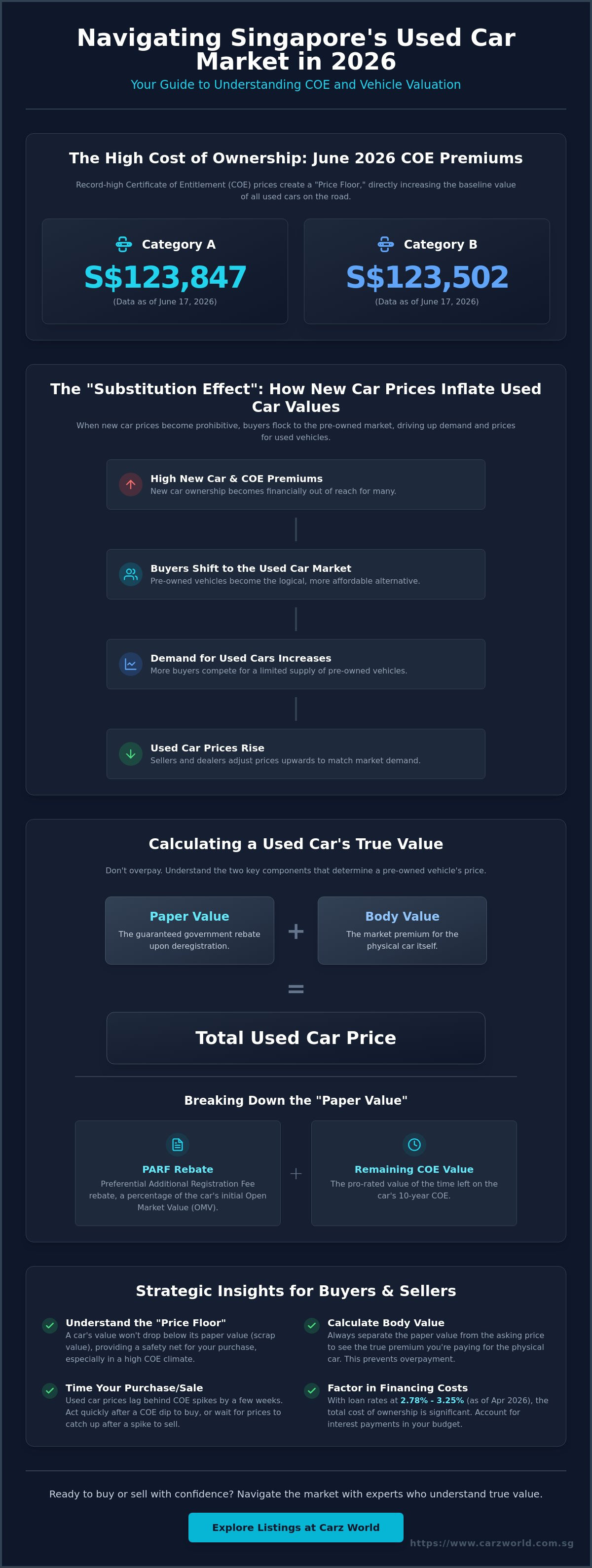
In Singapore, the Certificate of Entitlement (COE) system is the core driver of what you pay for any vehicle. It isn't just a registration fee; it's a quota that shapes the entire financial life of a car. As of June 17, 2026, Category A premiums reached S$123,847, while Category B sat at S$123,502. These high figures create a "Price Floor" for every vehicle on the road. Because a car's paper value includes its remaining COE, a used car's price can never drop below its scrap value. This ensures that even older models maintain a significant baseline price regardless of their physical condition.
The 2026 market context shows a tight quota supply and a highly competitive bidding climate. This scarcity has triggered a "cascading demand" effect. When buyers find new car prices too high, they don't give up on car ownership. Instead, they move into the pre-owned sector. This shift keeps the impact of COE on used car prices high, as more people compete for the same limited pool of available inventory.
To better understand how these market shifts affect the broader automotive industry, watch this helpful video:
The Quota System and Its Direct Effect on Inventory
LTA quota announcements are the heartbeat of the local automotive industry. Whenever a reduction in the quota is announced, showroom prices often adjust within hours. In 2026, limited new car supply has forced many drivers to explore the used car market instead. There is usually a slight lag time of a few weeks between a COE spike and a visible hike in used car price tags. Dealers must first assess the sustainability of the new premiums before they adjust their floor stock valuations to reflect the new replacement costs.
Why Used Cars Track New Car Premiums
Economists call this the "Substitution Effect." When a new Toyota Corolla Altis costs over S$200,000, a five year old model at S$100,000 suddenly looks like a logical bargain. This increased demand for older models allows sellers and dealers to raise prices. Dealers also adjust their trade-in offers based on the latest bidding results to remain competitive. Understanding the impact of COE on used car prices is vital for any buyer. The Quota Premium (QP) of the day serves as a benchmark that anchors the entire resale market. If the cost of a new "right to own" goes up, the value of the remaining "right to own" on an existing car rises along with it.
Why High COE Premiums Drive Up the Cost of Pre-Owned Vehicles
Every vehicle on Singapore's roads carries a "right to exist" cost that is directly anchored by the current bidding climate. When new COE premiums hit six figures, as seen in the June 17, 2026, bidding exercise where Category A reached S$123,847, it sets a high baseline for the entire market. This cost of entry is the most significant factor in the impact of COE on used car prices. Even a vehicle with only five years of its lifespan remaining still holds roughly 50% of its original COE value. This "leftover" value ensures that resale prices stay elevated regardless of how many kilometers are on the odometer.
Headlines of record-breaking premiums also create a powerful psychological ripple effect among sellers. When a car owner sees that a brand new replacement for their current vehicle now costs over S$200,000, they naturally adjust their expectations. They aren't just selling a piece of machinery; they're selling the remaining years of a quota that has become much more expensive to acquire. This mindset shift often leads to firmer asking prices across the board, as sellers try to preserve as much capital as possible for their next purchase.
Financing also complicates the picture for buyers in 2026. With car loan interest rates ranging from 2.78% to 3.25% as of April 2026, the total cost of ownership remains high even for older models. Higher resale prices require larger loan quantums. This means buyers end up paying more in interest over the life of their loan, further increasing the financial burden of choosing a pre-owned vehicle over a new one.
The "Paper Value" Anchor
A used car's price is built on its "paper value," which consists of the PARF rebate and the pro-rated COE rebate. This figure acts as a guaranteed safety net. If you deregister the car today, the government returns this amount to you. High paper values protect buyers from total capital loss, but they also keep prices high. With the June 2026 Prevailing Quota Premium (PQP) for Category A at S$118,357, renewing an existing car's COE has become a massive investment. This high cost of renewal pushes more buyers toward 5 to 7 year old cars, which still benefit from original, lower-tier ARF structures.
Market Demand and the "Body Value" Premium
Body value represents the premium you pay over and above the car's paper value. It is essentially what the physical car is worth to the market. In a high-COE environment, "COE cars"—those older than 10 years with a renewed quota—become incredibly popular because they offer a lower entry price point. Reliable models from brands like Toyota and Honda consistently maintain higher body values because buyers trust their longevity. If you want to see how these variables affect your specific model, you can consult an experienced specialist to get an accurate market valuation.
Calculating the Real Value: Paper Value vs. Body Value
To evaluate if a listing is fairly priced, you must separate the car's physical worth from its regulatory value. The impact of COE on used car prices is most evident when you look at the "Paper Value." This is the sum of the pro-rated COE rebate and the Preferential Additional Registration Fee (PARF) rebate. As of March 2026, the ARF is 100% for the first S$20,000 of a car's Open Market Value (OMV). Because your PARF rebate is a percentage of this ARF, a car with a high OMV often offers better downside protection. If the market crashes, you are still guaranteed that paper value upon deregistration.
The 10-year mark is a critical crossroads for every owner in Singapore. When a car reaches the end of its first COE, you must decide whether to scrap it, export it, or renew the quota. Renewing requires paying the Prevailing Quota Premium (PQP), which stood at S$118,357 for Category A in June 2026. If the PQP is high, the cost of renewal might exceed the car's actual utility. Buyers should look for "high paper value" cars—those with high original ARF and significant COE remaining—to minimize their financial exposure to market volatility.
The Math of Depreciation
Annual depreciation is the only metric that truly matters when comparing used cars. You can calculate this by taking the total purchase price, subtracting the minimum PARF rebate you'll get at the end, and dividing that by the years of ownership remaining. High COE premiums in 2026 mean that even a budget-friendly hatchback can have a high annual depreciation. The pro-rated COE rebate for 2026 is determined by dividing the original Quota Premium by 120 and multiplying that figure by the number of months remaining on the certificate. This math explains why an 8-year-old car might have a lower annual cost than a 2-year-old car, even if the older car requires more maintenance.
When the Body Value Outstrips the Paper Value
Body value is the premium you pay for the physical machine over its paper value. If a car is priced at S$110,000 but only has a paper value of S$70,000, the body value is S$40,000. You are essentially "risking" that S$40,000 on the car's condition and mileage. Overvalued cars are those where the body value is high despite poor maintenance or high mileage. Carz World ensures transparent valuation by providing a clear breakdown of both the paper components and the physical condition of every vehicle. This data-driven approach helps you avoid overpaying for the "body" when the impact of COE on used car prices is already stretching your budget.
Strategic Buying and Selling: Navigating COE Volatility
Successful car ownership in 2026 requires more than just picking the right model. You need a strategy to handle the impact of COE on used car prices, especially when premiums are as high as the June 17, 2026, figures of S$123,847 for Category A. High prices increase the risk of negative equity. This happens if you buy a car when COE is at its peak, only to see premiums drop significantly a year later. Your car's resale value would fall instantly, potentially leaving you owing the bank more than the car is worth. To avoid this, many savvy buyers look for "old COE" cars. These are vehicles registered during periods of lower premiums, which provide a larger financial buffer if the market corrects itself.
If you plan to sell your car, timing is everything. Monitoring the LTA quota announcements is vital. Selling just before a predicted quota increase can help you exit the market while used car prices are still artificially high. Long term owners can use COE cycles to their advantage by renewing their certificates during market dips. By paying a lower Prevailing Quota Premium (PQP), you lock in lower depreciation for the next ten years. This methodical approach turns a volatile system into a predictable financial plan.
Is Now the Right Time to Buy Pre-Owned?
You must look at the Total Cost of Ownership rather than just the sticker price. In some cases, brand new cars might offer better value if they come with lower interest rates or better fuel efficiency. However, a used car with a high original COE remains a safer bet for those worried about a market crash. These cars have a higher "paper value" guaranteed by the government, which acts as a safety net for your capital. Always compare the annual depreciation of a 3 year old car against a new model to see which truly fits your budget.
Maximizing Your Resale or Trade-In Value
Keep a close eye on PQP trends to decide whether to renew your COE or sell. As of June 2026, the PQP for Category A is S$118,357. If your car is nearing its 10 year limit and local resale demand is weak, export car services often provide the best exit strategy. Export value becomes your "price floor" when local buyers are hesitant due to high renewal costs. For a detailed assessment of your vehicle's current market position, you should speak with a valuation expert to explore all your options.
How Carz World Simplifies Your Car Ownership Journey
The 2026 automotive landscape is complex. You need more than just a dealer; you need a knowledgeable partner. Carz World has established a reputation for reliability in this volatile environment. The impact of COE on used car prices often creates confusion for consumers. We address this by providing data-driven valuations and transparent pricing. Our expert consultants monitor daily trends to help you save money and avoid the trap of negative equity. We've built our business on being thorough and honest with every client.
Our service suite is designed to be a one-stop solution for all your vehicle needs. Whether you are looking for pre-owned cars, brand new cars, or even commercial vehicles, we provide a clear path forward. We also offer car rental and car export services to ensure we can support you at every stage of the ownership cycle. Our team takes pride in making complex logistical processes feel like a seamless experience. We focus on efficiency and competence so you can enjoy your car without the stress of market volatility.
A Curated Inventory of Quality Used Cars
Every pre-owned vehicle in our showroom passes through a strict inspection. We don't just look at the engine; we analyze the paper-to-body ratio of every listing. This ensures we only offer "high-value" cars that stand up to financial scrutiny. Our goal is to minimize your depreciation losses from day one. We select inventory that provides the best downside protection for our clients. You're invited to explore our current used car collection to see our commitment to quality firsthand.
Seamless Selling and Financing Solutions
Whether you're looking to buy or sell your car, we handle the heavy lifting. We offer both direct purchase and consignment routes. This flexibility allows you to choose the path that maximizes your resale value based on current COE trends. Our in-house financing and insurance services simplify the transaction and streamline the paperwork. We believe in personalizing the experience for every driver who walks through our doors.
Our experienced staff members are dedicated to high-quality customer service. Many of our clients mention specific team members in their feedback, which highlights our focus on individual care. This continuous stream of positive testimonials reflects our focus on long-term reputation over short-term gains. We're here to provide the calm, assured guidance you need in today's market. Contact us today to see how we can make your next car transaction fluid and positive.
Take Control of Your Car Ownership Journey
Navigating the Singapore car market requires a clear understanding of how regulatory shifts dictate your vehicle's worth. You've learned that "paper value" acts as your primary safety net and that timing your transaction around quota cycles is essential for minimizing depreciation. The impact of COE on used car prices remains the most significant factor in your total cost of ownership. By focusing on models with healthy body-to-paper ratios, you can protect your capital even when premiums are at record highs.
Carz World is here to serve as your dependable expert in every transaction. We are a trusted Singapore dealer with over 100 positive client testimonials and a comprehensive suite of buy, sell, export, and rental services. Our consultants provide expert valuations based on real-time COE data so you don't have to guess your car's true value. Browse our latest used car inventory and find your next high-value ride at Carz World. We look forward to helping you make your next move with total confidence.
Frequently Asked Questions
Does a higher COE price always mean my used car is worth more?
Yes, a higher premium generally increases your car's resale value because it raises both the "paper value" and the cost of new alternatives. The impact of COE on used car prices is most visible when sellers adjust their asking prices to reflect the current bidding climate. However, if the physical car is in poor condition, the "body value" premium may stay low regardless of how high the quota price climbs.
What happens to the price of my used car if COE falls tomorrow?
Your car's market value will likely decrease if premiums drop significantly. This happens because the pro-rated COE rebate is tied to the original price paid, but the market price tracks current replacement costs. A sudden crash in premiums can lead to negative equity. This is where your outstanding loan exceeds the car's updated market value, making it difficult to sell without topping up cash.
Is it better to buy a car with 2 years or 8 years of COE left?
Buying a car with 8 years left is often a safer long-term investment. These vehicles typically have a higher paper value, which provides better downside protection if the market fluctuates. A car with only 2 years left has a lower entry price but suffers from higher annual depreciation. It also leaves you vulnerable to high renewal costs much sooner than a newer model would.
How is the PARF rebate calculated for a used car in 2026?
The PARF rebate is a percentage of the Additional Registration Fee (ARF) paid when the car was first registered. For cars deregistered between 9 and 10 years of age, the rebate is currently 5% of the ARF. Keep in mind that for many cars registered recently, this rebate is now capped at S$60,000. This cap is designed to manage the valuations of high-end luxury vehicles.
Should I renew my COE or buy another used car when my 10 years are up?
You should compare the Prevailing Quota Premium (PQP) against the annual depreciation of a 5-year-old model. If the PQP is S$118,357 for Category A, your annual cost just for the quota is over S$11,800. If a newer used car offers lower total depreciation and better fuel efficiency, upgrading is usually the more financially sound decision. Our consultants can help you run these specific numbers.
Can I get a higher loan for a used car if the COE is high?
Yes, you can typically secure a larger absolute loan quantum when prices are high. Since car loans are based on the purchase price or valuation, a more expensive car allows for a higher loan amount under MAS limits. However, remember that current interest rates range from 2.78% to 3.25%. A larger loan will result in higher monthly interest costs over the life of the agreement.
What is the difference between PQP and the current COE bidding price?
The current bidding price is the result of the latest twice-monthly auction for new car registrations. In contrast, the PQP is a moving average of the Quota Premium from the previous three months. You pay the PQP only when you choose to renew the certificate of an existing car. It is the standard rate for extending your vehicle's lifespan by another five or ten years.
Why are Japanese cars often more expensive in the used market despite the same COE?
Japanese models often command a higher "body value" premium due to their reputation for reliability and lower maintenance costs. While the impact of COE on used car prices provides a baseline floor for all vehicles, market demand for brands like Toyota and Honda remains consistently strong. Buyers are willing to pay more for the physical machine because they trust the vehicle will remain mechanically sound.
Disclaimer
This content is provided for general informational purposes only. Readers are encouraged to independently verify important information.
In Same Category
- Calculating the Breakeven Point for COE Renewal in Singapore
- Financial Checklist Before Committing to a Car Purchase in Singapore (2026)
- COE Renewal Conditions and Eligibility in Singapore: 2026 Guide
- Balloon Scheme Car Loan in Singapore: Pros and Cons for 2026
- Getting Car Finance with a New Business in Singapore: A Practical Guide
Related by Tags
- Used Cars for Sale in Tampines: 2026 Buyer's Guide
- Car Downpayment vs Monthly Instalment in Singapore: The 2026 Budgeting Guide
- Car Loan Singapore: The Complete 2026 Guide to Financing Your Vehicle
- How Much Salary to Afford a Car in Singapore: 2026 Affordability Guide
- Buying a Used Car in Singapore: 2026 Ultimate Guide
- What is PARF? The Ultimate Guide to Singapore’s Car Rebate System
- Mercedes-Benz EQB 250+ Review: The Ultimate 7-Seater Family EV in Singapore
- Long Term Car Rental Singapore: 2026 Definitive Guide
- How to Buy a Car in Singapore: The Ultimate 2026 Step-by-Step Guide
- Mercedes C-Class Singapore Guide 2026: Specs, COE, and Buying Tips
- Second Hand Hybrid Cars Singapore: The 2026 Value & Inspection Guide
- Cheapest Car in Singapore: The 2026 Guide to Affordable Ownership
- Parallel Import Cars Singapore: 2026 Buyer’s Guide
- Honda Civic Singapore: 2026 New & Pre-Owned Guide
- Suzuki Swift Singapore: The Ultimate Smart-Money Hatchback Guide 2026
- Mazda 3 Singapore Guide 2026: Specs, Prices, and Buying Tips
- The Ultimate Toyota Alphard Singapore Guide: Luxury & Performance in 2026
- Hyundai Ioniq 5 Singapore: The Definitive 2026 Buying & Ownership Guide
- Sell My Car in Singapore (2026): Complete Guide
- Nissan Qashqai Singapore: Ultimate Buyer’s Guide 2026
- The Ultimate Used Car Buying Guide for Singapore in 2026
- Why Carz World is Your Trusted Used Car Dealer in Singapore (2026 Guide)
- Honda Odyssey Singapore: 2026 Family Buying Guide
- Used Honda Singapore: The Ultimate Buyer’s Guide for 2026
- The Real Cost of Owning a Car in Singapore: 2026 Comprehensive Guide