Car Dealership Financing vs Bank Loan in Singapore: The 2026 Comparison Guide

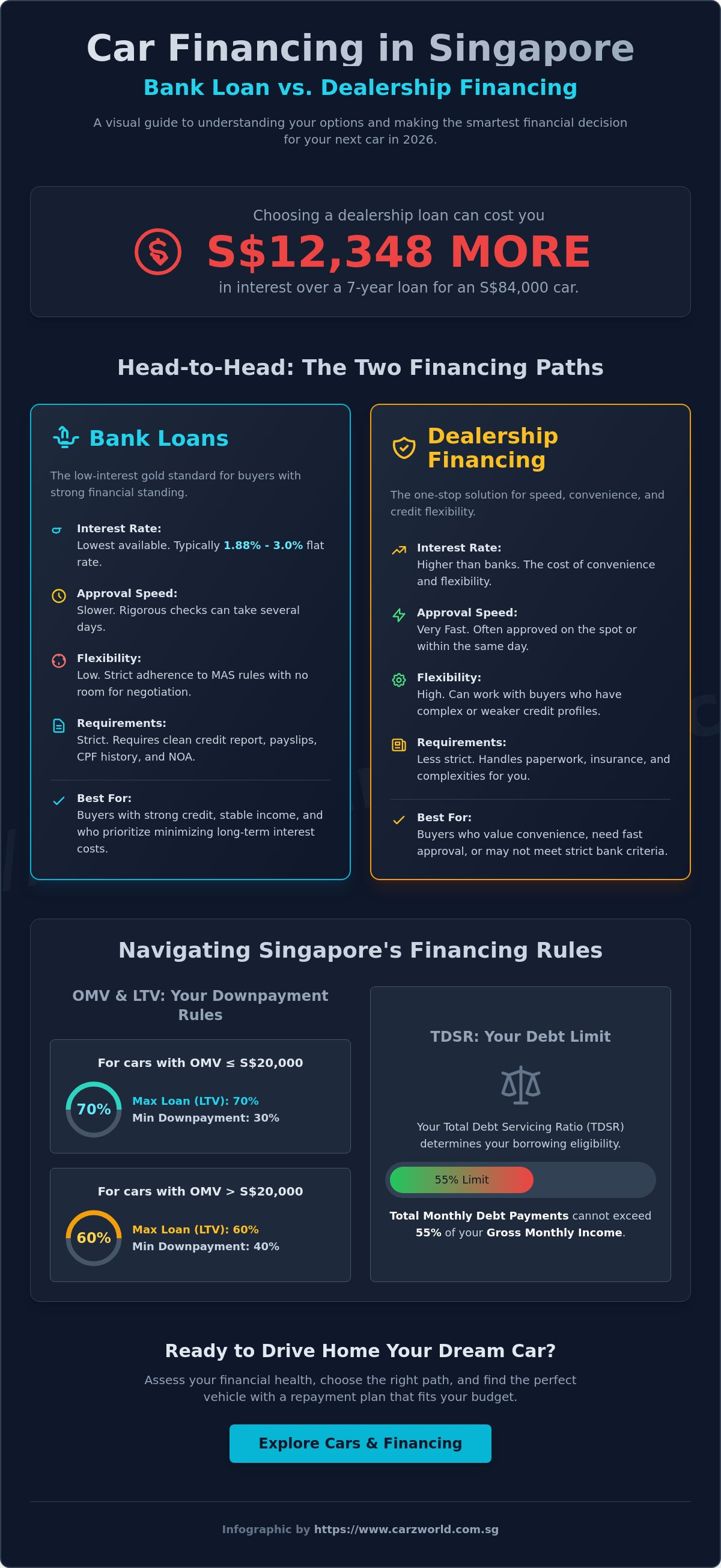
Did you know that choosing a dealership loan over a bank loan for a S$84,000 car could result in paying S$12,348 more in interest over seven years? It's a staggering figure, especially when COE prices in 2026 frequently exceed S$100,000. Most Singaporean car buyers find themselves stuck between the desire for the lowest possible monthly repayment and the need for a fast, hassle-free approval. Deciding between car dealership financing vs bank loan singapore is rarely just about the interest rate. It's about balancing your Total Debt Servicing Ratio (TDSR) with the convenience of immediate ownership.
We understand that the math behind flat rates and effective interest rates (EIR) can be confusing. This guide simplifies the complexities of the car finance market to help you find your best fit. You'll learn how bank loans offer the lowest raw interest while dealership financing acts as a strategic bridge for those who value speed and credit flexibility. We compare current 2026 rates, LTV limits, and the unique benefits of each option so you can drive home your next vehicle with total confidence.
Key Takeaways
- Understand how MAS regulations and LTV limits affect your upfront costs based on the car's Open Market Value.
- Learn why bank loans are the preferred choice for those with strong credit and a focus on minimizing interest expenses.
- Evaluate the benefits of car dealership financing vs bank loan singapore to see which option matches your timeline and credit profile.
- Discover how in-house financing simplifies the buying experience by handling complex paperwork and insurance requirements for you.
- Find out how to assess your financial health to select a repayment plan that keeps your monthly budget manageable.
Understanding the Car Financing Landscape in Singapore
The Monetary Authority of Singapore (MAS) maintains strict control over the local vehicle market to promote financial stability. Every buyer must work within these frameworks, regardless of whether they choose car dealership financing vs bank loan singapore. These rules dictate how much you can borrow and how long you have to pay it back. High COE prices, which consistently stay above S$100,000 in 2026, mean that your total loan amount is often much higher than the actual value of the car itself. Understanding the broader context of car finance helps you see why Singapore's rules are uniquely structured to manage debt and car ownership.
To see these differences in action, watch this helpful comparison video:
OMV and LTV: The Golden Rules
The Open Market Value (OMV) is the price paid or payable for a vehicle imported into Singapore. It is the foundation for your Loan-to-Value (LTV) limit. If you are eyeing a car with an OMV of S$20,000 or less, you can borrow up to 70% of the purchase price. This requires a 30% downpayment. However, if the OMV exceeds S$20,000, your borrowing limit drops to 60%; this means you must prepare a 40% downpayment upfront. These percentages apply to the total price, including the COE. For a car costing S$160,000 with a high OMV, you would need S$64,000 in cash or CPF before the keys are yours. This high entry barrier is why many buyers spend significant time weighing car dealership financing vs bank loan singapore to find the most sustainable path.
The Impact of TDSR on Your Car Loan
Your ability to secure a loan also depends on your Total Debt Servicing Ratio (TDSR). Banks and financial institutions look at your entire debt profile, including your mortgage, personal loans, and credit card balances. Under current regulations, your total monthly debt repayments cannot exceed 55% of your gross monthly income. If you already have a large home loan, the amount you can borrow for a car might be significantly reduced. In 2026, lenders calculate your TDSR by adding your potential car loan installment to your existing monthly obligations to ensure you aren't overleveraged. This strict criteria is a common reason for bank loan rejections, leading some buyers to explore dealership options that may offer more flexibility for those with complex financial backgrounds.
Bank Car Loans: The Low-Interest Gold Standard
Bank loans represent the most cost-effective way to fund a vehicle purchase. They typically offer the lowest flat interest rates, often ranging from 1.88% to 2.78% for new vehicles and around 2.78% to 3% for used cars. This financial efficiency makes them the first choice for buyers with strong financial standing. However, the trade-off for these competitive rates is a rigorous application process. Banks follow MAS car loan rules strictly, leaving little room for negotiation if you don't meet their specific criteria. When weighing car dealership financing vs bank loan singapore, the bank's lower interest rates are often the most compelling factor for long-term savings.
A clean Credit Bureau Singapore (CBS) report is non-negotiable. Banks view your credit score as a direct reflection of your reliability. If your report shows late payments or high unsecured debt, rejection is likely. While this rigidity can be frustrating, it ensures that those who qualify benefit from transparent monthly statements and the lowest possible total interest cost. If you have a strong credit history, a bank loan is almost always the most logical path forward.
Eligibility and Documentation Requirements
Applying for a bank loan requires a specific set of documents to prove your repayment ability. You'll need your latest payslips, CPF contribution history for the last 14 months, and your latest Income Tax Notice of Assessment (NOA). For many, using Singpass MyInfo streamlines this, but self-employed individuals often face more hurdles. Banks may require two years of NOA history to verify income stability. It's wise to seek an "Approval in Principle" before you start browsing pre-owned cars. This step clarifies your budget and prevents disappointment during the final transaction.
Understanding Flat vs. Effective Interest Rates
Confusion often arises when comparing car dealership financing vs bank loan singapore because of how interest is quoted. Banks advertise a "flat rate," which is calculated based on the original loan amount throughout the entire tenure. However, the Effective Interest Rate (EIR) represents the true cost of borrowing as you pay down the principal. For a used car loan at a 2.78% flat rate over 7 years, the EIR will be significantly higher. It's the EIR that truly determines the cost of your debt.
If you're considering an electric or hybrid vehicle, look for "green car" rebates. Many Singaporean banks now offer a discount of approximately 0.3% on interest rates for eco-friendly models. This small reduction can lead to meaningful savings over a 7-year loan term. Always ask your loan officer about these specific incentives before signing the agreement.
Dealership In-House Financing: Speed and Flexibility
While bank loans offer competitive rates, dealership financing serves as a vital alternative for those prioritizing speed and convenience. In Singapore’s fast-moving car market, a desired vehicle can be sold before a bank even processes a credit check. This is where car dealership financing vs bank loan singapore becomes a choice about timing. Dealerships operate via hire purchase agreements, often acting as a bridge for buyers who want a seamless transition from viewing a car to driving it home.
The speed factor is perhaps the most significant advantage. While banks typically take three to five business days for approval, dealerships often provide a response within 24 hours. Some even offer approval in just a few hours. This efficiency is particularly helpful for buyers with non-standard income profiles, such as freelancers or those with a shorter credit history. Dealers often have a wider appetite for risk and can look beyond a simple credit score to understand a buyer’s actual financial health.
The Convenience Factor of Dealer Financing
Choosing in-house financing transforms the car-buying journey into a "one-stop shop" experience. Instead of coordinating between a bank, an insurance provider, and the Land Transport Authority (LTA), the dealership handles every logistical detail. This includes bundling road tax, insurance quotes, and IU installation into a single workflow. Having a dedicated relationship manager ensures that you aren't just another application number in a massive banking system. This reflects Carz World’s customer-centric approach, where the focus remains on making complex logistical processes feel effortless for the client.
Balloon Scheme and Alternative Financing
For those purchasing pre-owned cars, dealerships often provide the "Balloon Scheme." This unique arrangement lowers your monthly instalments by deferring a portion of the car's cost, specifically the projected PARF rebate, to the end of the loan tenure. It's an excellent option for buyers who want to maintain more monthly liquidity. Additionally, dealerships are the primary source of financing for commercial vehicles, offering tailored plans that banks might not always support. While you must still adhere to legal downpayment limits, the flexibility in how these deals are structured makes dealership financing a strategic choice for many Singaporeans.
Head-to-Head: Comparing the Two Financing Paths
Choosing between car dealership financing vs bank loan singapore requires a side-by-side look at the numbers and the logistics. It's about finding the right balance between the cost of credit and the speed of the transaction. While the interest rate is a primary concern for most buyers, operational speed and long-term flexibility play equally important roles in your decision. If you value the lowest possible cost, banks are the clear winner. If you value time and a higher chance of approval, the dealership path offers a distinct advantage.
Approval timelines often dictate the choice for many Singaporeans. Banks typically require three to five business days to process an application, often asking for additional documentation if your profile is complex. In contrast, dealerships can often secure an approval within one to two days, and sometimes even within a few hours. This speed is crucial when you're competing for a popular used car model that might not stay on the lot for a week.
Financial Comparison Table
To help you visualize the differences, here is a breakdown of the typical landscape in 2026:
| Feature | Bank Car Loan | Dealership Financing |
|---|---|---|
| Interest Rate (Used Cars) | 2.78% to 3.00% p.a. | 4.00% to 4.80% p.a. |
| Approval Speed | 3 to 5 Business Days | 1 to 2 Business Days |
| Eligibility Criteria | Strict (High CBS Score) | Flexible (Varied Profiles) |
| Admin Fees | S$200 to S$500 (Fixed) | Variable (Agreement Fees) |
| Documentation | Full (Income Tax, CPF) | Simplified |
It is important to remember that even a 0.5% interest difference can cost thousands of dollars over the seven-year life of a loan. However, you must also watch out for the "Admin Fee" trap. Some dealerships might offer lower interest rates but compensate with higher processing or agreement fees. Banks usually charge a flat, transparent fee. Always calculate the total cost of ownership, including all fees, rather than just looking at the monthly instalment.
The Impact on Your Credit Score
Every loan you take affects your financial standing. A bank loan is a formal credit facility that appears immediately on your Credit Bureau Singapore (CBS) report. This directly impacts your Total Debt Servicing Ratio (TDSR). If you plan to apply for a home mortgage soon, a large car loan could significantly reduce your maximum borrowing power for property. Most in-house financing schemes are also registered and will be visible to other lenders. Maintaining a balanced debt-to-income ratio is essential for your future financial health, regardless of which path you choose.
If you're ready to see how these numbers apply to your next vehicle, explore our transparent financing options to find a plan that fits your budget.
How to Choose the Right Finance Option for Your Car
Deciding between car dealership financing vs bank loan singapore depends on your specific financial profile and how quickly you need to be on the road. Start by checking your Credit Bureau Singapore (CBS) report. If you have an "AA" rating, you're in a strong position to secure the lowest bank rates. If your score is closer to "Cx" or lower, a dealership might be a more reliable partner. They often provide a path to ownership for those who don't fit the rigid boxes of traditional banking. Your timeline also matters. If you need a vehicle for an immediate job change or an upcoming festive period, the speed of a dealership's in-house team is invaluable.
One factor many buyers overlook is the synergy of a trade-in. When you sell your car to them, dealerships can often structure your new financing more effectively. They handle the settlement of your existing loan and the downpayment for your next vehicle in a single, coordinated move. This eliminates the stress of managing two separate financial transactions and can sometimes result in more favorable loan terms. Before you sign any Hire Purchase Agreement, run through a final checklist: confirm the Effective Interest Rate (EIR), check for any early settlement penalties, and ensure all admin fees are clearly documented.
Scenario-Based Recommendations
The "Budget Conscious" path is best served by bank loans. If you have the luxury of time and a pristine credit record, the long-term interest savings are significant. For the "Urgent Buyer," dealership financing is the superior choice. It bypasses the 3 to 5-day bank waiting period, allowing for a quick collection. Finally, for the "Business Owner" looking to expand a fleet, specialized commercial vehicle financing through a dealer often provides the flexibility needed to manage company cash flow without overstretching personal credit lines.
Why Carz World Offers the Best of Both Worlds
We believe that financing should be as reliable as the car you drive. Our team maintains strong partnerships with major Singaporean banks to help you access competitive interest rates directly. At the same time, we provide flexible in-house options for clients who require a more tailored approach. This dual capability ensures you don't have to compromise on your financial goals. You can browse our certified pre-owned cars to see transparent pricing and explore the finance options that fit your lifestyle. Our focus is on making the transition to your next car feel seamless, honest, and entirely professional.
Securing Your Future on the Road
Choosing between car dealership financing vs bank loan singapore comes down to your personal priorities and financial timeline. If your primary goal is to minimize interest costs and you have a strong credit profile, a bank loan remains a reliable path. For buyers who value a seamless, one-stop experience or need a fast approval to secure a popular vehicle, dealership financing provides the necessary flexibility. It's about finding a balance that keeps your monthly budget manageable without overstretching your debt limits.
At Carz World, we simplify this decision by offering options that cater to every type of buyer. We maintain strong partnerships with leading Singaporean banks to ensure you get competitive rates without the stress of managing the paperwork alone. Our transparent, no-hidden-fee policy means you'll always know exactly what you're paying for. If speed is your priority, our fast 24-hour loan approval process ensures you won't miss out on your desired car. Our team is dedicated to making your purchase feel fluid and positive from start to finish.
Get a personalised car financing quote and browse our inventory today. We look forward to helping you drive home with a plan that fits your life perfectly.
Frequently Asked Questions
Can I switch from dealership financing to a bank loan later?
Yes, you can refinance your car loan, but it involves specific costs. You'll need to settle your existing hire purchase agreement, which usually triggers an early settlement penalty of 1% on the outstanding principal. Additionally, you must factor in a new bank's processing fees, which typically range from S$200 to S$500. It's essential to calculate if the interest savings from the new bank loan outweigh these upfront penalties.
Does dealership financing affect my TDSR for a home loan?
Yes, all car loans in Singapore are registered credit facilities that impact your Total Debt Servicing Ratio (TDSR). When lenders evaluate your borrowing power for a mortgage, they include your car instalments in their calculations. Whether you choose car dealership financing vs bank loan singapore, the debt stays on your Credit Bureau Singapore (CBS) report. This can reduce the maximum amount you can borrow for a property purchase.
What is the minimum downpayment for a used car in Singapore in 2026?
The minimum downpayment depends entirely on the car's Open Market Value (OMV). For vehicles with an OMV of S$20,000 or less, you can borrow up to 70% of the purchase price, requiring a 30% downpayment. If the OMV is higher than S$20,000, your loan is capped at 60%, meaning you'll need to pay 40% upfront. These limits are strictly regulated by MAS and apply to both bank and dealer loans.
Why are interest rates for used cars higher than for new cars?
Lenders view used cars as higher-risk assets due to faster depreciation and potential mechanical issues. In 2026, bank rates for used cars sit around 2.78% to 3%, while new car rates can be as low as 1.88%. This risk premium ensures that banks are protected as the vehicle's resale value drops. Dealerships also follow this trend, though they offer more flexibility for buyers who don't meet strict bank criteria.
Are there any hidden fees in dealership in-house financing?
Reputable dealers are transparent, but you should always check for agreement fees and administrative charges. These costs aren't always included in the advertised interest rate. When comparing car dealership financing vs bank loan singapore, ask for a complete breakdown of the total amount payable over the full tenure. This helps you identify any one-time processing fees that might make a seemingly low interest rate more expensive in the long run.
What happens if I want to settle my car loan early?
You'll likely face a penalty and an interest adjustment. Most Singaporean lenders use the "Rule of 78" to calculate interest, which means you pay more interest in the earlier years of the loan. If you settle early, you'll usually pay a 1% penalty on the outstanding principal. You also need to provide a formal notice period, typically 30 days, or pay interest in lieu of that notice to the lender.
Do I need to buy insurance from the dealer if I take their financing?
Many dealerships bundle financing with insurance as a requirement for specific promotional interest rates. While you aren't legally forced to use their insurer, it's often a contractual condition for in-house loan approval. You should weigh the convenience of this bundled service against the cost of sourcing your own insurance. Sometimes, the interest savings from the dealer's package exceed the slight premium you might pay for their preferred insurance provider.
How long does the LTA ownership transfer take after loan approval?
The actual ownership transfer is almost instantaneous once the loan is disbursed and the seller is paid. Most dealers use the OneMotoring portal to complete the transfer electronically within 24 hours. If you're managing a bank loan yourself, you'll need to coordinate with the seller to ensure they acknowledge the transfer online. Professional dealerships handle this entire logistical process for you, making the transition feel seamless and efficient.
In Same Category
- Used BYD Atto 3 Singapore: The Ultimate 2026 Buyer's Guide to Value and Reliability
- Complete Guide to Used Car Loans in Singapore (2026): Rates, Rules, and Requirements
- Used Toyota Camry Singapore: The 2026 Buyer’s Guide to Value & Reliability
- SGCarmart: 2026 Essential Guide to Used Cars in Singapore
- Sell My Car Singapore: The 2026 Ultimate Guide to Getting the Best Value
Related by Tags
- Used Toyota Camry Singapore: The 2026 Buyer’s Guide to Value & Reliability
- SGCarmart: 2026 Essential Guide to Used Cars in Singapore
- Sell My Car Singapore: The 2026 Ultimate Guide to Getting the Best Value
- Toyota Estima Price Singapore 2026: The Complete Financial Guide
- Toyota Voxy vs Toyota Estima: Which Family MPV Reigns Supreme in Singapore?
- Buying a Used Honda in Singapore: The Ultimate 2026 Guide to Value and Reliability
- Car Depreciation in Singapore: The Ultimate 2026 Guide to Smart Ownership
- How to Buy a Car in Singapore: The Ultimate 2026 Step-by-Step Guide
- Buying a Used Toyota in Singapore: The Ultimate 2026 Value Guide
- The Ultimate Guide to Buy New Commercial Vehicles in Singapore (2026 Edition)
- Checking for Accident Damage on a Car: The Ultimate 2026 Singapore Inspection Guide
- Parallel Import New Cars Singapore: The 2026 Ultimate Buying Guide
- How to Get a Fair Trade-In Offer for Your Car in Singapore: 2026 Guide
- Selling a Car with an Outstanding Loan in Singapore: The 2026 Complete Guide
- Car Consignment vs Direct Sale in Singapore: The 2026 Seller’s Guide
- How to Avoid Overpaying for a Used Car in Singapore (2026 Guide)
- 15 Practical Saving Tips for Car Buyers in Singapore (2026 Edition)
- When to Replace Your Car in Singapore: The 2026 Strategic Guide
- Used Car Warranty in Singapore: The Ultimate Guide to Protecting Your Investment (2026)
- Buying Chinese Cars in Singapore: The Ultimate 2026 Buying Guide
- Common Problems with Used Cars: A Singapore Buyer’s Guide to Avoiding Lemons
- The Importance of Car Service History: Protecting Your Investment in 2026
- Financial Planning for Buying a Car in Singapore: A 2026 Roadmap
- Government Regulations for Car Ownership in SG: The 2026 Essential Guide
- Top-of-the-Chart Hybrid Cars in Singapore: The 2026 Buyer’s Guide
- The Impact of COE on Used Car Prices in Singapore: A 2026 Guide
- Used Car Market Outlook Singapore 2026: Trends, COE Impact, and Value Shifts
- Refinancing a Car Loan in Singapore: The Complete 2026 Strategy Guide
- COE for Commercial Vehicles: The Complete 2026 Guide for Singapore Businesses
- Performance Cars for Sale in Singapore: The Enthusiast’s 2026 Buying Guide
- Best Compact SUV for City Driving in Singapore: The 2026 Urban Guide
- Used Japanese Cars for Sale: The Ultimate Singapore Buyer’s Guide for 2026
- Best 7 Seater SUV Singapore: The 2026 Family Guide to Space and Value