Bidding for COE Number in 2026: The Complete Strategic Guide for Singapore Car Buyers

In the first bidding exercise of June 2026, both Category A and Category B premiums surged past the $126,000 mark, leaving many prospective owners empty-handed. When the cost of entry is this high, bidding for COE number becomes less of a routine task and more of a high-stakes financial decision. It's completely understandable if you feel overwhelmed by the $10,000 deposit requirement or the technical differences between Category A, B, and E. No one wants to risk a significant sum of money only to be outbid in the final seconds or realize they've chosen the wrong vehicle category.
We've designed this guide to replace that uncertainty with a clear, expert-led framework for success. You'll learn how to master the complexities of the bidding process and secure your vehicle permit efficiently without overextending your budget. We will walk you through the critical bidding phases, explain how to choose the right category for your needs, and help you decide whether to bid privately or through a dealer. By the end of this article, you'll have the confidence to manage your bid with the precision and calm of a seasoned market expert.
Key Takeaways
- Understand the "Quota Premium" logic to ensure you only pay the minimum required amount above the highest unsuccessful bid.
- Learn the specific eligibility criteria and deposit requirements for bidding for COE number to prevent costly administrative errors.
- Compare the security of dealer-managed bidding against the flexibility of DIY methods to determine the safest approach for your purchase.
- Master a strategic bidding timeline by setting a firm budget and analyzing market sentiment during the first 48 hours of the exercise.
- Navigate the post-bid process with ease by understanding the six-month validity period and the necessary steps for vehicle registration.
What is Bidding for a COE Number and How Does the System Work in 2026?
In Singapore, owning a car begins with securing a legal permit rather than just choosing a model. This permit is known as Singapore's Certificate of Entitlement system, or COE. The Land Transport Authority (LTA) uses this mechanism to regulate the vehicle population and prevent gridlock on our roads. When you engage in bidding for COE number, you're essentially participating in an auction for the right to own and use a vehicle for a period of ten years.
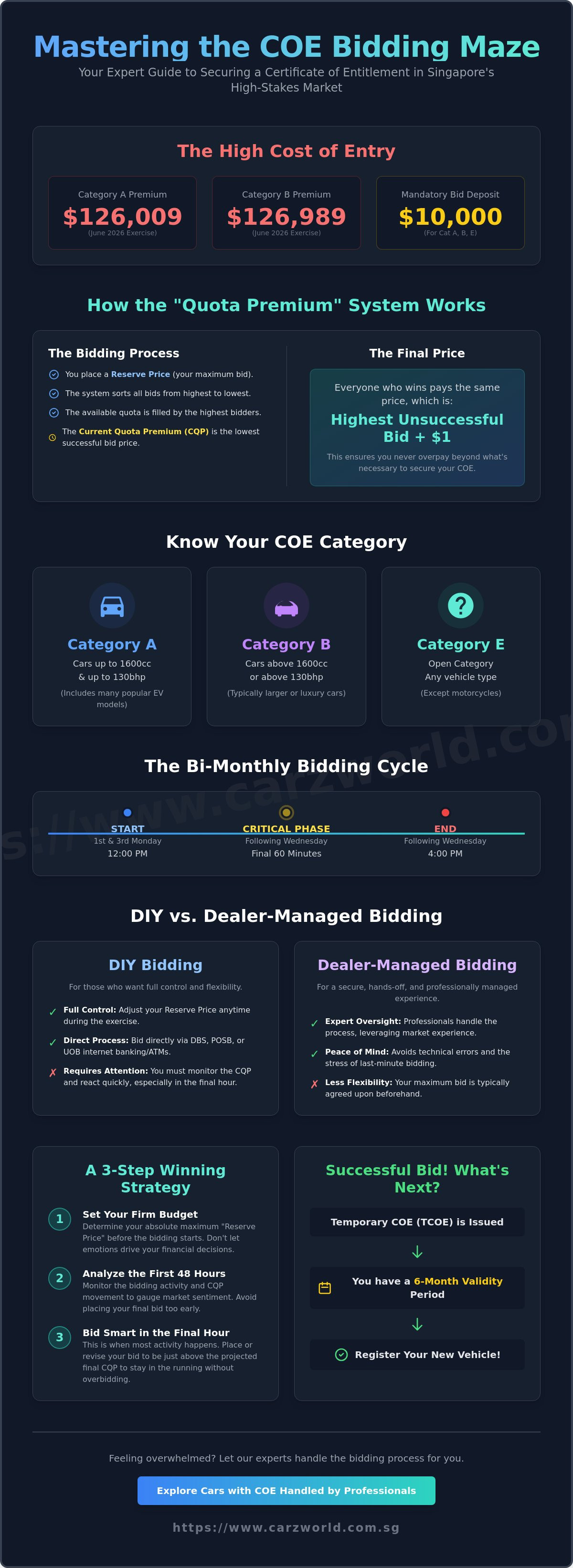
The system operates on a "Quota Premium" logic. This means you don't necessarily pay the exact amount you bid. Instead, the final price is determined by the highest unsuccessful bid plus one dollar. This ensures that everyone who successfully secures a COE in a specific exercise pays the same price, regardless of their individual reserve price. It's a fair way to manage limited supply while ensuring market value is met.
To better understand how these mechanics work in practice, watch this helpful video:
The 2026 landscape is defined by high demand and a carefully managed supply. For the May to July 2026 period, the total quota was set at 19,052, which is only a 1% increase from the previous quarter. This tight supply, combined with strong consumer interest, has pushed premiums to significant levels. In the first June 2026 exercise, Category A prices reached $126,009, while Category B hit $126,989. Success in this environment requires a calm, data-driven approach.
The Main COE Categories Explained
Most buyers focus on three specific categories. Category A is for cars with engines up to 1600cc and 130bhp, including many popular electric vehicles. Category B covers larger or more powerful luxury cars above those limits. If you need maximum flexibility, Category E, known as the Open Category, can be used for any vehicle type except motorcycles. Choosing the correct category is the first step in bidding for COE number effectively.
The Bi-Monthly Bidding Cycle
Bidding exercises happen twice a month. They typically start on the first and third Monday at 12:00 PM and close on the following Wednesday at 4:00 PM. While the window lasts for several days, the final 60 minutes are the most critical. This is when most bidders adjust their prices based on real-time data to ensure they stay within the winning quota. Being prepared for this final window is essential for any serious buyer.
The Mechanics of the Bid: Platforms, Deposits, and Eligibility
Before you participate in the next exercise, which is scheduled to run from June 15 to June 17, 2026, you must ensure you meet the basic eligibility requirements. Individuals must be at least 18 years old and possess a valid NRIC or passport. Corporate entities require a valid ACRA registration and a corporate bank account with one of the participating local banks. Having your LTA user ID ready is essential, as this serves as your digital gateway to the bidding platform.
A critical distinction to understand is the difference between your "Reserve Price" and the "Current Quota Premium" (CQP). The CQP represents the price of the lowest successful bid at any given moment during the exercise. Your Reserve Price is the maximum amount you are willing to pay. When bidding for COE number, your bid must be at least $1 higher than the CQP to be considered "in the running." If the CQP rises above your Reserve Price, your bid becomes inactive until you choose to revise it upward.
The $10,000 bid deposit is the most significant upfront cost for Categories A, B, C, and E. This amount is deducted from your bank account the moment you submit your bid. If you're looking for a vehicle that already has these logistics managed, you might find it easier to browse our inventory of brand new cars where the process is handled with professional oversight.
Private Bidding via ATMs and Internet Banking
Individual bidders can submit their entries through DBS, POSB, or UOB internet banking portals or at physical ATMs. To start, navigate to the "COE Bidding" section under the "Investments" or "Other Services" menu. You will need to enter your NRIC, select the correct vehicle category, and input your Reserve Price. A common mistake is entering the wrong bank account number or category, which can lead to an immediate disqualification of the bid. Always double-check your entries before confirming the transaction.
Understanding the Administrative Fees
Every bid submission or revision carries a non-refundable administrative fee. These fees typically range from $2 to $10 depending on the bank and the platform used. For example, a bid revision via the OneMotoring website currently costs $2. The bid deposit serves as the primary security measure for the LTA auction process. If your bid is unsuccessful, the $10,000 deposit is usually credited back to your bank account within one to two working days after the exercise closes, though the administrative fees will not be returned.
DIY Bidding vs. Dealer-Managed Bidding: Which is Better?
Choosing between handling the auction yourself or letting a professional manage it is a significant step in your car-buying journey. While DIY bidding is available through local bank portals, the vast majority of buyers in Singapore opt for dealer-managed services. This preference is largely due to the complexity and high financial stakes involved. When you take on bidding for COE number independently, you're responsible for monitoring the market in real-time. Missing the closing window at 4:00 PM on a Wednesday or under-estimating the final clearing price can result in a failed bid and another two-week wait.
Dealers typically simplify this by bundling the permit into an "On-the-road" (OTR) price. This single figure covers the vehicle, registration fees, road tax, and the COE itself, which makes budgeting much more straightforward. To maintain confidence in the transaction, always verify that your dealer is acting on your behalf. You can check your bid status through the LTA OneMotoring portal using your NRIC. A reputable partner will always be transparent about the bidding category and the status of your application.
Guaranteed vs. Non-Guaranteed COE Packages
Understanding the difference between these two packages is vital for managing your expectations. A "Guaranteed COE" package offers total peace of mind. Even if premiums spike unexpectedly, the dealer absorbs the extra cost, and your car price remains fixed. A "Non-Guaranteed" package usually features a lower upfront price but carries the risk of "top-ups" if market prices rise. You'll often see terms like a "6-bid guarantee," which means the dealer commits to bidding for you across six consecutive exercises, or roughly three months, to secure your permit.
Why Expertise Matters in a Volatile 2026 Market
In a volatile 2026 market where premiums for Category A and B have already crossed $126,000, professional expertise is invaluable. Dealers use historical data and real-time demand shifts to predict the "clearing price" with high accuracy. This professional oversight often includes integrated financing and insurance through trusted partners, making the entire journey seamless. You can explore our range of brand new cars with transparent COE options to see how we simplify these complex steps for our clients while maintaining a focus on reliability and service.
A Step-by-Step Strategy to Securing Your COE Number
Success in bidding for COE number requires a methodical approach rather than a reactive one. Start by setting a firm "walk-away" price. This is your absolute maximum budget, encompassing both the vehicle cost and the Quota Premium. Having this figure fixed before the exercise begins prevents emotional overspending during the heat of the auction. It ensures you remain financially disciplined, even if the market becomes volatile.
Monitor the first 48 hours of the three-day window to gauge market sentiment. Early bids often represent dealers clearing their order backlog, but they don't always reflect where the final price will land. By the second day, you should begin analyzing the "Total Bids Received" against the "Quota Available." For example, in the first June 2026 exercise, Category A saw 2,076 bids for a quota of only 1,246. This high ratio is a clear signal that demand is outstripping supply, which almost always leads to a price hike.
Timing Your Entry: The "Final Hour" Tactic
Bidding too early can be a strategic error. It artificially inflates the Current Quota Premium (CQP) early in the cycle, which encourages other participants to raise their reserve prices even higher. Instead, use the LTA OneMotoring website to track real-time updates. The most effective tactic is to execute your final revisions in the last 30 to 60 minutes of the exercise. This allows you to stay just above the CQP without overpaying by a large margin. It's vital to avoid the psychological trap of "Bidding Fever." If the price exceeds your pre-set budget, it's often better to wait for the next exercise than to overcommit financially.
Evaluating Market Signals
External factors often dictate bid volume. Major events like the Singapore Motorshow or recent car expos typically lead to a surge in orders, which translates to a higher number of bids in subsequent exercises. You should also keep an eye on Category E (Open Category) trends. Because these permits are transferable and flexible, they often serve as a precursor to price shifts in Categories A and B. The ratio of bids to quota is a more reliable predictor of price hikes than the previous round’s results. If the process feels overly technical or risky, you can speak with our experienced team to manage the entire bidding strategy on your behalf.
Once the exercise closes on Wednesday at 4:00 PM, verify your successful bid through your banking portal or the LTA website. If you've secured your permit, you can begin the vehicle registration process. If you were unsuccessful, your $10,000 deposit will be returned to your account, allowing you to refine your strategy for the next bidding cycle starting on June 15, 2026.
Successful Bid! What Happens After the COE Exercise Ends?
Securing a successful bid is a significant milestone, but it's only the beginning of the vehicle ownership journey. Once the exercise closes and your bid is confirmed, you are issued a Temporary COE (TCOE). It's vital to remember that this permit has a strict expiration date. For Categories A and B, the TCOE is valid for six months, while Categories C and E permits remain valid for only three months. If you don't register your vehicle within this timeframe, your $10,000 deposit is forfeited to the LTA. This makes prompt registration a top priority for every buyer.
The process for pre-owned car buyers is slightly different. If you're purchasing a used vehicle, it usually comes with an existing COE. You won't need to participate in bidding for COE number unless the vehicle's permit is nearing its ten-year limit. In those cases, you would pay the Prevailing Quota Premium (PQP) to renew the permit rather than entering the open bidding auction. At Carz World, we manage these transitions with precision, ensuring that the move from bid success to car delivery is fluid and positive.
Registration and Paperwork
Vehicle registration involves converting your TCOE into a permanent COE. This step requires you to settle the remaining balance of your car price and the Additional Registration Fee (ARF). The ARF is a tax imposed upon the registration of a vehicle and is calculated based on a percentage of the car's Open Market Value (OMV). It's a complex set of calculations, but our team handles the heavy lifting to ensure all paperwork is accurate and submitted on time. You can also Check our certified used cars with existing COE validity if you prefer to skip the bidding process entirely.
Why Professional Guidance Wins
A seamless experience is the hallmark of professional guidance. From the initial valuation of your trade-in to the final delivery of your new vehicle, having an expert partner reduces the risk of costly errors. Our clients have shared numerous success stories about how our data-driven approach to bidding for COE number saved them from the 2026 price peaks. We focus on long-term reputation and honest service, making complex logistical processes feel effortless. Speak to our experts at Carz World to secure your car and COE today and enjoy the confidence that comes with working with a dependable industry leader.
Secure Your Singapore Vehicle Permit with Confidence
Navigating the current automotive market demands a blend of patience and precision. You've learned that successfully bidding for COE number in 2026 depends on setting a firm budget, monitoring bid-to-quota ratios, and mastering the timing of the final auction hour. Staying disciplined is the key to avoiding the common pitfalls of a volatile market. Understanding the post-bid logistics, such as TCOE validity and registration requirements, ensures your transition to ownership remains fluid and positive.
As a trusted Singapore dealer with 5-star customer reviews, Carz World is committed to providing a reliable experience. Our expert COE strategists utilize over 10 years of market experience to help you navigate price shifts and secure your vehicle efficiently. We offer transparent pricing on an extensive inventory of brand new and pre-owned vehicles, ensuring you find the right car without the stress of complex bidding logistics. We focus on making the entire transaction feel seamless, allowing you to focus on the joy of your new purchase.
Let Carz World Handle Your COE Bidding Strategy today. We look forward to helping you get on the road with total peace of mind.
Frequently Asked Questions
Can I bid for a COE without buying a car first?
Yes, you can bid for a COE before you have purchased a specific vehicle. Both individuals and corporate entities are eligible to enter the auction independently through participating banks. However, keep in mind that the resulting permit has a strict validity period of either three or six months depending on the category. If you don't register a car within that timeframe, your $10,000 deposit will be forfeited. Most buyers find it safer to have a vehicle secured before starting the process.
What happens to my $10,000 deposit if I lose the bid?
Your deposit will be fully refunded if your bid is unsuccessful. The $10,000 amount is usually credited back to your linked bank account within one to two working days after the bidding exercise concludes. It's important to remember that the administrative fees, which typically range from $2 to $10, are non-refundable. This ensures that you only lose a small processing fee if you don't secure a permit in a particular round.
How many times can I revise my COE bid during the exercise?
There is no limit to the number of times you can revise your bid during the three-day exercise window. Each revision made through the OneMotoring website incurs a $2 administrative fee. Many strategic bidders wait until the final hour of the Wednesday window to make their last adjustments. This allows them to react to real-time shifts in the Current Quota Premium and stay just above the clearing price without overpaying.
Is it cheaper to bid for a COE privately than through a dealer?
Bidding privately isn't always the most cost-effective option for every buyer. While you avoid dealer service fees, you also lose out on the professional data analysis that dealers use to predict clearing prices. Dealers often bundle the permit into an "on-the-road" price, which protects you from unexpected price spikes. When bidding for COE number alone, you carry the full financial risk of under-bidding or over-bidding without the safety net of a guaranteed package.
What is the difference between Quota Premium (QP) and Prevailing Quota Premium (PQP)?
The Quota Premium (QP) is the price for a new permit, while the Prevailing Quota Premium (PQP) is used for renewals. The QP is determined twice a month through the open bidding system. In contrast, the PQP is a moving average of the QP from the previous three months. For June 2026, the Category A PQP stands at $118,357, which is lower than the $126,009 QP reached in the first bidding exercise of the month.
Can I transfer my successful COE bid to another person?
Transferability depends entirely on the vehicle category you've selected for your bid. Permits for Categories A, B, and D are strictly non-transferable and must be registered to the person or company that submitted the bid. However, Category C and E permits can be transferred once. This flexibility is why Category E often commands a higher price, as it allows dealers to secure permits and assign them to customers at a later date.
What happens if COE prices drop significantly after I have won my bid?
You must pay the price you committed to, even if market rates drop in the next round. The LTA does not offer adjustments or refunds if subsequent bidding exercises result in lower premiums. This is a primary reason why many buyers feel anxious about bidding for COE number during volatile periods. Working with an experienced partner can help you analyze market signals and avoid committing to a price that doesn't align with long-term trends.
How does the "Open Category" (Cat E) work for car buyers?
Category E functions as an "Open" permit that can be used for any vehicle class except motorcycles. Its main advantage is its one-time transferability and flexibility across different car types. In the first June 2026 exercise, the Category E premium was $129,000. While it's often more expensive than Category A or B, its versatility makes it a valuable tool for dealers who need to guarantee vehicle delivery for their clients.
Disclaimer
This content is provided for general informational purposes only. Readers are encouraged to independently verify important information.
In Same Category
- Used BYD Atto 3 Singapore: The Ultimate 2026 Buyer's Guide to Value and Reliability
- Complete Guide to Used Car Loans in Singapore (2026): Rates, Rules, and Requirements
- Used Toyota Camry Singapore: The 2026 Buyer’s Guide to Value & Reliability
- SGCarmart: 2026 Essential Guide to Used Cars in Singapore
- Sell My Car Singapore: The 2026 Ultimate Guide to Getting the Best Value
Related by Tags
- Used BYD Atto 3 Singapore: The Ultimate 2026 Buyer's Guide to Value and Reliability
- Used Toyota Camry Singapore: The 2026 Buyer’s Guide to Value & Reliability
- SGCarmart: 2026 Essential Guide to Used Cars in Singapore
- Sell My Car Singapore: The 2026 Ultimate Guide to Getting the Best Value
- Toyota Estima Price Singapore 2026: The Complete Financial Guide
- Toyota Voxy vs Toyota Estima: Which Family MPV Reigns Supreme in Singapore?
- Buying a Used Honda in Singapore: The Ultimate 2026 Guide to Value and Reliability
- Car Depreciation in Singapore: The Ultimate 2026 Guide to Smart Ownership
- How to Buy a Car in Singapore: The Ultimate 2026 Step-by-Step Guide
- Buying a Used Toyota in Singapore: The Ultimate 2026 Value Guide
- COE Renewal Singapore: The Ultimate 2026 Guide to PQP, Costs, and Strategy
- The Ultimate Guide to Buy New Commercial Vehicles in Singapore (2026 Edition)
- Checking for Accident Damage on a Car: The Ultimate 2026 Singapore Inspection Guide
- 10 Critical Red Flags to Watch for When Buying a Used Car in Singapore (2026)
- Parallel Import New Cars Singapore: The 2026 Ultimate Buying Guide
- How to Get a Fair Trade-In Offer for Your Car in Singapore: 2026 Guide
- Selling a Car with an Outstanding Loan in Singapore: The 2026 Complete Guide
- Car Consignment vs Direct Sale in Singapore: The 2026 Seller’s Guide
- How to Avoid Overpaying for a Used Car in Singapore (2026 Guide)
- 15 Practical Saving Tips for Car Buyers in Singapore (2026 Edition)
- When to Replace Your Car in Singapore: The 2026 Strategic Guide
- Used Car Warranty in Singapore: The Ultimate Guide to Protecting Your Investment (2026)
- Buying Chinese Cars in Singapore: The Ultimate 2026 Buying Guide
- Common Problems with Used Cars: A Singapore Buyer’s Guide to Avoiding Lemons
- The Importance of Car Service History: Protecting Your Investment in 2026
- Financial Planning for Buying a Car in Singapore: A 2026 Roadmap
- Government Regulations for Car Ownership in SG: The 2026 Essential Guide
- Top-of-the-Chart Hybrid Cars in Singapore: The 2026 Buyer’s Guide
- The Impact of COE on Used Car Prices in Singapore: A 2026 Guide
- Used Car Market Outlook Singapore 2026: Trends, COE Impact, and Value Shifts
- COE for Commercial Vehicles: The Complete 2026 Guide for Singapore Businesses
- Performance Cars for Sale in Singapore: The Enthusiast’s 2026 Buying Guide
- Best Compact SUV for City Driving in Singapore: The 2026 Urban Guide
- Used Japanese Cars for Sale: The Ultimate Singapore Buyer’s Guide for 2026
- Best 7 Seater SUV Singapore: The 2026 Family Guide to Space and Value
- Road Tax Calculator Singapore 2026: The Complete Owner’s Guide