How to Avoid Overpaying for a Used Car in Singapore (2026 Guide)

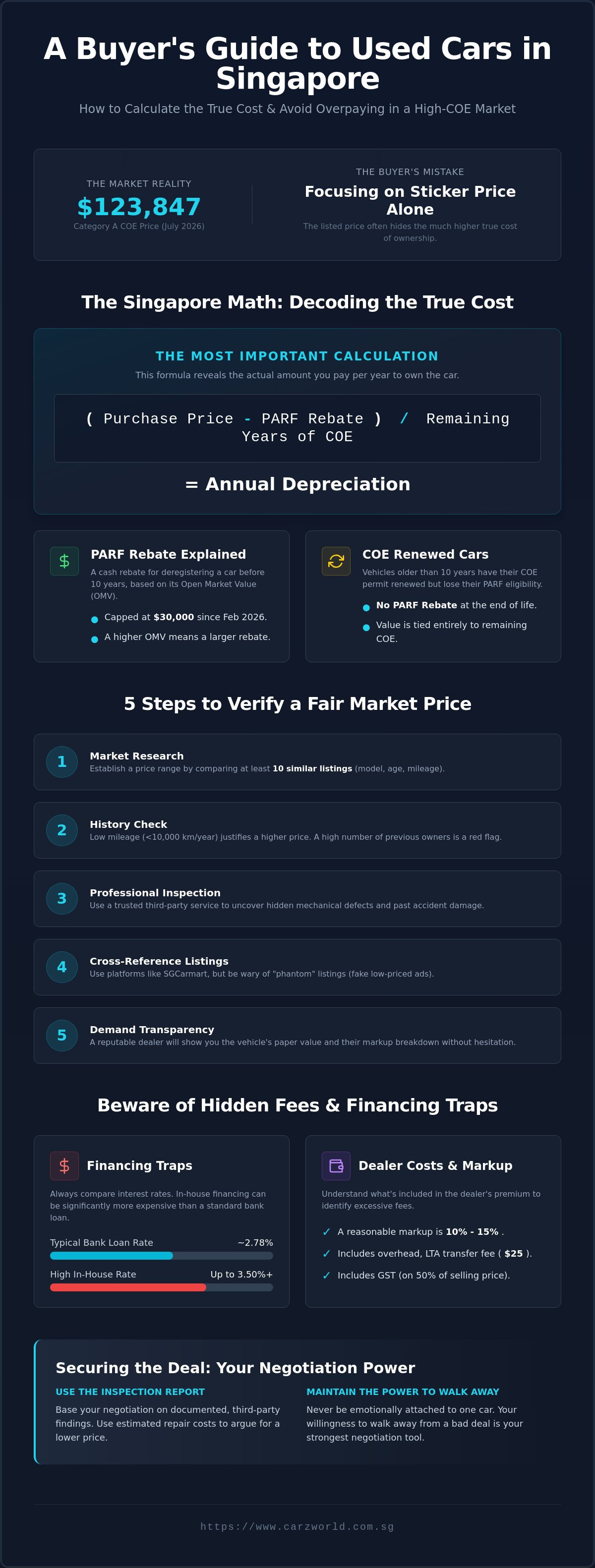
In Singapore, the sticker price of a pre-owned vehicle is often the least important number you'll see on a listing. With Category A COE prices reaching $123,847 in July 2026, the true cost of ownership is hidden deep within the math of depreciation and rebate structures. Learning how to avoid overpaying for a used car requires you to look past the shiny paint and focus on the annual cost instead. It's a high-stakes environment where a simple calculation error can lead to thousands of dollars in unnecessary losses.
Accurate math. Thorough inspections. Transparent deals. We know that the fear of buying a lemon or getting trapped in a loan with interest rates as high as 3.50% creates significant anxiety. The market has changed since the February 2026 PARF rebate reductions, making the math more vital than ever. This guide will help you master the specific calculations and inspection techniques needed to secure a fair deal. You'll learn how to accurately determine annual depreciation, identify mechanical red flags that signal hidden defects, and spot dealer markups that often go unnoticed. We provide the clarity you need to buy with confidence.
Key Takeaways
- Calculate the true cost of ownership using the annual depreciation formula to look past misleading sticker prices.
- Establish a reliable market price range by comparing at least ten similar listings and adjusting for vehicle mileage.
- Learn how to avoid overpaying for a used car by utilizing professional third-party inspections to reveal hidden accident history and mechanical defects.
- Protect your budget by identifying excessive dealer admin fees and comparing bank loan interest rates against in-house financing.
- Strengthen your negotiation position by focusing on documented repair costs and maintaining the power to walk away from a deal.
The Singapore Math: Decoding Depreciation and COE
The sticker price on a car listing tells you very little about its real value in Singapore. With Category A Certificate of Entitlement (COE) prices sitting at $123,847 as of July 2026, the vehicle's body value is often just a fraction of the total cost. Understanding these numbers is the first step in learning how to avoid overpaying for a used car. You aren't just buying a machine; you're buying the remaining time on its legal permit to be on the road.
To better understand this concept, watch this helpful video:
The most important metric in any transaction is the "Annual Depreciation." This is calculated using a simple formula: (Total Purchase Price - PARF Rebate) / Remaining Years of COE. If a dealer quotes you a low total price but the car only has two years left on its COE, the annual depreciation might actually be higher than a newer, more expensive model. Always calculate the yearly cost to see if the deal is truly fair.
Calculating Your PARF and COE Rebates
The Preferential Additional Registration Fee (PARF) is a rebate you receive when you deregister a car before its 10-year mark. It's based on the Open Market Value (OMV). As of the February 2026 policy update, these rebates are now capped at $30,000. For cars registered after this date, the rebate scales down significantly as the car ages. It starts at 30% of the ARF paid for cars under five years old. You can check the exact paper value of any vehicle through the LTA OneMotoring portal. A car with a higher OMV serves as a financial safety net because it guarantees a higher cash return at the end of its life.
Depreciation vs. Market Price
Market prices fluctuate based on COE supply. A 7-year-old car might have a higher depreciation than a 3-year-old car if it was registered during a period of record-high COE prices. This is especially true for "COE renewed" cars, which don't have a PARF rebate at all. Their value is tied entirely to the remaining COE. You can identify overpriced listings by comparing similar models on our used car collections page. If the annual depreciation of a listing is significantly higher than the market average for that specific model and year, it's a clear sign to look elsewhere.
5 Steps to Verify a Fair Market Price
Establishing a baseline is the most effective way to understand how to avoid overpaying for a used car. You should never settle for the first listing that fits your budget. Instead, find at least 10 similar models with comparable age and mileage to identify the price floor and the ceiling. This data-driven approach prevents you from being swayed by emotional sales pitches or "limited time" offers.
Mileage and ownership history are critical value drivers that dictate the final price. A car that has traveled 10,000km per year justifies a slightly higher annual depreciation than one that has covered 25,000km annually. Similarly, check the registration history. A high number of previous owners often leads to lower resale value. If a five-year-old car has had four owners, it often signals recurring mechanical issues or poor maintenance habits.
For vehicles older than 10 years, you must factor in the "Renewed COE" premium. These cars do not have a PARF rebate, so their value is tied entirely to the remaining COE and the Prevailing Quota Premium (PQP) paid during renewal. Always use professional valuation benchmarks. A transparent dealer will show you the exact breakdown of the vehicle's paper value and their specific markup without hesitation.
Cross-Referencing Platforms
SGCarmart and Carousell are excellent tools, but you must use them carefully. Watch out for "phantom" listings. These are fake, low-priced ads designed to lure you into a showroom only for you to be told the car was "just sold." Consignment cars can offer "direct owner" prices, but they often lack the mechanical guarantees and administrative support provided by established dealers. Stick to verified listings to save time and avoid frustration.
Evaluating the 'Dealer Premium'
A reasonable dealer markup usually ranges from 10% to 15%. This premium covers essential overhead, the $25 LTA vehicle transfer fee, and the Goods and Services Tax (GST), which is charged on 50% of the selling price under the Discounted Sale Price Scheme. Buying from an established showroom like Carz World adds long-term value through rigorous vehicle preparation. It also protects you from ownership transfer disputes that can occur with less reputable entities. You can view our current inventory of pre-owned vehicles to see how we maintain price transparency and service quality.
Avoid the 'Lemon' Tax: Inspection Secrets
Purchasing a vehicle with hidden mechanical issues is the quickest way to inflate your total cost of ownership. While this guide provides practical tips on the administrative steps of buying, you must personally verify the vehicle's physical health. A professional third-party inspection, which typically costs about $200, is your strongest defense. Learning how to avoid overpaying for a used car involves looking past a polished exterior to find the mechanical reality underneath.
Insisting on STA or VICOM Evaluations
Insist on an evaluation from recognized centers like STA or VICOM. These facilities provide a standardized grading system that removes the guesswork from your purchase. A "Grade A" report suggests a vehicle in excellent condition, while a "Grade C" indicates significant wear or past accident repairs. If a report highlights specific faults, use the estimated repair costs as a direct negotiation tool to lower the asking price. If a seller refuses to allow an independent inspection, it's a major red flag. You should be prepared to walk away from the deal immediately.
Major accidents can leave lasting damage that isn't visible to the untrained eye. Check for chassis alignment issues and inconsistent paint thickness, which are clear indicators of structural repairs. During your test drive, turn off the radio and listen carefully. Pay attention to suspension knocks when going over humps or gearbox hesitations during acceleration. A smooth gear transition is vital, especially in modern dual-clutch systems common in the Singapore market.
Spotting Hidden Wear and Tear
Small details often reveal large upcoming expenses. Check the four-digit manufacture date on the tire sidewalls. If the tires are more than four years old, you'll likely face a replacement cost of $600 to $1,000 very soon. Test the air conditioning thoroughly at various fan speeds. In our tropical climate, a failing compressor is a common and expensive repair that can easily be missed during a short viewing. Finally, look at the interior condition. Heavily worn seat bolsters or sticky buttons often suggest the car was used more intensely than the mileage suggests.
Ask for the full service history. Vehicles maintained regularly at authorized workshops or reputable specialist centers command a higher price for a reason. This documentation proves the previous owner didn't skip essential maintenance. It preserves the car's long-term reliability and ensures you aren't inheriting a backlog of neglected repairs.
Beware of Hidden Fees and Financing Traps
The advertised price of a vehicle is often just the starting point of a much larger financial conversation. To master how to avoid overpaying for a used car, you must look closely at the "admin fees" and "processing charges" that appear on the final sales agreement. While most reputable dealers charge a nominal fee for paperwork and the $25 LTA transfer fee, some outlets use these line items to hide significant markups. If you see an admin fee exceeding $500, ask for a specific breakdown of what that cost covers. Often, these are simply additional profit margins disguised as necessary expenses.
Financing is another area where costs can spiral if you aren't careful. Used car loan interest rates in 2026 typically range between 2.78% and 3.50% per annum. While a "full loan" with zero down payment might seem convenient, it is often a trap that leads to negative equity. Because used cars depreciate quickly, a high-interest full loan can result in a situation where you owe the bank more than the car is worth. This makes it nearly impossible to sell or trade in the vehicle before the loan term ends without paying a heavy penalty.
Don't forget to scrutinize insurance quotes provided by the dealer. Many sellers receive kickbacks for referring customers to specific insurers. You should always obtain your own independent insurance quote first to use as a benchmark. This ensures you aren't paying a premium just to cover a dealer's commission.
The Truth About In-House Financing
In-house loans sometimes make sense for buyers with lower credit scores who might struggle with traditional bank approvals. However, you must calculate the Effective Interest Rate (EIR) rather than relying on the advertised flat rate. A flat rate of 3.5% can be misleading because it doesn't account for the reducing balance of your loan. You can often negotiate a lower car price by opting for a specific loan package, but only do this if the total interest paid over the life of the loan doesn't outweigh the upfront discount.
GST and Transfer Fees
Confirm that the advertised price includes the prevailing GST. In Singapore, used car dealers typically use the Discounted Sale Price Scheme, where GST is only charged on 50% of the selling price. If a dealer attempts to charge GST on the full 100% of the vehicle price, they are incorrectly applying the tax. Always clarify who is responsible for the $25 LTA transfer fee. While it's a small amount, a transparent dealer will include this in the final "drive-away" price. We believe in complete transparency, which is why we provide clear breakdowns for all our pre-owned cars to ensure you never face unexpected costs.
Securing the Deal: Negotiation and Final Steps
Negotiation is often the most stressful part of the car-buying process, but it becomes much simpler when you base your offer on objective facts. Instead of asking for a discount because you "want it cheaper," use the specific mechanical findings from your third-party inspection. If the tires are near the end of their life or the brake pads need immediate replacement, present the estimated cost of repair as a reason for a price adjustment. This professional approach is the final step in learning how to avoid overpaying for a used car. It shifts the conversation from a battle of wills to a logical discussion about the vehicle's current value.
Never feel pressured to sign a sales agreement on your first visit. The "walk away" power is your strongest psychological tool. A reputable dealer will respect your need to sleep on the decision and won't use high-pressure tactics to force a same-day deposit. Use this time to review the total math once more, ensuring the annual depreciation aligns with the market benchmarks you established earlier. If the dealer is unwilling to meet a fair market price based on your research, it's better to continue your search than to overpay for a vehicle that doesn't meet your criteria.
When you are ready to proceed, review the Sales Agreement with extreme care. Ensure all verbal promises, such as a fresh coat of paint or a specific warranty period, are documented in writing. Transparency is the hallmark of a dependable partner. If any clause feels vague or if the dealer refuses to clarify certain fees, take it as a sign to reconsider the transaction. A clear, detailed agreement protects both parties and ensures a smooth transfer of ownership.
The Final Paperwork
Before making the final payment, verify that the log card details match the actual vehicle. Double-check the chassis number and the number of previous owners against the original listing. It's also vital to understand your rights under the "Lemon Law" in Singapore. This legislation protects consumers against defective goods, including pre-owned cars, that do not meet the standards of quality and performance promised at the time of sale. Ready to buy with total transparency? Browse our inspected used cars to find your next reliable vehicle.
Choosing a Partner, Not Just a Car
At Carz World, we focus on building long-term trust rather than securing a one-time sale. We believe that the relationship with our clients begins, not ends, when the keys are handed over. We provide comprehensive one-stop services, including competitive financing, insurance arrangements, and a seamless process for selling your old car. Use this final checklist before driving off the lot:
- Confirm the spare key and owner's manual are in the vehicle.
- Verify the road tax expiry date.
- Ensure the IU (In-vehicle Unit) is functioning correctly.
- Check that the interior has been cleaned and all agreed-upon repairs are complete.
By following these systematic steps, you can navigate the complex Singaporean car market with confidence. Armed with accurate math and a clear understanding of the current COE climate, you're now ready to secure a fair deal on a quality pre-owned vehicle.
Drive Away with Financial Confidence
Navigating the Singaporean car market in 2026 requires a blend of sharp mathematical analysis and physical verification. You've learned that the true value of a vehicle lies in its annual depreciation rather than its sticker price. By insisting on professional inspections and scrutinizing every line item on a sales agreement, you now possess the tools for how to avoid overpaying for a used car. These steps ensure your investment is protected against hidden defects and inflated dealer markups. It's about choosing a vehicle that fits your lifestyle without compromising your financial future.
We apply these same standards of transparency to every vehicle in our inventory. Our team provides case-by-case transparent pricing and manages the entire logistical process for you. This includes everything from securing competitive financing to completing the LTA transfer. With hundreds of positive client testimonials, our reputation is built on the dedication of our staff and the quality of our service. We focus on making complex processes feel like a seamless experience for every customer.
Find Your Next Fair-Priced Car at Carz World
You deserve a transaction that is fluid and positive. Start your journey today with a partner who values your long-term trust and peace of mind.
Frequently Asked Questions
What is a fair annual depreciation for a used car in Singapore currently?
A fair annual depreciation depends on the vehicle category and age, but in the 2026 market, $15,000 to $18,000 is common for standard sedans. Luxury models or those with high OMV will naturally see higher figures. You should compare the depreciation of your target car against at least ten similar listings to establish a baseline. This is the most reliable way to determine if you are paying a fair price relative to current COE levels.
Is it better to buy from a direct owner or a used car dealer?
Buying from a reputable dealer is generally safer because it provides administrative support and consumer protection under the Lemon Law. While direct owners might offer a slightly lower price, you must handle the paperwork, LTA transfer, and financing yourself. Dealers also offer pre-inspected inventory and professional preparation. This reduces the risk of inheriting hidden mechanical issues that a direct seller might not disclose or even be aware of.
Does the Singapore Lemon Law actually protect used car buyers?
Yes, the Lemon Law protects you if the used car doesn't meet the standards of quality or performance promised at the time of sale. It applies to defects that surface within six months of delivery. However, it only covers purchases from registered businesses, not direct owner transactions. Understanding these legal rights is a key part of how to avoid overpaying for a used car that might require immediate, expensive repairs.
How much should I budget for hidden costs after buying a used car?
You should budget approximately $1,500 to $3,000 for immediate post-purchase expenses. This covers a major service, potential tire replacements, and minor wear and tear repairs like brake pads or battery changes. Additionally, factor in the $25 LTA transfer fee and the pro-rated road tax. Having this buffer ensures you don't face financial strain immediately after the transaction and keeps the car in peak condition for the long term.
Can I negotiate the price of a used car if I'm paying in cash?
Cash payments often have less negotiating power than financing because dealers receive commissions from banks for loan referrals. If you pay in cash, the dealer loses that additional revenue, which may lead to a higher car price. It's often more effective to negotiate based on the vehicle's mechanical condition or documented repair needs. Always calculate the total cost of interest versus the cash discount to see which path offers better value.
What is the difference between a PARF car and a COE car?
A PARF car is less than 10 years old and still eligible for a Preferential Additional Registration Fee rebate upon deregistration. A COE car has already completed its initial 10-year cycle and had its COE renewed, meaning it no longer carries a PARF rebate. COE cars generally have lower upfront costs but higher annual depreciation because their value is tied solely to the remaining COE and a small scrap value.
How do I check if a used car has been in a major accident?
You can identify major accidents by checking for inconsistent gaps between body panels and signs of welding on the chassis. A professional inspection at STA or VICOM will use specialized tools to measure paint thickness and check structural alignment. You should also request a vehicle history report to see past insurance claims. These steps are essential for anyone wanting to know how to avoid overpaying for a used car with structural damage.
Should I worry about high mileage if the car has a full service history?
High mileage is less concerning if the vehicle has a documented service history from an authorized workshop. Consistent maintenance proves that the previous owner replaced wear and tear parts on schedule, which preserves mechanical integrity. A well-maintained car with 150,000km can often be a better investment than a low-mileage vehicle that has been neglected. Focus on the quality of the maintenance records rather than just the number on the odometer.
Disclaimer
This content is provided for general informational purposes only. Readers are encouraged to independently verify important information.
In Same Category
- Pros and Cons of Buying a High PARF Car in Singapore
- Car Valuation Services in Bukit Merah: A Seller’s Guide
- Scrapping Your Car Before 10 Years in Singapore: What Happens?
- Calculating the Breakeven Point for COE Renewal in Singapore
- Financial Checklist Before Committing to a Car Purchase in Singapore (2026)
Related by Tags
- Used Cars for Sale in Tampines: 2026 Buyer's Guide
- Car Downpayment vs Monthly Instalment in Singapore: The 2026 Budgeting Guide
- Check Outstanding Car Finance in Singapore: 2026 Guide
- Car Loan Singapore: The Complete 2026 Guide to Financing Your Vehicle
- How Much Salary to Afford a Car in Singapore: 2026 Affordability Guide
- Buying a Used Car in Singapore: 2026 Ultimate Guide
- What is PARF? The Ultimate Guide to Singapore’s Car Rebate System
- Mercedes-Benz EQB 250+ Review: The Ultimate 7-Seater Family EV in Singapore
- Long Term Car Rental Singapore: 2026 Definitive Guide
- How to Buy a Car in Singapore: The Ultimate 2026 Step-by-Step Guide
- Second Hand Hybrid Cars Singapore: The 2026 Value & Inspection Guide
- Cheapest Car in Singapore: The 2026 Guide to Affordable Ownership
- Parallel Import Cars Singapore: 2026 Buyer’s Guide
- Honda Civic Singapore: 2026 New & Pre-Owned Guide
- Suzuki Swift Singapore: The Ultimate Smart-Money Hatchback Guide 2026
- The Ultimate Toyota Alphard Singapore Guide: Luxury & Performance in 2026
- Sell My Car in Singapore (2026): Complete Guide
- Nissan Qashqai Singapore: Ultimate Buyer’s Guide 2026
- The Ultimate Used Car Buying Guide for Singapore in 2026
- Why Carz World is Your Trusted Used Car Dealer in Singapore (2026 Guide)
- Honda Odyssey Singapore: 2026 Family Buying Guide