15 Practical Saving Tips for Car Buyers in Singapore (2026 Edition)

With Category A COE prices reaching S$123,847 in June 2026, finding effective saving tips for car buyers in singapore is now a financial necessity. You're likely feeling the pressure of high upfront cash requirements and the recent S$30,000 cap on PARF rebates. It's a complex environment where hidden costs like road tax and tiered ARF rates can lead to car-poverty if you don't have a clear plan. We understand that the fear of making a wrong move in this market is high, but the right information can build your confidence.
We're here to help you navigate these challenges with the expertise of a dependable partner. This guide provides a professional roadmap to master the financial math of ownership and save thousands on your next purchase. You'll learn how to optimize your interest costs, compare the value of parallel imports, and utilize the latest EV incentives that currently drive over 57% of new registrations. We'll give you a clear savings target so you can enjoy the drive without the financial stress.
Key Takeaways
- Understand the impact of the "40% Rule" and the 9% GST on your initial cash outlay to plan your budget accurately.
- Implement the 30/20 rule to ensure your total vehicle expenses never exceed 20% of your monthly income.
- Learn how to time your purchase and compare Parallel Imports with Authorized Dealers to secure the best possible price.
- Discover essential saving tips for car buyers in singapore that focus on maximizing PARF rebates and utilizing the "Hybrid Hedge" for lower taxes.
- Evaluate the long-term financial benefits of pre-owned cars, including lower depreciation rates and reduced insurance costs.
Understanding the 2026 Car Buying Landscape in Singapore
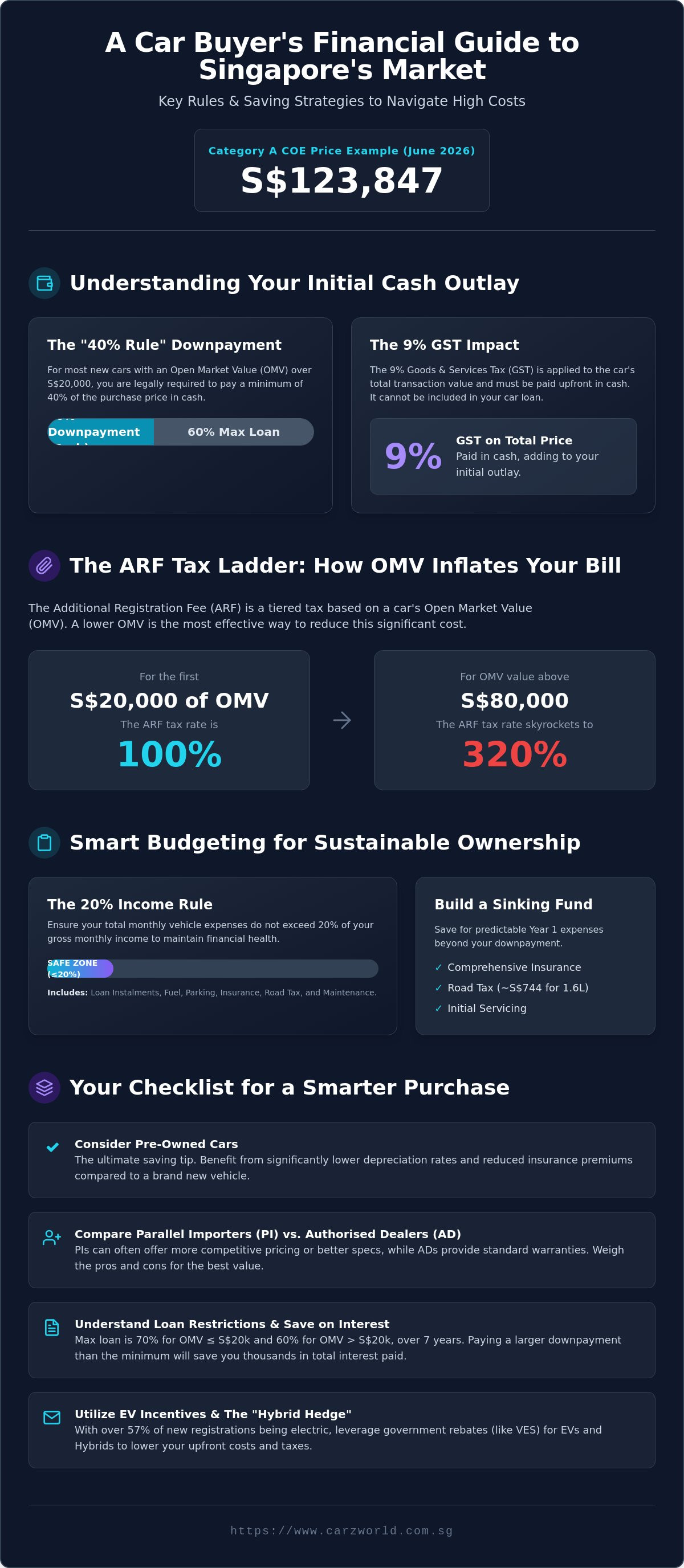
Buying a car in Singapore requires more than just picking a model. You must understand the financial framework that dictates your upfront cash and monthly commitment. The Certificate of Entitlement (COE) system is the foundation of this landscape. With Category A prices reaching S$123,847 in June 2026, the barrier to entry is higher than ever. One of the most critical saving tips for car buyers in singapore is to calculate your "all-in" price before visiting a showroom. This prevents the shock of hidden fees that often surprise unprepared buyers.
The "40% Rule" has become a standard hurdle for most residents. Since the vast majority of cars today have an Open Market Value (OMV) exceeding S$20,000, you are legally limited to a 60% loan. This necessitates a 40% cash downpayment. When you add the 9% GST applied to the total transaction value, your initial cash requirement can easily exceed six figures. We recommend keeping a six-month emergency maintenance buffer separate from your car fund. This ensures you can handle unexpected repairs or road tax renewals without dipping into your daily savings.
To better understand this concept, watch this helpful video:
The MAS Loan Restrictions Explained
Loan eligibility is strictly governed by the Monetary Authority of Singapore (MAS). If the vehicle's OMV is S$20,000 or less, you can borrow up to 70% of the purchase price. However, if the OMV is above S$20,000, the limit drops to 60%. Your Total Debt Servicing Ratio (TDSR) also plays a role; your total monthly debt obligations cannot exceed 55% of your gross monthly income. While borrowing the maximum is tempting, putting down a larger downpayment reduces your total interest paid over the seven-year maximum tenure. This simple move can save you thousands in the long run. If you are looking for more affordable entry points, exploring pre-owned cars can often help you stay within lower OMV tiers.
The GST and ARF Impact in 2026
Taxation is where Singapore's car market becomes truly unique. The 9% GST is levied on the total price, making it a heavy upfront cost that cannot be financed. On top of this, the Additional Registration Fee (ARF) uses a tiered system that scales aggressively with the car's value. The Open Market Value (OMV) is the price paid for the vehicle including freight and insurance, acting as the baseline for all subsequent taxes. For instance, the first S$20,000 of OMV is taxed at 100%, but any value above S$80,000 is taxed at a staggering 320%. Choosing a vehicle with a lower OMV is one of the most effective ways to reduce your tax burden and manage your cash flow.
Pre-Purchase Strategies: How to Build Your Car Fund
When searching for saving tips for car buyers in singapore, the 30/20 Rule is a reliable benchmark for financial health. It suggests that your total car expenses, including instalments, fuel, and parking, shouldn't exceed 20% of your monthly income. This is one of the most effective saving tips for car buyers in singapore because it forces you to look at the total cost of ownership rather than just the sticker price. By automating your "COE Fund" through a separate savings account, you remove the temptation to spend that cash on lifestyle upgrades before you're ready to buy.
Evaluating opportunity cost is equally vital for a successful purchase. Money spent on a depreciating asset is money not earning interest in your CPF or investment portfolio. Before committing, consider how this purchase affects your long-term wealth; you may even want to visit Zenith Wealth to ensure your car purchase fits into a broader financial strategy. Most successful buyers treat their car fund as a non-negotiable monthly "bill" for at least 12 months before they step into a showroom. This practice builds the discipline needed to handle the recurring costs of vehicle ownership without stress.
The Maintenance Sinking Fund
A common mistake is saving only for the downpayment. You must also build a sinking fund for Year 1 expenses. This includes comprehensive insurance, road tax (which is approximately S$744 for a typical 1,600cc engine), and initial servicing. If you choose from our inventory of pre-owned cars, you should set aside a larger buffer for wear-and-tear items. Tyres, batteries, and brake pads are inevitable expenses that shouldn't come as a surprise during your first year on the road.
Financial Stress Testing Your Budget
Current interest rates typically range from 2.78% to 3.78% per annum. Before signing your agreement, simulate a 1% interest rate hike to see if your cash flow can still handle the instalments. You should also account for daily variables like ERP charges and parking fees in your simulation. You can find the official government regulations on car loans to understand the strict Loan-to-Value limits that apply to your situation. If your budget feels tight during this simulation, it's a clear sign you might be heading toward being "car-poor."
At CarzWorld, we believe in helping you find a vehicle that fits your lifestyle and your financial goals. If you need a partner to help you navigate these complex math-heavy decisions, our team is ready to provide expert guidance on your next purchase.
Transaction Tips: Saving Money at the Dealership
Walking into a showroom without a strategy is a common mistake. One of the most effective saving tips for car buyers in singapore is to leverage the "End-of-Quarter" advantage. Dealerships often have strict sales targets for March, June, September, and December. If you visit during the final two weeks of these months, sales consultants are more likely to offer flexible pricing or additional freebies to hit their quotas. This timing can significantly lower your final invoice without requiring intense negotiation skills.
You should also understand the concept of "Overtrade" when discussing your trade-in. This is a practice where the dealer offers a higher-than-market value for your old car but offsets it by raising the price of the new one. While it doesn't change the total cost, it effectively reduces the 40% cash downpayment required by MAS loan restrictions. It's a useful tactical move if your primary concern is preserving upfront cash. For a deeper look at the legalities of these transactions, consult the Official Guide to Buying a Car in Singapore before you commit.
The Parallel Import (PI) Advantage
Choosing between an Authorized Dealer (AD) and a Parallel Importer (PI) can lead to substantial savings. Parallel importers typically offer popular Japanese models at a lower price point because they source vehicles from different markets. While an AD provides a manufacturer warranty, many reputable PIs now offer robust in-house warranties and servicing packages that provide similar peace of mind. You can explore our range of brand new parallel imports to see how much you can save on the latest models compared to traditional dealership prices.
Timing Your COE Bid
The Certificate of Entitlement (COE) is the most volatile part of your purchase. Don't rush into a bid immediately after a major Motor Show; these events often trigger a surge in demand that spikes prices in the following weeks. Instead, analyze the trend over the last three months. The second bidding round of the month is often more volatile because dealers are rushing to secure certificates for their monthly deliveries. If you're on a tight budget, avoid "Non-Guaranteed COE" packages. While they look cheaper on paper, a sudden price hike like the June 2026 Cat A peak of S$123,847 could leave you without a car for months while the dealer waits for prices to drop.
Our team at CarzWorld focuses on transparency during every step of the transaction. We believe that an informed buyer is a satisfied customer, and we're here to ensure your purchase is both efficient and cost-effective. By combining these dealership-specific strategies with a clear understanding of market trends, you can secure a vehicle that meets your needs without overextending your finances.
Reducing the Total Cost of Ownership (TCO)
Most buyers focus solely on the sticker price, but the most effective saving tips for car buyers in singapore involve planning your exit strategy. Your "exit price" is the amount you receive when you eventually sell or scrap the vehicle. By choosing a car with a high Preferential Additional Registration Fee (PARF) rebate, you secure a guaranteed cash return. It's important to note that for cars registered with COEs from February 2026 onwards, the PARF rebate is capped at S$30,000. This makes your initial vehicle selection critical for long-term financial health.
The "Hybrid Hedge" is another essential strategy in 2026. It allows you to reduce your monthly fuel bill while qualifying for significant tax breaks. Fully electric vehicles in Band A currently receive a rebate of S$22,500 under the Vehicular Emissions Scheme (VES). When you combine this with the EV Early Adoption Incentive (EEAI), which offers a 45% rebate off the ARF capped at S$7,500, the upfront savings are substantial. These incentives are scheduled to expire after December 31, 2026, so acting before the year ends can save you thousands.
Understanding Depreciation and Rebates
Annual depreciation is the most accurate way to measure the true cost of your car. To calculate this, take the total purchase price, subtract the expected PARF rebate, and divide the result by the years of COE remaining. Many budget-conscious buyers find that a 5-year-old pre-owned car offers the lowest depreciation curve. The first owner has already absorbed the steep "instant depreciation" hit, allowing you to enjoy a lower annual cost for the remaining five years of the COE.
Fuel and Maintenance Savings
Your daily running costs can make or break your budget. Comparing petrol, hybrid, and EV charging costs is vital as energy prices fluctuate in 2026. Beyond fuel, insurance premiums offer another opportunity for savings. Maintaining a 50% No Claims Discount (NCD) is your best tool for lowering premiums. You might also consider a high-excess plan if you're a safe driver, as this significantly reduces your annual bill. Finally, look for cars that include a 5-year free servicing package to eliminate maintenance surprises. These combined efforts ensure your vehicle remains an asset rather than a financial burden.
If you're ready to find a vehicle that maximizes your exit value and minimizes daily costs, view our latest inventory to see how our selection can fit your TCO goals.
Why Pre-Owned Cars are the Ultimate Saving Tip
Choosing a pre-owned vehicle is often the smartest financial move you can make in the current market. New cars suffer from "instant depreciation," losing a significant portion of their value as soon as they're registered. By opting for a used vehicle, you allow the first owner to absorb that initial loss. This is one of the most practical saving tips for car buyers in singapore because it directly reduces your capital outlay and monthly commitment. Older vehicles also benefit from lower insurance premiums because their market value is lower than brand new alternatives.
The "Short-Lease" strategy is another effective way to manage your budget. This involves buying a car with only 2-3 years of COE remaining. It's an ideal solution if you need a vehicle for a specific period without committing to a long-term loan or the high costs of a fresh 10-year COE. At CarzWorld, we prioritize your peace of mind by ensuring every vehicle in our inventory is reliable. Our team conducts rigorous inspections on every unit to maintain the high standards our clients expect from a dependable partner. This methodical approach ensures that your "saving" doesn't turn into a maintenance headache later on.
The Math of Used Car Savings
The financial difference becomes clear when you compare the downpayment for a new versus a 3-year-old Honda Vezel. Because the 3-year-old model has a lower purchase price, the 40% cash requirement mandated by MAS becomes much more manageable. You should also look for high-value consignment deals, where owners sell their cars through a dealer's platform. These deals often provide a more transparent vehicle history and better pricing for the buyer. You can browse our curated collection of used cars to find the best value for your specific budget.
Maximizing Your Trade-In Value
If you already own a vehicle, your trade-in is your most powerful tool to offset the 40% downpayment hurdle we discussed earlier. Trading in directly with a professional dealer often provides a more seamless experience than using third-party aggregators. Aggregators may offer lower valuations to cover their own margins, whereas a direct sale to us ensures you get a fair, competitive price that goes straight toward your next purchase. Our process is designed to be efficient and honest, focusing on long-term reputation over short-term gains. If you're ready to upgrade, you can sell your car to us for a professional valuation today. Our experienced staff will guide you through the logistics, making the transition to your next car feel effortless.
Mastering Your Car Ownership Journey
Navigating the 2026 automotive market requires a blend of strategic planning and financial discipline. By understanding the MAS loan limits and optimizing your exit strategy with PARF rebates, you've already gained a significant advantage. These saving tips for car buyers in singapore are designed to prevent the common pitfalls of car-poverty while ensuring you get the most value from your investment. Whether you're choosing a high-rebate hybrid or a reliable pre-owned model, the right information makes all the difference.
At CarzWorld, we pride ourselves on being a dependable partner in your transaction. As a direct parallel importer with competitive 2026 pricing, we offer options that authorized dealers often can't match. Our expert consultants are ready to personalize your financial roadmap to ensure your purchase is both sustainable and enjoyable. We're honored by the trust shown in over 1,000+ positive client testimonials from our community of satisfied drivers. Just as AsianArrivalCard helps travelers navigate digital entry requirements for regional destinations, it's our mission to make complex logistical processes feel like a seamless experience.
Start your smart car ownership journey with Carz World today. We look forward to helping you drive with confidence and financial peace of mind.
Frequently Asked Questions
Is it better to buy a new or used car in Singapore in 2026?
Choosing between a new or used car depends on your financial goals and intended ownership period. Used cars are often superior for those seeking saving tips for car buyers in singapore because they avoid the steep depreciation hit that occurs in the first three years. However, new cars offer the latest safety technology and full manufacturer warranties. In 2026, many buyers favor pre-owned vehicles to manage the high upfront costs of current COE levels.
How much cash downpayment do I really need for a $150,000 car?
For a car priced at $150,000, you'll likely need a 40% cash downpayment, which totals $60,000. This is because most vehicles at this price point have an OMV exceeding S$20,000, triggering the lower 60% Loan-to-Value limit. You must also factor in the 9% GST and registration fees, which are paid upfront in cash. Planning for these high entry costs is a fundamental part of mastering the financial math of ownership.
Can I use my CPF to pay for a car in Singapore?
No, you can't use your CPF funds to purchase a vehicle or pay for car loans in Singapore. CPF savings are strictly reserved for retirement, housing, and healthcare needs. You must rely on personal cash savings or a bank loan for your purchase. It's vital to ensure your car fund is separate from your long-term retirement planning to maintain overall financial stability while managing your vehicle expenses.
What is the difference between PARF and COE cars for saving money?
PARF cars are less than 10 years old and offer a cash rebate when deregistered, whereas COE cars have had their lifespan extended and offer no such rebate. For budget buyers, COE cars have lower upfront prices but higher annual depreciation since there's no "exit value" at the end. PARF cars generally provide a safer "delayed saving" through the rebate, which is currently capped at S$30,000 for newer registrations.
How does the VES rebate help me save on my car purchase?
The Vehicular Emissions Scheme (VES) helps you save by providing rebates of up to S$22,500 for low-emission vehicles in Band A. These rebates are applied directly against the Additional Registration Fee (ARF), effectively lowering the purchase price of clean-energy cars. Choosing an eligible model is one of the most effective saving tips for car buyers in singapore. It allows you to benefit from government incentives while reducing your long-term fuel expenditure.
Are parallel import cars reliable and do they really save money?
Parallel import cars are generally reliable and can save you significant money by offering lower prices than authorized dealers. These vehicles are identical in mechanical quality but are sourced from different global markets to bypass local dealership markups. While they don't carry a manufacturer warranty, reputable importers provide comprehensive in-house servicing and warranty packages. This makes them a cost-effective alternative for buyers who want a brand new car without the premium price tag.
What are the hidden costs of car ownership that buyers often forget?
Buyers often forget recurring costs like road tax, insurance premiums, and the 6-month maintenance buffer. For a standard 1,600cc car, road tax costs approximately S$744 annually. You should also account for daily variables like ERP charges, parking fees, and the increasing cost of tyres and batteries. These hidden expenses can quickly add up; including them in your initial budget is essential to avoid becoming "car-poor" after your purchase.
How can I lower my car insurance premiums in Singapore?
You can lower your insurance premiums by maintaining a high No Claims Discount (NCD) and opting for a plan with a higher excess. A 50% NCD is the most powerful tool for reducing your annual bill. Additionally, choosing a car with advanced safety features or a lower engine capacity can lead to more competitive quotes. Comparing multiple providers before renewing ensures you aren't paying more than necessary for the protection you need.
Disclaimer
This content is provided for general informational purposes only. Readers are encouraged to independently verify important information.
In Same Category
- Pros and Cons of Buying a High PARF Car in Singapore
- Car Valuation Services in Bukit Merah: A Seller’s Guide
- Scrapping Your Car Before 10 Years in Singapore: What Happens?
- Calculating the Breakeven Point for COE Renewal in Singapore
- Financial Checklist Before Committing to a Car Purchase in Singapore (2026)
Related by Tags
- Used Cars for Sale in Tampines: 2026 Buyer's Guide
- Car Downpayment vs Monthly Instalment in Singapore: The 2026 Budgeting Guide
- Car Loan Singapore: The Complete 2026 Guide to Financing Your Vehicle
- How Much Salary to Afford a Car in Singapore: 2026 Affordability Guide
- Buying a Used Car in Singapore: 2026 Ultimate Guide
- What is PARF? The Ultimate Guide to Singapore’s Car Rebate System
- Mercedes-Benz EQB 250+ Review: The Ultimate 7-Seater Family EV in Singapore
- Long Term Car Rental Singapore: 2026 Definitive Guide
- How to Buy a Car in Singapore: The Ultimate 2026 Step-by-Step Guide
- Second Hand Hybrid Cars Singapore: The 2026 Value & Inspection Guide
- Cheapest Car in Singapore: The 2026 Guide to Affordable Ownership
- Parallel Import Cars Singapore: 2026 Buyer’s Guide
- Toyota Harrier Singapore: The Definitive 2026 Buyer’s Guide
- Honda Civic Singapore: 2026 New & Pre-Owned Guide
- Suzuki Swift Singapore: The Ultimate Smart-Money Hatchback Guide 2026
- The Ultimate Toyota Alphard Singapore Guide: Luxury & Performance in 2026
- Hyundai Ioniq 5 Singapore: The Definitive 2026 Buying & Ownership Guide
- Sell My Car in Singapore (2026): Complete Guide
- Nissan Qashqai Singapore: Ultimate Buyer’s Guide 2026
- The Ultimate Used Car Buying Guide for Singapore in 2026
- Why Carz World is Your Trusted Used Car Dealer in Singapore (2026 Guide)
- Honda Odyssey Singapore: 2026 Family Buying Guide