Cat A vs Cat B COE Difference: The Complete 2026 Singapore Guide
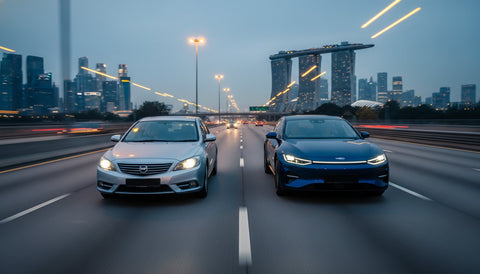
Did you know that as of the first bidding in June 2026, the price gap between Category A and Category B COEs has shrunk to just $980? For many Singaporean drivers, the traditional boundary between mass-market and luxury cars has practically vanished. Understanding the Cat A vs Cat B COE difference is now more critical than ever, especially as record-high premiums change how we value our next purchase.
You're likely feeling the pressure of these rising costs and perhaps some confusion over how electric vehicle power ratings now dictate these categories alongside traditional engine capacities. It's a complex environment where a premium EV might actually sit in the same category as a family sedan. We promise to provide the clarity you need to make a confident, data-driven decision without the fear of overpaying. This guide offers a straightforward look at current LTA classifications, where the most popular 2026 models fall, and how the revised PARF rebate structure impacts your total cost of ownership over the next decade.
Key Takeaways
- Identify the specific engine capacity and power output thresholds that define current LTA vehicle classifications.
- Explore how the 110kW power limit for electric vehicles allows certain premium models to qualify for a more accessible category.
- Analyze the financial impact of the 2026 PARF rebate cap and how it changes the long-term value of your vehicle.
- Learn how to navigate the narrowing Cat A vs Cat B COE difference to ensure you aren't overpaying for a car that doesn't meet your driving needs.
- Gain expert insights on budgeting for the total package, including road tax and insurance costs tailored to each category.
Understanding the LTA Classifications: Cat A vs Cat B Defined
Singapore's car population management relies heavily on specific categories. The LTA uses the Certificate of Entitlement (COE) to control the number of vehicles on our roads. In 2026, understanding the Cat A vs Cat B COE difference is the first step toward a smart purchase. Category A targets "small" cars, while Category B is for "large" or "luxury" models. There's also Category E, known as the Open Category. It's flexible and can be used for any vehicle type, though its price usually mirrors Category B because dealers often use it for larger, high-value cars.
To better understand how these premiums impact the market, watch this helpful video:
The LTA sets these boundaries to ensure a balanced mix of vehicles. Without these tiers, luxury models would likely outbid every mass-market sedan, making car ownership impossible for many families. By separating them, the government creates a distinct space for different budget levels. However, as technology evolves, the lines between "basic" and "premium" have become blurred. Even if the price gap between the two categories is narrow, the technical requirements remain strict.
The Engine Capacity (CC) Rule
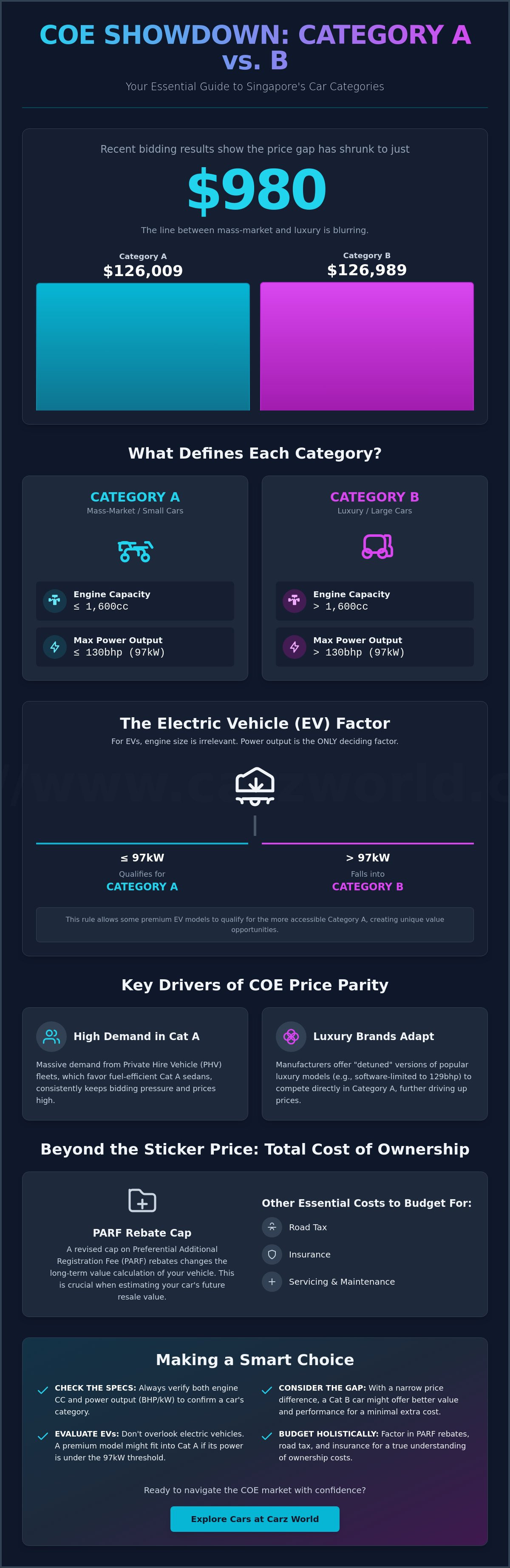
For internal combustion engine (ICE) vehicles, cubic centimeters (cc) remain the primary divider. Category A is strictly for cars with an engine capacity of 1,600cc or less. If an engine is even slightly over this limit, it's automatically placed in Category B. This rule is straightforward, but it leads to common misconceptions. Many buyers assume all "continental" cars from Europe are Category B. That isn't always true. Many luxury brands now offer 1.5L or 1.6L variants specifically to enter the Category A market. When you browse brand new cars, checking the exact cc is vital for your budget.
The Maximum Power Output Rule
Engine size alone doesn't tell the whole story. LTA also enforces a power cap of 130bhp (97kW) for Category A. This is often the "deal-breaker" for modern turbocharged cars. A 1.6L engine can easily produce 150bhp or more. If it does, it lands in Category B despite its small size. Manufacturers sometimes use software tuning to limit power to exactly 129bhp. This technical adjustment allows a car to qualify for Category A. It's a smart way to get a premium driving experience at a lower COE price. Whether you're looking at pre-owned cars or new ones, always verify both the cc and the bhp to know which category you're bidding in.
Comparing COE Premiums: Trends and Price Parity in 2026
Historically, the price gap between Category A and Category B was a reliable indicator of a car's market segment. Most buyers expected to pay a premium of $20,000 to $30,000 more for a larger engine or a luxury badge. This clear financial boundary helped families stick to budgets while allowing enthusiasts to pay more for performance. However, the 2026 market has turned this logic on its head. The Cat A vs Cat B COE difference has narrowed to levels rarely seen in the history of the LTA's official COE guide and bidding system.
Several factors drive this current parity. Massive demand from Private Hire Vehicle (PHV) fleets has flooded Category A. These companies prioritize fuel-efficient, mass-market sedans that fit the "small car" criteria, which keeps bidding pressure high. Simultaneously, luxury manufacturers have adapted by offering "detuned" versions of their popular models. This allows premium brands to compete in Category A, further driving up prices for what was once considered the "budget" tier. When Cat A prices stay high, the jump to Cat B often feels like a logical step for many buyers.
Analyzing the Recent 2026 Bidding Results
The first bidding exercise in June 2026 perfectly illustrates this trend. Category A premiums reached $126,009, while Category B followed closely at $126,989. This represents a Cat A vs Cat B COE difference of only $980. The data shows that while there were 2,076 bids for a quota of 1,246 in Cat A, Cat B saw 1,300 bids for 889 slots. This intense competition in the mass-market segment means that Category A is no longer the "safe haven" for low-cost ownership it once was. Quota supply changes often impact Cat A more severely because the volume of interested buyers is much larger.
Is the Price Gap Closing?
Psychologically, once COE prices cross the $120,000 mark, the relative difference between categories feels smaller to the consumer. If you are already committing to a six-figure premium, a few hundred dollars extra for a more powerful engine in Category B becomes a tempting proposition. Dealers have noticed this shift and often bundle COE packages to make the transition between categories feel seamless. This strategy helps buyers move toward more powerful vehicles without the traditional "sticker shock" associated with luxury categories. If you are weighing these options, exploring our inventory of brand new cars can help you see how these premiums translate to the final price tag.
Understanding these trends is essential for timing your purchase. While Cat A remains popular for its lower road tax and insurance, the narrowing premium gap means you might get more vehicle for your money in Cat B. It's often helpful to consult with an experienced partner like Carz World to evaluate which category aligns best with your long-term financial goals.
The EV Factor: How Electric Vehicles Redefine Categories
Electric vehicles (EVs) have fundamentally changed how we view car classifications in Singapore. The Certificate of Entitlement (COE) system has undergone several adjustments to support Singapore's Green Plan 2030. In 2026, the Cat A vs Cat B COE difference for electric vehicles is unique because the LTA provides a higher power ceiling for Category A EVs compared to petrol cars. While internal combustion engine (ICE) cars are capped at 97kW (130bhp) for Category A, electric cars enjoy a limit of 110kW (147bhp). This 13kW gap is a strategic move to make cleaner energy vehicles more attractive to the mass market.
Choosing an electric model in 2026 isn't just about fuel savings. It's about maximizing the performance you get within a specific COE tier. Because of the 110kW rule, many electric family SUVs feel more powerful and responsive than their petrol counterparts in the same category. Buyers often find that a Category A EV provides a driving experience that used to require a Category B premium. This makes the EV segment a "sweet spot" for those who want performance without the higher bidding costs associated with larger engines.
Why 110kW is the New Magic Number
The LTA's decision to set the EV Category A limit at 110kW allows a wider range of electric models to enter the more affordable bidding pool. As of 2026, the maximum power output threshold for a fully electric car to qualify for Category A is 110kW (147bhp). This higher threshold compensates for the heavier weight of EV batteries, ensuring that family-sized electric cars don't feel underpowered. It creates a distinct advantage for buyers who prioritize efficiency but still need a vehicle capable of handling daily commutes with ease.
Popular Cat A vs Cat B EV Models
The distinction between categories often comes down to specific model variants. Manufacturers frequently "detune" their electric motors via software to ensure a car stays under the 110kW limit. This allows premium brands to offer Category A options that would otherwise sit in Category B. Here is how some popular models compare:
- BYD Atto 3: Most variants are specifically tuned to 110kW, placing this popular SUV firmly in Category A.
- Tesla Model 3: While the standard version often lands in Category B due to its high power output, specific "RWD" variants may be adjusted to fit Cat A requirements.
- Hyundai Ioniq 5: This model offers different battery and motor configurations that span both categories, depending on your need for range and speed.
Beyond the COE price, your choice impacts your long-term costs. In 2026, buyers of brand new cars can receive up to $30,000 in combined rebates through the EV Early Adoption Incentive (EEAI) and the Vehicular Emissions Scheme (VES). These incentives are capped at $7,500 for the EEAI and up to $22,500 for VES Band A. When you combine these rebates with a Category A COE, the total cost of ownership becomes significantly more manageable than a traditional Category B petrol vehicle.
Financial Implications: ARF, PARF, and Resale Value
Many buyers focus solely on the initial bid, but the real cost of ownership is hidden in the vehicle's paper value. While the current Cat A vs Cat B COE difference is nearly negligible at $980, the two categories often diverge significantly when you look at the Additional Registration Fee (ARF). Category B cars typically have a higher Open Market Value (OMV). Because the ARF is a tiered tax based on that OMV, a Category B car often carries a much higher tax burden than a Category A model. As of 2026, the ARF rates are 100% for the first $20,000 of OMV, rising to 140% for the next $60,000, and a steep 320% for any amount exceeding $80,000.
This higher ARF isn't just an expense; it's a financial hedge. When you deregister your car, you receive a PARF rebate based on the ARF paid. It's vital to note that for vehicles registered on or after 13 February 2026, the PARF rebate cap has been reduced to $30,000. Even with this cap, a Category B car with a higher ARF often retains a better "paper value" than a Category A car. This makes Category B vehicles potentially safer investments if you plan to sell before the 10-year mark, as the higher rebate can offset the initial purchase price. The Cat A vs Cat B COE difference in upfront cost is only part of the equation when calculating your long-term return.
Calculating Total Cost of Ownership (TCO)
To find the true cost of your car, you must look at the 10-year depreciation. A Category A car might be cheaper to buy and insure, but its resale value is heavily tied to market demand for mass-market models. In contrast, the higher rebate of a Category B vehicle lowers its "real" annual depreciation in many cases. You should also factor in road tax. Category B cars generally have larger engines, leading to higher annual taxes. Insurance premiums also tend to be higher for the more powerful engines found in this bracket, so your monthly budget should account for these recurring costs.
Used Car Considerations for Cat A and B
When you browse for a pre-owned car, the original COE category remains fixed. Older Category B cars can often be a bargain in the second-hand market because their higher road tax and fuel consumption lower their appeal to budget-conscious buyers. This allows savvy shoppers to get a premium vehicle for a price similar to a Category A model. Always check the "COE expiry" against the "PARF value" before you commit. A car with high paper value provides a guaranteed floor for your investment if you decide to scrap the vehicle early.
If you're unsure which category offers the best return on investment for your lifestyle, speak with our experts at Carz World for a personalized cost breakdown.
Expert Advice: Choosing the Right Category at Carz World
Choosing between categories requires a clear look at your lifestyle and driving habits. Many drivers are finding that 2026 is truly the year of the premium Category A vehicle. With manufacturers detuning engines to fit the lower power bracket, you don't necessarily have to sacrifice luxury for a more accessible COE. Understanding the Cat A vs Cat B COE difference is just the beginning of making a smart investment. Our goal is to make these complex logistical processes feel like a seamless experience for every customer.
If your daily routine involves city commuting and short trips, Category A remains a highly efficient choice. These models offer lower road tax and are often more fuel-efficient in stop-start traffic. However, if you frequently travel on the North-South Highway or prefer more "grunt" when overtaking, Category B is likely worth the small premium. With the Cat A vs Cat B COE difference sitting at less than $1,000 in recent June 2026 bidding, the jump to a more powerful engine has never been more justifiable.
Budgeting for your car involves looking at the total package. Don't just focus on the monthly installment. You should also account for insurance premiums, which vary based on engine power, and the annual road tax. Parallel imports can also offer a strategic advantage in the Category B segment. These models often provide higher specifications or unique features that official distributors might not carry, giving you better value for your money. Our dedicated consultants, like those mentioned in our many positive client testimonials, provide honest feedback to help you weigh these options.
Finding Value in Our Inventory
Our team at Carz World is here to simplify the car-buying process. We offer a wide range of brand new cars across both categories to suit different needs. We handle the bidding process on your behalf, ensuring a smooth and transparent transaction from start to finish. You can visit our showrooms at Ubi or Alexandra for a hands-on comparison of various models. Seeing the cars in person helps you understand the physical differences in build quality and cabin space between the two categories.
Next Steps for Buyers
Getting started is easy. If you're looking to upgrade, you can request a professional valuation to sell your current car at a competitive price. Our staff members are highly organized and detail-oriented. They'll help you find models that sit right on the border of Category A and B to maximize your value. The positive feedback from our community highlights our dedication to high-quality service and reliable advice. Visit Carz World today to find your perfect match in any COE category and drive home with confidence.
Secure Your Next Car with Confidence
Deciding between vehicle categories in 2026 requires more than just checking engine size. You now understand that the current Cat A vs Cat B COE difference is remarkably small, making more powerful models a viable option for many families. We've also explored how electric vehicle power ratings and the revised PARF rebate structure play a critical role in your car's long-term paper value. Making the right choice today ensures you enjoy both performance and financial peace of mind over the next decade.
At Carz World, we simplify every step of your journey. With over 100+ positive client testimonials, our team is proven to provide reliable and professional service. We offer expert handling of COE bidding and vehicle financing to take the stress out of your purchase. Visit us at our dual locations in Ubi and Alexandra for a personalized consultation and a hands-on look at our extensive range of vehicles. Our staff is ready to help you find a model that fits your budget and driving needs perfectly.
Ready to make your move? Browse our latest Cat A and Cat B car inventory at Carz World and find the perfect match for your lifestyle today.
Frequently Asked Questions
Can I convert a Cat A car to a Cat B car later?
No, you cannot change a car's COE category after it's registered. The LTA classifies a vehicle based on its engine capacity and power output at the point of first registration. Even if you modify the engine later, the original category stays fixed for the life of the vehicle. This is why it's vital to check the technical specs before you commit to a purchase.
Why is the COE for Cat B sometimes cheaper than Cat A?
Bidding behavior and quota supply drive these fluctuations. If many buyers or fleet owners target mass-market models simultaneously, Cat A prices can surge. Occasionally, this demand pushes Cat A premiums above Cat B. While the Cat A vs Cat B COE difference usually favors Cat A, these market shifts happen when supply in the larger car category exceeds immediate demand from luxury buyers.
Does the COE category affect my car insurance premiums?
Yes, the category often influences your insurance costs. Insurers assess risk based on engine size and horsepower, which are the primary dividers between the two categories. Since Category B cars generally feature more powerful engines, they're often more expensive to insure. You should request a quote for specific models to see how the power output impacts your annual premium.
How does the 110kW rule affect electric SUVs in Singapore?
This rule makes many electric family SUVs more affordable. By setting the power limit at 110kW for electric cars in Category A, the LTA allows larger, more versatile EVs to qualify for the smaller car category. This creates a broader selection for families who need space but want to avoid Category B prices. It's a key factor to consider when evaluating the Cat A vs Cat B COE difference for electric models.
What happens to my COE if I scrap my car before 10 years?
You'll receive a pro-rated rebate for the unused portion of your COE. This is known as the COE rebate. If you scrap your car at the five-year mark, you'll get back approximately half of the COE premium you originally paid. This amount is added to your PARF rebate, providing a financial return that can be used toward your next vehicle purchase.
Is it better to buy a used Cat B car or a new Cat A car in 2026?
The choice depends on your priorities regarding depreciation and technology. A used Category B car often provides a more premium driving experience for a lower purchase price. However, a new Category A car in 2026 comes with the latest efficiency features and a full manufacturer warranty. You should compare the total cost of ownership, including maintenance and road tax, before making a final decision.
How often do COE bidding exercises happen?
Bidding exercises occur twice every month. They typically start on the first and third Monday of the month at 12:00 PM and end on the following Wednesday at 4:00 PM. Knowing these dates helps you time your purchase. Dealers usually manage the bidding process for you, but staying informed about the results allows you to understand current market trends and price movements.
Does a higher COE category mean higher road tax?
Generally, yes. Road tax in Singapore is calculated based on engine capacity for petrol cars or power output for electric vehicles. Since Category B vehicles typically have engines larger than 1,600cc or power outputs exceeding 97kW, they naturally fall into higher tax brackets. This recurring cost is a significant factor when budgeting for the long-term ownership of a more powerful vehicle.
Disclaimer
This content is provided for general informational purposes only. Readers are encouraged to independently verify important information.
In Same Category
- Complete Guide to Used Car Loans in Singapore (2026): Rates, Rules, and Requirements
- Used Toyota Camry Singapore: The 2026 Buyer’s Guide to Value & Reliability
- SGCarmart: 2026 Essential Guide to Used Cars in Singapore
- Sell My Car Singapore: The 2026 Ultimate Guide to Getting the Best Value
- Toyota Estima Price Singapore 2026: The Complete Financial Guide
Related by Tags
- Used Toyota Camry Singapore: The 2026 Buyer’s Guide to Value & Reliability
- SGCarmart: 2026 Essential Guide to Used Cars in Singapore
- Sell My Car Singapore: The 2026 Ultimate Guide to Getting the Best Value
- Toyota Estima Price Singapore 2026: The Complete Financial Guide
- Toyota Voxy vs Toyota Estima: Which Family MPV Reigns Supreme in Singapore?
- Buying a Used Honda in Singapore: The Ultimate 2026 Guide to Value and Reliability
- Car Depreciation in Singapore: The Ultimate 2026 Guide to Smart Ownership
- How to Buy a Car in Singapore: The Ultimate 2026 Step-by-Step Guide
- Buying a Used Toyota in Singapore: The Ultimate 2026 Value Guide
- COE Renewal Singapore: The Ultimate 2026 Guide to PQP, Costs, and Strategy
- The Ultimate Guide to Buy New Commercial Vehicles in Singapore (2026 Edition)
- How to Negotiate Used Car Price in Singapore: The 2026 Insider’s Guide
- Checking for Accident Damage on a Car: The Ultimate 2026 Singapore Inspection Guide
- 10 Critical Red Flags to Watch for When Buying a Used Car in Singapore (2026)
- Parallel Import New Cars Singapore: The 2026 Ultimate Buying Guide
- How to Get a Fair Trade-In Offer for Your Car in Singapore: 2026 Guide
- Selling a Car with an Outstanding Loan in Singapore: The 2026 Complete Guide
- Car Consignment vs Direct Sale in Singapore: The 2026 Seller’s Guide
- How to Avoid Overpaying for a Used Car in Singapore (2026 Guide)
- 15 Practical Saving Tips for Car Buyers in Singapore (2026 Edition)
- Total Cost of Ownership Calculator: The Real Cost of a Car in Singapore (2026)
- When to Replace Your Car in Singapore: The 2026 Strategic Guide
- Used Car Warranty in Singapore: The Ultimate Guide to Protecting Your Investment (2026)
- Buying Chinese Cars in Singapore: The Ultimate 2026 Buying Guide
- Common Problems with Used Cars: A Singapore Buyer’s Guide to Avoiding Lemons
- The Importance of Car Service History: Protecting Your Investment in 2026
- Financial Planning for Buying a Car in Singapore: A 2026 Roadmap
- Government Regulations for Car Ownership in SG: The 2026 Essential Guide
- Top-of-the-Chart Hybrid Cars in Singapore: The 2026 Buyer’s Guide
- The Impact of COE on Used Car Prices in Singapore: A 2026 Guide
- Used Car Market Outlook Singapore 2026: Trends, COE Impact, and Value Shifts
- COE for Commercial Vehicles: The Complete 2026 Guide for Singapore Businesses
- Performance Cars for Sale in Singapore: The Enthusiast’s 2026 Buying Guide
- Luxury Sedan Used Cars in Singapore: The Complete 2026 Buyer’s Guide
- Best Compact SUV for City Driving in Singapore: The 2026 Urban Guide
- Used Japanese Cars for Sale: The Ultimate Singapore Buyer’s Guide for 2026
- Best 7 Seater SUV Singapore: The 2026 Family Guide to Space and Value
- The Ultimate Guide to Buying Continental Cars in Singapore (2026 Edition)
- Road Tax Calculator Singapore 2026: The Complete Owner’s Guide
- Understanding the Vehicle Emission Scheme (VES) in Singapore: A 2026 Guide