How to Prepare Your Car for Sale in Singapore: The Ultimate 2026 Checklist
Did you know that as of February 2026, the PARF rebate is capped at just $30,000, potentially changing your car's paper value in an instant? Most Singaporean car owners feel a sense of dread when it's time to sell, fearing they'll be lowballed by dealers or tripped up by complex LTA paperwork. It's a valid concern. Between the mandatory standardized condition reports introduced this year and the strict seven day transfer window, the process often feels like a regulatory minefield.
Addressing warning lights or strange engine noises before the first viewing is essential. A single "Check Engine" light can slash thousands off your asking price or end a negotiation instantly. If your car is still under a manufacturer warranty, ensure all recall works are completed and documented at an authorized dealer. This shows you're a responsible owner who values safety. Small investments in minor repairs often yield a high return by preventing buyers from using defects as leverage to lowball your price. Even for those outside of their local service area, you can visit their website to see how JCP Car Parts catalogs quality second-hand components for such repairs.
We believe that selling your vehicle should be a clear and rewarding experience. By mastering how to prepare your car for sale, you can navigate these 2026 regulations with confidence and ensure you don't leave money on the table. This guide provides a structured checklist to maximize your resale value and handle the 9% GST requirements effectively. You'll learn which specific repairs offer the best return on investment and how to present a professional listing that attracts serious buyers immediately.
Key Takeaways
- Calculate your vehicle’s true market value by analyzing OMV, PARF, and COE components within the unique 2026 Singapore landscape.
- Identify the high-impact mechanical fixes and service documentation strategies that define how to prepare your car for sale for maximum profit.
- Apply climate-specific detailing tips to remove humidity odors and sun-induced oxidation, ensuring your car looks its best for potential buyers.
- Create a high-conversion listing using a professional 10-angle photography sequence and scenic local backdrops.
- Navigate the final transaction with ease by mastering the Singpass ownership transfer and loan settlement process.
Assessing Market Value and Singapore-Specific Factors
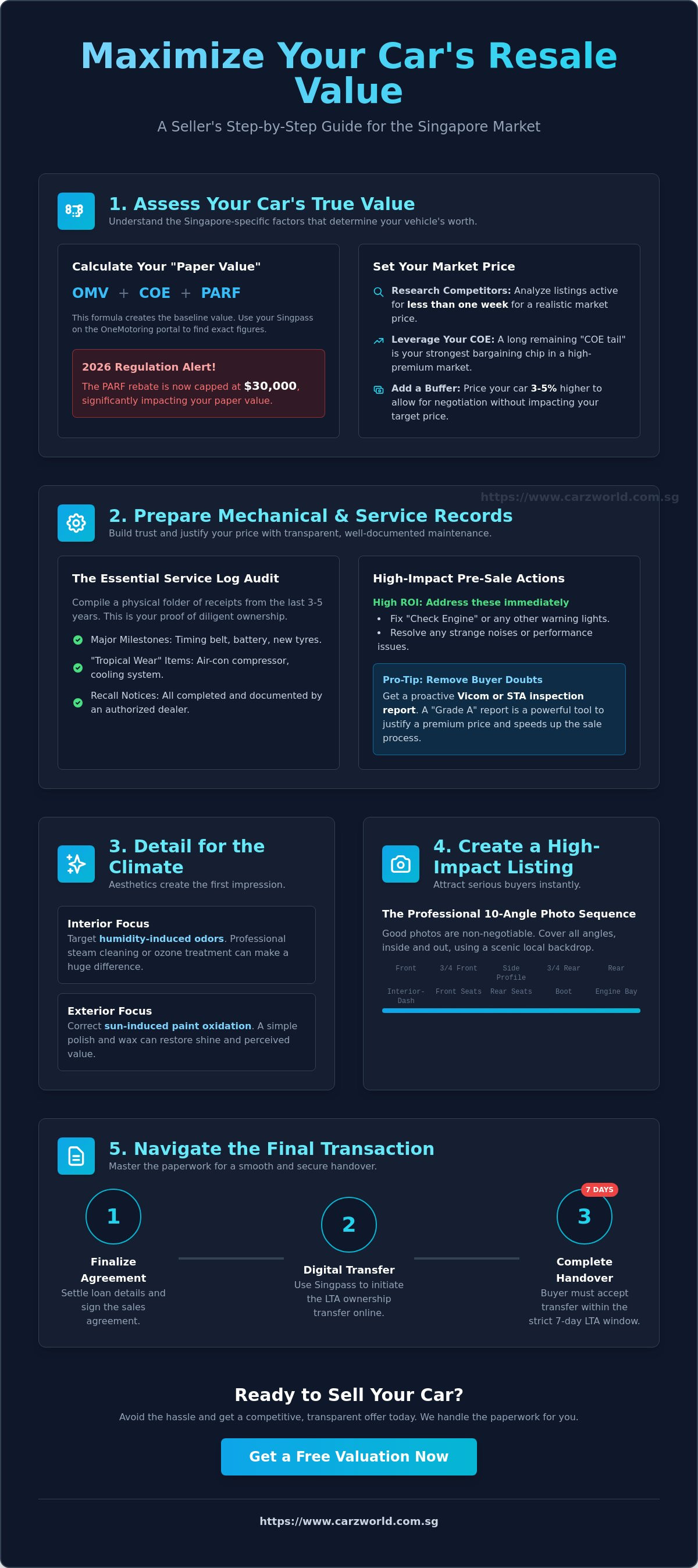
Understanding your vehicle's worth is the foundation of a successful transaction. In Singapore, this involves more than just looking at the odometer. You need to account for the Open Market Value (OMV), the Certificate of Entitlement (COE), and the Preferential Additional Registration Fee (PARF). These components create a baseline "paper value" that dictates your minimum asking price. When you learn how to prepare your car for sale, you must first apply car valuation principles to this local framework to avoid underpricing your asset.
The "COE tail" is a significant factor in 2026. Because COE premiums have remained high, the unused portion of your certificate is your strongest bargaining chip. Buyers are often looking for cars with a healthy balance of COE remaining to avoid the immediate hit of a new registration. Additionally, keep an eye on LTA's quarterly quota announcements. Selling just after a dip in COE prices can be challenging, as new cars become more attractive. It's often better to list your car when premiums are rising, making your pre-owned vehicle a more economical choice.
Calculating Your Paper Value vs. Market Value
Start by logging into the OneMotoring portal with your Singpass to check your exact PARF rebate. Remember that as of 2026, the PARF rebate for cars aged 9 to 10 years is capped at 5% of the ARF, with a maximum limit of $30,000. If your car's market value is close to this paper value, you might explore export cars options. However, if the car is in excellent condition, the local used cars market usually offers a higher return than the scrap value alone.
Researching Competitor Listings in Singapore
Browse major local portals to see what other sellers are asking for the same make, model, and year. Don't just look at the highest prices; focus on listings that have been active for less than a week. These represent the "fair market price" that actually triggers a sale. Highlight your unique selling points, such as a single-owner history or exceptionally low mileage. When you are ready to sell your car, include a small negotiation buffer of roughly 3% to 5% in your initial asking price. This allows you to give the buyer a "discount" during the viewing without hurting your bottom line.
Mechanical Preparation and Service History Documentation
Trust is the currency of the pre-owned market. While valuation sets the price, mechanical integrity closes the deal. Buyers in Singapore are notoriously risk-averse, often fearing hidden costs that might arise after the keys change hands. Learning how to prepare your car for sale requires you to act like a meticulous auditor. You're not just selling a machine; you're selling the confidence that it has been well-maintained. A car with a transparent history always commands a premium over a "mystery" vehicle with missing logs.
Addressing warning lights or strange engine noises before the first viewing is essential. A single "Check Engine" light can slash thousands off your asking price or end a negotiation instantly. If your car is still under a manufacturer warranty, ensure all recall works are completed and documented at an authorized dealer. This shows you're a responsible owner who values safety. Small investments in minor repairs often yield a high return by preventing buyers from using defects as leverage to lowball your price.
The Essential Service Log Audit
Compile every receipt from the last three to five years into a dedicated folder. Focus on major milestones like timing belt changes, battery replacements, and new tyres. In our humid climate, "tropical wear" items are critical selling points. A recent receipt for an air-con compressor replacement or a cooling system flush proves the car can handle Singapore's heat. If you've used digital logs, print them out. Skeptical private buyers prefer physical folders they can flip through during the test drive. This level of organization is a key part of how to prepare your car for sale effectively.
Pre-Sale Inspection: Vicom vs. STA
Don't wait for the buyer to suggest an inspection. Taking the initiative to get a Vicom or STA evaluation report early saves weeks of back-and-forth. A "Grade A" report justifies a higher asking price because it removes the fear of major mechanical failure. If the report identifies minor defects, you can choose to fix them or disclose them upfront to set a firm price. This transparency makes the eventual LTA vehicle ownership transfer process much smoother. Having your records organized allows you to sell your car with confidence and move on to your next vehicle without lingering liabilities.
Aesthetic Detailing for the Singapore Climate
Visual appeal is your most powerful marketing tool. While mechanical health is vital, most buyers decide whether they like a car within the first thirty seconds of seeing it. Singapore's relentless sun and high humidity create unique challenges that generic detailing guides often overlook. From oxidation caused by UV exposure to the "tropical musk" that develops in damp interiors, your car needs specific attention. When considering how to prepare your car for sale, aesthetic rejuvenation is about more than just a quick wash; it's about restoring that "showroom" feel that justifies a higher price point.
Don't neglect the engine bay. A clean engine suggests a well-maintained vehicle. While you shouldn't douse sensitive electronics in water, a simple degreasing and wipe-down of plastic covers can make a massive difference. Similarly, wheel and tyre grooming provides the finishing touch. Removing baked-on brake dust and applying a matte tyre dressing makes the car look professional and ready for its next owner. If your car looks this good, it will stand out among other used cars currently on the market.
Interior Rejuvenation and Odour Removal
Singapore's humidity is the enemy of a fresh-smelling cabin. Leather seats require a dedicated pH-neutral cleaner to remove oils and sweat without leaving a sticky residue. If your car has developed a damp smell, use an ozone treatment or a specialized odour neutralizer rather than heavy perfumes. Strong scents often signal to a buyer that you're trying to hide a leak or a mould issue. Clear out all personal clutter from the glovebox and door pockets. A minimalist interior allows the buyer to imagine themselves owning the car. This step is a critical part of any comprehensive checklist for preparing your car.
Exterior Paint and Glass Protection
The exterior takes the brunt of our tropical weather. Acid rain and hard water leave stubborn spots on the paint and glass that a standard wash won't remove. Use a clay bar and a light polish to restore the surface. This process also helps remove minor scratches and "door dings" common in our tight urban car parks. Once the paint is smooth, apply a fresh coat of wax or a ceramic sealant. This creates a deep gloss that makes the car "pop" in your listing photos and protects it during test drives. Ensure all windows and mirrors are streak-free. Crystal-clear glass improves visibility and enhances the overall perception of quality. By following these steps for how to prepare your car for sale, you're positioning your vehicle as a premium option.
Creating a High-Impact Listing and Photography
Once your vehicle is mechanically sound and aesthetically polished, you must capture that value through a professional digital presentation. In the competitive 2026 Singapore market, your online listing is the first point of contact. Buyers spend an average of two to four weeks researching before committing to a viewing. High-quality visuals and a transparent description don't just attract more clicks; they attract higher-quality leads. Learning how to prepare your car for sale effectively means moving beyond blurry car park photos and generic one-line descriptions.
Choose your location wisely. While a multi-storey car park is convenient, the harsh fluorescent lighting often creates unflattering reflections. Instead, drive to a scenic backdrop like the Tuas South industrial area or the greenery around Seletar Aerospace Park. These locations provide clean, neutral backgrounds that allow your car to be the star of the show. Be honest about the vehicle's condition. Mentioning a minor, non-structural scratch in the description builds immediate trust. It shows you're a reliable seller with nothing to hide, which often prevents awkward negotiations during the physical viewing.
The Professional Car Photography Checklist
Timing is everything. Aim for the "Golden Hour," which occurs shortly after sunrise or before sunset. The soft, directional light highlights the car's contours without the harsh shadows of the midday sun. Your "Hero Shot" sequence should include at least 10 essential angles:
- Front and rear three-quarter views.
- Direct side profile.
- Full dashboard and steering wheel.
- Front and rear seat condition.
- Odometer and infotainment screen while active.
- Engine bay and boot interior.
- Close-ups of all four alloy wheels and tyre tread depth.
Capturing the odometer proves your mileage claims, while clear shots of the tyre treads show the buyer they won't face immediate replacement costs.
Writing Descriptions that Sell
Structure your ad for quick readability on mobile devices. Use short sentences and bullet points to highlight key benefits. Keywords like "accident-free," "low mileage," and "parked under shelter" are highly effective in Singapore. Mentioning that the car was "serviced at agent" or has a "full service history" justifies a higher asking price. To screen for serious buyers, state your preferred viewing times and location clearly. This approach helps you avoid "lowballers" and focus on individuals who value the effort you've put into how to prepare your car for sale properly. If you want to skip the hassle of private listings, you can sell your car directly to us for a transparent and efficient valuation.
Navigating the Transaction and Paperwork
The final stage of your journey involves the legal transfer of ownership. In Singapore, this is a highly regulated process that requires precision. Since January 2026, all sellers must provide a standardized condition report during the transfer. This document protects both parties and ensures total transparency. Understanding how to prepare your car for sale technically means having your Singpass ready and your financial documents in order to avoid delays.
Handling the financial transition is often the most complex part. If you have an outstanding car loan, you must arrange for a full settlement with your bank. The sale proceeds are typically used to clear this balance before the LTA allows the transfer to proceed. Once the transaction is complete, don't forget to contact your insurance provider. You're entitled to a pro-rated refund on your premium and can request an NCD (No Claims Discount) resin statement for your next vehicle purchase.
LTA Ownership Transfer Step-by-Step
The transfer begins on the OneMotoring portal. You initiate the process using your Singpass, and the buyer receives a notification to accept the transfer. There's a strict seven day window for this acceptance. Before you hand over the keys, verify that the buyer’s insurance policy is already active. Additionally, ensure you've cleared any remaining balances on your IU (In-vehicle Unit) and removed your e-Tag. This prevents you from being charged for the new owner's tolls or parking fees. This level of detail is a vital part of how to prepare your car for sale in a professional manner.
The Hassle-Free Alternative: Selling to Carz World
Managing these logistical hurdles independently can be time-consuming. Many sellers find that the coordination between banks, insurers, and the LTA is a significant source of stress. A professional partner like Carz World eliminates these pain points. We manage the entire LTA paperwork trail and handle loan settlements directly with financial institutions. This ensures a seamless transition without the uncertainty of private negotiations or the risk of paperwork errors. Skip the stress and get a professional valuation for your car at Carz World. Our team provides an efficient, transparent experience that prioritizes your convenience and maximizes your returns.
Maximise Your Resale Value Today
Mastering the nuances of the Singapore market is the difference between a frustrating negotiation and a successful sale. You now have the essential tools to evaluate your vehicle’s paper value, restore its tropical worn surfaces, and navigate the OneMotoring transfer window with ease. These steps ensure your car stands out in a crowded digital marketplace. Learning how to prepare your car for sale is a strategic investment that pays dividends in the final transaction price.
If you prefer a more streamlined approach, our team is here to support you. As a trusted Singapore dealership with consistent 5-star reviews, we provide expert handling of all LTA paperwork and bank settlements. We offer transparent pricing with no hidden consignment fees, making your transition to a new vehicle completely seamless. Sell your car effortlessly with Carz World; get a free valuation today!
Taking the right steps today sets you up for a smooth and rewarding experience tomorrow. We look forward to helping you achieve the best possible outcome for your vehicle.
Frequently Asked Questions
How much more can I get if I sell my car privately in Singapore?
Selling privately usually yields a higher price, often 5% to 10% above dealer trade-in offers. You're essentially capturing the margin a dealer would otherwise take for their overhead and profit. However, this requires you to manage all viewings, handle the technicalities of how to prepare your car for sale, and coordinate the legal paperwork yourself. It's a trade-off between higher financial returns and the time invested in the process.
Do I need to settle my car loan before selling my vehicle?
You must settle your outstanding car loan in full before the LTA allows an ownership transfer. Banks require a "Full Settlement" to release the vehicle's digital log card. If you're selling to a dealership, they typically pay the bank directly and deduct that amount from your sale price. Private sellers must either use their own savings or the buyer's deposit to clear the balance before the final handover occurs.
What documents do I need to prepare for an LTA ownership transfer?
The primary requirement is a valid Singpass account for both the seller and the buyer to access the OneMotoring portal. You don't need physical log cards as all records are now digital. Ensure you have your vehicle's registration details ready and confirm the buyer has a valid insurance policy. Since January 2026, you also need to provide the mandatory standardized condition report to complete the transfer successfully.
Is it worth repairing scratches and dents before selling?
Minor aesthetic repairs like small scratches or door dings usually offer a high return on investment. These small flaws are often used by buyers as leverage to negotiate much larger discounts during a viewing. While major bodywork might not fully recoup its cost, focusing on low-cost visual improvements is a key part of how to prepare your car for sale. A pristine exterior suggests the car was well-loved and maintained.
What happens to my insurance NCD when I sell my car?
Your No Claims Discount (NCD) stays with you as an individual, not with the vehicle itself. When the sale is finalized and your policy is cancelled, the NCD is held by your insurer for typically 12 to 24 months. You can apply this discount to your next vehicle purchase to lower your premiums. If you aren't buying a replacement car immediately, request an NCD resin statement from your insurance provider for future use.
Can I sell my car if the COE is expiring in less than 6 months?
You can sell a car with a short COE balance, but your market will be limited to specific buyers. Most local drivers avoid cars with less than six months of COE unless they intend to renew the certificate. In these cases, your vehicle is often better suited for car export services or scrap. The price will be dictated by the remaining COE paper value and the 2026 PARF rebate caps.
How do I transfer my IU (In-vehicle Unit) to the new owner?
The IU stays with the car and isn't removed during the ownership change. You simply need to remove your physical NETS FlashPay or CashCard from the unit before the handover. Ensure any virtual payment accounts for ERP 2.0 are de-registered from your Singpass. The new owner will then register the existing IU under their own name once the LTA transfer is officially accepted on the OneMotoring website.
How long does the entire car selling process take in Singapore?
The timeline varies based on your chosen sales method. Private sales typically take two to four weeks as you wait for the right buyer and manage multiple viewings. Selling to a reputable dealership is much faster and can often be completed within 24 to 48 hours. Once a buyer is found, the actual digital transfer on OneMotoring is instantaneous, though the buyer has a strict seven day window to accept the request.
Disclaimer
This content is provided for general informational purposes only. Readers are encouraged to independently verify important information.