COE for Commercial Vehicles: The Complete 2026 Guide for Singapore Businesses

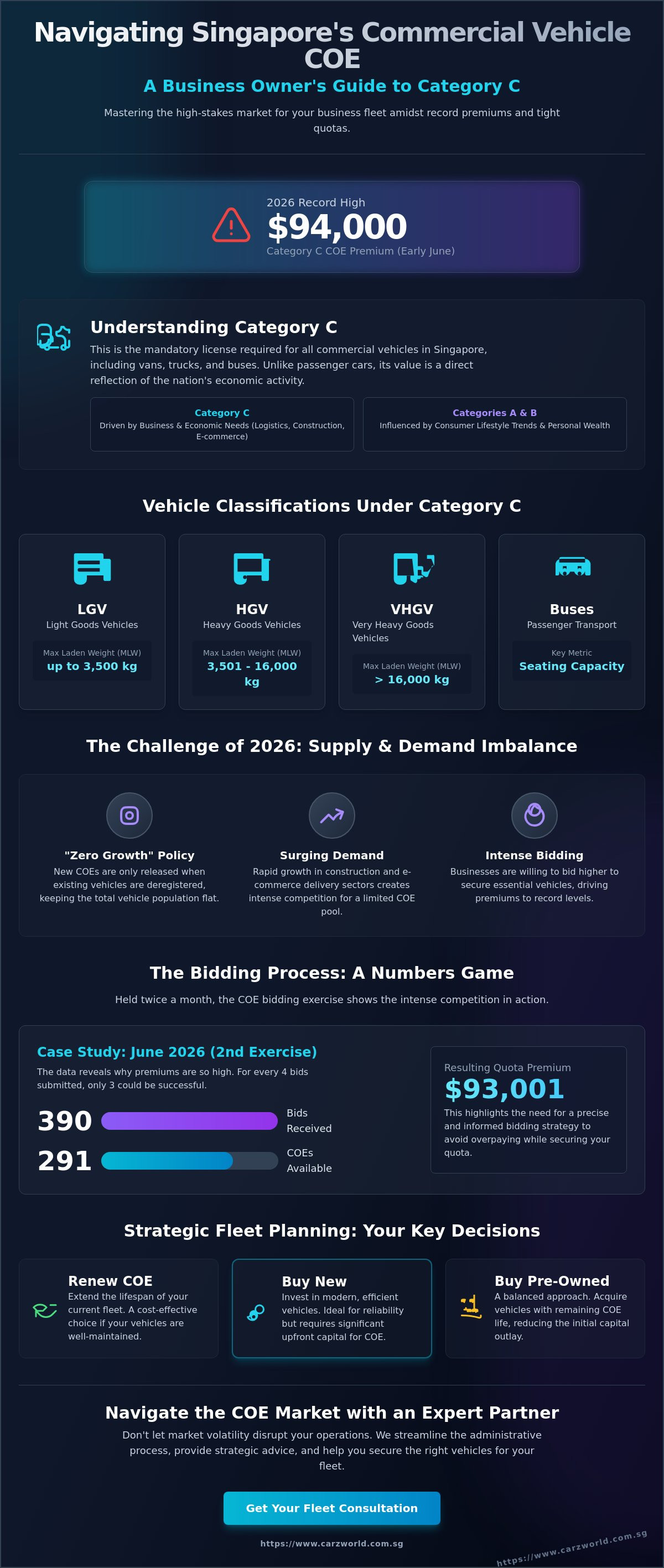
Did you know that Category C COE premiums reached a record high of $94,000 in early June 2026? For many business owners in Singapore, maintaining an efficient fleet has become a high-stakes balancing act between operational needs and rising overheads. You're likely feeling the weight of these record premiums while trying to keep your logistics moving without disrupting your vital cash flow.
This guide helps you master the current landscape for COE for commercial vehicles so you can make informed decisions for your business. We'll show you how to optimize your total cost of ownership and secure the vehicles you require through reliable bidding and renewal strategies. You'll get a clear look at the transition from the Early Turnover Scheme to the new Heavy Vehicle Zero Emissions Scheme (HVZES), along with practical tips for managing the 20-year statutory lifespan of your trucks and vans.
Key Takeaways
- Learn how Category C differs from passenger car categories and identify which specific vehicle types fall under this quota.
- Navigate the twice-monthly bidding cycle and calculate Prevailing Quota Premium (PQP) to manage COE for commercial vehicles renewals effectively.
- Compare the total cost of ownership for new, pre-owned, and renewed fleets to identify the most cost-effective path for your business operations.
- Explore financial incentives like the Early Turnover Scheme (ETS) and Additional Registration Fee (ARF) structures to reduce high upfront vehicle expenses.
- Discover how professional fleet partners streamline administrative paperwork and help you secure quality commercial vehicles in a volatile market.
Understanding Category C: The Essentials of Commercial Vehicle COE
Every business vehicle in Singapore requires a Certificate of Entitlement (COE) to legally operate on public roads. Category C is the mandatory license to operate business logistics in Singapore. This specific category covers a wide range of vehicles, including vans, trucks, and buses. Unlike passenger car categories (Cat A and B) which are often influenced by consumer lifestyle trends, COE for commercial vehicles is a direct reflection of the nation's economic activity. When businesses expand, the demand for transport and delivery services rises, which puts immediate pressure on the limited pool of available certificates.
The current market dynamics in 2026 show that commercial premiums are behaving quite differently from private car categories. High demand from the construction sector and the rapid growth of e-commerce delivery networks have created a competitive environment. Because these vehicles are essential tools for generating revenue, businesses are often more willing to bid higher to keep their operations running. This logistical necessity makes the Category C market particularly resilient, even when other vehicle categories might see a price dip.
To better understand this concept, watch this helpful video:
Vehicle Classifications Under Category C
Understanding which classification your vehicle falls into is vital for your long-term fleet strategy. Category C is broadly divided based on the Maximum Laden Weight (MLW) of the vehicle. Light Goods Vehicles (LGV) include vans and small trucks with an MLW of up to 3,500kg. Heavy Goods Vehicles (HGV) cover those between 3,501kg and 16,000kg, while Very Heavy Goods Vehicles (VHGV) exceed 16,000kg. Seating capacity also plays a role, especially for buses. Small buses are typically defined by having up to 15 seats, whereas private buses or larger excursion buses have higher capacities. Your choice of vehicle weight impacts your COE for commercial vehicles strategy because heavier vehicles often face different statutory lifespan rules and maintenance costs, which affects your total cost of ownership.
The 2026 Market Context
The first half of 2026 has been a period of significant volatility for business owners. Premiums hit a record high of $94,000 in early June, creating a challenging environment for fleet expansion. This price surge is compounded by the government's "Zero Growth" policy. Under this regulation, the total population of commercial vehicles is kept flat. New COEs are only released into the system when existing vehicles are deregistered. When it's time to sell or scrap an older vehicle, the replacement must compete for a very limited quota. This supply-and-demand imbalance is a primary driver of the current record-high costs, making strategic planning and expert advice more important than ever for maintaining your business margins.
The COE Bidding and Renewal Process for Businesses
The COE open bidding process occurs twice every month, typically starting on the first and third Monday. For business owners, these cycles are critical windows to secure or extend the right to operate their fleet. Missing a deadline or miscalculating a bid can lead to operational delays or unexpected costs. It's essential to stay ahead of the schedule to ensure your logistics remain uninterrupted and your fleet stays active on the road.
Managing a COE for commercial vehicles requires a clear understanding of the current market competition. During the second bidding exercise in June 2026, the Land Transport Authority received 390 bids for only 291 available certificates in Category C. This high level of demand pushed the Quota Premium to $93,001. When supply is tight, your bidding strategy must be precise to avoid overpaying while still securing the necessary quota for your business operations.
How to Bid for a New Category C COE
Bidding for a new certificate involves a structured three-step process designed for commercial entities. First, you must determine your ceiling price by analyzing your business ROI. You need to know exactly how much a new vehicle contributes to your bottom line to avoid bidding beyond your means. Second, you submit your bid through corporate internet banking or at an ATM. Most businesses prefer digital portals because they allow for quick adjustments during the bidding window. Third, you must monitor the "Current Quota Premium" throughout the three-day window. Since the price can spike in the final minutes, staying alert helps you decide whether to raise your bid or wait for the next cycle.
COE Renewal: 5 Years vs. 10 Years
If you already have a fleet, you can choose to renew your existing certificates by paying the Prevailing Quota Premium (PQP). The PQP is the moving average of the COE for commercial vehicles over the previous three months. For June 2026, the 10-year PQP was $82,868, but this rate increased to $88,368 for July 2026. You generally have two choices for renewal:
- 5-Year Renewal: You pay 50% of the PQP. This is a one-time extension. Once these five years are up, you cannot renew the vehicle again and must deregister it.
- 10-Year Renewal: You pay 100% of the PQP. This option allows for subsequent renewals every 10 years, provided the vehicle hasn't reached its statutory limit.
Statutory lifespan is a major factor in this decision. Singapore law mandates that commercial vehicles must be deregistered after 20 years of service. If your truck or van is approaching this age, a 10-year renewal might not be possible. You should also be aware of late renewal penalties. Failing to pay the PQP before your current COE expires results in heavy fees, and if left too long, the LTA will automatically deregister the vehicle. If you're weighing the cost of renewal against a replacement, exploring our latest brand new cars and commercial models can help you find the most efficient path forward.
Strategic Fleet Planning: Renew, Buy New, or Buy Used?
When COE for commercial vehicles reaches record heights, your fleet strategy becomes a critical financial decision. You aren't just choosing a truck; you're managing a major business asset that impacts your daily margins. Business owners must decide whether the reliability of a brand new vehicle justifies the high upfront cost or if renewing an existing certificate offers a better path to preserving cash flow. Making the right choice requires a methodical look at your long-term operational needs and the current market volatility.
Comparison Framework: New vs. Used vs. Renewal
Evaluating the Total Cost of Ownership (TCO) helps you see beyond the initial sticker price. Each option carries different implications for your balance sheet and maintenance schedule.
| Option | Initial Outlay | Maintenance Costs | Lifespan |
|---|---|---|---|
| New Vehicle | Highest | Lowest | Full 20 years |
| Used Vehicle | Moderate | Moderate | Remaining COE |
| COE Renewal | Lowest | Highest | 5 or 10 years |
Depreciation analysis shows that used commercial vehicles often have a lower "paper loss" because the steepest drop in value occurs in the first few years of registration. While a new Category C vehicle requires a full Quota Premium payment of $93,001 plus the vehicle cost, a 5-year PQP renewal for June 2026 costs only $41,434 without the need for a new vehicle purchase. If you're looking for a balance between reliability and affordability, explore Carz World Pte Ltd's used vehicle collection for cost-effective options that are ready for immediate deployment.
Assessing Your Current Fleet Health
Before committing to a renewal, you must identify your "Maintenance Threshold." This is the point where your annual repair bills and parts replacement costs begin to exceed the value of a PQP renewal. If your van spends more time in the workshop than on the delivery route, the hidden cost of operational downtime is likely eroding your profits. Keeping an aging vehicle might seem cheaper on paper, but the loss of productivity and potential missed deliveries can be far more expensive than upgrading to a newer model.
Reliability is paramount for business logistics, especially during peak seasons. For short-term project-based needs or when you're waiting for a new COE for commercial vehicles to be secured, consider the strategic use of rental cars and commercial vans. This approach keeps your operations flexible without the long-term burden of high vehicle ownership costs during volatile market periods, ensuring your business stays mobile regardless of quota fluctuations.
Financing and Incentives: Lowering Your Commercial Vehicle Costs
Managing the high upfront costs of a fleet requires more than just a large budget. You need to understand the underlying taxes and incentives that shape the final price tag. Two key figures are the Open Market Value (OMV) and the Additional Registration Fee (ARF). While the OMV represents the actual price paid for the vehicle, the ARF is a tax based on a percentage of that OMV. For COE for commercial vehicles, these costs are fixed, but strategic financing and government schemes can significantly reduce your total cash outlay.
The Transition from ETS to Modern Incentives
For many years, the Early Turnover Scheme (ETS) was the primary way for businesses to save by transferring "unused" COE from old vehicles to new ones. As of 2026, the landscape has shifted significantly. The ETS for light commercial vehicles ended on March 31, 2025, and the version for heavy vehicles concluded on December 31, 2025. Today, businesses look toward the Heavy Vehicle Zero Emissions Scheme (HVZES) for incentives on cleaner heavy goods vehicles. For lighter fleets, the Commercial Vehicle Emissions Scheme (CVES) remains active until March 31, 2027, offering rebates for low-emission vans that help offset the high cost of COE for commercial vehicles.
Business Financing Strategies
Most SMEs in Singapore rely on financing to maintain their cash flow. You generally choose between Hire Purchase, where you eventually own the vehicle, and Finance Leases, which may offer different tax treatments. Current interest rates for new commercial vehicle loans typically range from 2.99% to 4.50% per annum. While banks offer competitive rates, in-house financing is often faster for businesses that need to deploy vehicles quickly. You can also generate immediate capital by selling your old vehicle to fund your new acquisition.
Tax benefits also play a major role in your fleet's affordability. Under Section 19 or 19A of the Income Tax Act, you can claim capital allowances to write off the cost of your business vehicles against your taxable income. Businesses can also explore Section 14Q deductions for certain renovation or transport-related expenses. These tools, combined with a 9% GST claimable for GST-registered entities, make fleet ownership more manageable. If you're ready to optimize your business transport costs, view our full range of commercial solutions to find the right fit for your budget.
Why Carz World is the Preferred Partner for Singapore Business Fleets
Choosing the right partner makes the difference between a fleet that drains your capital and one that drives your growth. Carz World Pte Ltd stands as a dependable and experienced expert in the Singapore automotive market. We understand that managing the COE for commercial vehicles is a complex logistical process that requires precision and market insight. Our team focuses on making this experience seamless so you can concentrate on your core business operations without worrying about the next bidding cycle.
The 2026 market demands flexibility. Our expertise spans both parallel imports and high-quality pre-owned commercial vehicles, giving you access to a broader range of inventory than traditional dealerships. We don't just sell vehicles; we provide a structured path to ownership that respects your budget. By leveraging our established export network, we help you secure better trade-in values for your aging trucks and vans. This practical approach provides the necessary capital to offset record-high premiums while maintaining a modern, efficient fleet.
Expertise You Can Trust
Our professional, customer-centric approach is designed to build your confidence at every step. We prioritize transparency over high-pressure tactics, ensuring you have the data needed to make informed choices. For businesses that require the latest technology and fuel efficiency standards, we offer a curated selection of brand new cars and commercial models. We're highly organized and detail-oriented, which means we handle all the administrative burdens of COE for commercial vehicles, from initial bidding to complex renewal paperwork.
Customization is at the heart of what we do. We serve a diverse range of clients, from small business owners needing a single reliable van to large logistics firms managing extensive fleets. Our one-stop service includes competitive financing and comprehensive insurance, so you don't have to coordinate with multiple vendors. We focus on long-term reputation and honest service, ensuring that your logistical processes feel fluid and positive from the moment you step into our showroom.
Start Your Fleet Transformation Today
We invite you to visit our showrooms at Ubi or Alexandra to see our inventory firsthand. Our specialists are ready to discuss your specific needs and help you navigate the 20-year statutory lifespan rules and PQP calculations. We value your time and aim to make every transaction efficient and straightforward. The Carz World Pte Ltd promise is built on reliability and a deep understanding of the Singapore business environment. Contact our commercial vehicle specialists today to secure the best transport solutions for your business.
Take Command of Your Business Logistics in 2026
Managing a fleet requires more than just capital; it demands foresight in a shifting regulatory environment. You've seen how to evaluate the total cost of ownership and leverage tax incentives to protect your business margins. Whether you choose to renew an existing quota or upgrade to a newer model, your strategy for COE for commercial vehicles should align with your long-term operational goals. Making informed decisions now ensures your logistics remain robust even as market conditions fluctuate.
Carz World Pte Ltd is here to support your journey. We're trusted by hundreds of Singapore SMEs for our professional handling of LTA paperwork and financing. As a winner of multiple service excellence awards, we focus on making complex logistics feel like a seamless experience for every client. Our team is dedicated to providing the clarity and reliability you need to succeed. Browse our latest commercial vehicle inventory and secure your fleet today. Let's build a more resilient business fleet for the years ahead.
Frequently Asked Questions
What is the statutory lifespan of a commercial vehicle in Singapore?
All commercial vehicles in Singapore have a maximum statutory lifespan of 20 years. Once a vehicle reaches this limit, it must be deregistered and removed from the road. This rule is strictly enforced by the Land Transport Authority to ensure that older, less efficient vehicles are phased out of the national fleet regularly.
Can I renew the COE for my van for only 5 years?
You can choose a 5-year renewal by paying 50% of the Prevailing Quota Premium (PQP). It's important to remember that this is a one-time renewal option. After these five years expire, you won't be able to renew the COE for commercial vehicles again and must deregister the van immediately.
Is Category C COE transferable like Category E?
No, Category C certificates are non-transferable and must be registered to a specific vehicle and owner. Unlike Category E certificates, which can be traded before they are used, a Category C quota is tied to your business entity from the moment the bid is successful. This prevents speculative trading in the commercial sector.
How is the PQP calculated for commercial vehicle COE renewal?
The Prevailing Quota Premium (PQP) is the moving average of the Quota Premiums (QP) from the bidding exercises over the previous three months. For example, the July 2026 PQP of $88,368 was determined by averaging the results from April, May, and June. This rate is updated at the start of every month.
What happens if I don’t renew my commercial COE before it expires?
Your vehicle is automatically deregistered the moment its COE expires. If you miss the deadline, you may still renew within a one-month grace period, but you'll have to pay a heavy late renewal fee. Failing to renew within that month means the vehicle can no longer be driven and must be scrapped.
Are electric vans eligible for the same Category C COE?
Electric vans are classified under Category C, but they often qualify for specific financial incentives. While you still require a COE for commercial vehicles, schemes like the Commercial Vehicle Emissions Scheme (CVES) provide rebates for low-emission models. These incentives help businesses manage the higher upfront costs of adopting greener technology.
Can a business bid for its own COE or must it go through a dealer?
Any business entity can bid for its own COE through corporate internet banking or at designated ATMs. While many SMEs choose to let a dealer handle the paperwork for convenience, you have the right to manage your own bids. This requires a valid bank account and a clear understanding of the bidding window.
What are the benefits of the Early Turnover Scheme (ETS) in 2026?
The Early Turnover Scheme is no longer available in 2026 as it has been discontinued. The scheme for light commercial vehicles ended on March 31, 2025, and the version for heavy vehicles ended on December 31, 2025. Businesses should now explore the Heavy Vehicle Zero Emissions Scheme (HVZES) for current fleet replacement incentives.
Disclaimer
This content is provided for general informational purposes only. Readers are encouraged to independently verify important information.
In Same Category
- Scrapping Your Car Before 10 Years in Singapore: What Happens?
- Calculating the Breakeven Point for COE Renewal in Singapore
- Financial Checklist Before Committing to a Car Purchase in Singapore (2026)
- COE Renewal Conditions and Eligibility in Singapore: 2026 Guide
- Balloon Scheme Car Loan in Singapore: Pros and Cons for 2026
Related by Tags
- Used Cars for Sale in Tampines: 2026 Buyer's Guide
- Car Downpayment vs Monthly Instalment in Singapore: The 2026 Budgeting Guide
- Car Loan Singapore: The Complete 2026 Guide to Financing Your Vehicle
- How Much Salary to Afford a Car in Singapore: 2026 Affordability Guide
- Buying a Used Car in Singapore: 2026 Ultimate Guide
- What is PARF? The Ultimate Guide to Singapore’s Car Rebate System
- Mercedes-Benz EQB 250+ Review: The Ultimate 7-Seater Family EV in Singapore
- Long Term Car Rental Singapore: 2026 Definitive Guide
- How to Buy a Car in Singapore: The Ultimate 2026 Step-by-Step Guide
- Second Hand Hybrid Cars Singapore: The 2026 Value & Inspection Guide
- Cheapest Car in Singapore: The 2026 Guide to Affordable Ownership
- Parallel Import Cars Singapore: 2026 Buyer’s Guide
- Suzuki Swift Singapore: The Ultimate Smart-Money Hatchback Guide 2026
- The Ultimate Toyota Alphard Singapore Guide: Luxury & Performance in 2026
- Sell My Car in Singapore (2026): Complete Guide
- Nissan Qashqai Singapore: Ultimate Buyer’s Guide 2026
- The Ultimate Used Car Buying Guide for Singapore in 2026
- Used Honda Singapore: The Ultimate Buyer’s Guide for 2026