COE Price Trend Analysis 2026: Is Now the Best Time to Buy a Car in Singapore?

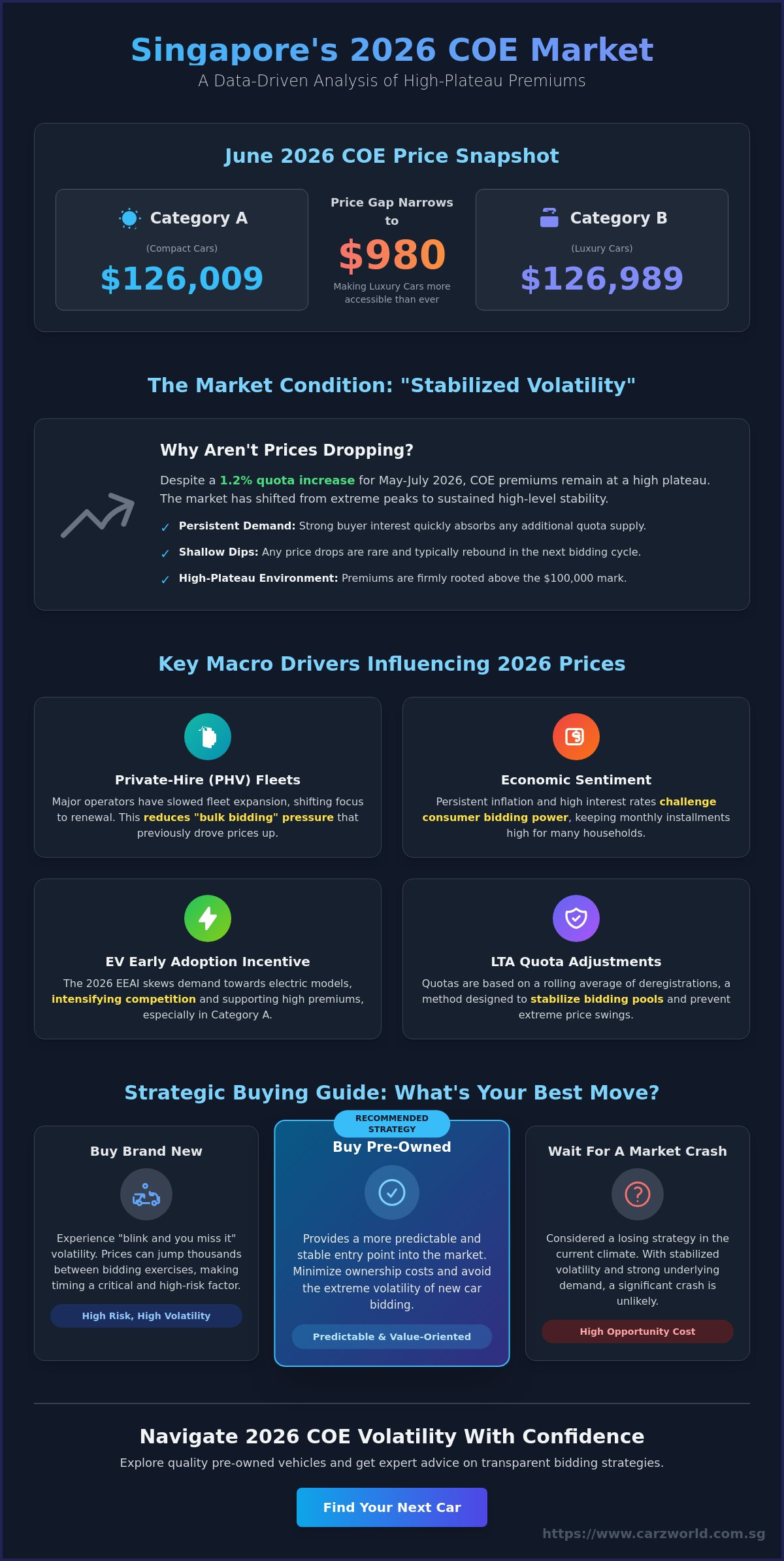
Did you know that as of June 2026, the price gap between a compact car and a luxury vehicle has narrowed to just $980? With Category A premiums sitting at $126,009 and Category B at $126,989, the traditional logic of car buying in Singapore is shifting. This COE price trend analysis 2026 examines why premiums remain at historic highs despite a 1.2% increase in the quota announced for the May to July period. It's clear that higher supply isn't always leading to the significant price drops many buyers hoped to see.
We understand the pressure of managing high monthly installments and the uncertainty surrounding quota increases. It's difficult to plan when depreciation concerns and high premiums make every decision feel like a financial risk. This article provides a comprehensive, data-driven look at 2026 market movements to help you decide between buying new, going pre-owned, or waiting for a dip. We'll break down the primary price drivers and share a clear strategy to minimize your ownership costs, giving you the confidence to choose the right vehicle for your lifestyle and budget.
Key Takeaways
- Understand why 2026 is defined by "stabilized volatility" where increased quota supply is offset by persistent market demand.
- Use our COE price trend analysis 2026 to identify why premiums have remained resilient and how to navigate the narrowing gap between car categories.
- Evaluate the impact of economic sentiment and private-hire fleet trends on your potential monthly installments and long-term depreciation.
- Learn why waiting for a significant market crash may be a losing strategy and how to use a decision matrix to time your purchase.
- Discover how to minimize ownership costs by exploring quality pre-owned vehicles and transparent bidding strategies.
The 2026 COE Landscape: Analyzing the Current Market Trend
The 2026 automotive market in Singapore is currently defined by a high-plateau pricing environment. Even with marginal increases in supply, premiums have stayed remarkably high. This COE price trend analysis 2026 highlights how the market has shifted from the extreme peaks of previous years to a sustained, high-level stability. While many car buyers expected a significant correction, the Certificate of Entitlement (COE) system continues to see strong demand that absorbs any additional quota. It's a market where "waiting for a drop" has often resulted in paying more just a few weeks later.
To better understand the current market momentum and how technical indicators are shaping the 2026 landscape, watch this helpful video:
The first half of 2026 showed that premiums are firmly rooted above the $100,000 mark. This resilience is partly due to short-term spikes driven by major automotive events. For instance, demand often surges following the Car Expo as dealers rush to secure COEs for new orders. This creates a "blink and you miss it" volatility where prices can jump several thousand dollars between bidding exercises. This pattern makes timing a critical factor for anyone looking at brand new cars, as market sentiment can shift overnight based on a single weekend's sales performance.
Q1 and Q2 2026 Performance Review
During the first two quarters of 2026, average premiums remained significantly higher than historical averages, though they haven't quite touched the absolute records seen in late 2024. The June 4, 2026, bidding exercise was a standout moment for analysts. Category A premiums reached $126,009, while Category B hit $126,989. This narrowed the gap between small and large cars to just $980. Category A has shown intense upward resistance because many buyers are pivoting toward more efficient models and electric vehicles to manage their total ownership costs. Dips in 2026 have been rare and shallow, usually lasting only one bidding cycle before prices rebound.
The Role of LTA Quota Adjustments
The Land Transport Authority (LTA) continues to use a refined distribution method to manage supply. For the May to July 2026 period, the quota saw a modest 1.2% increase. However, the correlation between vehicle deregistrations and bidding pools remains tight. If fewer owners scrap their cars, the supply for the next quarter stays constrained. The 2026 quota supply logic relies on a rolling average of deregistrations to stabilize bidding pools and prevent extreme price fluctuations. For those seeking better value during these high-price periods, exploring pre-owned cars often provides a more predictable entry point than the volatile new car market.
Key Macro Drivers Influencing COE Prices in 2026
Understanding the broader economic forces is essential for a thorough COE price trend analysis 2026. While private car ownership remains a primary goal for many, macro drivers like the Private-Hire Vehicle (PHV) sector have shifted. In 2026, PHV fleet expansion has notably slowed compared to previous years. Most major operators have reached their desired scale, focusing now on fleet renewal rather than aggressive growth. This shift has removed some of the "bulk bidding" pressure that previously drove premiums upward. However, consumer bidding power is currently being tested by persistent inflation and high interest rates, which keep monthly installments at challenging levels for many households.
Another factor providing a "floor" for prices is the 3-year lock-in rule for certain incentives. This regulation prevents a sudden flood of vehicles into the used market, effectively managing supply and preventing a market collapse. Simultaneously, the 2026 EV Early Adoption Incentive (EEAI) continues to skew demand. As more drivers pivot toward electric models to save on long-term fuel costs, Category A has seen intense competition. This is reflected in recent COE price movements, where Category A prices have stayed remarkably close to Category B levels, with a difference of less than $1,000 in early June.
The Heavy Vehicle Zero Emissions Scheme
Category C premiums reached an all-time high of $94,000 on June 4, 2026. This surge is largely driven by the Heavy Vehicle Zero Emissions Scheme, which offers a $40,000 cash grant for businesses adopting electric trucks and buses. This incentive has created a ripple effect across the market. When Category C supply is tight, businesses often bid in Category E (Open), further inflating prices across the board. Private buyers now find themselves competing directly with corporate logistics fleets for the same limited pool of certificates, which keeps the overall market floor high.
Dealer Bidding Behaviour and Speculation
The way dealers approach the bidding floor has also evolved. Many authorised dealers and parallel importers are moving away from traditional "COE guaranteed" packages. These packages often require higher upfront costs to account for market volatility. Instead, "non-guaranteed" options are gaining popularity. These allow budget-conscious buyers to wait for a potential dip without committing to a locked-in premium. Speculative bidding remains common in the final minutes of each exercise, often causing prices to jump unexpectedly. If you're looking for a more stable path to ownership, browsing our pre-owned cars can help you avoid the unpredictability of the bidding floor. A careful COE price trend analysis 2026 suggests that while macro factors are complex, choosing a reliable partner makes the process much more manageable.
Category Breakdown: Comparing Cat A, B, and E Trends
The June 4, 2026 bidding exercise highlighted a significant shift in the market structure. The price difference between Category A and Category B narrowed to a mere $980. This convergence is a central theme in our COE price trend analysis 2026. When the gap is this small, many buyers who originally planned for a compact car find themselves considering larger, more powerful models. Category E continues to lead the market at $129,000, serving as a bellwether for sustained luxury demand. For those looking to renew a 10-year COE, the Prevailing Quota Premium (PQP) for June 2026 sits at $118,357 for Category A and $121,218 for Category B.
Category A: The Mass Market Resilience
Category A has remained incredibly resilient throughout the first half of the year. This is largely due to the influx of high-quality electric vehicles from brands like BYD and the continued popularity of reliable hybrids from Toyota. These models offer a blend of efficiency and technology that appeals to the mass market. Additionally, several luxury manufacturers have adjusted their model line-ups to fit into this category, further driving up competition. We expect Category A prices to remain firm for the rest of 2026 as more households prioritize fuel-efficient brand new cars to offset high ownership costs.
Category B and E: The Luxury Segment Shift
Category B saw a slight downward slant in early 2026, though it remains well above the $120,000 mark. High-end EV brands like Tesla and BMW are the primary drivers in this segment. While demand is steady, it isn't quite as frenetic as the mass-market surge seen in Category A. Category E remains the most volatile and expensive category. Because it can be used for any vehicle type except motorcycles, dealers often use it to secure cars quickly for buyers who don't want to wait. This unpredictability makes it a risky category for individual bidders, but it's a useful indicator of where the market might head in the next quarter.
Beyond passenger cars, other segments are hitting new psychological barriers. Category C for commercial vehicles reached an all-time high of $94,000 in early June. Motorcycles in Category D are currently holding steady at $10,000. These figures show that the high-cost environment isn't limited to private cars. If these premiums feel prohibitive, exploring our pre-owned cars is a practical way to bypass the current bidding volatility while still securing a quality vehicle. Our team focuses on providing a transparent experience, ensuring you understand exactly how the current PQP and COE trends affect your purchase price.
Strategic Buying Guide: Should You Buy Now or Wait?
Deciding when to enter the market involves more than just checking the latest bidding results. Your personal decision matrix should balance your immediate need for transport against the current COE price trend analysis 2026. Many drivers are waiting for a significant "COE crash" to return to pre-2023 levels. However, the data suggests this is a losing strategy. With only a 1.2% increase in quota for the May to July period and demand consistently exceeding supply (4,920 bids were received for just 3,215 COEs on June 4), the market floor remains high. Waiting too long often means facing even higher premiums if fleet renewals or new model launches trigger another surge.
Identifying "sweet spots" in the bidding calendar can save you thousands. Historically, post-holiday lulls or the weeks immediately following major car shows can see a slight softening in bidding aggression. If you notice a "down-slanting" trend in Category B, it's often an ideal time to lock in a purchase before the next spike. This methodical approach helps you avoid the emotional stress of peak-price bidding cycles. If you're ready to see how these strategies apply to real-world options, explore our current inventory to find a vehicle that fits your budget.
The Case for Pre-Owned Cars in 2026
For many, pre-owned cars act as the ultimate hedge against high COE depreciation. In the current market, it's essential to calculate the "Paper Value" (the remaining PARF rebate) versus the "COE Value" (the unused portion of the premium). Five-year-old used cars have emerged as the "value play" of 2026. These vehicles have already moved past their steepest depreciation curve. By choosing a well-maintained second-hand model, you're essentially buying into a lower PQP environment from years prior, which protects your capital if prices eventually soften.
Navigating the New Car Market
There are still compelling reasons to opt for brand new cars despite the $126,000+ premiums. If you're moving toward an electric vehicle, the 2026 EV Early Adoption Incentive (EEAI) and other green rebates can significantly offset the high COE cost. Modern engines and EVs also offer superior fuel efficiency, which reduces your long-term operating expenses. When dealing with parallel importers, don't hesitate to negotiate for better COE rebates or "off-peak" bidding packages. A thorough COE price trend analysis 2026 shows that while the entry price is high, the right technology can make the total cost of ownership much more manageable over a ten-year period.
How Carz World Pte Ltd Helps You Navigate 2026 COE Volatility
Managing the complexities of the Singapore car market requires more than just a passing interest in the news. It demands a partner who provides transparent bidding updates and expert advice. Our COE price trend analysis 2026 helps you understand the data, but our team helps you apply it to your specific financial situation. Carz World Pte Ltd focuses on providing a clear path to ownership, whether you're looking for a brand new model or a high-quality pre-owned vehicle. Our inventory is carefully selected and priced with current PQP-adjusted trends in mind to ensure you receive fair value in a high-premium environment.
We recognize that many drivers feel the pressure of high monthly installments. To address this, we offer flexible financing and insurance options that help you manage the total cost of ownership. If you currently own a vehicle and want to capitalize on high resale values, our professional car consignment and sales service is an ideal solution. We help you exit your current vehicle at a competitive price, providing the capital you need for your next move. This methodical approach ensures that every transaction is fluid and positive for our clients.
Expert Guidance and Trustworthy Service
Our customer-centric approach is built on a foundation of trust and social proof. We invite you to read our numerous client testimonials, which highlight the dedication of our experienced staff. Team members at Carz World Pte Ltd are frequently mentioned in reviews for their ability to guide first-time buyers through the bidding process. We're committed to providing straightforward, jargon-free advice. By integrating a COE price trend analysis 2026 into your buying strategy, we help you make decisions based on facts rather than market panic. We believe in building long-term reputations through honest, professional service.
Comprehensive Automotive Solutions
Carz World Pte Ltd caters to every segment of the market. From robust commercial vehicles for your business to luxury sedans for your family, we cover all COE categories. If you aren't ready to commit to a purchase, our car rental options provide a flexible alternative. This allows you to stay mobile while waiting for a more favorable window in the 2026 market. We're organized and detail-oriented, making sure the logistical process feels seamless for you. Visit Carz World Pte Ltd at our showrooms in Ubi or Alexandra for a personalized consultation. Our team is ready to help you find the most cost-effective way to get behind the wheel.
Taking Your Next Step in the 2026 Car Market
Our COE price trend analysis 2026 shows that while premiums remain at historic levels, strategic buying is still possible. The narrowing gap between Category A and B offers a unique opportunity for those looking to upgrade to larger models without the typical price penalty. Additionally, high-quality pre-owned vehicles provide a reliable way to manage depreciation in a supply-constrained environment. By focusing on data rather than market panic, you can find a vehicle that meets both your lifestyle needs and your budget requirements.
Navigating these choices is easier with a partner you can trust. With over 100+ positive client testimonials, we take pride in our reputation for professional and honest service. Whether you're interested in our parallel import expertise or browsing our curated pre-owned selection, our experienced team at Ubi and Alexandra is ready to help. We focus on making complex logistical processes feel seamless for every customer, ensuring you have total confidence in your purchase. Browse our 2026 inventory and find your next car today. You don't have to face market volatility alone; we're here to ensure your car ownership journey is both positive and rewarding.
Frequently Asked Questions
Will COE prices drop in late 2026?
Significant drops are unlikely for the remainder of the year. While the LTA increased the quota by 1.2% for the May to July period, demand continues to outpace supply. In the June 4 exercise, 4,920 bids were received for only 3,215 available certificates. This COE price trend analysis 2026 suggests that unless bidding aggression from private-hire fleets and EV buyers eases, premiums will stay on a high plateau.
Is it better to buy a used car or a new car when COE is high?
Used cars are often a better financial hedge when premiums are at record highs. Buying a pre-owned vehicle allows you to benefit from the lower COE or PQP values of previous years. This reduces your total capital outlay and minimizes the impact of depreciation compared to a brand new car. It's a practical strategy for those who need a vehicle now but want to avoid the current $126,000 bidding floor.
How does the 2026 quota supply affect my monthly car loan?
The constrained quota supply keeps premiums high, which directly increases the total purchase price of your vehicle. Since the loan amount is based on the car's price inclusive of COE, higher premiums result in larger monthly installments. Borrowers must also consider current interest rates. Even with the 1.2% quota increase, the sustained high prices mean most buyers will face monthly payments significantly higher than those seen three or four years ago.
What is the current PQP for COE renewal in 2026?
The Prevailing Quota Premium (PQP) varies each month based on the moving average of the previous three months. For June 2026, the PQP for Category A is $118,357, while Category B is $121,218. For commercial vehicle owners, the Category C PQP is $82,868. These figures are essential for anyone planning to renew their existing 10-year COE rather than purchasing a new vehicle in the current market.
Can I still get a car with a COE below $100,000 in 2026?
It's currently impossible to find a passenger car with a premium below $100,000. As of June 2026, Category A and B prices have both stabilized well above $126,000. Only Category C for commercial vehicles ($94,000) and Category D for motorcycles ($10,000) remain under the six-figure mark. Buyers looking for lower entry costs should consider quality pre-owned vehicles that were registered when premiums were more affordable.
How do EV incentives help offset high COE premiums this year?
EV incentives like the 2026 EV Early Adoption Incentive (EEAI) provide cash rebates that lower the car's additional registration fee (ARF). While these incentives don't reduce the COE premium itself, they lower the total cost of the vehicle. This makes electric models more competitive against internal combustion cars. Using a COE price trend analysis 2026 helps you determine if the long-term fuel savings and rebates justify the high upfront premium.
What happens to my car value if COE prices collapse?
If premiums fall sharply, the resale value of existing cars typically decreases. This happens because the cost of a brand new replacement vehicle becomes lower, which pushes down the market price for used cars. However, the high demand seen in 2026 makes a total collapse unlikely. Most experts believe prices will remain stable, protecting the paper value of vehicles purchased at current rates for the foreseeable future.
Why is Category A COE sometimes higher than Category B in 2026?
Category A prices are rising because of intense competition for more efficient models and small EVs. In June 2026, the gap between Category A and B narrowed to just $980. This convergence occurs when many luxury brands introduce models that fit into Category A specifications. As more buyers pivot toward these models to manage ownership costs, the increased bidding pressure in Category A can drive its premium close to Category B.
Disclaimer
This content is provided for general informational purposes only. Readers are encouraged to independently verify important information.
In Same Category
- Used Toyota Camry Singapore: The 2026 Buyer’s Guide to Value & Reliability
- SGCarmart: 2026 Essential Guide to Used Cars in Singapore
- Sell My Car Singapore: The 2026 Ultimate Guide to Getting the Best Value
- Toyota Estima Price Singapore 2026: The Complete Financial Guide
- Toyota Voxy vs Toyota Estima: Which Family MPV Reigns Supreme in Singapore?
Related by Tags
- Used Toyota Camry Singapore: The 2026 Buyer’s Guide to Value & Reliability
- SGCarmart: 2026 Essential Guide to Used Cars in Singapore
- Sell My Car Singapore: The 2026 Ultimate Guide to Getting the Best Value
- Toyota Estima Price Singapore 2026: The Complete Financial Guide
- Toyota Voxy vs Toyota Estima: Which Family MPV Reigns Supreme in Singapore?
- Buying a Used Honda in Singapore: The Ultimate 2026 Guide to Value and Reliability
- Car Depreciation in Singapore: The Ultimate 2026 Guide to Smart Ownership
- How to Buy a Car in Singapore: The Ultimate 2026 Step-by-Step Guide
- Buying a Used Toyota in Singapore: The Ultimate 2026 Value Guide
- COE Renewal Singapore: The Ultimate 2026 Guide to PQP, Costs, and Strategy
- The Ultimate Guide to Buy New Commercial Vehicles in Singapore (2026 Edition)
- Checking for Accident Damage on a Car: The Ultimate 2026 Singapore Inspection Guide
- Parallel Import New Cars Singapore: The 2026 Ultimate Buying Guide
- How to Get a Fair Trade-In Offer for Your Car in Singapore: 2026 Guide
- Selling a Car with an Outstanding Loan in Singapore: The 2026 Complete Guide
- Car Consignment vs Direct Sale in Singapore: The 2026 Seller’s Guide
- How to Avoid Overpaying for a Used Car in Singapore (2026 Guide)
- 15 Practical Saving Tips for Car Buyers in Singapore (2026 Edition)
- Total Cost of Ownership Calculator: The Real Cost of a Car in Singapore (2026)
- When to Replace Your Car in Singapore: The 2026 Strategic Guide
- Used Car Warranty in Singapore: The Ultimate Guide to Protecting Your Investment (2026)
- Buying Chinese Cars in Singapore: The Ultimate 2026 Buying Guide
- Common Problems with Used Cars: A Singapore Buyer’s Guide to Avoiding Lemons
- The Importance of Car Service History: Protecting Your Investment in 2026
- Financial Planning for Buying a Car in Singapore: A 2026 Roadmap
- Government Regulations for Car Ownership in SG: The 2026 Essential Guide
- Top-of-the-Chart Hybrid Cars in Singapore: The 2026 Buyer’s Guide
- The Impact of COE on Used Car Prices in Singapore: A 2026 Guide
- Used Car Market Outlook Singapore 2026: Trends, COE Impact, and Value Shifts
- COE for Commercial Vehicles: The Complete 2026 Guide for Singapore Businesses
- Performance Cars for Sale in Singapore: The Enthusiast’s 2026 Buying Guide
- Best Compact SUV for City Driving in Singapore: The 2026 Urban Guide
- Used Japanese Cars for Sale: The Ultimate Singapore Buyer’s Guide for 2026
- Best 7 Seater SUV Singapore: The 2026 Family Guide to Space and Value
- Bidding for COE Number in 2026: The Complete Strategic Guide for Singapore Car Buyers