When to Replace Your Car in Singapore: The 2026 Strategic Guide

Did you know that for vehicles registered after February 13, 2026, waiting until the tenth year to deregister could slash your PARF rebate from 50% down to a mere 5% of your ARF? It's a staggering shift that fundamentally changes the math of vehicle ownership. Knowing exactly when to replace your car singapore is no longer just about personal preference; it's a critical financial decision. You've likely noticed your maintenance bills climbing as your car hits the 100,000km mark, and with Category A COE premiums reaching $123,847 in June 2026, the pressure to time your next move perfectly is intense.
We understand the uncertainty that comes with balancing rising repair costs against volatile COE prices. This guide will show you how to master the financial and mechanical timing required to protect your resale value and maximize your cash back. We'll provide a clear timeline for replacement, analyze the 2026 rebate caps, and help you decide if selling now is more cost-effective than waiting for your COE to expire.
Key Takeaways
- Learn how the 2026 PARF rebate schedule affects your car's residual value and why timing your deregistration is more critical than ever.
- Identify the optimal financial windows for when to replace your car singapore to maximize your cash back before major depreciation hits.
- Recognize the mechanical warning signs, such as transmission issues and the 100,000km milestone, that signal rising maintenance costs.
- Compare the long-term math of keeping an aging vehicle versus the benefits of upgrading to a newer model with warranty coverage.
- Navigate the disposal process effectively by understanding the differences between trade-ins, consignments, and direct sales.
Understanding the Singapore Car Life Cycle: COE and PARF
Every vehicle in Singapore operates on a fixed 10-year statutory lifespan. This cycle is governed by the Certificate of Entitlement (COE), a quota system that grants you the right to own and use a vehicle for a decade. Once this period concludes, you face a critical junction. You must either scrap the car, export it, or pay to renew the COE for another five or ten years. Knowing exactly when to replace your car singapore requires a deep understanding of your vehicle's "paper value," which is the sum of your remaining COE value and your PARF rebate.
The market dynamics in 2026 have made this calculation more complex than ever. With Category A COE premiums sitting at $123,847 and Category B at $123,502 as of June 2026, the cost of entering a new ownership cycle is exceptionally high. Owners must balance the rapidly depreciating paper value of their current car against the high barrier of entry for a new one. Timing your exit is no longer just about mechanical wear; it's about financial preservation in a high-tax environment.
To better understand this concept, watch this helpful video:
The PARF Rebate: Why the 5th and 10th Years Matter
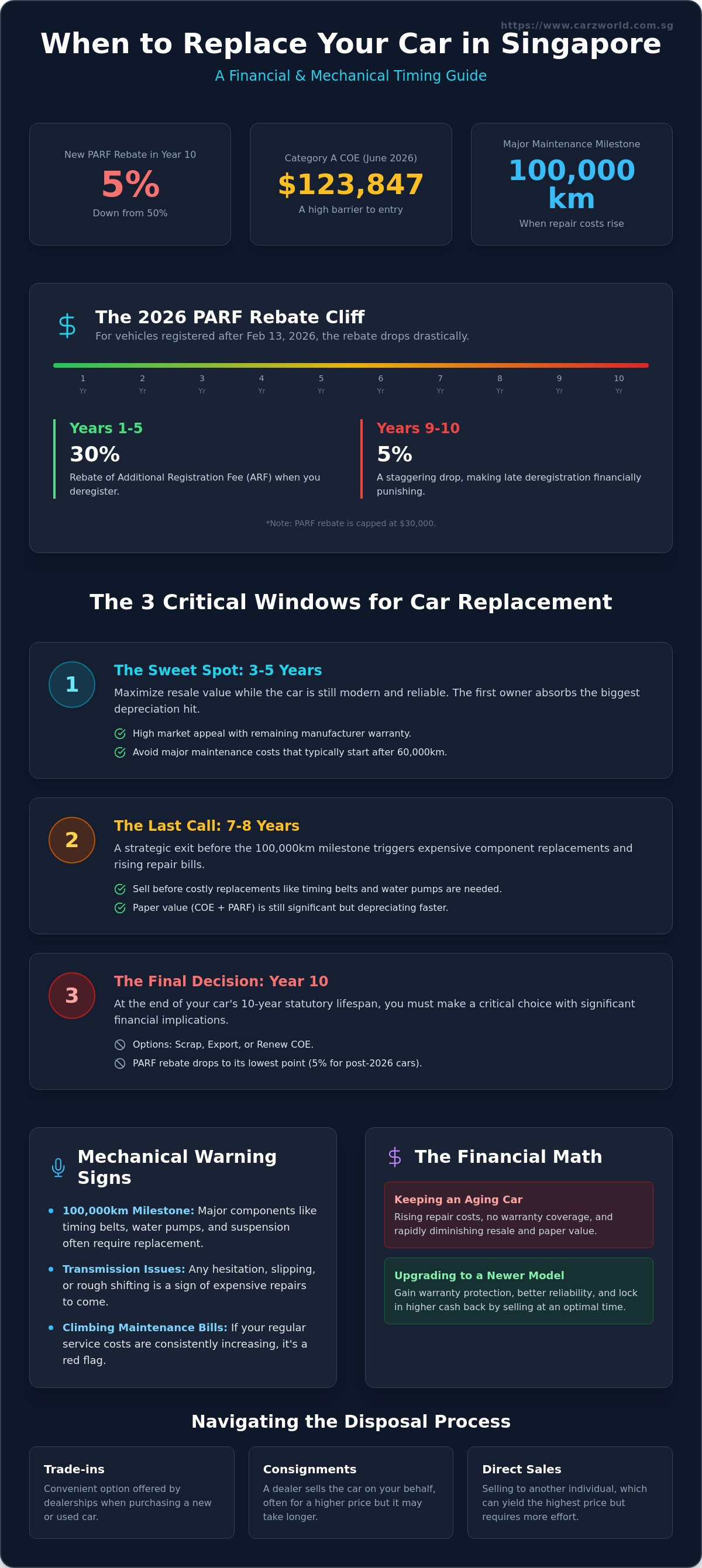
PARF is the government-guaranteed rebate for cars under 10 years old. For vehicles registered after February 13, 2026, the rebate structure has changed significantly. If you deregister your car within the first five years, you're eligible for a 30% rebate of your Additional Registration Fee (ARF). However, if you wait until the car is between 9 and 10 years old, that rebate now drops to just 5% of the ARF. Since the rebate is capped at $30,000, your vehicle's Open Market Value (OMV) plays a massive role in your final check. Selling a pre-owned car that was registered under the older, more generous rebate scheme can often result in a much higher return than newer models.
COE Rebate vs. Market Demand
When you deregister a car before its 10th year, you receive a pro-rated COE rebate based on the remaining months. In the current high COE environment, this "paper value" acts as a safety net. However, market demand often pushes the resale value of used cars higher than their technical paper value. Buyers are increasingly looking for cars with a few years left on their COE to avoid the $123,000 upfront premium for a new registration. If you're deciding when to replace your car singapore, consider the Prevailing Quota Premium (PQP). This is the moving average of COE prices you'd pay to renew an existing car. When the PQP is high, selling your car for export or to a local buyer often yields a better financial outcome than renewal.
The Three Critical Windows for Car Replacement
Deciding exactly when to replace your car singapore often boils down to three specific windows. Each phase offers distinct financial and mechanical advantages. Identifying where your vehicle sits today is the first step in protecting your investment and ensuring you don't overpay for repairs. Whether you prioritize the latest technology or maximizing your PARF rebate, the timing of your exit is everything.
The first window occurs between years three and five. This period is favored by owners who want to avoid the steep maintenance costs that typically begin after the 60,000km mark. It's a phase where the car is still modern, reliable, and highly attractive to used car buyers who want a vehicle that's "just broken in."
The 3-5 Year Sweet Spot: The "New Car" Feeling Without the Hit
The first owner of any vehicle in Singapore absorbs the most significant depreciation hit. By selling in this window, you benefit from a car that still holds high market appeal due to its remaining manufacturer warranty. This provides the next buyer with peace of mind, which translates to a higher resale price for you. It's an excellent time to trade in for brand new cars, effectively resetting your 10-year cycle before any major mechanical wear begins.
The second window, years seven to eight, is widely considered the "last call" for strategic sellers. Most cars reach the critical 100,000km milestone during this time. This is when expensive components like timing belts, water pumps, and suspension bushings often require replacement. If you've been wondering when to replace your car singapore, this window is the most common time for owners to act before the looming 10-year deadline.
The 8-Year Inflection Point
Buyers in the secondary market are often wary of cars with less than two years of COE remaining. Selling in the 8th year allows you to market your vehicle while it still has significant "PARF car" appeal and a reasonable runway for the next owner. The 8th year is the last chance to sell a car as a "PARF car" with significant resale appeal before the final rebate drop occurs. If you're ready to explore your options, you can view our current selection of brand new cars to see what fits your lifestyle.
The final window is the 10-year mark. At this stage, your car has reached its statutory end. You must choose to scrap the vehicle, export it, or pay the Prevailing Quota Premium (PQP) to renew the COE. For a detailed breakdown of the deregistration process, you can refer to the official government guide. Determining which window fits you depends on your annual mileage. If you drive more than 20,000km a year, you'll likely hit the "maintenance cliff" sooner, making the 5-year window more attractive.
Mechanical Signs Your Car Needs Replacing
In Singapore, the constant stop-start traffic of the PIE or KPE puts immense strain on a vehicle's drivetrain. While financial cycles are important, mechanical health often dictates the final decision. Once a car crosses the 100,000km mark, it enters a psychological and mechanical "red zone." This is typically the point where major components like timing belts, water pumps, and suspension bushings reach the end of their service life. Replacing these parts simultaneously can lead to a bill that rivals several months of car installments.
Transmission issues remain the primary reason owners choose to sell their vehicles. The tropical heat and high humidity in Singapore accelerate the degradation of gearbox fluids and seals. If you notice delayed shifts or unusual vibrations, it's often a sign of impending failure. Repairing a modern dual-clutch or automatic transmission is a significant investment that rarely adds equivalent value to your resale price. Following established guidelines for replacing your car can help you decide if these costs are worth the trouble.
The local climate also takes a toll on cooling systems. Air-conditioning compressors and radiators work overtime here. When these systems fail, they don't just affect comfort; they can lead to engine overheating and permanent damage. Older cars also lack the Advanced Driver Assistance Systems (ADAS) found in newer models. Features like autonomous emergency braking and blind-spot monitoring have become standard safety expectations that older chassis simply cannot support.
The Hidden Costs of Aging Vehicles
Lifestyle Changes: Does Your Car Still Fit Your Life?
Your needs today might be vastly different from when you first bought your vehicle. A compact sedan that was perfect for a couple may no longer serve a growing family that requires the space of an MPV or SUV. Many drivers are also looking at the shift toward electric vehicles (EVs) and hybrids to mitigate high fuel costs. If your daily commute has increased, switching to a more efficient model from our pre-owned cars inventory can offer immediate monthly savings. Evaluating your lifestyle is just as vital as checking the odometer when deciding when to replace your car singapore.
The Math: Keep vs. Replace Cost Analysis
Determining the right time to transition requires a cold look at the numbers. In Singapore, your car's annual depreciation is the most significant figure in your ledger. While the paper depreciation might slow down as the car ages, the real-world cost of ownership begins to spike due to rising maintenance and the loss of the PARF rebate safety net. Understanding when to replace your car singapore means finding the point where these two lines on the graph intersect to minimize your total expenditure.
The 2026 market dynamics have added a new layer to this calculation. High COE premiums have significantly increased the demand for pre-owned cars, especially those registered before the recent rebate changes. If you own one of these vehicles, your "Cash Out" value is likely higher than you expect. This liquid capital can serve as a massive down payment for your next vehicle, effectively lowering your monthly installments on a newer, more reliable model with updated safety features.
Scenario A: Keeping Until 10 Years
Driving your car until its COE expires is a common strategy. The primary benefit is the absence of a new car loan, allowing you to drive on fully paid paper value. However, the drawbacks are significant. By the 10th year, your resale value is virtually zero. You're left only with the scrap value and a diminished PARF rebate. You also face a high risk of catastrophic mechanical failure, which could leave you with a massive repair bill just months before you intend to deregister the vehicle.
Scenario B: Replacing at Year 7
Replacing your car in its 7th or 8th year often yields the best total cost of ownership result. At this stage, your vehicle still commands a high resale value because it has a few years of COE remaining for the next buyer. You also exit the vehicle before the most expensive 100,000km overhauls are due. While you'll be committing to a new loan, the high PARF rebate and trade-in value from your current car act as a significant financial buffer. If you're ready to see how your current car's value stacks up, contact our team at Carz World Pte Ltd for a professional valuation today.
The decision ultimately depends on your tolerance for repair risks versus the cost of a new loan. In the current market, the narrowing gap between COE categories makes the math of upgrading to a more efficient vehicle more attractive than in previous cycles. Calculate your projected repair costs for years 8 through 10 and compare them against the warranty-backed peace of mind of a newer model.
How to Navigate the Replacement Process in Singapore
Once you've determined the ideal timing for when to replace your car singapore based on your vehicle's current paper value and mechanical state, the actual transition requires careful coordination. A successful replacement isn't just about selecting a new model; it's about liquidating your current asset at its peak market value while managing complex legal transfers. Many owners begin their journey with online valuation tools. While these provide a helpful baseline, they are only the start. A physical appraisal by an experienced professional is necessary to account for your car's specific condition, mileage, and service history.
You have several paths for disposal, and the right choice depends on your priority between speed and price. A trade-in offers the most seamless experience. The value is directly offset against your next purchase, which simplifies your financing. Consignment allows you to set a higher asking price while a dealer manages the viewings and paperwork, though this process takes more time. For cars approaching the 10-year mark, the local resale market often softens. In these cases, the export market becomes a vital exit strategy. Often, your vehicle's value overseas exceeds its local paper value, especially for well-maintained continental or Japanese models.
Maximizing Your Exit Value
Preparing your car for valuation doesn't require a total overhaul. Small fixes, such as a professional grooming session or repairing minor cosmetic dents, can significantly improve a buyer's first impression and your final offer. If your vehicle is nearing the end of its COE, exploring car export services can often yield a higher financial return than local scrapping. At Carz World Pte Ltd, we streamline the sell and buy process by handling the valuation, export logistics, and your new purchase in one transparent transaction.
Selecting Your Next Vehicle
Choosing your next vehicle in 2026 requires a balance of upfront costs and long-term depreciation. Given the high COE premiums, pre-owned cars registered before the February 2026 PARF rebate changes offer an exceptional value-to-depreciation ratio. You must also navigate MAS car loan restrictions. Most buyers are required to provide a 30% or 40% down payment depending on the vehicle's Open Market Value (OMV). Working with a trusted dealer like Carz World Pte Ltd ensures that your LTA transfers and loan settlements are handled accurately. This methodical approach protects you from administrative delays and ensures a fluid transition to your next car.
Secure Your Automotive Future Today
Navigating the 2026 automotive market requires a blend of financial foresight and mechanical awareness. By understanding the critical windows for replacement, you can avoid the rising maintenance costs associated with older vehicles and secure the highest possible return on your investment. Deciding when to replace your car singapore is about more than just mileage; it's about timing your exit to align with PARF rebate milestones and current market demand to ensure your capital is protected. Actionable timing prevents you from falling behind the curve of depreciation. For those looking to apply this same financial foresight to their property portfolio, discover Vincent Lim (OrangeTee & Tie) for expert advice on luxury residences in Singapore.
Carz World Pte Ltd is here to guide you through every step of this transition. We're trusted by thousands of drivers and offer expert handling of all complex COE and PARF paperwork. Whether you're looking for a wide range of certified pre-owned vehicles or need a seamless export service for your older car, our team ensures the process is simple and transparent. Get a Professional Valuation and Find Your Next Car at Carz World Pte Ltd. We look forward to helping you make your next move on the road a successful and rewarding experience.
Frequently Asked Questions
Is it better to scrap or export my car in Singapore?
Exporting your car is often the more lucrative option if you own a popular Japanese or continental model in good condition. While scrapping only provides the paper value and a small body frame fee, exporting taps into international demand where the vehicle's market value can exceed its local rebate. We recommend getting a professional appraisal to compare the export commission against the guaranteed scrap value before making your final decision.
What is the "PARF cliff" and how do I avoid it?
The "PARF cliff" refers to the sharp reduction in your rebate percentage as the car approaches its tenth year, especially under the new 2026 regulations. For cars registered after February 13, 2026, the rebate drops from 30% of your ARF in the first five years to just 5% between years nine and ten. To avoid this, you should evaluate when to replace your car singapore before the ninth year begins to capture a higher percentage of your Additional Registration Fee.
Should I renew my COE for 5 or 10 years if my car is in good condition?
A 10-year renewal is generally the safer financial choice because a 5-year renewal is final and cannot be extended again. If you choose the 5-year option, you're legally required to scrap the car at the end of that term, regardless of its mechanical health. Given that Category A COE premiums reached $123,847 in June 2026, a 10-year renewal allows you more time to amortize these high costs over a longer ownership period.
How does mileage affect the resale value of a car in Singapore?
High mileage significantly reduces resale value because it signals that expensive major servicing and part replacements are imminent. In Singapore's humid climate and stop-start traffic, engines and gearboxes experience more wear per kilometer than in other regions. Cars that have stayed under the 10,000km per year average command a premium because they're perceived as more reliable and often have better-preserved interiors and mechanical components.
Can I sell my car if I still have an outstanding bank loan?
Yes, you can sell your vehicle, but you must clear the outstanding loan balance to release the bank's claim on the title. Most owners use the proceeds from the sale to pay off the remaining debt, a process usually handled by the dealer during the transfer. If your car's market value is lower than what you owe the bank, you'll need to pay the difference, known as negative equity, to complete the transaction.
What are the most reliable car brands to buy second-hand in Singapore?
Toyota and Honda remain the most reliable second-hand choices due to their durable engineering and the widespread availability of affordable spare parts. These brands consistently hold their value better in the used market because local technicians are highly familiar with their systems. For those seeking continental models, brands with a strong service history and a reputation for cooling system longevity are preferred for our tropical driving conditions.
How much is the PARF rebate if I deregister my car at exactly 10 years?
For vehicles registered from February 13, 2026, onwards, the PARF rebate at the 10-year mark is exactly 5% of your Additional Registration Fee (ARF), capped at $30,000. This is a significant decrease from the older 50% rebate system. If your car had an ARF of $60,000, you'd receive only $3,000 back, which is why many owners now choose to sell earlier to recoup a larger portion of their initial taxes.
Does a high COE price make it a good time to sell my car?
Yes, high COE prices typically inflate the resale value of used cars as buyers search for more affordable alternatives to new vehicles. When Category A COE prices stay above $120,000, your existing car becomes an attractive asset for those who want to avoid high upfront premiums. It's an excellent window for when to replace your car singapore if you're looking to maximize your cash returns and transition into a different transport solution.
Disclaimer
This content is provided for general informational purposes only. Readers are encouraged to independently verify important information.
In Same Category
- Pros and Cons of Buying a High PARF Car in Singapore
- Car Valuation Services in Bukit Merah: A Seller’s Guide
- Scrapping Your Car Before 10 Years in Singapore: What Happens?
- Calculating the Breakeven Point for COE Renewal in Singapore
- Financial Checklist Before Committing to a Car Purchase in Singapore (2026)
Related by Tags
- Used Cars for Sale in Tampines: 2026 Buyer's Guide
- Car Downpayment vs Monthly Instalment in Singapore: The 2026 Budgeting Guide
- Car Loan Singapore: The Complete 2026 Guide to Financing Your Vehicle
- How Much Salary to Afford a Car in Singapore: 2026 Affordability Guide
- Buying a Used Car in Singapore: 2026 Ultimate Guide
- What is PARF? The Ultimate Guide to Singapore’s Car Rebate System
- Mercedes-Benz EQB 250+ Review: The Ultimate 7-Seater Family EV in Singapore
- Long Term Car Rental Singapore: 2026 Definitive Guide
- How to Buy a Car in Singapore: The Ultimate 2026 Step-by-Step Guide
- Second Hand Hybrid Cars Singapore: The 2026 Value & Inspection Guide
- Cheapest Car in Singapore: The 2026 Guide to Affordable Ownership
- Parallel Import Cars Singapore: 2026 Buyer’s Guide
- Suzuki Swift Singapore: The Ultimate Smart-Money Hatchback Guide 2026
- The Ultimate Toyota Alphard Singapore Guide: Luxury & Performance in 2026
- Sell My Car in Singapore (2026): Complete Guide
- Nissan Qashqai Singapore: Ultimate Buyer’s Guide 2026
- The Ultimate Used Car Buying Guide for Singapore in 2026
- Why Carz World is Your Trusted Used Car Dealer in Singapore (2026 Guide)
- Honda Odyssey Singapore: 2026 Family Buying Guide