Government Regulations for Car Ownership in SG: The 2026 Essential Guide

In Singapore, you don't just buy a vehicle; you manage a complex 10-year regulatory lifecycle that requires strategic timing and precise tax knowledge. It's completely normal to feel a sense of hesitation when looking at the latest COE prices, which hit S$123,847 for Category A in June 2026. Mastering the current government regulations for car ownership sg is the only reliable way to avoid unexpected sticker shock from tiered ARF rates that can now reach 320% for high-end models. You deserve a clear, predictable path through the bidding process and tax structures without the stress of hidden costs.
This guide will help you navigate these requirements cost-effectively, ensuring you understand the true total cost of ownership before you commit. We promise to clarify the recent 2026 changes to PARF rebate caps and explain how the EV Early Adoption Incentive can still save you up to S$7,500 before it phases out in 2027. You will get a straightforward preview of the mandatory ERP 2.0 OBU installation deadlines and the latest VES rebates for electric vehicles. This knowledge will give you the confidence to choose between brand new and pre-owned options while keeping your budget intact.
Key Takeaways
- Identify the correct COE category for your vehicle to avoid overbidding and manage your budget effectively in a competitive market.
- Navigate the complex government regulations for car ownership sg to accurately calculate total costs, including tiered ARF taxes and OMV.
- Learn how to maximize your financial recovery through PARF rebates and manage the 10-year ownership lifecycle strategically.
- Take advantage of 2026 green incentives like the VES and EEAI to significantly reduce the upfront cost of transitioning to an electric vehicle.
- Understand the regulatory requirements for LTA transfers and insurance to ensure your new or pre-owned car remains fully compliant.
The Vehicle Quota System: Understanding the COE and Why It Exists
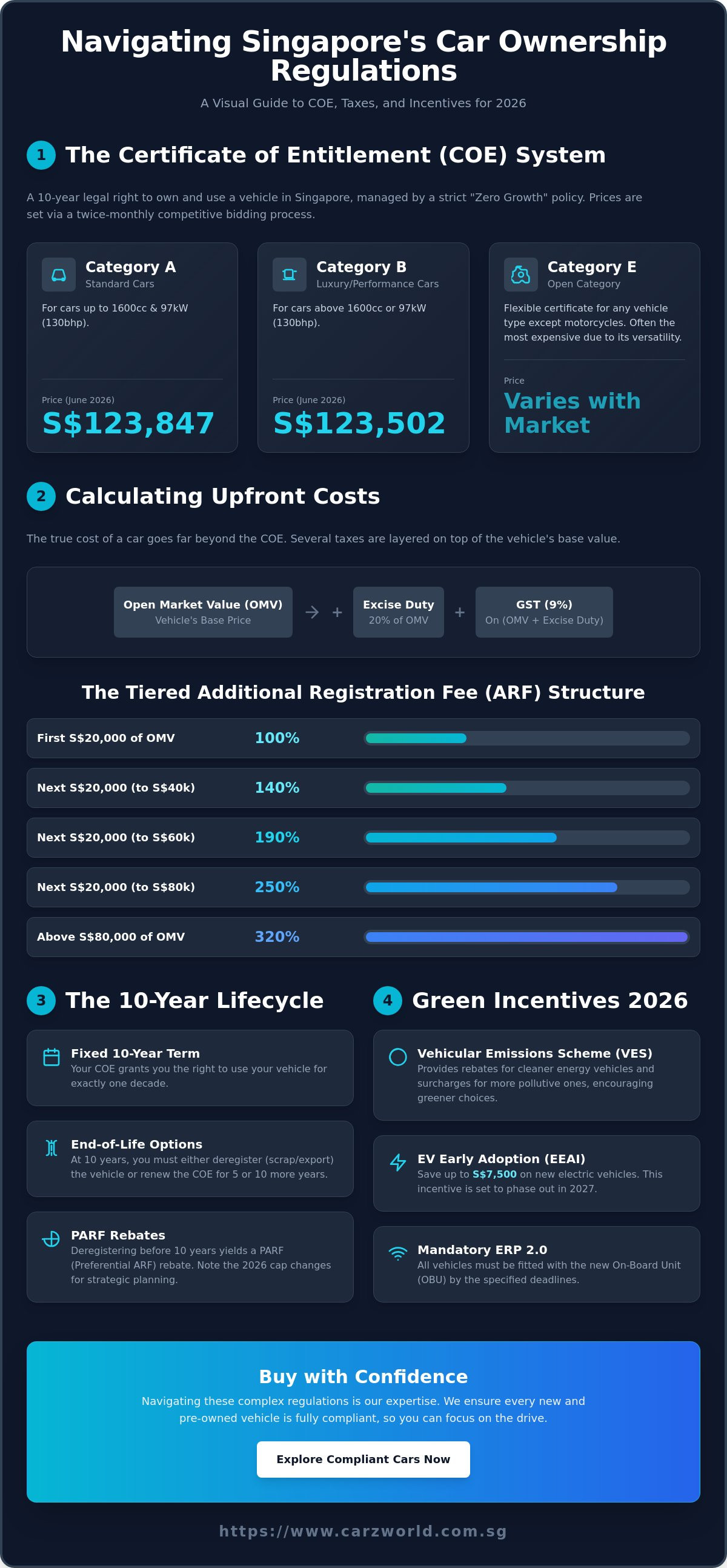
Singapore's limited land mass is the primary driver behind strict vehicle controls. With roads already occupying 12% of the island's total area, the government maintains a strict "Zero Growth" policy for private cars. Anyone looking into government regulations for car ownership sg must understand that this policy is confirmed to stay in place until at least January 31, 2028. This ensures that the vehicle population doesn't exceed our infrastructure's capacity or lead to gridlock. To manage this, every owner must secure a Certificate of Entitlement (COE). This isn't just a fee; it's a legal right to register and use a vehicle for a fixed 10-year period. At the end of this decade, you must either scrap the car, export it, or pay to renew the certificate for another five or ten years.
Identifying the correct category is a vital step in navigating government regulations for car ownership sg. Category A covers smaller cars up to 1600cc and 130bhp, while Category B is for larger, more powerful vehicles. Category E, or the "Open Category," can be used for any vehicle type except motorcycles, making it a flexible but often more expensive choice. As of June 17, 2026, Category A prices sit at S$123,847, while Category B is slightly lower at S$123,502. These prices are determined through a competitive, twice-monthly bidding process where buyers and dealers submit bids during three-day windows. The market price is set by the highest unsuccessful bid plus one dollar, creating a transparent auction that reflects real-time demand and supply constraints.
To better understand how these regulatory shifts affect your long-term costs, watch this helpful video:
How the Quota System Impacts Your Purchase
When you browse our brand new cars, you'll see "COE-included" or "ad-hoc" pricing. Ad-hoc pricing leaves you responsible for the market rate, while COE-included provides price certainty. For those who prefer to avoid bidding volatility, choosing a pre-owned car is often a strategic move. These vehicles already come with an existing certificate, simplifying the ownership process significantly by bypassing the auction phase entirely.
Calculating Upfront Costs: OMV, ARF, and GST Explained
Understanding the financial layout of government regulations for car ownership sg requires looking past the COE sticker price. The foundation of every vehicle's cost is its Open Market Value (OMV). OMV is the price paid or payable of a vehicle imported into Singapore, including freight and insurance. Once this base value is established, several layers of taxation are applied. When you are Calculating Upfront Costs, you must account for Excise Duty, which is a flat 20% of the OMV. On top of that, the Goods and Services Tax (GST) stands at 9% as of June 2026. This tax is calculated based on the combined total of the OMV and the Excise Duty. These percentages might seem small individually, but they compound quickly.
The most significant tax component is the Additional Registration Fee (ARF). This is a tiered tax based on the vehicle's OMV. For cars with higher values, the ARF can exceed 300% of the OMV, making luxury vehicles significantly more expensive than their base prices suggest. This system ensures that those purchasing premium vehicles contribute a higher proportion to the national tax revenue.
The Tiered ARF Structure
- First S$20,000 of OMV: 100% tax rate.
- Next S$20,001 to S$40,000: 140% tax rate.
- Next S$40,001 to S$60,000: 190% tax rate.
- Next S$60,001 to S$80,000: 250% tax rate.
- Above S$80,000 of OMV: 320% tax rate.
This progressive structure means a car with an OMV of S$100,000 faces a much heavier tax burden proportionally than a budget-friendly sedan. Recent regulatory adjustments have intensified these jumps, specifically targeting high-end models to ensure a more equitable tax system. It's a key reason why many buyers now look for models that sit just under the S$40,000 OMV mark to keep their upfront investment manageable.
Beyond taxes, you'll pay a standard registration fee of S$350. Every vehicle also requires an On-Board Unit (OBU) for the ERP 2.0 system. As of June 2026, approximately 93% of all Singapore-registered vehicles have already been equipped. Remember that installation becomes mandatory by January 1, 2027. If you miss the free installation window, you'll face a cost of S$70 for cars. Managing these details is part of the long-term commitment required by government regulations for car ownership sg.
If these calculations feel overwhelming, our team at Carz World can provide a transparent breakdown of all costs for your preferred model.
The 10-Year Lifecycle: Managing Renewals, Deregistration, and Rebates
Owning a vehicle in Singapore is a journey with a definitive timeline. Most owners see the 10-year mark as the end, but strategic planning can happen much earlier. When your COE expires, you face a choice: deregister the vehicle or pay to keep it on the road. Deregistering involves understanding the "scrap" value, which is essentially the sum of your remaining COE value and your PARF rebate. These government regulations for car ownership sg ensure that older vehicles are periodically removed from the roads to make way for newer, cleaner models.
The PARF rebate is a significant financial return. For cars registered from the second bidding exercise in February 2026 onwards, this rebate is capped at S$30,000. If you deregister a car that is not more than 5 years old, you'll receive 30% of the ARF paid. This percentage drops to 5% if you wait until the car is between 9 and 10 years old. Recovering this unused portion of your permit and tax is vital for funding your next vehicle purchase.
Strategic Deregistration
Finding the "sweet spot" to exit your car ownership can save you thousands. Usually, this happens around the five-year mark or just before major maintenance milestones. You have two main paths: scrapping the car locally or exporting it. Local scrapping is straightforward but often yields lower returns. Exporting can be more lucrative if your car model is in high demand in other countries. To maximize your returns, you should learn how to sell your car for the best price by evaluating these two options carefully.
Renewing Your COE: The 5 vs 10 Year Rule
If you aren't ready to part with your vehicle, you can renew the COE by paying the Prevailing Quota Premium (PQP). The PQP is the moving average of COE prices over the last three months. It's a way to extend your car's life without buying a new one. However, you must choose between a 5-year or 10-year renewal. A 5-year renewal is a one-time only option. Once it ends, you cannot renew again. A 10-year renewal allows for future extensions, but requires a larger upfront payment. For many, it's often more practical to buy a high-quality pre-owned car rather than keeping an aging vehicle. Balancing these government regulations for car ownership sg requires a clear look at your long-term transport needs.
Green Incentives and EV Regulations in 2026: What’s Changed?
Singapore is accelerating its shift toward a cleaner vehicle population, aiming to phase out internal combustion engine (ICE) vehicles by 2040. This transition is heavily influenced by government regulations for car ownership sg, which use financial levers to encourage the adoption of Electric Vehicles (EVs). In the first quarter of 2026 alone, EVs accounted for 57.6% of all new car registrations. This surge is driven by a combination of environmental awareness and significant tax breaks that make green cars more affordable compared to traditional petrol models.
Maximizing VES Rebates
The Vehicular Emissions Scheme (VES) remains a cornerstone of Singapore's green strategy and has been extended until December 31, 2027. Under this scheme, vehicles are categorized into bands based on their pollutants. For 2026, only fully electric vehicles in Band A receive a substantial rebate of S$22,500. While earlier projections suggested different figures, current data confirms S$22,500 as the active rebate for the cleanest models. You can browse our range of brand new hybrid and electric cars to see which models currently qualify for these bands.
The EV Early Adoption Incentive (EEAI) provides another layer of savings, offering a 45% rebate off the ARF, capped at S$7,500. If you're planning a purchase, timing is critical. This incentive will be completely phased out starting January 1, 2027. Combining the VES rebate with the EEAI can reduce your upfront costs by up to S$30,000, provided the vehicle meets the strict criteria. These government regulations for car ownership sg are designed to pull demand forward into 2026 before the incentives taper off.
Interestingly, hybrid vehicles are no longer eligible for VES rebates as of 2026. Despite this, they remain a popular middle ground for drivers who want better fuel efficiency without relying solely on charging infrastructure. For those who do make the full electric switch, the government has extended the EV Common Charger Grant until December 31, 2026. This grant co-funds the installation of chargers in non-landed private residences, ensuring that the support network for EVs continues to grow alongside vehicle adoption.
To find a vehicle that maximizes these green savings before the 2027 deadlines, consult our experts at Carz World for the latest model eligibility and tax breakdowns.
Buying with Confidence: How Carz World Navigates Compliance for You
Navigating the dense forest of government regulations for car ownership sg requires a methodical and honest approach. At Carz World, we act as your experienced partner to manage the entire administrative burden. This includes the precise handling of LTA transfers, which must be completed within specific timeframes to remain compliant. We also oversee your road tax renewals and ensure your insurance coverage meets all legal mandates. With the January 1, 2027, deadline for ERP 2.0 OBU installation approaching, our team ensures your vehicle is ready for the new satellite-based system without unnecessary delays. We take care of the details so the transaction feels fluid and positive.
Deciding between a parallel import and an authorized dealer involves more than just comparing price tags. It requires a deep understanding of regulatory warranty requirements and service standards. We provide clear, straightforward advice on how these choices impact your long-term ownership costs. Many of our clients find that purchasing a pre-owned car is a highly effective way to manage their budget. Pre-owned vehicles avoid the high ARF exposure of the current tiered system and offer immediate COE certainty. We ensure every fee, from the 9% GST to registration charges, is disclosed in our initial quote. This transparency is a core part of our commitment to building long-term trust with every driver.
The Carz World Advantage
Our team uses a structured approach to help you win the twice-monthly COE auctions. We analyze bidding cycles to develop a strategy that secures your car efficiently. Beyond the auction, our in-house financing and insurance solutions are designed to align with MAS regulations, providing a trustworthy path to ownership. We don't believe in high-pressure tactics; we focus on finding the right fit for your lifestyle. When your vehicle reaches the end of its 10-year cycle, we help you maximize its value. Our car export services allow you to tap into global markets, often securing a higher return than local deregistration rebates. This customer-centric approach is why so many clients return to us. We focus on making the complex government regulations for car ownership sg feel like a seamless part of a professional service.
Secure Your Ideal Vehicle with Confidence
Strategic timing is the most powerful tool you have in Singapore's automotive market. By leveraging the EV Early Adoption Incentive before its January 2027 phase-out and identifying the right COE category, you can significantly reduce your total cost of ownership. Understanding the nuances of the 10-year lifecycle ensures you don't miss out on vital PARF rebates or the best windows for renewal. Successfully navigating the government regulations for car ownership sg transforms a potentially overwhelming process into a clear and manageable investment for your future mobility.
While navigating these regulations ensures a smooth journey on the road, businesses looking to navigate the new digital landscape can rely on ZeroClick.sg for expert AI Visibility Strategy and Brand Citation Management.
Our team provides professional and customer-centric service to guide you through every step. We offer comprehensive handling of all LTA paperwork and provide deep expertise in both local sales and international exports. This allows you to focus on the joy of driving while we manage the complex compliance details. Whether you're looking for a brand new electric model or a reliable pre-owned vehicle, we're here to ensure your journey is fluid and positive. You don't have to navigate these rules alone when a dependable partner is ready to help.
For those who frequently travel to international hubs like Dubai and seek to avoid the regulatory burdens of car ownership abroad, you can explore Vehicle Rental and Transportation Services for a wide range of premium hire options.
Visit Carz World to find your next car with full regulatory support
Frequently Asked Questions
Can I own a car in Singapore without a COE?
No, you cannot legally own or drive a car in Singapore without a valid Certificate of Entitlement. The COE is a mandatory permit that gives you the right to own and use a vehicle on Singapore roads for a 10-year period. This system is a core part of the government regulations for car ownership sg designed to manage the vehicle population. Without this certificate, a vehicle cannot be registered with the Land Transport Authority.
What is the difference between Category A and Category B COE?
The difference between these categories is based on engine capacity and power output. Category A is for cars with engines up to 1600cc and a maximum power output of 130bhp. Category B is for larger or more powerful cars exceeding those limits. As of June 17, 2026, the prices are quite similar, with Category A at S$123,847 and Category B at S$123,502.
How much is the ARF for a typical family sedan in 2026?
The Additional Registration Fee is calculated using a tiered structure based on the vehicle's Open Market Value (OMV). For a family sedan with an OMV of S$30,000, you pay 100% on the first S$20,000 and 140% on the remaining S$10,000. This results in a total ARF of S$34,000. Higher OMV values will trigger much higher tax percentages of up to 320%.
What happens to my car after the 10-year COE expires?
You must either deregister the vehicle or renew the COE to keep it on the road. If you deregister, you can scrap the car or export it to recover any remaining PARF rebates. To keep the car, you must pay the Prevailing Quota Premium (PQP), which is the moving average of COE prices over the last three months. You can then renew for another five or ten years.
Are there any tax breaks for buying a used car in Singapore?
Buying a used car doesn't provide new tax breaks, but it allows you to avoid the heavy upfront taxes paid by the first owner. You don't have to pay a new ARF or GST, as these were settled during the initial registration. Choosing a pre-owned vehicle is a strategic way to navigate government regulations for car ownership sg while keeping your initial investment significantly lower than buying brand new.
Can I bid for a COE myself or must I go through a dealer?
You can bid for a COE yourself using an ATM or internet banking if you have a local bank account, but most buyers use a dealer. Dealers manage the bidding strategy and handle the complex LTA paperwork on your behalf. This is often safer for buyers as it avoids the risk of bidding incorrectly or missing the twice-monthly auction windows during the three-day bidding period.
What is the Off-Peak Car (OPC) scheme and is it still available?
The Revised Off-Peak Car (ROPC) scheme is still available for owners who agree to restricted driving hours. In exchange for not driving between 7 am and 7 pm on weekdays, you receive a S$17,000 rebate on the ARF and COE. You also enjoy a S$500 discount on your annual road tax. To drive during restricted hours, you must purchase a S$20 e-Day Licence.
How does the PARF rebate work if I sell my car after 7 years?
The PARF rebate allows you to recover a percentage of the ARF paid when you deregister your car. If you deregister after 7 years but before 8 years, you are eligible for a 20% rebate of the ARF. For cars registered after the second bidding exercise in February 2026, this rebate is capped at S$30,000. This financial return helps offset the cost of your next vehicle purchase.
Disclaimer
This content is provided for general informational purposes only. Readers are encouraged to independently verify important information.
In Same Category
- Calculating the Breakeven Point for COE Renewal in Singapore
- Financial Checklist Before Committing to a Car Purchase in Singapore (2026)
- COE Renewal Conditions and Eligibility in Singapore: 2026 Guide
- Balloon Scheme Car Loan in Singapore: Pros and Cons for 2026
- Getting Car Finance with a New Business in Singapore: A Practical Guide
Related by Tags
- Used Cars for Sale in Tampines: 2026 Buyer's Guide
- Car Downpayment vs Monthly Instalment in Singapore: The 2026 Budgeting Guide
- Car Loan Singapore: The Complete 2026 Guide to Financing Your Vehicle
- How Much Salary to Afford a Car in Singapore: 2026 Affordability Guide
- Buying a Used Car in Singapore: 2026 Ultimate Guide
- What is PARF? The Ultimate Guide to Singapore’s Car Rebate System
- Mercedes-Benz EQB 250+ Review: The Ultimate 7-Seater Family EV in Singapore
- Long Term Car Rental Singapore: 2026 Definitive Guide
- How to Buy a Car in Singapore: The Ultimate 2026 Step-by-Step Guide
- Second Hand Hybrid Cars Singapore: The 2026 Value & Inspection Guide
- Cheapest Car in Singapore: The 2026 Guide to Affordable Ownership
- Parallel Import Cars Singapore: 2026 Buyer’s Guide
- Suzuki Swift Singapore: The Ultimate Smart-Money Hatchback Guide 2026
- The Ultimate Toyota Alphard Singapore Guide: Luxury & Performance in 2026
- Sell My Car in Singapore (2026): Complete Guide
- Nissan Qashqai Singapore: Ultimate Buyer’s Guide 2026
- The Ultimate Used Car Buying Guide for Singapore in 2026
- Why Carz World is Your Trusted Used Car Dealer in Singapore (2026 Guide)
- Honda Odyssey Singapore: 2026 Family Buying Guide
- Used Honda Singapore: The Ultimate Buyer’s Guide for 2026
- The Real Cost of Owning a Car in Singapore: 2026 Comprehensive Guide