The Importance of Car Service History: Protecting Your Investment in 2026

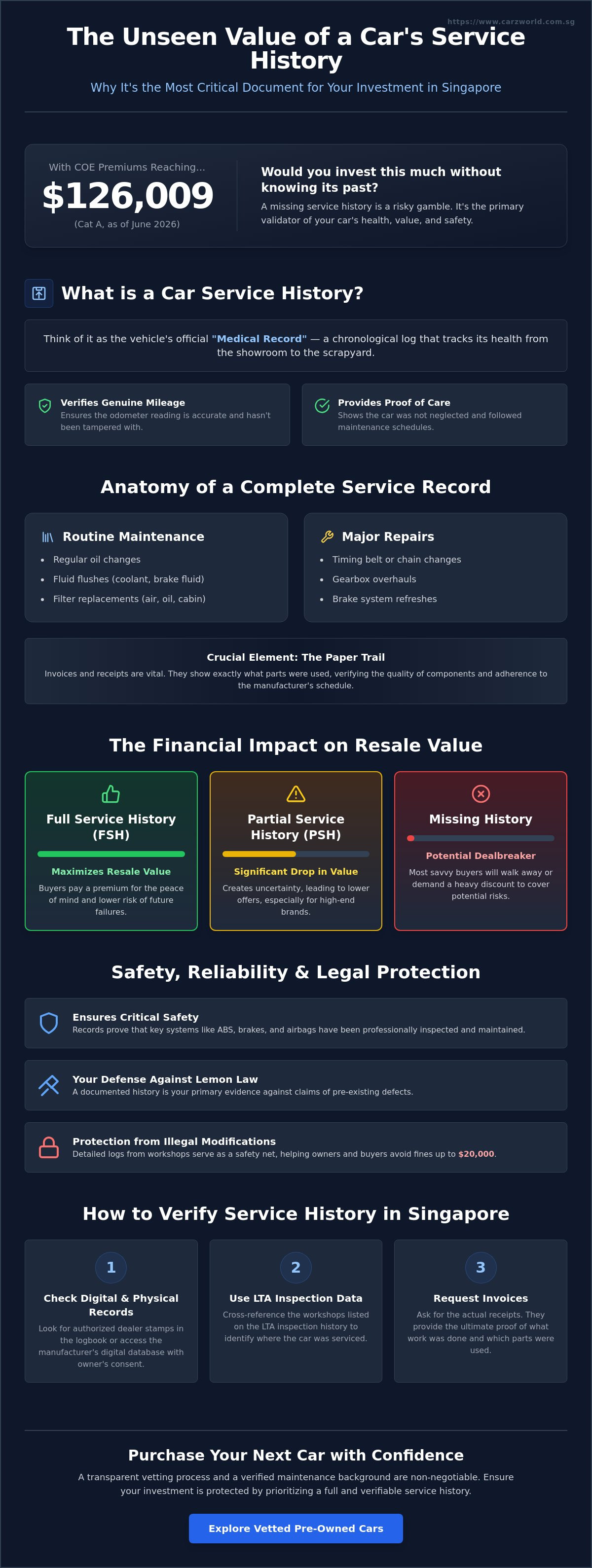
Would you hand over more than $126,000 for a vehicle without knowing exactly how it was treated by its previous owner? With Category A COE premiums sitting at $126,009 as of June 2026, the importance of car service history has never been more apparent. We understand the stress of worrying about hidden mechanical issues or wondering how much a missing logbook might devalue your asset. It's natural to feel confused between a standard VICOM inspection and actual maintenance logs; however, mistaking one for the other is a costly error for any buyer.
This record serves as your primary defense against the Lemon Law and ensures you aren't caught off guard by illegal modifications that carry fines up to $20,000 for individuals. You'll discover why a comprehensive service history is the most critical document for any car owner or buyer in Singapore. We'll guide you through how to verify digital records, the direct impact of maintenance on resale value, and the key differences between full and partial history so you can protect your investment with confidence.
Key Takeaways
- Understand why service history acts as a vehicle's "medical record," tracking every maintenance milestone to ensure long-term health.
- Learn how to maximize your resale value by recognizing the importance of car service history and why buyers prioritize cars with full records.
- Discover the practical steps to verify digital and physical logbooks using authorized dealer stamps and LTA inspection data.
- Identify the differences between full and partial histories to avoid common dealbreakers that devalue your vehicle.
- See how a transparent vetting process ensures you purchase a pre-owned car with a verified and reliable maintenance background.
What is Car Service History and What Does It Include?
A car service history is a chronological record of every maintenance task, repair, and inspection performed on your vehicle. Think of it as a "medical record" for your car. It tracks the vehicle's health from the day it leaves the showroom until it reaches the end of its lifespan. Understanding What is a Car Service History? helps you realize that this isn't just a collection of papers. It's definitive proof of care.
In 2026, the importance of car service history has shifted from traditional paper booklets to sophisticated digital ecosystems. A complete record should include the specific date of service, the exact odometer reading, and an official workshop stamp or digital signature. These details verify that the car hasn't been neglected. They also ensure the mileage shown on the dashboard is genuine and hasn't been tampered with.
To better understand this concept, watch this helpful video:
The Anatomy of a Complete Service Record
A robust record categorizes work into routine maintenance and major repairs. These typically include:
- Routine maintenance: Regular oil changes, fluid flushes, and filter replacements.
- Major repairs: Timing belt changes, gearbox overhauls, and brake system refreshes.
While stamps are great, the actual invoices and receipts provide the necessary "paper trail." They show exactly what parts were used. This is vital for verifying the quality of components installed in your vehicle. A clear paper trail proves you've followed the manufacturer's recommended schedule, which is the gold standard for maintenance.
Digital vs. Physical History
Digital records are now the industry standard. Many used cars from Authorized Dealers (AD) have their histories stored in centralized manufacturer databases. You can often access these through official owner portals or by visiting the service center with the owner's consent. Third-party workshops are also adopting digital logs and apps to track maintenance. This trend helps workshops protect themselves from liability related to illegal modifications. In Singapore, first-time offenders face fines up to $20,000, so detailed logs are a safety net for everyone. If you lose your physical booklet, don't worry. You can often reconstruct the history by requesting past records from the workshops listed on your LTA inspection history.
Why Car Service History is Crucial for Value and Safety
In a market where Category B COE premiums sit at $126,989 as of June 2026, a car is a massive financial commitment. The importance of car service history becomes undeniable when you realize it acts as the primary validator for that investment. Without it, you're essentially buying or selling a mystery. A well-documented history provides the transparency needed to justify a high asking price or ensure a safe purchase. It's the difference between a confident transaction and a risky gamble.
This transparency is just as critical in the luxury transport sector. For example, a professional Zurich airport transfer Mercedes service relies on meticulous maintenance records to ensure its high-end fleet remains in peak condition for every client.
The Financial Impact on Resale Value
A "Full Service History" (FSH) means the vehicle has met every milestone according to the manufacturer's manual. Buyers often pay a significant premium for these cars because the risk of future failure is lower. When comparing Full vs. Partial vs. Missing History, a partial record (PSH) can significantly drop a car's market value. This is especially true for high-end continental brands where repair costs are steeper. If you can't prove the oil was changed or the gearbox was serviced, savvy buyers will simply walk away or demand a heavy discount. Keeping your records organized makes the process of selling your car much smoother and faster.
Safety and Long-Term Reliability
Singapore’s humid climate and constant stop-start traffic put immense strain on engines and cooling systems. Regular service records prove that preventative maintenance was performed to combat these local conditions. Beyond the engine, these logs verify that critical safety systems like ABS, brake pads, and airbags were inspected by professionals. A standard LTA inspection, which costs S$5.45 for a basic report, only confirms technical specs and ownership. It doesn't tell you if the car was neglected between those mandatory checks. A thorough service history also helps you spot "clocking" or odometer tampering. By cross-referencing the mileage at each service interval, you can ensure the numbers on the dash are honest.
Missing just one scheduled service can also void your manufacturer's warranty, leaving you unprotected against defects. Under the Consumer Protection (Fair Trading) Act, or Lemon Law, having a clear service history is vital evidence if you need to prove a defect existed at the time of purchase. If you're looking for a vehicle that has been thoroughly vetted for its maintenance background, you can browse our inventory of pre-owned cars to find a reliable match.
Full vs. Partial vs. Missing History: Navigating the Dealbreakers
A Full Service History (FSH) is the gold standard in the Singapore automotive market. It means the vehicle has met every single maintenance milestone exactly when the manufacturer intended. This isn't just about ticking boxes; it's about proving the car's internal components haven't been stressed beyond their limits. The importance of car service history is most evident when you're deciding whether to walk away from a deal or commit to a purchase. When you understand how service history affects car value, you see that an FSH car is much easier to finance and sell later.
Partial Service History (PSH) is a different story. This usually means there are gaps in the timeline, late services, or missing invoices for specific repairs. While not always a dealbreaker, it requires closer scrutiny. You should also be wary of "Service History Forgery." Look for suspicious logbooks where the ink color and handwriting remain identical across years of entries. Genuine records usually show a natural variety of pens, stamps, and signatures from different technicians over time. If every stamp looks brand new and identical, it's a major red flag.
When is Partial History Acceptable?
Not all gaps are created equal. A missed minor oil change from three years ago is less concerning than a missing record for a major 100,000km gearbox overhaul. If a car has a spotty past but shows consistent, high-quality maintenance for the last two years, it has been "rehabilitated." This recent care suggests the current owner took the importance of car service history seriously even if the previous one didn't. We always recommend looking for cars where at least the most recent 24 months are fully documented and verifiable.
Dealing with a Missing History
Buying a car with no history is a high-risk move, especially with the complex hybrid and electric systems common in 2026. If the records are gone, a professional Pre-Purchase Inspection (PPI) is your only fallback. You must use this lack of data as a negotiation tool. Typically, a missing history should result in a significant discount from the market rate of an FSH equivalent. Without proof of maintenance, you're inheriting unknown risks that could lead to engine failure or expensive battery issues. At Carz World, we prioritize transparency by helping you navigate these records for all our pre-owned cars, ensuring you don't buy someone else's neglect.
Verifying Service History in the Singapore Market
Verifying a vehicle's background is essential when Category A COE premiums are $126,009 as of June 2026. You shouldn't take a seller's word at face value. The importance of car service history lies in its ability to be cross-referenced with official data. Start by checking the physical or digital logbook for Authorized Dealer stamps. These stamps represent a commitment to manufacturer standards. If the book is digital, ask the seller to log into the dealer's portal in your presence to confirm the entries.
Next, use the OneMotoring portal to obtain an LTA vehicle history report for S$5.45. This report confirms technical specifications and previous ownership. More importantly, it allows you to cross-reference mileage. You can see the odometer readings recorded during mandatory inspections. For cars aged 3 to 10 years, these inspections happen every 2 years. If the service history shows a higher mileage than the LTA report, or vice versa, it's a clear sign of tampering. Finally, call the workshops listed in the records. Verifying that an invoice number actually exists in their system is the best way to spot forgeries.
AD vs. Parallel Import (PI) Records
Authorized Dealer (AD) cars usually have a centralized, clean history. Parallel Import (PI) cars can be more challenging because their history is often fragmented across various independent workshops. If you're looking at a PI car imported from Japan or the UK, ask for the original export documents. These papers often list the mileage at the time of export, providing a vital baseline. Specialized PI workshops in Singapore are becoming better at maintaining digital records; look for those that use modern tracking apps to ensure continuity.
Leveraging Local Inspection Reports
Many buyers confuse a VICOM or STA inspection with a full service history. A VICOM report is a snapshot of the car's health on a single day. It tells you if the brakes work now, but it doesn't tell you if the oil was changed every 10,000km. A "Grade A" result from STA is excellent for structural peace of mind, but it's a supplement to maintenance logs, not a replacement. Use OneMotoring to verify how many previous owners the car had. A high number of owners in a short period often explains why a service history might be missing or incomplete.
If you want a vehicle that has already undergone this rigorous verification, you can view our certified pre-owned cars to ensure your next purchase is backed by facts.
Buying and Selling with Confidence at Carz World
At Carz World, we recognize that a vehicle is more than just a mode of transport. It's a significant financial asset. We don't just acknowledge the importance of car service history; we treat it as a mandatory requirement for every vehicle we represent. Our team understands that transparency builds trust. This is why we provide our buyers with full access to all available maintenance records and digital logs. When you choose a vehicle from us, you aren't just buying a car. You're investing in a machine with a verified past and a clear future. Understanding the importance of car service history is only half the battle; having a partner who verifies it for you is the other half.
Our approach is designed to remove the uncertainty often associated with the pre-owned market. Buying "Certified Pre-Owned" from a reputable dealer means the heavy lifting of verification has already been completed. We examine every entry in the logbook to ensure the vehicle has been maintained to the highest standards. This rigorous vetting process ensures that our inventory meets the expectations of even the most detail-oriented buyers in Singapore; similarly, for those who apply this same standard of excellence to their personal style, visit Marlo Bespoke to discover the meticulous art of handcrafted tailoring.
Our Rigorous Selection Process
Our used car collection is curated through a strict vetting process. We prioritize vehicles with verifiable histories because they offer the best reliability for our clients. We perform detailed internal checks to ensure odometer readings match the service intervals recorded by previous workshops. This methodical approach eliminates the guesswork. By documenting every maintenance milestone and professional inspection, we provide the peace of mind you deserve. Our experienced staff members take the time to walk you through these records, explaining what each service means for the car's long-term health.
Simplifying the Transaction for You
We also assist owners who want to ensure a successful car sale. Our experts help you compile and present your vehicle's history to maximize its resale value. We handle the complex logistics of the transaction, from service logs to LTA transfers. Our goal is to make the process feel seamless and professional. We believe that a transaction should be fluid and positive, free from high-pressure tactics. Whether you are looking to trade in your current vehicle or explore our latest brand new cars, our team is here to guide you. We value our long-term reputation and focus on making every logistical detail feel effortless for you.
Secure Your Automotive Future
A vehicle's maintenance record is more than just a stack of papers. It's a testament to its reliability and long-term value. We've explored how a full record acts as a safeguard against the Lemon Law and justifies a premium price in a market with high COE premiums. By cross-referencing logbooks with official LTA data, you can navigate the market with total clarity and avoid the pitfalls of missing or forged documents.
Recognizing the importance of car service history is the first step toward a smarter investment. At Carz World, our comprehensive vehicle vetting process ensures every car in our inventory meets our strict quality standards. We're proud to be a partner trusted by a community of satisfied Singaporean drivers who value honesty and efficiency. Our professional and customer-centric team is ready to help you find a vehicle that has been cared for properly. We take the guesswork out of the process so you can focus on the joy of driving.
Browse our vetted and reliable used car inventory today and drive away with complete peace of mind. Your journey toward a safe and valuable car purchase starts with transparency and expert care.
Frequently Asked Questions
Does "Full Service History" mean the car was only serviced at the main dealer?
No, a Full Service History (FSH) simply means that every maintenance milestone was completed according to the manufacturer's schedule. While Authorized Dealers provide these records, reputable independent workshops can also maintain a car to the same standard. The key is having a complete, chronological set of stamps or digital logs that prove the work was done. It's the consistency of care that matters most to future buyers.
What should I do if the seller says they lost the service booklet?
You should ask for the names of the workshops where the vehicle was maintained. Most modern service centers keep digital backups of their invoices and work orders. You can contact these workshops directly to request a summary of the car's history. If the car was serviced at a main dealer, they can often reprint the entire record from their central database once the owner provides consent.
Can I still get a car loan for a vehicle with no service history?
Yes, you can still secure a car loan. Lenders in Singapore primarily focus on your credit profile and the official valuation of the vehicle. However, the importance of car service history comes into play during the valuation process. A car without records might be valued lower by surveyors. This could reduce the maximum loan amount you're eligible to receive, requiring a larger cash downpayment from you.
Is a digital service record as valid as a stamped physical book?
Digital records are actually preferred by many professionals in 2026. They're much harder to forge than a physical stamp and are usually linked to a workshop's secure management system. Digital logs often include detailed metadata like timestamps and specific part numbers used. Many Authorized Dealers have phased out paper booklets entirely, making digital records the gold standard for verifying a vehicle's maintenance background and mechanical integrity.
How much does a missing service history affect the trade-in value in Singapore?
A missing history can lead to a significantly lower trade-in offer. Dealers must account for the financial risk of inheriting a car with unknown mechanical issues or neglected major components. Without proof of maintenance, a dealer may assume the worst and lower their bid to cover potential repair costs. Keeping your records organized is one of the easiest ways to ensure you receive a fair and competitive trade-in price.
Does a car with "Partial History" still have a valid manufacturer warranty?
It depends on which specific services were missed. Manufacturers typically require strict adherence to their maintenance schedule to keep the warranty intact. If a major engine or gearbox service was skipped, the dealer might deny a warranty claim related to those systems. You should review the warranty terms carefully and check which milestones are missing before assuming the car is still fully protected by the manufacturer.
How can I spot a fake service history stamp?
You should look for entries that seem too perfect or uniform. If multiple stamps from different years use the exact same ink color and handwriting, it's a major red flag. Genuine records usually show natural variations in pen pressure and stamp alignment over time. The most reliable way to spot a forgery is to call the workshop listed on the stamp to verify that the service actually took place.
Is it worth buying a car that was serviced at an independent workshop instead of the AD?
Yes, it's often a great choice if the workshop is a known specialist for that brand. Many owners move to independent specialists after the initial warranty expires to save on costs while maintaining high standards. The importance of car service history isn't about where the stamp came from, but whether the work followed the manufacturer's guidelines. A car with detailed independent receipts is far better than one with no records at all.
Disclaimer
This content is provided for general informational purposes only. Readers are encouraged to independently verify important information.
In Same Category
- Calculating the Breakeven Point for COE Renewal in Singapore
- Financial Checklist Before Committing to a Car Purchase in Singapore (2026)
- COE Renewal Conditions and Eligibility in Singapore: 2026 Guide
- Balloon Scheme Car Loan in Singapore: Pros and Cons for 2026
- Getting Car Finance with a New Business in Singapore: A Practical Guide
Related by Tags
- Used Cars for Sale in Tampines: 2026 Buyer's Guide
- Car Downpayment vs Monthly Instalment in Singapore: The 2026 Budgeting Guide
- Car Loan Singapore: The Complete 2026 Guide to Financing Your Vehicle
- How Much Salary to Afford a Car in Singapore: 2026 Affordability Guide
- Buying a Used Car in Singapore: 2026 Ultimate Guide
- What is PARF? The Ultimate Guide to Singapore’s Car Rebate System
- Mercedes-Benz EQB 250+ Review: The Ultimate 7-Seater Family EV in Singapore
- Long Term Car Rental Singapore: 2026 Definitive Guide
- How to Buy a Car in Singapore: The Ultimate 2026 Step-by-Step Guide
- Second Hand Hybrid Cars Singapore: The 2026 Value & Inspection Guide
- Cheapest Car in Singapore: The 2026 Guide to Affordable Ownership
- Parallel Import Cars Singapore: 2026 Buyer’s Guide
- Toyota Harrier Singapore: The Definitive 2026 Buyer’s Guide
- Honda Civic Singapore: 2026 New & Pre-Owned Guide
- Suzuki Swift Singapore: The Ultimate Smart-Money Hatchback Guide 2026
- Mazda 3 Singapore Guide 2026: Specs, Prices, and Buying Tips
- The Ultimate Toyota Alphard Singapore Guide: Luxury & Performance in 2026
- Sell My Car in Singapore (2026): Complete Guide
- Nissan Qashqai Singapore: Ultimate Buyer’s Guide 2026
- The Ultimate Used Car Buying Guide for Singapore in 2026
- Honda Odyssey Singapore: 2026 Family Buying Guide
- Toyota Sienta vs Honda Freed: The Ultimate 2026 Singapore MPV Comparison
- Used Honda Singapore: The Ultimate Buyer’s Guide for 2026
- Nissan Kicks e-Power Review Singapore (2026): The Ultimate No-Charge Electric SUV?
- The Real Cost of Owning a Car in Singapore: 2026 Comprehensive Guide