Japanese and Korean Cars in Singapore: The Ultimate 2026 Buying Guide
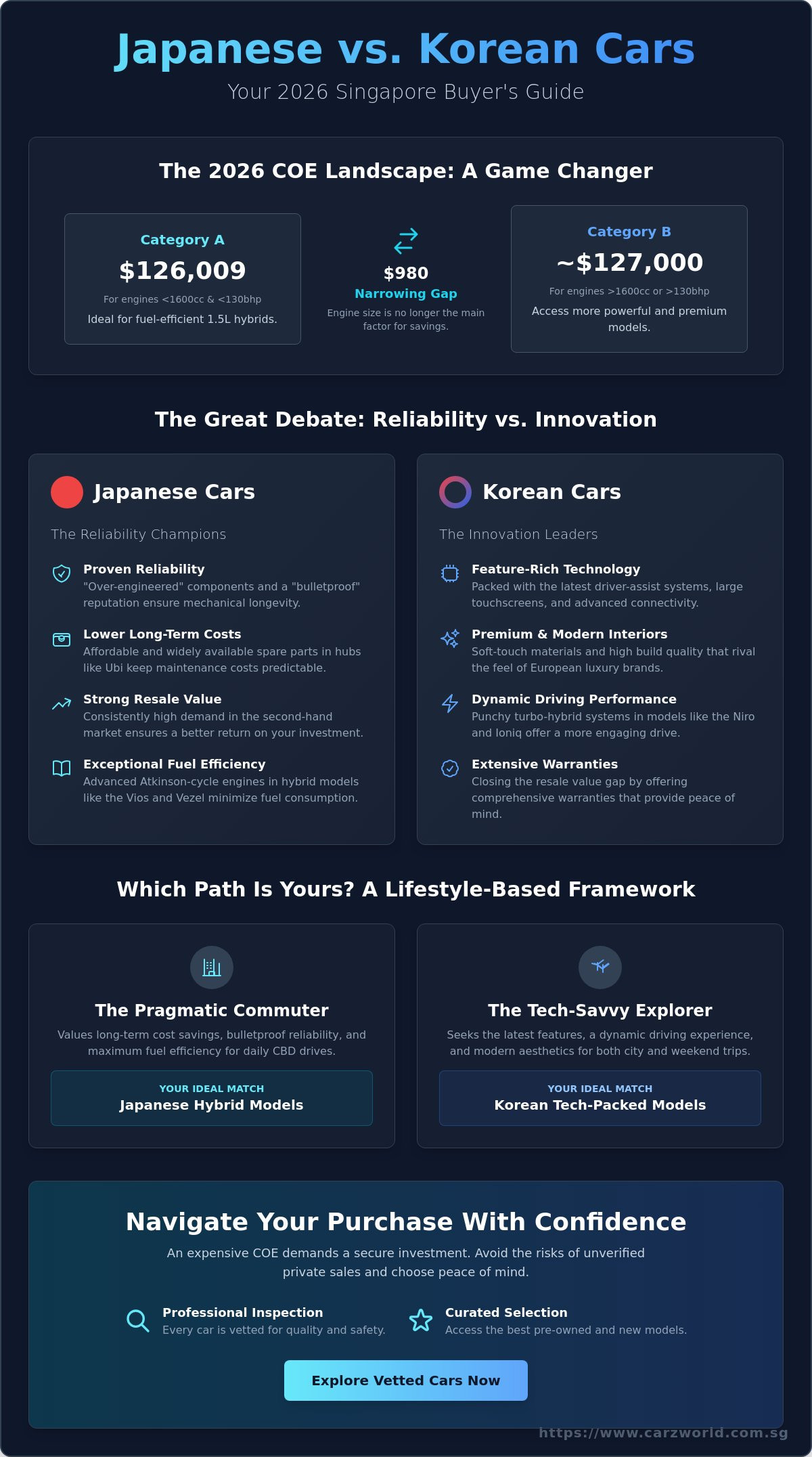
With the price gap between Category A and Category B COEs narrowing to just $980 in June 2026, the old strategy of choosing a smaller engine just to save on taxes has been turned on its head. Many drivers feel overwhelmed by the current cost of ownership and the difficult choice between established Japanese reliability and the high-tech appeal of Korean arrivals. It's a significant financial commitment when COE premiums sit above $126,000, and you want to ensure your investment stands the test of time.
This guide will help you navigate these choices so you can find a vehicle that fits your budget and your daily commute. You'll learn how to maximize your 2026 COE value while balancing long-term maintenance costs and modern features. We'll break down the latest hybrid models, compare lifestyle fits, and clarify the differences between Parallel Import and Authorized Dealer benefits. You'll gain a clear framework for selecting the best japanese and korean cars in singapore to ensure your next purchase is both a practical and rewarding experience.
Key Takeaways
- Learn why the narrowing gap between Category A and B COEs in 2026 changes how you should evaluate engine capacity for better long-term value.
- Discover the distinct differences between the "reliability-first" Japanese philosophy and the "feature-rich" Korean approach to help you choose the best japanese and korean cars in singapore.
- Understand why Japanese models remain the most cost-effective options for long-term ownership due to the wide availability of affordable spare parts in local hubs like Ubi.
- Use our lifestyle-based framework to determine whether a hybrid SUV or a tech-packed sedan best suits your daily CBD commute or weekend trips.
- Find out how a professional inspection and a curated selection of pre-owned or brand new cars provide more security than unverified private sales.
The 2026 Landscape: Why Japanese and Korean Cars Dominate Singapore Roads
Japanese and Korean brands consistently lead the Land Transport Authority (LTA) registration charts in 2026. This dominance isn't accidental. These manufacturers have spent decades refining vehicles specifically for the urban constraints of our city-state. When looking at japanese and korean cars in singapore, it's clear their success stems from a blend of fuel efficiency, right-sized engines, and a deep understanding of local tax structures. They offer a sense of familiarity and reliability that resonates with the local community.
To better understand why these two regions dominate our roads, watch this helpful video:
A primary driver for this market leadership is Singapore's Certificate of Entitlement (COE) system. With premiums for Category A and B sitting at high levels in June 2026, buyers prioritize brands that offer the most value for their money. We've seen a massive shift toward hybrid and electric models. Toyota and Honda lead the hybrid charge with the Vios and Vezel, while Kia and Hyundai have successfully positioned themselves as leaders in the EV space with the Niro and Ioniq series. This "East Asian Advantage" is bolstered by a massive local ecosystem. Spare parts are readily available. Specialized mechanics in Ubi or Sin Ming are intimately familiar with these drivetrains, which keeps long-term maintenance costs predictable and affordable.
The COE Factor: Cat A vs. Cat B Considerations
Engine optimization is a key strategy for brands like Toyota, Honda, and Kia. They specifically tune their engines to stay under the 130bhp limit for Category A. This allows drivers to access premium-feel vehicles while paying the Category A COE price, which was $126,009 in early June 2026. Many buyers are currently choosing 1.5L hybrid models to save on fuel and road tax. You can explore various brand new car options that maximize this specific tax bracket without sacrificing performance.
Resale Value and the PARF/ARF System
Japanese cars often command higher resale prices because of their "bulletproof" reputation in the second-hand market. However, Korean manufacturers are closing this gap by offering extensive warranties and high-spec interiors that maintain appeal over time. The Additional Registration Fee (ARF) also plays a role in your financial planning. Since PARF rebates provide a guaranteed return upon deregistering a car before the 10-year mark, these models remain a safer financial bet for drivers looking for stable long-term ownership costs.
Japanese Reliability vs. Korean Innovation: The Great Debate
The choice between japanese and korean cars in singapore often comes down to a preference for either mechanical longevity or technological flair. Historically, brands like Toyota and Honda built their reputations on "over-engineered" components that withstand heavy use. In 2026, this philosophy continues with the widespread use of Atkinson-cycle engines in hybrids. These engines prioritize thermal efficiency over raw power, ensuring your car remains fuel-efficient for the full 10-year COE cycle. Understanding these specific strengths helps you decide which philosophy aligns with your driving habits.
Korean manufacturers like Hyundai and Kia have taken a "feature-first" approach. They integrate advanced turbo-hybrid systems that offer a punchier driving experience. While some older drivers might remember Korean interiors as feeling "plasticky," the 2026 models have completely changed that narrative. You'll now find soft-touch materials, premium synthetic leathers, and build quality that rivals European luxury brands. According to official government data, these two regions continue to represent the vast majority of our local car population, proving that Singaporeans value both approaches.
The Japanese Edge: Longevity and Ease of Maintenance
Toyota, Honda, and Mazda remain the gold standard for bulletproof engineering. Your local mechanic in Ubi or Sin Ming will likely have the most experience with these brands. This familiarity translates to faster turnaround times and lower labor costs. Because Japanese components are produced in such high volumes, the spare parts market is incredibly robust. This makes owning pre-owned Japanese models a very safe choice, as these vehicles often drive like new even after several years on the road.
The Korean Edge: Advanced Tech and Premium Interiors
If you want a car that feels like a smartphone on wheels, Korea is the place to look. Features like ventilated seats, massive dual-curved infotainment screens, and sophisticated Advanced Driver Assistance Systems (ADAS) often come standard in Korean models. Young drivers in Singapore are increasingly drawn to the bold, futuristic design of the Kia Niro or Hyundai Ioniq. Their rapid advancement in EV technology has also made them a top choice for those looking to transition away from internal combustion engines.
If you're still undecided on which brand fits your lifestyle, you can browse our latest inventory to see these differences in person.
How to Choose: A Lifestyle-Based Selection Framework
Choosing between the various japanese and korean cars in singapore requires more than just a glance at a brochure. It involves a systematic approach to your daily habits and financial goals. A recent market analysis shows that while new competitors are entering the fray, Japanese and Korean manufacturers remain the bedrock of the local market due to their adaptability. By following a clear framework, you can ensure your next vehicle serves you well for the full duration of its COE.
To find your perfect match, follow this five-step framework:
- Step 1: Define your use case. A daily commute to the CBD requires high fuel efficiency, while frequent weekend trips to JB demand comfort and ample luggage space.
- Step 2: Assess your infrastructure. HDB residents may prefer hybrids over full EVs due to charging convenience, whereas landed property owners can easily install home chargers.
- Step 3: Calculate the 10-year TCO. Don't just look at the sticker price. Factor in insurance premiums, road tax, and the tiered ARF system to understand the true cost.
- Step 4: Choose your channel. Decide if you want the specific, high-spec options often found with Parallel Imports or the standard packages from Authorized Dealers.
- Step 5: Test drive. Visit a multi-brand showroom like Carz World to compare different models back-to-back.
For the Family: Choosing the Right MPV or SUV
Families often struggle to choose between the compact Toyota Sienta and the larger, more luxurious Kia Carnival. The Sienta is perfect for narrow HDB carparks, while the Carnival offers a "continental" feel with massive interior space. The Honda Vezel remains a top choice for small families because it balances urban agility with impressive fuel economy. If you're undecided, exploring rental options is a great way to live with a car before committing to a purchase.
For the Urban Professional: Efficiency and Style
Urban professionals often prioritize a sharp image alongside low running costs. The Mazda 6 offers a premium, driver-centric cockpit, while the Hyundai Elantra provides cutting-edge tech at a competitive price. In 2026, hybrid technology is essential for stop-start traffic in the city. If you're looking to upgrade, our export car market services can help you manage your current vehicle effectively as you transition to a newer model.
Standout Models: Top Japanese and Korean Picks at Carz World
Selecting the right vehicle involves looking at specific models that have proven their worth on local roads. When evaluating japanese and korean cars in singapore, certain models stand out because they solve specific pain points for drivers here. Many drivers looking for japanese and korean cars in singapore find that these specific models offer the best balance of price and performance in the current 2026 market.
The Honda Vezel Hybrid continues to be a dominant force. It remains a leader in fuel efficiency and maintains remarkably high resale value in the second-hand market. Its compact footprint makes it ideal for navigating peak-hour traffic. In contrast, the Kia Niro Hybrid offers a tech-packed alternative. It provides a continental driving feel with premium interior finishes, all while staying within an Asian car price bracket. This balance makes it a favorite for those who want luxury features without the higher maintenance costs associated with European brands.
For families, the Toyota Sienta Hybrid is the ultimate compact MPV. It handles tight Singaporean carparks with ease while offering the flexibility of seven seats. It's a practical solution for multi-generational families who need space without the bulk of a full-sized van. If you're ready to transition to full electric, the Hyundai Ioniq 5 and Ioniq 6 lead the charge. These models offer futuristic design and impressive range, making them practical choices for 2026 drivers who have access to charging points at home or in public lots.
Spotlight on Japanese Icons
The Honda Vezel is famous for its Magic Seats. This feature allows you to flip the rear bench up to carry tall items like potted plants or bicycles. It's a level of utility that few competitors can match in such a small frame. Meanwhile, the Toyota Prius remains the gold standard for high-mileage drivers. Its hybrid drivetrain is incredibly durable, which is why it's a favorite for those who spend hours on the road every day. If you want something more rugged and straightforward, the Mitsubishi ASX provides a value-oriented SUV experience with a focus on durability and ease of use.
Spotlight on Korean Innovators
The Kia Cerato remains one of the best value-for-money sedans in the Category A bracket. It offers a spacious cabin and a sleek exterior that feels modern and upscale. The Hyundai Tucson Hybrid is another standout. It blends premium aesthetics with significant fuel savings, proving that you don't have to sacrifice style for efficiency. You can browse the full Japanese and Korean collection to see which design language speaks to you.
If you want to experience these features firsthand, you should view our brand new car inventory today.
The Carz World Advantage: Peace of Mind for Your Purchase
Navigating the selection of japanese and korean cars in singapore requires a partner who understands local logistics and regulatory requirements. While private listings might look tempting, they often hide mechanical issues or complex paperwork trails that can lead to future headaches. Choosing an established dealer like Carz World ensures your investment is protected through a rigorous inspection process. We don't just sell cars; we provide a complete ownership solution that prioritizes your safety and satisfaction. Every vehicle in our curated selection undergoes a thorough mechanical check to ensure it meets our high standards before it ever reaches the showroom floor.
Our team handles the heavy lifting so you don't have to. This includes managing your COE bidding, LTA transfers, and insurance arrangements all in one place. By centralizing these processes, we eliminate the stress of coordinating with multiple third-party vendors. We also offer flexible financing options designed to be accessible and straightforward. These loans are tailored to fit your monthly budget, making the transition to a newer model a seamless experience. Our goal is to make the entire transaction feel fluid and positive from start to finish.
Parallel Import (PI) vs. Authorized Dealer (AD)
When comparing japanese and korean cars in singapore, many buyers are surprised to learn that Parallel Import (PI) models often feature higher equipment levels than their Authorized Dealer (AD) counterparts. We prioritize faster delivery times so you can get on the road without unnecessary delays. Our pricing is completely transparent. You won't encounter hidden "admin fees" or unexpected "COE top-up" surprises when you sit down to sign the contract. If you're looking to fund your next purchase, you can easily Sell your car through our streamlined appraisal system to get a fair market value quickly.
Visit Our Showrooms
We invite you to visit our showrooms at Vertex in Ubi or Alexandra Central Mall to see our inventory in person. Our "Customer-First" philosophy means you'll never face high-pressure sales tactics. Instead, our consultants provide expert advice based on your specific lifestyle needs and driving habits. For 2026, we've strengthened our commitment to transparency by providing comprehensive vehicle history reports for every car in our inventory. This ensures you know the exact pedigree of your vehicle before you drive off the lot. We believe that building trust through honesty is the only way to maintain a long-term reputation in this industry.
Start Your Driving Future Today
Choosing the right vehicle involves more than just picking a brand. It's about finding the perfect balance between legendary reliability and the high-tech features that make every commute easier. By understanding how the 2026 COE categories and lifestyle frameworks impact your purchase, you can invest in a car that offers genuine value for the next decade. Whether you prefer the mechanical longevity of Japanese engineering or the bold innovation of Korean models, the ideal fit for your daily routine is within reach.
We're here to help you navigate this complex process with confidence. With over 800 Japanese and Korean models in stock, our team provides a dependable and customer-centric experience that has earned us consistent 5-star reviews. You can visit our convenient showrooms in Ubi and Alexandra to see our curated selection in person. We're committed to making your search for japanese and korean cars in singapore a seamless and rewarding journey.
Explore Our Full Collection of Japanese and Korean Cars Today!
Frequently Asked Questions
Are Korean cars as reliable as Japanese cars in 2026?
Modern Korean brands have effectively closed the reliability gap with their Japanese counterparts in 2026. They consistently rank at the top of global quality studies and offer robust warranties that provide long-term security. While brands like Toyota are still famous for mechanical longevity, Hyundai and Kia now use high-quality materials and advanced engineering that stand up to years of daily use for japanese and korean cars in singapore.
Which Japanese car brand has the highest resale value in Singapore?
Toyota remains the Japanese brand with the highest resale value in Singapore. This strong performance is driven by the massive demand for their hybrid models in the second-hand market and their reputation for lasting well beyond a 10-year COE cycle. Honda also performs exceptionally well, as both brands benefit from a huge local network of specialized mechanics and readily available spare parts that keep long-term maintenance costs predictable for future owners.
Can I buy a brand new Japanese car via parallel import at Carz World?
Yes, we offer a wide range of brand new Japanese models through our parallel import services. Choosing a brand new car from this category often gives you access to specialized features and higher trim levels that are not found in the standard local catalog. We manage the entire registration process and ensure all pricing is transparent, so you can drive home your new vehicle with complete confidence and full documentation.
What is the difference between Cat A and Cat B COE for Japanese SUVs?
The primary difference lies in the engine's power output and capacity. Category A is reserved for cars with engines up to 1,600cc and 130bhp, while Category B covers more powerful vehicles. Many Japanese SUVs are designed to fit into Category A to keep ownership costs lower. This category distinction is vital for your budget, as it directly impacts both your initial COE bid and your annual road tax payments over the next decade.
Is it easy to find spare parts for Korean cars in Singapore?
It is very easy to find spare parts for Korean cars across Singapore. Because brands like Kia and Hyundai have become so popular, local distributors maintain a constant supply of both original and high-quality aftermarket components. You'll find that workshops in industrial hubs like Ubi are well-equipped to handle repairs quickly. This ensures your vehicle stays on the road without long waits for imported parts, making maintenance a stress-free experience for any owner.
Does Carz World offer financing for both Japanese and Korean used cars?
We provide comprehensive financing solutions for both Japanese and Korean pre-owned vehicles. Our team works closely with reputable banks to secure competitive interest rates that align with your financial goals. We believe in a transparent process, so we'll explain all the terms clearly without any hidden fees. This allows you to focus on choosing the right car while we handle the complex administrative details and paperwork of your loan for you.
What should I check when buying a second-hand Japanese car?
You should always verify the full service history and check for any signs of major accident repairs. It is also important to test the hybrid battery health and inspect the interior for excessive wear that might suggest high mileage. When you look at japanese and korean cars in singapore at our showroom, you can rest assured that every unit has passed a strict mechanical inspection to guarantee its quality and roadworthiness for the future.
Which is better for fuel economy: Toyota Hybrid or Kia Hybrid?
Toyota hybrids generally offer the best fuel economy for city driving due to their specialized engine designs that prioritize thermal efficiency. They are specifically built to maximize every drop of fuel in heavy traffic. Kia hybrids provide a different advantage by using turbo-hybrid systems that offer more punchy acceleration while still maintaining excellent efficiency. Your final choice depends on whether you value maximum fuel savings or a more spirited driving experience during your daily commute.
Disclaimer
This content is provided for general informational purposes only. Readers are encouraged to independently verify important information.
In Same Category
- Used Toyota Camry Singapore: The 2026 Buyer’s Guide to Value & Reliability
- SGCarmart: 2026 Essential Guide to Used Cars in Singapore
- Sell My Car Singapore: The 2026 Ultimate Guide to Getting the Best Value
- Toyota Estima Price Singapore 2026: The Complete Financial Guide
- Toyota Voxy vs Toyota Estima: Which Family MPV Reigns Supreme in Singapore?
Related by Tags
- Used Toyota Camry Singapore: The 2026 Buyer’s Guide to Value & Reliability
- SGCarmart: 2026 Essential Guide to Used Cars in Singapore
- Toyota Voxy vs Toyota Estima: Which Family MPV Reigns Supreme in Singapore?
- Buying a Used Honda in Singapore: The Ultimate 2026 Guide to Value and Reliability
- Honda Shuttle vs Toyota Sienta: The Ultimate 2026 Comparison for Singapore Families
- How to Buy a Car in Singapore: The Ultimate 2026 Step-by-Step Guide
- Buying a Used Toyota in Singapore: The Ultimate 2026 Value Guide
- COE Renewal Singapore: The Ultimate 2026 Guide to PQP, Costs, and Strategy
- How to Negotiate Used Car Price in Singapore: The 2026 Insider’s Guide
- 10 Critical Red Flags to Watch for When Buying a Used Car in Singapore (2026)
- Parallel Import New Cars Singapore: The 2026 Ultimate Buying Guide
- 15 Practical Saving Tips for Car Buyers in Singapore (2026 Edition)
- Best Used Car Deals in Singapore: Your 2026 Guide to Value and Reliability
- Total Cost of Ownership Calculator: The Real Cost of a Car in Singapore (2026)
- Used Car Warranty in Singapore: The Ultimate Guide to Protecting Your Investment (2026)
- Pre-Purchase Car Inspection Singapore: The Complete Buyer’s Guide (2026)
- Used Car Maintenance Costs in Singapore 2026: The Complete Owner’s Guide
- Buying Chinese Cars in Singapore: The Ultimate 2026 Buying Guide
- Common Problems with Used Cars: A Singapore Buyer’s Guide to Avoiding Lemons
- The Importance of Car Service History: Protecting Your Investment in 2026
- Financial Planning for Buying a Car in Singapore: A 2026 Roadmap
- Lemon Law for Used Cars in Singapore Explained: Your Rights as a Buyer
- Top-of-the-Chart Hybrid Cars in Singapore: The 2026 Buyer’s Guide
- The Impact of COE on Used Car Prices in Singapore: A 2026 Guide
- Choosing the Right Van for Business in Singapore: A 2026 Comprehensive Guide
- Electric Cars (EV) in Singapore: The Ultimate 2026 Buying Guide
- Performance Cars for Sale in Singapore: The Enthusiast’s 2026 Buying Guide
- Luxury Sedan Used Cars in Singapore: The Complete 2026 Buyer’s Guide
- Best Compact SUV for City Driving in Singapore: The 2026 Urban Guide
- Used Japanese Cars for Sale: The Ultimate Singapore Buyer’s Guide for 2026
- Best 7 Seater SUV Singapore: The 2026 Family Guide to Space and Value
- The Ultimate Guide to Buying Continental Cars in Singapore (2026 Edition)
- Understanding the Vehicle Emission Scheme (VES) in Singapore: A 2026 Guide
- Bidding for COE Number in 2026: The Complete Strategic Guide for Singapore Car Buyers