Checking for Accident Damage on a Car: The Ultimate 2026 Singapore Inspection Guide
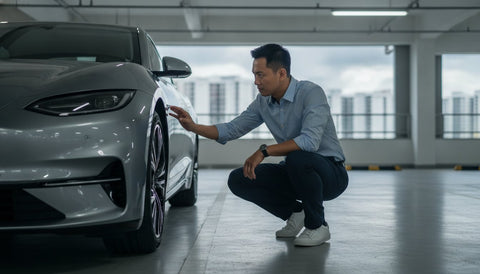
What if the "accident-free" claim on a listing is actually hiding a history of structural repairs tucked away behind a fresh layer of paint? With Category A COE premiums reaching $123,847 in June 2026, buying a used vehicle in Singapore is a significant financial commitment. It's understandable why many buyers feel a sense of distrust when reviewing a car's history, as official reports don't always capture private, off-record repairs. Mastering the art of checking for accident damage on a car is the only way to ensure your investment is truly safe and structurally sound.
We've created this guide to help you look past the polished exterior and spot the subtle signs of past collisions like a professional inspector. You'll learn exactly what to look for, from misaligned panels to irregular welding marks. We'll provide a clear checklist to follow and explain how to distinguish between minor cosmetic scuffs and serious frame damage. This knowledge will empower you to make an informed decision or walk away from a compromised deal with absolute peace of mind.
Key Takeaways
- Understand why official history reports often miss private settlements and why a physical inspection is essential in the Singapore market.
- Master simple visual techniques like the "Marble Test" to identify inconsistent panel gaps and mismatched paint finishes that indicate past repairs.
- Learn the professional secrets of checking for accident damage on a car by inspecting structural pillars and engine bay bolts for signs of tampering.
- Discover how a targeted test drive can reveal alignment issues and drivetrain stress that suggest a history of heavy impact.
- Gain the confidence to choose certified pre-owned vehicles that have already undergone rigorous multi-point inspections to ensure your safety and investment.
Why History Reports Aren’t Enough: The "Off-Record" Reality in Singapore
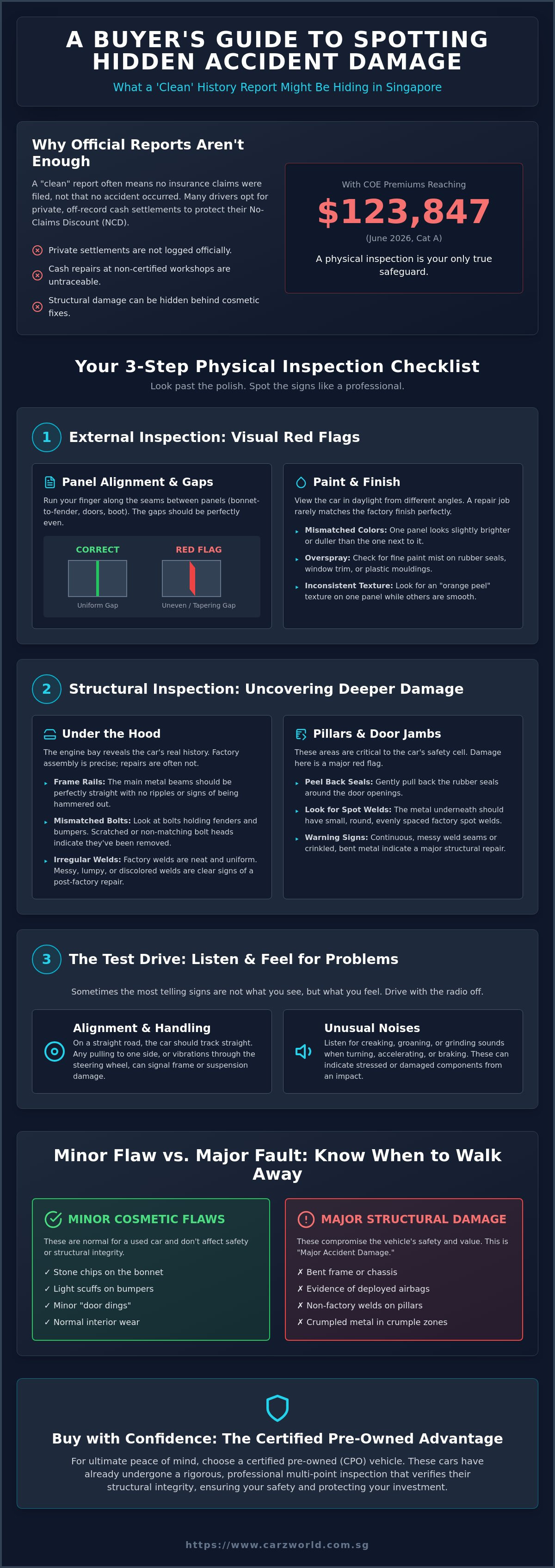
Relying solely on a vehicle history report is a common mistake for many used car buyers in Singapore. While the General Insurance Association (GIA) and Land Transport Authority (LTA) provide valuable data, these logs only tell part of the story. A "clean" report simply means no insurance claims were filed. It doesn't guarantee the car hasn't been involved in a collision. In our high-stakes market, sellers often have a strong incentive to keep accident records off the books to preserve resale value.
The "Singapore Factor" plays a massive role here. Many drivers opt for private settlements after a minor or even moderate accident. By paying cash for repairs, they avoid losing their No Claims Discount (NCD) and prevent the accident from appearing on official databases. This creates a significant data gap. To protect your investment, you must supplement these reports with an independent, third-party professional service. Relying on your own skills for checking for accident damage on a car is the only way to uncover these hidden private repairs.
To better understand this concept, watch this helpful video:
The Limitations of Official Vehicle Logs
Insurance databases in Singapore primarily track claims where a payout was made. If a car was involved in a "self-skid" or a minor brush with a wall, the owner might choose a cheaper workshop for a quick fix. These cash-based repairs are invisible to the next buyer. The biggest risk is purchasing a vehicle with a "straightened" chassis. Even if the car looks perfect on paper, a compromised frame affects safety and handling. Reputable dealers like Carz World address this by offering a professional multi-point inspection on all pre-owned inventory, ensuring that what you see is what you actually get.
Minor Scratches vs. Structural Integrity
It's important to remember that every used car will have some level of wear. Small stone chips on the bonnet or minor scuffs on the bumper are normal and don't affect safety. However, you must be able to define "Major Accident Damage." This refers to anything that compromises the car's original structural integrity, such as crumpled crumple zones or deployed airbags. When checking for accident damage on a car, your focus should always be on safety-critical components. A professional inspection prioritizes the pillars, floor pans, and engine mounts over simple cosmetic touch-ups. Knowing the difference allows you to accept minor flaws while walking away from dangerous structural defects.
External Inspection: Spotting the Visual Red Flags
Visual evidence is often the first sign that a vehicle has a hidden history. While a car might look pristine under showroom lights, a tactical approach to checking for accident damage on a car reveals what the seller might not mention. You don't need expensive equipment to perform a basic assessment. Most professional inspectors rely on their eyes and a few simple physical tests to identify inconsistencies in the bodywork.
One effective method is the "Marble Test" or "Finger Test." Run your index finger along the gaps between panels, such as where the bonnet meets the wings. These gaps should be perfectly uniform from top to bottom. Modern Continental vehicles, like those from BMW or Audi, typically feature extremely tight tolerances compared to some mass-market Japanese or Korean models. If a German car has a gap wide enough for a marble, or if the gap tapers significantly, it's a clear indicator that the panel has been removed or the underlying structure was pushed out of alignment. Because these findings can be subtle, it is always wise to get an independent inspection before signing any contracts.
Panel Alignment and Gaps
Uneven gaps are rarely a factory defect. If the space between the bonnet and the front grille is wider on one side, the car has likely suffered a front-end impact. Don't stop at the front. Check the door seams carefully. All four doors should close with the same sound and require the same amount of effort. A "tinny" sound or a door that needs a firm shove suggests the door frame is slightly warped. Inspect the fuel filler flap as well. This small panel is often overlooked during a respray, making it easy to spot colour mismatches against the rear-quarter panel.
Paint Quality and Texture Analysis
Factory paint is applied by robots in a sterile environment, resulting in a specific "orange peel" texture that is uniform across the entire car. Aftermarket repairs often leave "fish eyes" or tiny dust nibs trapped under the clear coat. Use a high-powered flashlight to look for sanding marks beneath the surface. These fine lines are a dead giveaway of body filler usage. Always check the inner door sills and the underside of the bonnet. Repainted cars often show a slight colour difference or a lack of clear coat in these hidden areas.
Lights, Glass, and Tyres
Mismatched headlights are a major red flag. If one headlight looks crystal clear while the other is slightly yellowed or pitted, the newer one was likely replaced after a collision. Check the manufacturer stamps on every window. If most windows say "Toyota" but the windscreen is unbranded or from a different year, it has been replaced. Finally, look at the tyres. Uneven wear on the inner or outer edges often points to a bent chassis or damaged suspension components that prevent proper alignment. If you want to skip the guesswork, explore the pre-owned inventory at Carz World, where every vehicle has already passed these rigorous visual checks.
Under the Hood and Chassis: Detecting Structural Repairs
Moving your inspection from the exterior to the internal structure is where you truly separate a well-maintained vehicle from one with a hidden past. While a skilled body shop can make a car look perfect on the outside, the skeleton of the vehicle often retains the scars of a major impact. Checking for accident damage on a car at this level requires a methodical approach, as structural repairs are both safety-critical and incredibly expensive to rectify.
One of the most reliable indicators is the "Bolt Head" secret. During the manufacturing process, car brands paint the bolts in the engine bay after they are installed. Look closely at the bolts securing the wings and the bonnet. If you see exposed silver metal on the edges or if the paint appears cracked and rounded, a wrench has been used to remove those panels. This suggests they were either replaced or removed for extensive repair. Similarly, inspect the A, B, and C pillars, which form the safety cage of the cabin. Any signs of "bubbly" or irregular welding here are a massive red flag. Factory spot welds are always perfectly circular and evenly spaced. Aftermarket welding is almost always messier and less uniform.
Engine Bay and Front Support
The front of the car is the most common area for collision damage. Start by inspecting the radiator support, which is the metal frame holding the radiator in place. It should be perfectly straight with no kinks or fresh, non-factory paint. Check the inner wings and look at the sealant beads where the panels meet. On most Continental models, these beads are applied with robotic precision. If the sealant on the left side looks different from the right, one side has been repaired. Be wary of an engine bay that is "too clean." While a tidy engine is nice, a heavy steam clean can sometimes be used to hide fluid leaks or fresh repair marks from a recent collision.
The Chassis and Crumple Zones
The chassis is the foundation of the car, and any damage here is a deal-breaker. Look at the main frame rails for "clamping marks." These are small indentations or scratches left by a frame-straightening jig used to pull a bent chassis back into alignment. You should also check the "crumple zones" for any permanent kinks in the metal. These areas are designed to fold during a crash to absorb energy. Once they have been compromised, they cannot be safely "unfolded." Finally, always lift the carpet in the boot to inspect the spare tyre well. This area is rarely seen and often contains "ripples" in the metal if the car has suffered a rear-end hit. If you find these signs, it is best to walk away. At Carz World, we perform these deep structural checks on all our pre-owned cars so you don't have to worry about hidden frame damage.
The Test Drive and Professional Assessment
While visual and structural checks are vital, the way a vehicle behaves on the road often tells the final truth. A car might look perfect in a car park, but a test drive can reveal underlying mechanical stress that static inspections miss. Checking for accident damage on a car must include a rigorous dynamic test to ensure the vehicle’s handling hasn't been compromised by a past collision.
One of the most effective maneuvers is the "Hands-Off" steering check. On a flat, straight road with no traffic, briefly loosen your grip on the steering wheel. If the car immediately drifts to one side, it suggests an alignment issue or, more seriously, a slightly twisted chassis. You should also listen for "clunks" when driving over speed bumps or "whines" from the drivetrain during acceleration. These sounds often indicate that the energy from a previous impact has stressed the suspension mounts or transmission components. A car that has been properly repaired should feel tight, responsive, and silent.
Dynamic Testing on the Road
Braking behavior provides another clue. Apply the brakes firmly on a clear stretch of road. If the car pulls to one side or the pedal vibrates excessively, the braking system or wheel hubs may be damaged. You should also pay close attention to the dashboard when you first turn the ignition. Every warning light, including the airbag symbol, should illuminate briefly and then disappear. If the airbag light never turns on, it's possible the bulb has been removed or the circuit has been taped over to hide a deployed system. High-speed vibrations are another red flag. While often just a wheel balance issue, persistent shaking through the seat or floor can point to a bent axle or a damaged propshaft.
Engaging Singaporean Inspection Centres
In the Singapore market, professional evaluation reports from STA or VICOM are the gold standard. A standard LTA inspection is merely a "fitness for road" check and won't uncover hidden accident history. You should always insist on a comprehensive evaluation. As of 2026, a comprehensive STA vehicle evaluation costs $237.62, inclusive of GST. These reports provide a Grade (A to D) based on the vehicle's condition. A Grade A or B report is essential for peace of mind, as it confirms the chassis and structural components are intact.
If a private seller refuses to allow an evaluation at an authorized center, it is usually a sign to walk away. Reputable dealers understand the importance of this transparency. If you want to bypass the stress of private negotiations and unverified claims, browse our rigorously inspected pre-owned cars for a safer buying experience. We ensure every vehicle meets high standards before it ever reaches our showroom, so you can buy with absolute confidence.
Buying with Confidence: Why Certified Pre-Owned is the Safer Bet
Buying a car privately in Singapore often feels like a gamble. While you now have the tools for checking for accident damage on a car, performing these checks in a dimly lit car park isn't the same as a professional workshop evaluation. Private sales are almost always "as-is" transactions. If you discover a bent chassis or a hidden structural repair three days after the handover, you have very little legal recourse. Choosing a reputable dealer provides a layer of protection that private sellers simply cannot match.
The Singapore Lemon Law offers a crucial safety net for those who buy from registered dealers. It covers used cars for defects for up to six months after the date of purchase. This protection does not apply to consumer-to-consumer sales. This legal framework, combined with a professional multi-point inspection, ensures that your investment is sound. At Carz World, we take this responsibility seriously because our long-term reputation depends on the quality and safety of every vehicle we sell.
The Carz World Inspection Standard
We perform the heavy lifting long before a car ever reaches our showroom. Our experienced team pre-screens every vehicle to filter out those with major structural issues or unrecorded private repairs. This rigorous process saves you the stress of checking for accident damage on a car yourself on every single viewing. Buying from an established dealer with a physical presence means you have a dependable partner for the entire ownership journey. You can explore our current range of inspected pre-owned cars to see the difference that professional curation makes.
The Value of Transparency and Trust
Transparency is the foundation of a positive buying experience. We don't just ask you to take our word for it; we encourage third-party inspections and provide a clear, honest history of the vehicle. Our business model relies on authentic, peer-to-peer endorsement, which is why our communication is backed by a continuous stream of satisfied client testimonials. If you are looking to sell your car, we offer fair valuations based on its actual condition, ensuring a transparent and efficient process for both buyers and sellers.
Before you sign the final Sales Agreement, ensure you have reviewed this essential document checklist:
- LTA Log Card: This confirms the ownership history and exact vehicle specifications.
- Vehicle Accident Report History (VARH): A GIA report that shows insurance claims reported over the last six years.
- Service History: Verified records showing how the previous owner maintained the vehicle.
- Professional Evaluation Report: A Grade A or B certificate from STA or VICOM to confirm structural integrity.
Secure Your Next Drive with Confidence
Purchasing a used vehicle in Singapore's high-value market requires more than just a quick look at a log card. You've learned that official reports often miss private settlements, making your own physical assessment vital. By focusing on panel alignment, structural welds, and dynamic test drive behavior, you're now equipped to spot red flags that others might miss. Mastering the process of checking for accident damage on a car ensures you don't inherit someone else's hidden mechanical troubles.
At Carz World, we believe that transparency is the foundation of every successful transaction. We're a trusted name in Singapore for both pre-owned and new cars because we do the heavy lifting for you. Every vehicle in our inventory undergoes a professional multi-point inspection and comes with transparent history reports to ensure total peace of mind. Why take a risk on unverified listings when you can choose a partner who values your safety? Browse our 100% inspected and certified used cars today. With the right knowledge and a dependable partner, you can drive away in a vehicle that's truly worth every dollar.
Frequently Asked Questions
Can a car be "accident-free" if it has had a bumper replaced?
Is it illegal to sell a car with hidden accident damage in Singapore?
It isn't a criminal offense, but the Singapore Lemon Law protects you if you buy from a registered dealer. If a dealer fails to disclose significant defects, you can legally claim for a repair, replacement, or refund within six months. Private sellers aren't covered by this law, which makes checking for accident damage on a car essential before finalizing a private deal.
How much does a professional pre-purchase inspection cost at VICOM or STA?
As of 2026, a comprehensive vehicle evaluation at STA costs $237.62, inclusive of the 9% GST. Standard evaluations typically range between $190 and $260 depending on the vehicle type. This fee is a small price to pay compared to the thousands of dollars you might lose when checking for accident damage on a car without professional diagnostic tools.
What is the most common sign of a major accident that people miss?
The most common sign people overlook is mismatched glass branding and date codes on the windows. Every piece of glass on a factory-standard car should usually feature the same manufacturer stamp. If the windscreen is unbranded while the side windows have factory markings, it has likely been replaced. This often points to a major front-end impact or a rollover accident.
Will a chassis repair affect my car insurance premiums in Singapore?
Yes, a history of chassis repair can lead to higher insurance premiums or even a refusal of coverage by some providers. Insurers view structurally repaired vehicles as higher risks because their integrity in a future collision is compromised. If an accident was reported to the GIA, it stays on the vehicle's record for six years, which can also lower the car's insured value.
How can I check if the airbags have ever been deployed?
You should watch the dashboard warning lights closely when you first turn the ignition. The airbag light must illuminate briefly and then disappear; if it stays on or never appears, the system might be faulty or disconnected. You can also feel the seams on the steering wheel boss and passenger dashboard for irregular gaps or glue residue that suggests a cover-up.
Should I buy a car that has been "straightened" on a chassis jig?
You should generally avoid buying a car that has undergone chassis straightening. Even if the car drives straight, the metal has been stressed and won't absorb energy correctly in a subsequent accident. These vehicles have significantly lower resale value and pose a genuine safety risk to you and your family. It's always safer to walk away from a car with structural frame damage.
Does a respray always mean the car was in a crash?
A respray doesn't always indicate a major collision. Many owners in Singapore refresh their paint to fix minor stone chips, sun fading, or small parking scratches. It's a common cosmetic upgrade for older used cars. However, a fresh coat of paint can also be used to hide body filler, so you should always check the door sills and engine bay for over-spray or colour mismatches.
Disclaimer
This content is provided for general informational purposes only. Readers are encouraged to independently verify important information.
In Same Category
- Toyota Prius in Singapore: A Practical Buyer’s Guide for 2026
- Best Cars for Home-Based Businesses in Singapore: 2026 Guide
- Risks of Buying a Car with 1 Year of COE Left in Singapore (2026 Guide)
- Best Second Hand Cars for Malaysia: Singapore Buyer's Guide
- Buying a Used Lorry in Singapore: 2026 Buyer’s Guide
Related by Tags
- Best Cars for Home-Based Businesses in Singapore: 2026 Guide
- Risks of Buying a Car with 1 Year of COE Left in Singapore (2026 Guide)
- Best Second Hand Cars for Malaysia: Singapore Buyer's Guide
- Financial Planning for Your First Car in Singapore
- Best Time to Renew COE in 2026: A Practical Singapore Guide
- COE Renewal for 5 Years vs 10 Years: Pros and Cons in Singapore
- Understanding the MAS Car Loan Restrictions in Singapore (2026)
- Pros and Cons of Buying a High PARF Car in Singapore
- Car Valuation Services in Bukit Merah: A Seller’s Guide
- Calculating the Breakeven Point for COE Renewal in Singapore
- Used Electric Cars in Singapore: 2026 Buyer's Guide
- Electric Vehicle Guide 2026: Types, Charging and Buying in Singapore
- COE Results Singapore: How to Read the Latest Bidding Outcomes in 2026
- Singapore Car Loan Guide for EP Holders (2026)
- Car Consignment Services in Bedok: 2026 Selling Guide
- Mazda CX-5 Singapore Review: Buyer Guide, Specs & Ownership (2026)
- Calculating the Real 5-Year Cost of Car Ownership in Singapore (2026 Guide)
- Used Cars for Sale in Tampines: 2026 Buyer's Guide
- Car Downpayment vs Monthly Instalment in Singapore: The 2026 Budgeting Guide
- Parallel Import Singapore: The Ultimate 2026 Buyer’s Guide
- Car Loan Singapore: The Complete 2026 Guide to Financing Your Vehicle
- How Much Salary to Afford a Car in Singapore: 2026 Affordability Guide
- Buying a Used Car in Singapore: 2026 Ultimate Guide
- What is PARF? The Ultimate Guide to Singapore’s Car Rebate System
- Mercedes-Benz EQB 250+ Review: The Ultimate 7-Seater Family EV in Singapore
- Long Term Car Rental Singapore: 2026 Definitive Guide
- How to Buy a Car in Singapore: The Ultimate 2026 Step-by-Step Guide
- Second Hand Hybrid Cars Singapore: The 2026 Value & Inspection Guide
- Cheapest Car in Singapore: The 2026 Guide to Affordable Ownership
- Parallel Import Cars Singapore: 2026 Buyer’s Guide