Selling a Car with an Outstanding Loan in Singapore: The 2026 Complete Guide

What if the biggest obstacle to upgrading your vehicle isn't finding a buyer, but the "Rule of 78" hiding in your bank contract? Many Singaporean drivers feel trapped when selling a car with outstanding loan because they realize they might owe the bank more than the car is actually worth. With Category A COE prices hitting a record $129,000 in July 2026, the stakes for getting your math right have never been higher. It's completely normal to feel overwhelmed by the prospect of early settlement penalties or the complex LTA transfer requirements.
We understand that you want a clean break from your debt and the maximum cash return possible. This guide shows you exactly how to navigate the 2026 landscape, from calculating your equity against current interest rates of 2.78% to 3.78% to handling the $30,000 PARF rebate cap. You'll learn the step-by-step process to settle your bank debt safely and ensure a seamless ownership transfer without the paperwork stress. We'll break down the logistics so you can move forward with confidence and clarity.
Key Takeaways
- Understand that while the bank holds a financial lien, you can successfully sell your vehicle by initiating a full settlement process.
- Learn how to calculate your equity by comparing your car's current market value against your remaining bank balance to avoid "top-up" surprises.
- Discover the specific steps for selling a car with outstanding loan, starting with obtaining a valid settlement figure from your lender.
- See why trading in with a professional dealer often eliminates the paperwork stress and trust issues common in private sales.
- Gain the confidence to navigate complex financing situations and secure a clean break from your existing car debt.
Can You Sell a Car with an Outstanding Loan in Singapore?
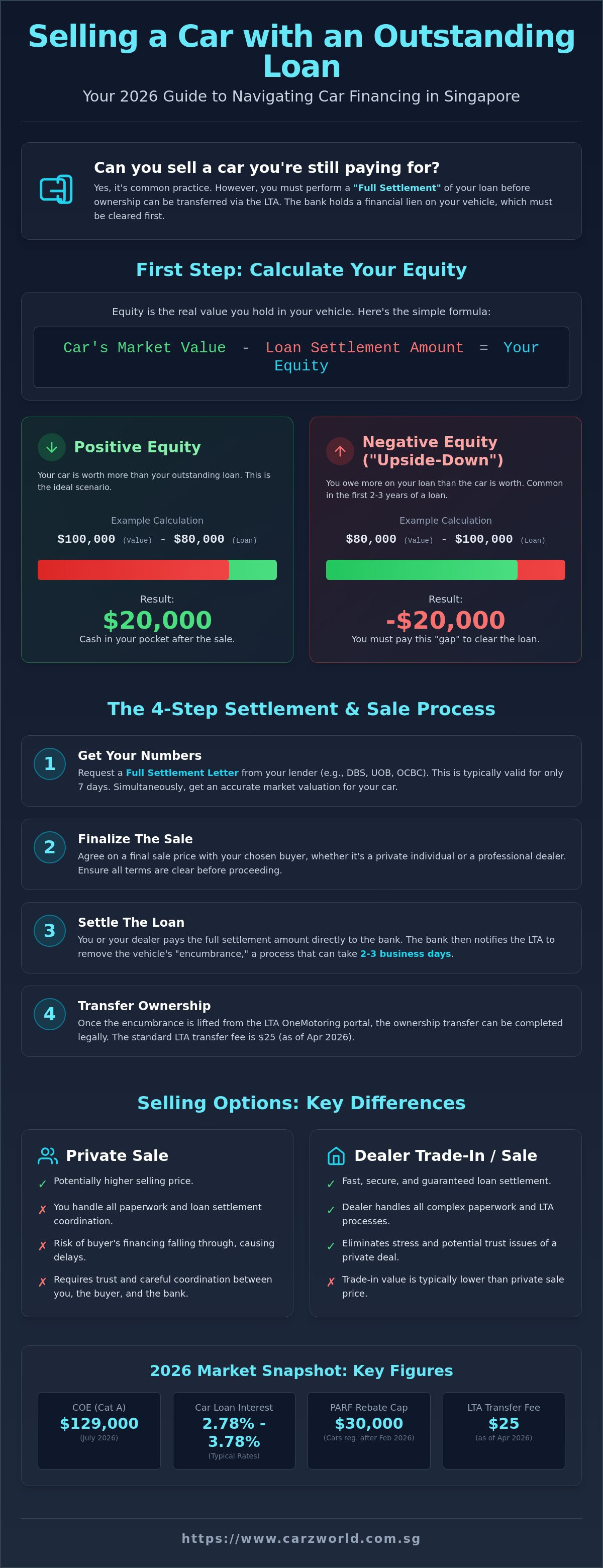
Yes, you can sell your car even if you haven't finished paying the bank. It is a standard practice in Singapore's automotive market. However, you cannot simply hand over the keys and walk away. You must perform a "Full Settlement" before the vehicle changes hands. The bank technically holds a financial lien on your car. In legal terms, while you are the registered owner, the lender retains a claim on the vehicle title until the debt is cleared. Ownership cannot be transferred via LTA until the financing institution officially notifies the authority of the loan discharge.
A Full Settlement Amount is the total sum required to close your account, which includes the remaining principal and early exit fees, offset by any unearned interest rebates. This figure is often higher than the principal balance you see on your monthly statement due to how interest is front-loaded in the early years of a loan.
The Role of the Land Transport Authority (LTA)
The LTA maintains a strict oversight of all vehicle transactions through the OneMotoring portal. If your car has an active loan, the system marks it with an "encumbrance." This status effectively blocks any attempt to transfer ownership. It protects the bank's interests and ensures that buyers don't inherit someone else's debt. Once you or your dealer pays the bank, there is a typical 2-3 day lag before the financial institution notifies the LTA to lift this block. You should plan your timeline around this delay. Only after this discharge is processed can the transfer proceed. The standard LTA transfer fee for a passenger car is $25 as of April 2026. While the buyer often covers this, it is a point of negotiation you should clarify before signing any agreement.
Common Lenders in the Singapore Market
Major banks like DBS, UOB, and OCBC dominate the car loan market in 2026. These institutions have standardized procedures for settling loans, but they require a formal request for a settlement letter. This letter is usually valid for only seven days. You might also have "In-House" financing from a dealership. In-house loans often have different penalty structures compared to traditional bank loans, sometimes involving higher administrative charges. Regardless of your lender, you must obtain your latest loan statement. This document provides the baseline for your calculations and is the first thing a professional buyer will ask for when you are selling a car with outstanding loan. Having this information ready shows you are a serious seller and helps speed up the valuation process.
Calculating Your Equity: Positive vs. Negative Equity
Equity is the financial stake you truly own in your vehicle. It is the simple difference between what your car is worth on the open market and the amount you still owe the bank. If your car is worth $100,000 and your loan balance is $80,000, you have $20,000 in positive equity. You walk away with that cash after the sale. Conversely, negative equity occurs when your loan balance exceeds the car's value. Negative equity is most common in the first 2-3 years of a 7-year loan because cars depreciate fastest when they're new while interest payments are highest.
In 2026, COE fluctuations play a massive role in this calculation. With Category A COE prices sitting at $129,000 as of July 2026, resale values for relatively young used cars have remained high. However, if you bought when COE was lower, you might find your car's value hasn't kept pace with the high cost of a new replacement. Understanding this balance is the first step when you are considering selling a car with outstanding loan.
How to Get an Accurate Market Valuation
To understand your position, you need a realistic valuation. Don't just look at list prices on classified sites. Those are asking prices, not closing prices. You must factor in your specific mileage, the condition of the vehicle, and the remaining COE months. For cars registered after February 2026, remember that the PARF rebate is now capped at $30,000. This cap can significantly lower your car's paper value compared to older models. A private sale might fetch a slightly higher price, but it comes with the risk of the buyer being unable to secure financing. Dealers provide a trade-in price that is typically lower than private sales but offers the benefit of an immediate, guaranteed settlement.
Handling the 'Upside-Down' Loan Scenario
Being "upside-down" on a loan is a stressful position. If you have negative equity, you must pay the bank the "gap" amount out of your own pocket before the LTA allows the ownership transfer. High-mileage cars are particularly prone to this in the current market because their market depreciation often outruns the loan repayment schedule. You have a few options here. Most sellers use cash savings to cover the shortfall. If cash isn't available, some take out a separate personal loan, though interest rates in 2026 for such products can be high. When you work with a professional dealer, you can often negotiate to have the negative equity absorbed into the financing of your next vehicle purchase. This allows you to settle any outstanding loans without an immediate large cash outlay.
If you're unsure where you stand, a professional car valuation can clarify your equity position in minutes.
Step-by-Step: The Process of Selling Your Car with a Loan
Once you've determined your equity position, you can begin the formal logistics of the sale. The process of selling a car with outstanding loan is more structured than a cash-and-carry transaction. It requires coordination between you, the buyer, and the financial institution. You don't necessarily need to have the cash on hand to pay the bank first. Most professional transactions involve the buyer or a dealer paying the bank directly to discharge the lien. This ensures the money goes exactly where it needs to go to free up the vehicle's title.
Follow these five steps to ensure a smooth transition:
- Step 1: Request a "Full Settlement Figure" from your bank. This document is typically valid for seven days.
- Step 2: Obtain a firm purchase offer. Whether you're selling to a private party or a dealer, get the price in writing.
- Step 3: Clear the loan. The buyer pays the bank the settlement amount. If you have negative equity, you'll need to provide the "top-up" funds at this stage.
- Step 4: Wait for the bank to update the LTA. This typically takes 2 to 5 working days.
- Step 5: Complete the ownership transfer. Once the lien is lifted, both parties log into OneMotoring to finalize the deal.
Requesting the Settlement Figure
You must specify a precise "Settlement Date" when calling your bank. This is because interest is calculated daily. If you pay even one day late, the figure changes. Most Singaporean banks use the "Rule of 78" for car loans. This method weights interest payments heavily toward the beginning of the loan term. You might find your interest rebate is smaller than expected if you're in the early years of your tenure. Additionally, prepare for early settlement penalties. These are usually 1% of the original loan amount, though some lenders charge a percentage of the remaining interest instead. Having your latest loan statement ready will help you verify these numbers quickly.
The Transfer of Ownership via OneMotoring
The final transfer happens digitally via the OneMotoring portal using Singpass. It's a secure and instant process, but it only works once the bank notifies the LTA that the loan is cleared. You'll initiate the transfer, and the buyer must log in to accept it. During this transition, your car insurance doesn't automatically transfer. You'll need to cancel your policy to receive a pro-rated refund. Similarly, any remaining road tax stays with the vehicle, so you should factor its value into your final selling price. If you want a hassle-free experience, selling your car to a professional dealer allows them to handle all these administrative hurdles on your behalf.
Private Sale vs. Dealer Trade-In: The Loan Factor
Deciding between a private sale and a dealer trade-in involves more than just comparing the final price tag. When you are selling a car with outstanding loan, the complexity of the transaction often dictates the best route. A private sale might promise a higher gross figure, but the logistical hurdles can be significant. Dealers provide a streamlined path by acting as a financial intermediary, ensuring that the bank is paid and the title is cleared without you having to manage the cash flow yourself.
Why Private Sales are Difficult with Loans
The biggest barrier in a private transaction is the "Trust Gap." Most buyers are understandably wary of paying a large sum of money to a bank for a car that is still legally tied to your name. They fear a scenario where you disappear after the loan is settled but before the LTA transfer is accepted. Coordinating a three-way meeting between the buyer, the seller, and the bank is a logistical challenge. It often requires all parties to be physically present at the bank branch during office hours to ensure the payment is processed correctly.
Even if the buyer is willing, their own lender might refuse to issue a loan for a vehicle that has an existing encumbrance. This creates a situation where neither side wants to release funds first. If you're looking for a new ride while navigating these hurdles, you can browse Used Cars for Sale to see what your next options are, but the private sale process remains slow and labor-intensive.
The Dealer Advantage: 'Sell and Forget'
Professional dealers like Carz World simplify this by taking over the bank liaison entirely. We act as a bridge, paying the bank the full settlement amount immediately. This stops your interest accrual on the spot, which is vital given the 2.78% to 3.78% interest rates seen in 2026. Because dealers have established relationships with major lenders like DBS and UOB, the discharge of the lien is often faster than in a private transaction. You won't have to spend your afternoon waiting at a bank branch or worrying about LTA paperwork.
Consignment offers a middle ground where a dealer markets your car for a higher price while you retain ownership. However, this often results in a slower loan settlement since the bank isn't paid until a final buyer is found. For many, the "sell and forget" nature of a direct dealer purchase is the most reliable way to handle selling a car with outstanding loan. You receive the balance of your equity in cash, and the administrative burden vanishes.
If you want a quick and secure way to clear your debt and move on to your next vehicle, you should sell your car to us for a hassle-free loan settlement.
How Carz World Simplifies Your Sale and Loan Settlement
Carz World understands that the paperwork involved in selling a car with outstanding loan is often the biggest deterrent for most owners. While earlier sections highlighted the complexities of the "Rule of 78" and LTA discharge lags, our role is to remove those burdens from your shoulders. We specialize in handling complex financing cases. This includes situations where you might be facing significant negative equity or high-loan balances. Our professional staff manage all communications with your bank, ensuring that the settlement is accurate and the lien is lifted as quickly as possible.
If you're planning an upgrade, we offer a seamless transition to our wide selection of Brand New Cars. We can often coordinate the settlement of your old debt while arranging the financing for your next vehicle. Our valuation process is completely transparent. We show you exactly how we've accounted for your loan balance and current market trends, such as the $129,000 Category A COE prices seen in July 2026. This clarity ensures you know your exact equity position before you sign any documents.
Our 24-Hour Settlement Guarantee
We know that every extra day your loan remains active is another day of interest accrual. That's why we offer an expedited settlement process. Once we agree on a price, we aim to pay your bank within 24 hours. You can visit our showrooms at Vertex or Alexandra for a quick, professional valuation by our experienced team. Recently, we helped a client who was struggling to exit a high-interest loan during a sudden COE spike. By handling the bank liaison and providing an immediate settlement, we saved them from weeks of additional interest payments and the stress of managing multiple bank calls.
Get Started with a Free Valuation
Knowing your car's true worth is the first step toward a clean break from your bank debt. We provide no-obligation quotes that give you a clear, honest picture of your equity. For those with older vehicles or high-mileage cars that might be difficult to sell locally, our Export Car Services often provide a more competitive price. This global reach allows us to offer better returns even when local demand is lower. The Carz World promise is simple: we provide a trustworthy, professional, and efficient service that makes selling a car with outstanding loan feel like a standard transaction. We value our reputation for honesty and long-term customer satisfaction over short-term gains.
Secure Your Clean Financial Break Today
You now have a clear roadmap for navigating the Singaporean automotive market in 2026. You understand how to calculate your equity and the importance of timing your bank settlement letter perfectly. Selling a car with outstanding loan is a standard procedure that becomes effortless when professional experts handle the technical logistics for you. Our team is dedicated to providing a calm and assured environment where your transaction is handled with absolute precision. We value our long-term reputation, which is why we ensure every detail of your ownership transfer is managed correctly.
Our experienced staff focus on making complex logistical processes feel like a seamless experience. We maintain strong relationships with major lenders to handle your DBS, UOB, or OCBC loan discharge directly. With over 100 5-star reviews praising our personalized service, you can trust us to provide a fair and transparent valuation at our Ubi and Alexandra locations. We manage the bank liaison and LTA requirements so you don't have to worry about the paperwork.
Get a Free, No-Obligation Valuation and Settle Your Loan Today
We're here to make your transition to your next vehicle positive and stress-free. Let our methodical and honest team help you achieve the best possible outcome for your sale.
Frequently Asked Questions
How long does it take for a bank to release a car's lien in Singapore?
It typically takes between 2 to 5 working days for a bank to process the discharge of a financial lien. Once the full settlement amount is received, the bank must officially notify the Land Transport Authority (LTA) to lift the encumbrance. You can check the status on the OneMotoring portal to confirm when the vehicle is cleared for ownership transfer.
Can I sell my car if I have negative equity on my loan?
Yes, you can still proceed with the sale, but you'll need to pay the shortfall to the bank out of your own pocket. This "top-up" ensures the loan is fully cleared so the LTA can process the transfer. When selling a car with outstanding loan in a negative equity position, many owners use cash savings or a personal loan to cover the gap.
Do I get a refund on my car insurance when I sell a car with a loan?
You'll receive a pro-rated refund on your car insurance after the ownership transfer is finalized. You must contact your insurer to cancel the policy once the buyer has accepted the transfer on OneMotoring. Most insurers calculate the refund based on the remaining months, though they may deduct a small administrative fee for the cancellation process.
What is the 'Rule of 78' and how does it affect my car loan settlement?
The 'Rule of 78' is a mathematical formula banks use to allocate interest charges more heavily toward the beginning of your loan term. This means that in the early years of your tenure, a larger portion of your monthly installments goes toward interest rather than the principal balance. Consequently, your settlement figure might be higher than you expect when you decide to pay off the debt early.
Can I transfer my current car loan to the person buying my car?
No, car loans in Singapore are not transferable between individuals. The existing loan must be fully settled and the lien discharged before the vehicle can change hands. The new buyer will need to apply for their own financing package based on their credit profile and the current 2026 interest rates, which typically range from 2.78% to 3.78%.
What happens if I sell my car for more than the outstanding loan?
You'll receive the surplus amount as cash, which is known as positive equity. In a typical transaction, the buyer or dealer pays the bank the full settlement figure first. Any remaining balance from the agreed sale price is then paid directly to you. This is the ideal scenario for most sellers, especially with the high resale values seen in the 2026 market.
Is there a penalty for paying off my car loan early in Singapore?
Most Singaporean banks charge an early settlement penalty to compensate for the interest they lose when you close the account early. This fee is commonly 1% of the original loan amount, though some lenders might also charge 20% of the unearned interest. It's vital to check your specific loan agreement for these terms before requesting your settlement letter.
Do I need to inform the LTA before I pay off my car loan?
You don't need to inform the LTA yourself because the bank handles this notification. Once your payment is cleared, the financial institution updates the OneMotoring system to reflect that the car is no longer under finance. This automated process is why there's a short waiting period between paying the bank and being able to complete the digital ownership transfer.
Disclaimer
This content is provided for general informational purposes only. Readers are encouraged to independently verify important information.
In Same Category
- Pros and Cons of Buying a High PARF Car in Singapore
- Car Valuation Services in Bukit Merah: A Seller’s Guide
- Scrapping Your Car Before 10 Years in Singapore: What Happens?
- Calculating the Breakeven Point for COE Renewal in Singapore
- Financial Checklist Before Committing to a Car Purchase in Singapore (2026)
Related by Tags
- Used Cars for Sale in Tampines: 2026 Buyer's Guide
- Car Downpayment vs Monthly Instalment in Singapore: The 2026 Budgeting Guide
- Car Loan Singapore: The Complete 2026 Guide to Financing Your Vehicle
- How Much Salary to Afford a Car in Singapore: 2026 Affordability Guide
- Buying a Used Car in Singapore: 2026 Ultimate Guide
- What is PARF? The Ultimate Guide to Singapore’s Car Rebate System
- Mercedes-Benz EQB 250+ Review: The Ultimate 7-Seater Family EV in Singapore
- Long Term Car Rental Singapore: 2026 Definitive Guide
- How to Buy a Car in Singapore: The Ultimate 2026 Step-by-Step Guide
- Second Hand Hybrid Cars Singapore: The 2026 Value & Inspection Guide
- Cheapest Car in Singapore: The 2026 Guide to Affordable Ownership
- Parallel Import Cars Singapore: 2026 Buyer’s Guide
- Suzuki Swift Singapore: The Ultimate Smart-Money Hatchback Guide 2026
- The Ultimate Toyota Alphard Singapore Guide: Luxury & Performance in 2026
- Sell My Car in Singapore (2026): Complete Guide
- Nissan Qashqai Singapore: Ultimate Buyer’s Guide 2026
- The Ultimate Used Car Buying Guide for Singapore in 2026