COE Renewal Singapore: The Ultimate 2026 Guide to PQP, Costs, and Strategy

Is your current car truly worth a S$123,315 investment just to keep it on the road? With Category A PQP rates reaching these levels in July 2026, it's natural to feel uncertain about what to do when coe expires. You're likely balancing the convenience of your familiar vehicle against the reality of losing your PARF rebate and facing higher road tax surcharges. It's a high-stakes decision that requires more than just a glance at your bank balance.
We're here to help you evaluate these costs with a clear, professional strategy. This guide provides everything you need to master the renewal process, from precise PQP calculations to a detailed comparison of 5-year versus 10-year extensions. You'll gain a full understanding of the maintenance implications for older cars and the exact steps required for a successful LTA application. We'll help you determine if your car is a long-term keeper or if trading it in for a newer model is the smarter move for your budget.
Key Takeaways
- Learn how the Prevailing Quota Premium (PQP) is calculated and why timing your payment is essential in the volatile 2026 market.
- Compare the strategic benefits of a 5-year versus a 10-year renewal to decide which financial commitment best suits your long-term plans.
- Understand exactly what to do when coe expires, including how to weigh the loss of your PARF rebate against the cost of a new vehicle.
- Discover the hidden costs of keeping an older car, such as escalating road tax surcharges and increased maintenance requirements.
- Explore professional financing solutions and trade-in options that could make upgrading to a brand new car more affordable than renewing.
Understanding COE Renewal and the PQP in 2026
Ownership of a vehicle in Singapore is tied to a ten-year lifespan defined by the Certificate of Entitlement (COE) system. Once this decade concludes, you face a critical junction. You must either deregister the vehicle or pay to extend its life. This extension doesn't require you to join the bidding war of a fresh auction. Instead, you pay the Prevailing Quota Premium (PQP), which serves as the administrative price for renewal.
Many owners feel overwhelmed when deciding what to do when coe expires, especially with the high prices seen in 2026. The PQP acts as a middle ground. It reflects recent market trends without the unpredictability of a live bidding session. It's a structured cost that allows you to keep your car for another five or ten years, provided you meet the payment deadlines set by the Land Transport Authority (LTA).
To better understand this concept, watch this helpful video:
How PQP is Calculated in 2026
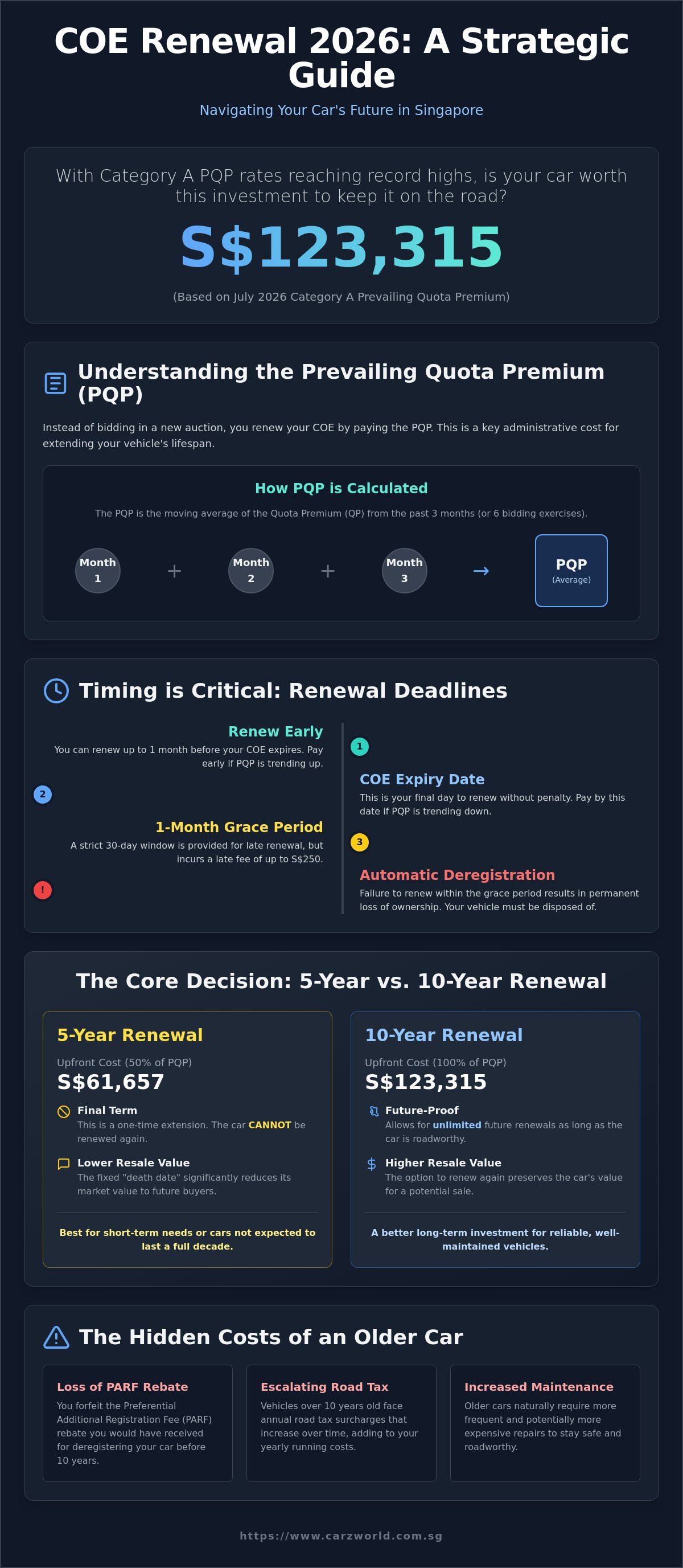
The PQP isn't a static number. It's a moving average of the Quota Premiums (QP) from the preceding three months. For instance, the July 2026 PQP for Category A vehicles reached S$123,315, while Category B sat at S$124,705. These figures are influenced by the bidding results from six separate exercises. Because the PQP lags behind current bidding results, savvy owners track the OneMotoring portal closely. If bidding prices are rising, it's often cheaper to renew early. If they're falling, waiting until the month of expiry might save you thousands of dollars.
The 1-Month Grace Period and Late Fees
Timing is everything. You can renew your COE up to one month before it expires. If you miss the deadline, the LTA provides a strict one-month grace period to settle the payment. However, this delay isn't free. In 2026, car owners face a late renewal fee of up to S$250. It's a small price compared to the alternative. If you fail to renew within that 30-day window, your vehicle is automatically deregistered. At that point, you'll be forced to dispose of the car, losing the chance to keep a well-maintained vehicle on the road. Knowing what to do when coe expires means staying ahead of these dates to avoid permanent loss of ownership.
5-Year vs. 10-Year COE Renewal: A Strategic Comparison
Choosing between a five-year or ten-year extension is the most critical part of deciding what to do when coe expires. The financial gap is wide. You pay 50% of the PQP for five years or 100% for ten. In July 2026, a 10-year renewal for a Category A car costs S$123,315. Opting for five years cuts that immediate cost to S$61,657. It sounds like an easy win for your cash flow, but the long-term reality is far more complex.
This decision isn't just about the initial payment. It's about the vehicle's "death date." One option allows for a future, while the other sets a hard limit on your car's life. Understanding how these choices affect your asset's longevity and resale value is essential before you commit your hard-earned savings.
The 5-Year Renewal Trap
A five-year renewal is often a "death sentence" for your car. Under LTA rules, once you choose the five-year path for a private vehicle, you can never renew it again. The car must be deregistered and disposed of at the end of that period. This decision significantly impacts the car's resale value. Potential buyers know the vehicle has a fixed expiry date with no hope of further extension. This option only makes sense if you're certain the car won't last another decade or if you're simply bridging the gap while waiting for brand new car prices to soften. It's a short-term fix that limits your future flexibility.
The 10-Year Renewal Advantage
Paying the full PQP for a ten-year renewal offers much better security. Unlike the shorter option, a ten-year renewal allows for unlimited future extensions. If your car remains in excellent condition in 2036, you can renew it again. This flexibility keeps the car's market value higher. If you decide to sell the vehicle after seven years, the next owner still has the option to renew the COE again. It's a better investment for those with reliable vehicles that have been well-maintained. You can find more technical details on these categories in the official government guide provided by OneMotoring.
Your choice should align with your 2026 financial profile. If upfront capital is tight, five years might seem tempting. However, you'll forfeit the PARF rebate and still face increasing road tax surcharges regardless of the duration. For many, the 10-year route provides a more stable asset. If you're still undecided on what to do when coe expires, our team at Carz World Pte Ltd can help you evaluate your car's current health and potential export value. We provide expert advice to help you choose the path that maximizes your vehicle's remaining worth.
To Renew or Not? Evaluating Your Car’s 2026 Worth
Deciding what to do when coe expires requires a cold, hard look at your vehicle's residual value. Many owners focus solely on the high PQP prices of 2026. However, the true cost of renewal includes the "opportunity cost" of the cash you leave on the table. You must weigh the immediate financial loss of your PARF rebate against the potential savings of keeping a car you already own and trust.
This evaluation isn't just about the numbers on a screen. It involves assessing the physical reliability of your vehicle and its projected running costs over the next decade. If the math doesn't add up, you might find that your current car is actually more expensive to keep than replacing it with a newer model.
Calculating the Forfeited PARF Rebate
The Preferential Additional Registration Fee (PARF) is a rebate that Singapore car owners receive when they deregister a car before its tenth year. It's essentially a financial incentive to keep the car population young. If you choose to renew your COE, you forfeit this rebate entirely. This money doesn't just get delayed; it vanishes the moment you pay your PQP. It's a "sunk cost" that most people forget to include in their renewal budget.
Before you commit, visit the OneMotoring portal to check your exact PARF value. For many mid-range sedans, this could be anywhere from S$8,000 to S$15,000. Understanding the history and rationale behind the Vehicle Quota System helps explain why these rebates exist. Forfeiting this rebate means your "real" cost of renewal is the PQP plus your lost PARF value. If your PARF is high, the financial argument for renewal weakens significantly.
Maintenance and Road Tax Surcharges
The financial burden doesn't stop at the PQP. Cars over ten years old face a sliding scale of road tax surcharges. This starts at a 10% increase in year 11 and climbs by 10% annually until it caps at 50% in year 15. For a car with a high engine capacity, this surcharge adds thousands of dollars to your annual running costs over a five or ten-year period. It is a recurring expense that never goes away.
Mechanical health is the final piece of the puzzle. At the 10-year mark, many vehicles hit a major maintenance cycle. You might face expensive repairs for gearbox systems, cooling units, or engine mounts. If these repairs total more than S$5,000, your car might be turning into a "money pit." In such cases, it is often more economical to trade in your vehicle and invest that PQP money into a high-quality pre-owned car. A newer used car offers better fuel efficiency, lower road tax, and the peace of mind that comes with modern safety features. Calculating your Total Cost of Ownership (TCO) for the next five years is the only way to make a truly informed decision about what to do when coe expires.
Step-by-Step Guide to the COE Renewal Process
The administrative side of extending your car's life is efficient if you follow the right sequence. Knowing exactly what to do when coe expires prevents unnecessary stress and avoids the S$250 late renewal fee. Your process begins at the OneMotoring portal. By logging in with your Singpass, you can view your vehicle's specific PQP rate and confirm its eligibility for renewal. As of July 2026, Category A PQP stands at S$123,315, while Category B is S$124,705. These figures determine your total outlay and must be paid in full to secure your extension.
Preparation is key to a smooth digital submission. You don't want to be caught at the final payment screen with a rejected transaction. Following the structured steps below ensures your renewal is processed without delay.
Payment Methods and Bank Limits
Most owners choose to pay their PQP via internet banking. Major local banks like DBS, POSB, OCBC, and UOB are fully integrated with the LTA system. However, a significant obstacle often arises: daily transfer limits. Because 2026 PQP rates are exceptionally high, your standard daily limit of S$5,000 or S$25,000 won't be enough. You must log into your banking app to temporarily increase your e-payment limit to match the PQP amount before starting the process. Failing to do this is a common reason for failed renewals. For those who are less comfortable with digital platforms, alternative methods include renewing by mail or visiting the LTA Customer Service Centre in person.
Finalising Insurance and Road Tax
Renewing your COE is only one part of the legal requirement. You must also ensure your vehicle has valid insurance and road tax for the new period. The LTA system requires your insurance record to be updated at least three working days before you attempt to renew your COE. This policy must cover the entire duration of your new COE. Additionally, vehicles reaching their tenth year must pass a mandatory inspection at an authorized centre. This check ensures the car is still roadworthy before the road tax can be renewed. Start this entire process at least one month before your expiry date. This timeline gives you enough room to handle any minor repairs needed to pass the inspection. If the logistics feel overwhelming, reach out to our consultants to handle the paperwork and financing on your behalf.
Financing and Alternatives: How Carz World Pte Ltd Can Help
Deciding what to do when coe expires is a complex financial pivot that requires more than just a glance at current PQP rates. A professional valuation is the essential first step in this journey. It allows you to see the true market value of your vehicle compared to the high cost of a 2026 renewal. At Carz World Pte Ltd, we act as your expert consultant. We help you weigh the benefits of keeping your current car against the long-term advantages of starting fresh with a newer model.
Our team understands that every owner's situation is unique. Some vehicles are sentimental favorites worth every cent of the PQP. Others are better suited for the international market. We provide the data you need to make a methodical, honest choice without any high-pressure sales tactics. Our goal is to ensure your next decade on the road is both affordable and enjoyable.
COE Loan Options in 2026
Financing a COE renewal requires a clear understanding of Loan-to-Value (LTV) limits. In Singapore, you can typically secure a loan for up to 70% of the PQP amount. With July 2026 Category B prices reaching S$124,705, the remaining 30% down payment is still a significant cash outlay. While banks offer competitive interest rates, their approval processes can be rigid and time-consuming. Personal loans are an alternative, though they often carry higher interest rates than dedicated COE loans for large amounts.
Carz World Pte Ltd simplifies this entire logistical process. We offer flexible in-house financing options that cater to different credit profiles. Our staff manages all the LTA digital submissions and paperwork on your behalf. This ensures your renewal is completed before the expiry date, helping you avoid late fees or the risk of deregistration. We focus on making the transaction feel fluid and positive for every customer, providing a seamless experience from start to finish.
The Trade-In Alternative
There are times when the "sell" option offers superior value. If your car's maintenance costs are rising, it might be time to sell your car effortlessly through our professional trade-in service. You can use your PARF rebate and the car's body value as a substantial down payment for a brand new car. This path often leads to lower monthly running costs and much better fuel efficiency.
Consider the experience of owners who transitioned from aging petrol sedans to modern hybrids. By avoiding the S$123,315 Category A PQP and the escalating road tax surcharges, they gained a more reliable vehicle with a fresh warranty. If your car isn't worth the renewal cost, our Carz World Pte Ltd export service ensures you get the best international market price. We handle the export logistics, ensuring you receive the maximum value for your vehicle regardless of its age. Knowing what to do when coe expires means exploring every alternative to protect your financial health.
Secure Your Driving Future in 2026
Navigating the volatile 2026 COE market requires a methodical approach to protect your savings. You now understand how the three-month PQP average determines your costs and the critical differences between 5-year and 10-year commitments. Deciding what to do when coe expires shouldn't be a guessing game. By weighing the loss of your PARF rebate against your car's mechanical health, you can determine if renewal is a sound investment or a costly mistake.
Carz World Pte Ltd is trusted by thousands of Singaporean drivers to provide honest, expert guidance during this transition. We offer expert handling of LTA paperwork and specialized COE financing to make the renewal process feel seamless. If renewal doesn't make sense for your situation, we provide highly competitive trade-in and export rates to ensure you maximize your vehicle's remaining value.
Get a Professional Valuation and Decide: Renew or Sell Today
Take the first step toward a stress-free ownership experience today. We're ready to help you find the best path forward for your budget and lifestyle.
Frequently Asked Questions
Can I renew my COE after it has already expired?
Yes, you have a strict one-month grace period to renew your COE after the expiry date. However, you'll face a late renewal fee of up to S$250 for cars or S$50 for motorcycles. If you miss this additional 30-day window, your vehicle is automatically deregistered and must be disposed of. This is a critical timeline when deciding what to do when coe expires.
How is the PQP calculated if there are no bidding exercises in a month?
The PQP is always calculated as the moving average of the Quota Premiums over the last three months, even if a specific month lacks bidding exercises. If an exercise is canceled or postponed, the LTA uses the results from the most recent successful exercises to maintain the rolling average. This ensures the price reflects market trends accurately without being affected by temporary pauses in the bidding cycle.
Will I get a refund if I deregister my car before the renewed COE expires?
You'll receive a pro-rated refund of the PQP you paid if you deregister the vehicle before the new COE term ends. This rebate is based on the number of full months remaining on the COE at the time of deregistration. It's important to remember that you still won't get any PARF rebate back, as that was forfeited permanently the moment you chose to renew.
Is it better to take a COE loan or a personal loan for renewal?
A dedicated COE loan is usually the better choice because it offers lower interest rates than a standard personal loan. These loans are designed specifically for PQP payments and allow you to spread the cost over several years. Personal loans might offer faster approval but typically carry a higher financial burden. Our team can help you compare these options to find the most sustainable fit for your 2026 budget.
What happens to my car insurance when I renew my COE?
Your car insurance must be renewed or extended to cover the entire duration of the new COE period. The LTA won't process your renewal unless they have a record of valid insurance that matches your new expiry date. It's best to settle your insurance at least three working days before you pay the PQP to allow for digital system synchronization between your provider and the LTA.
Can I change my mind and switch from a 5-year to a 10-year renewal later?
No, you cannot switch from a five-year renewal to a ten-year renewal once the transaction is processed. A five-year extension is a one-time, non-renewable option for private vehicles. Once this period ends, the car must be deregistered. If you're unsure about the vehicle's longevity, a ten-year renewal offers much more flexibility for your future decisions and maintains the car's resale value.
How much is the road tax surcharge for a 12-year-old car?
A 12-year-old car is subject to a 20% road tax surcharge. This annual penalty starts at 10% when the car turns 11 and increases by 10% each year until it hits a 50% cap at the 15-year mark. These recurring costs are a major factor to consider when evaluating what to do when coe expires, as they significantly increase your total cost of ownership over time.
Is there a limit to how many times I can renew a 10-year COE?
There's currently no limit on how many times you can renew a 10-year COE for Category A, B, and D vehicles. As long as your car passes the mandatory periodic inspections and you pay the prevailing PQP, you can keep it on the road indefinitely. This makes the 10-year renewal a strategic choice for those who own reliable, well-maintained vehicles they intend to keep for the long haul.
Disclaimer
This content is provided for general informational purposes only. Readers are encouraged to independently verify important information.
In Same Category
- Toyota Prius in Singapore: A Practical Buyer’s Guide for 2026
- Best Cars for Home-Based Businesses in Singapore: 2026 Guide
- Risks of Buying a Car with 1 Year of COE Left in Singapore (2026 Guide)
- Best Second Hand Cars for Malaysia: Singapore Buyer's Guide
- Buying a Used Lorry in Singapore: 2026 Buyer’s Guide
Related by Tags
- Best Time to Renew COE in 2026: A Practical Singapore Guide
- COE Renewal for 5 Years vs 10 Years: Pros and Cons in Singapore
- Calculating the Breakeven Point for COE Renewal in Singapore
- COE Renewal Conditions and Eligibility in Singapore: 2026 Guide
- Used Cars for Sale in Tampines: 2026 Buyer's Guide
- Buying a Used Car in Singapore: 2026 Ultimate Guide
- What is PARF? The Ultimate Guide to Singapore’s Car Rebate System
- Mercedes-Benz EQB 250+ Review: The Ultimate 7-Seater Family EV in Singapore
- Long Term Car Rental Singapore: 2026 Definitive Guide
- Cheapest Car in Singapore: The 2026 Guide to Affordable Ownership
- Parallel Import Cars Singapore: 2026 Buyer’s Guide
- Toyota Harrier Singapore: The Definitive 2026 Buyer’s Guide
- Honda Civic Singapore: 2026 New & Pre-Owned Guide