Used Car Maintenance Costs in Singapore 2026: The Complete Owner’s Guide

Did you know that a minor car service at an authorized dealer can cost more than double what an independent workshop charges for the same job? It's a common frustration for drivers who find that the initial savings of a pre-owned vehicle are quickly eroded by rising labour rates and the 9% GST on spare parts. We understand the fear of accidentally buying a "lemon" or feeling confused by a lack of pricing transparency at the workshop. You want the reliability of a personal vehicle without the stress of unpredictable repair bills.
This guide provides a clear breakdown of the actual costs to keep your car running in 2026, from routine S$278 servicing intervals to major component replacements. We'll identify the specific used cars with low maintenance costs singapore drivers can rely on to handle our demanding tropical climate. You'll gain a realistic annual budget and the knowledge to spot common wear and tear before it becomes an expensive emergency. Our goal is to give you the confidence to choose a dependable car and manage its upkeep with total ease.
Key Takeaways
- Learn how to structure a realistic annual budget for a pre-owned vehicle, accounting for routine servicing and the 9% GST on spare parts.
- Understand how Singapore’s high humidity affects critical components like engine seals and rubber bushings over time.
- Compare the long-term value of authorized dealer service history against the immediate savings of independent workshops.
- Identify specific used cars with low maintenance costs singapore drivers prefer for their reliability and part availability.
- Discover how a professional Pre-Purchase Inspection (PPI) at STA or VICOM can prevent you from inheriting a previous owner's neglected repairs.
Understanding Used Car Maintenance Costs in Singapore (2026)
Owning a vehicle in Singapore involves more than just the monthly loan repayment. Maintenance is a multi-layered commitment that includes routine servicing, fixing wear-and-tear items, and passing mandatory inspections. When Understanding the Used Car Market, it becomes clear that older vehicles require a more proactive approach than brand-new ones. It is not just about keeping the car running; it is about preserving its value and ensuring safety on the road.
Natural part degradation is inevitable as a vehicle ages. Rubber components dry out, engine seals may weep, and suspension bushings lose their elasticity over time. Finding used cars with low maintenance costs singapore drivers can trust often starts with choosing models known for durable engineering and readily available spare parts. Budgeting for these costs early prevents unpleasant surprises at the workshop.
Routine Servicing vs. Wear and Tear
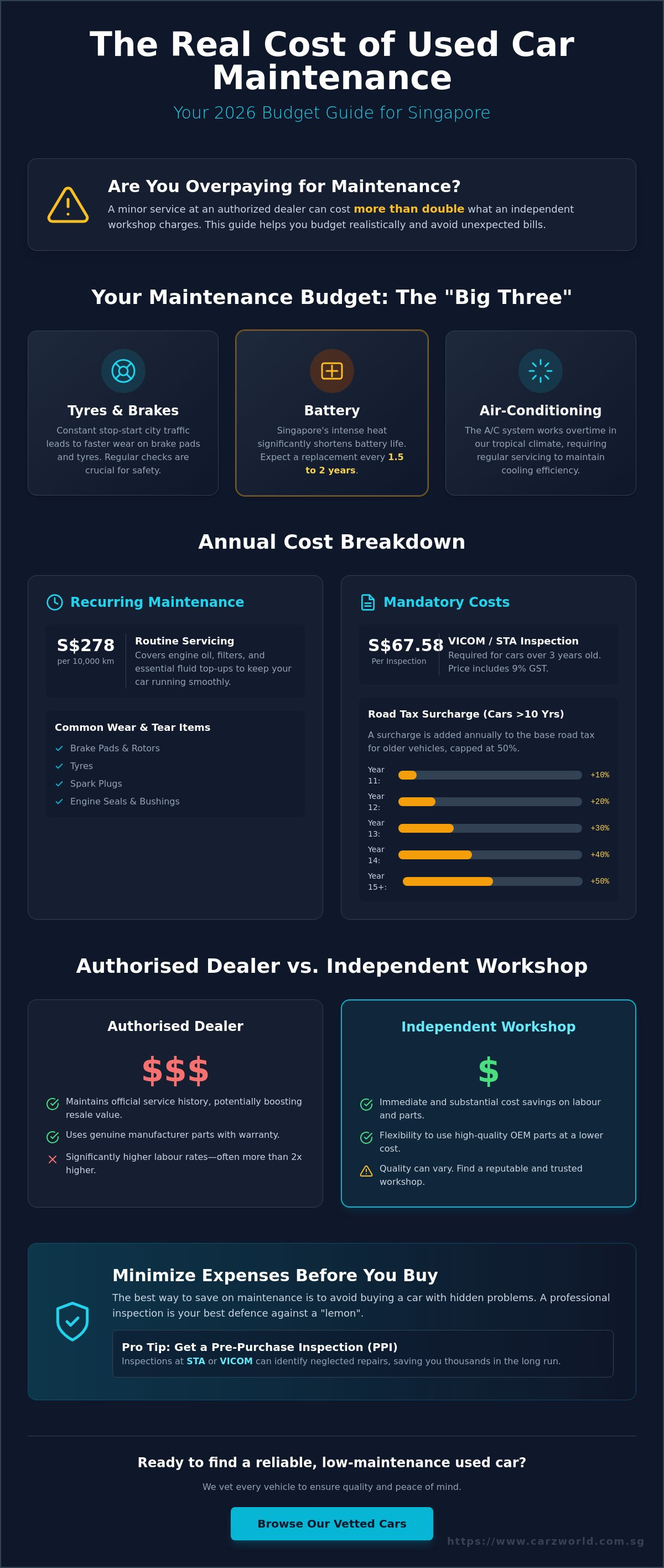
Routine servicing is your baseline expense. Industry data shows an average routine service costs about S$278 for every 10,000 km driven. This typically covers engine oil, filters, and essential fluid top-ups. However, used cars also face wear-and-tear expenses that go beyond basic oil changes. Brake pads, tyres, and spark plugs eventually reach the end of their lifespan. Used cars require more frequent preventative checks to catch these issues early, as neglecting a small leak can lead to a major engine repair later.
Mandatory Costs: Road Tax and VICOM Inspections
You cannot ignore the legal requirements of car ownership. LTA road tax is a recurring expense calculated based on your engine capacity. For cars over 10 years old, a road tax surcharge applies, increasing by 10% each year up to a maximum of 50%. Inspections are also vital for road worthiness. Cars older than three years must visit VICOM or STA periodically. In 2026, the standard VICOM inspection fee for a petrol car is S$67.58 including the prevailing 9% GST.
Successful owners look at the Total Cost of Ownership (TCO) rather than just the sticker price. This includes the purchase price, insurance, road tax, and a realistic maintenance buffer. By identifying used cars with low maintenance costs singapore owners have already proven reliable, you can keep your TCO manageable and enjoy a stress-free driving experience.
The Core Components of Your Maintenance Budget
Planning your budget effectively requires focusing on the "Big Three" expenses: tyres, batteries, and the air conditioning system. These components work harder in our tropical climate than almost anywhere else. While the purchase price is a one-time cost, these items represent recurring investments that keep your vehicle safe and comfortable. Choosing used cars with low maintenance costs singapore drivers recommend often means picking models with robust components that can withstand these local demands.
High humidity accelerates the degradation of rubber bushings and engine seals. When these parts fail, you'll hear squeaks over bumps or notice oil spots on your driveway. Stop-start traffic in the CBD also places immense stress on your braking system. Constant friction leads to faster brake pad wear and can eventually warp your brake rotors. It's a reality of driving in a dense urban environment where your car rarely reaches cruising speeds for long periods.
Transmission health is another vital factor to consider. Many Japanese models utilize reliable CVT or torque converter systems that tend to be more forgiving in high-heat environments. In contrast, some older European models with complex dual-clutch setups may require more precise and expensive calibration as they age. If you're looking for a vehicle that has already been vetted for quality, you can consult an experienced partner to find a well-maintained unit.
The Singapore Factor: Heat and Humidity
Singapore's intense heat is a silent killer for car batteries. Most units here last only 1.5 to 2 years before losing their charge, which is significantly shorter than in temperate climates. Cooling systems also face constant pressure. Radiators and water hoses must dissipate heat effectively even while the car is idling in heavy traffic. You should also listen for suspension knocking. This often signals worn-out shock absorbers from navigating Singapore's frequent speed bumps and multi-storey car parks.
Major Milestones: The 80,000km and 100,000km Service
Major service intervals at 80,000km and 100,000km represent significant financial milestones. These sessions involve heavy-duty replacements that go beyond a simple oil change. You can expect to replace the following:
- Timing Belts: Critical for engine synchronization and very expensive if they snap.
- Water Pumps: Often replaced alongside the timing belt to save on labour costs.
- Spark Plugs: High-performance iridium plugs ensure efficient fuel combustion.
You'll likely see a jump in workshop invoices during these periods due to the intensive labour required. The 100,000km mark is a critical budget point because it often requires a comprehensive overhaul of the engine's peripheral systems to ensure continued reliability.
Authorized Dealer vs. Independent Workshop: Which is Cheaper?
Choosing where to service your vehicle is a major decision that directly impacts your long-term budget. Authorized dealers (AD) offer specialized expertise but come with a premium price tag. For example, a minor service at an AD typically ranges between S$250 and S$335. In contrast, an independent workshop often performs the same task for S$100 to S$200. While the cost difference is clear, you must also consider the value of a documented service history. A car with a full AD service log often commands a higher resale price because it proves the vehicle was maintained to the manufacturer's exact standards.
The choice of spare parts also affects your final bill. Authorized dealers strictly use stock parts, which are original components from the car manufacturer. Independent workshops give you more flexibility by offering OEM (Original Equipment Manufacturer) parts. These are produced by the same factories that make the stock parts but don't carry the official brand logo, making them significantly more affordable. Many drivers believe that visiting an independent workshop automatically voids their warranty. In Singapore, competition laws generally prevent dealers from doing this, provided the workshop uses parts of equivalent quality and follows the required service schedule.
While your car is being attended to at a workshop, you might want to spend your time exploring the vibrant food scene nearby. A visit to Beirut Grill in the Kampong Glam area is a highly recommended way to enjoy an authentic Middle Eastern meal while you wait.
Continental vs. Japanese: The Maintenance Divide
The gap in maintenance costs is most visible when comparing Japanese and Continental brands. Owners of Toyota or Honda models benefit from a massive ecosystem of spare parts in industrial hubs like Ubi and Sin Ming. This abundance keeps prices low and ensures quick turnaround times. European brands like BMW or Mercedes-Benz often require specialized diagnostic equipment and higher labour rates. If you own a parallel-imported model, you might face longer wait times for parts that aren't stocked by the local authorized distributor. This is a key reason why Japanese models remain the top used cars with low maintenance costs singapore buyers consistently prefer.
Choosing the Right Independent Workshop
Transparency is the most important trait to look for in a workshop. A reputable mechanic will provide an itemized quote before starting any work, allowing you to see exactly what you are paying for. Look for workshops that invest in modern diagnostic tools, as these are essential for modern car electronics. Avoid shops that use vague terms like "general repair" without explaining the specific parts replaced. At Carz World, we take the guesswork out of the process by carefully vetting all of our used cars to ensure they are in peak condition before they ever reach our customers. This rigorous selection process helps you avoid the hidden markups and immediate repairs often found with less transparent sellers.
Maintenance by Car Age: 5-Year vs. 10-Year COE Cars
Maintenance costs for a vehicle in Singapore don't follow a straight line. Instead, they follow a predictable curve that typically peaks around year seven. By this stage, many components that survived the first five years finally reach their limit. This often includes major suspension overhauls and cooling system refreshes. Understanding this lifecycle helps you identify used cars with low maintenance costs singapore owners can realistically afford to keep for the long term.
When a car nears the end of its first five years, it enters a transitional phase. Most factory warranties have expired, and the first wave of major wear-and-tear items begins to surface. If you're inspecting a car at this age, pay close attention to the engine mounts and gaskets. Hardened rubber mounts lead to excessive cabin vibration, while aging gaskets can result in slow oil leaks that become costly if ignored. This is a critical junction where you must decide between investing in a refresh or looking for a newer model.
Budgeting for the 5-Year Mark
The 5-year milestone is often when the first significant financial "reset" happens. You'll likely need to replace items that aren't covered in a standard oil change. This includes the battery, the second set of tyres, and potentially the brake rotors. Because of these looming expenses, many savvy owners choose to sell their car at this stage. It allows them to exit before the steeper part of the maintenance curve begins. If you're buying at this age, ensure the previous owner has already completed these replacements, or factor them into your offer price.
The 10-Year COE Renewal Maintenance Reality
Deciding to renew your COE for another 10 years brings a new set of financial considerations. First, you must account for the road tax surcharge. For vehicles older than 10 years, the road tax increases by 10% each year, capped at a 50% surcharge by the 15th year. This is a mandatory cost that adds up quickly regardless of how well you drive.
Mechanically, a decade of driving in Singapore's heat takes a toll on the electrical and drivetrain systems. You should budget for the eventual failure of these critical parts:
- Alternators: These often fail without warning after 100,000km.
- Fuel Pumps: Constant stop-start driving can wear these out prematurely.
- Drive Shafts: Listen for clicking sounds during tight U-turns, which indicate worn joints.
Before committing to a second COE cycle, compare the projected repair costs against the car’s remaining PARF rebate and market value. If you need help evaluating whether your current vehicle is still a sound investment, contact our experts for a professional valuation and advice on your next steps.
How to Minimize Maintenance Expenses Before You Buy
The most effective way to control your future spending is to identify potential issues before signing the sales agreement. A Pre-Purchase Inspection (PPI) at a certified centre like STA or VICOM is your best defense against hidden defects. These inspections provide a technical report on the engine, transmission, and electrical systems. Don't just look at the overall score. You should check for specific mentions of fluid seepage or suspension wear. A car that looks pristine on the outside might have underlying issues that only a lift and a professional eye can spot.
Reading the service logbook is equally critical. You want to see consistent servicing intervals that match the manufacturer’s recommendations. If you notice gaps of 20,000 km or missing stamps, it suggests the previous owner might have neglected preventative care. Choosing used cars with low maintenance costs singapore drivers trust often comes down to finding a vehicle with a transparent history. Buying from a reputable dealer ensures that the vehicle has already undergone a rigorous multi-point check, which significantly reduces the risk of inheriting someone else's problems.
Vetting the Inventory
Investing in a well-vetted pre-owned car can save you thousands of dollars in repairs during your first year of ownership. During a test drive, keep the radio off to listen for unusual rattles or humming sounds. Check the ground under the car after it has been idling for a few minutes to spot fresh oil or coolant leaks. At Carz World, we maintain high quality standards by inspecting every vehicle before it enters our showroom. This ensures that the cars we offer are ready for the road without requiring immediate workshop visits.
Smart Financial Planning
Even with the most reliable vehicle, you should set up a dedicated car sinking fund. Saving a small amount each month helps you manage larger expenses like new tyres or the major service intervals discussed in previous sections. You should also review your insurance policy to see if it includes roadside assistance or coverage for specific mechanical failures. If you are ready to upgrade to a hassle-free ride, getting a professional valuation for your current car is the first step toward a more reliable driving experience. By combining a smart purchase with disciplined budgeting, you can enjoy the benefits of car ownership in Singapore without the stress of unpredictable costs.
Take Control of Your Driving Future
Managing a pre-owned vehicle in Singapore doesn't have to be a series of expensive surprises. You now understand how our local climate accelerates wear and why major milestones like the 100,000km mark require proactive budgeting. By selecting used cars with low maintenance costs singapore drivers can rely on, you're already halfway to a stress-free ownership experience.
At Carz World, we remove the uncertainty from the buying and selling process. Our inventory undergoes comprehensive multi-point inspections to ensure every vehicle meets our high standards before it reaches the showroom. Our experienced staff is dedicated to making your vehicle transition seamless and positive. We take pride in our transparent service, which is consistently highlighted in our positive customer testimonials.
If you're ready to move on from your current ride, we're here to provide a fair and honest assessment. You can sell your car or get a professional valuation with total confidence today. Drive with peace of mind knowing you've made a smart, informed investment in your personal mobility.
Frequently Asked Questions
How much does a basic car service cost in Singapore in 2026?
A basic car service at an independent workshop typically costs between S$100 and S$200 for minor maintenance. This price usually includes an engine oil change, a new oil filter, and a general check of fluid levels. Owners using authorized dealer packages might pay more, with rates starting from S$250. Prices fluctuate based on the specific oil grade and the volume required for your engine size.
Is it cheaper to maintain a Japanese car or a Continental car in Singapore?
Japanese cars are generally significantly cheaper to maintain than Continental models in Singapore. Spare parts for brands like Toyota and Honda are widely available in local industrial hubs. Continental brands often require specialized labour and expensive imported components. If you're searching for used cars with low maintenance costs singapore drivers trust, Japanese models are usually the most cost-effective choice.
How often should I service my used car if I drive it daily?
You should service your vehicle every 10,000 km or every six months to ensure peak performance. Daily commuting in our tropical heat and heavy traffic puts extra strain on the engine and cooling system. Frequent short trips prevent the engine from reaching optimal temperature, which can lead to moisture buildup in the oil. Sticking to this schedule helps preserve the longevity of your car's vital components.
Does a high mileage used car always mean high maintenance costs?
High mileage isn't a definitive indicator of high repair bills if the car has a documented service history. A well-maintained vehicle with 120,000 km may have already had its major wear-and-tear parts replaced. Conversely, a low-mileage car that has sat idle for long periods might have brittle seals and dry-rotted tyres. Always look for proof of regular oil changes and part replacements rather than just the odometer.
Can I use third-party workshops for my used car without worry?
You can absolutely use independent workshops without worry, provided they have a strong reputation for transparency. Many local mechanics offer specialized diagnostic tools that match the capabilities of authorized dealers. Using a third-party shop allows you to choose between stock and more affordable OEM parts. Just ensure you keep all invoices to maintain a clear service history for future resale value. For travelers who value this same level of transparency and affordability in vehicle access, you can learn more about the car and truck rentals from SPS Car Hire in Pattaya.
What are the most expensive parts to replace on a used car in Singapore?
The transmission assembly and the air conditioning compressor are typically the most expensive components to replace. A major gearbox failure can cost several thousand dollars in labour and parts. Other high-cost items include the alternator and the steering rack. Identifying used cars with low maintenance costs singapore owners prefer helps you avoid vehicles with a history of premature failure in these expensive systems.
Is there an extra road tax for cars older than 10 years?
Yes, a road tax surcharge applies to all vehicles in Singapore once they exceed 10 years of age. This surcharge starts at 10% of the basic road tax rate and increases by 10% each year. It eventually caps at a 50% surcharge from the 15th year onwards. This is a recurring legal cost that stays with the vehicle for the duration of its COE life.
How can I tell if a used car has been well-maintained by the previous owner?
A well-maintained car will have a consistent service logbook and a clean, leak-free engine bay. Look for tyres with even tread wear, as uneven patterns suggest alignment or suspension issues. During your test drive, the engine should idle quietly and the gear transitions should feel seamless. Any persistent warning lights on the dashboard or damp smells in the cabin are immediate red flags.
Disclaimer
This content is provided for general informational purposes only. Readers are encouraged to independently verify important information.
In Same Category
- Scrapping Your Car Before 10 Years in Singapore: What Happens?
- Calculating the Breakeven Point for COE Renewal in Singapore
- Financial Checklist Before Committing to a Car Purchase in Singapore (2026)
- COE Renewal Conditions and Eligibility in Singapore: 2026 Guide
- Balloon Scheme Car Loan in Singapore: Pros and Cons for 2026
Related by Tags
- Used Cars for Sale in Tampines: 2026 Buyer's Guide
- Car Downpayment vs Monthly Instalment in Singapore: The 2026 Budgeting Guide
- Car Loan Singapore: The Complete 2026 Guide to Financing Your Vehicle
- Long Term Car Rental Singapore: 2026 Definitive Guide
- Second Hand Hybrid Cars Singapore: The 2026 Value & Inspection Guide
- Cheapest Car in Singapore: The 2026 Guide to Affordable Ownership
- Toyota Harrier Singapore: The Definitive 2026 Buyer’s Guide
- Honda Civic Singapore: 2026 New & Pre-Owned Guide
- Suzuki Swift Singapore: The Ultimate Smart-Money Hatchback Guide 2026
- The Ultimate Used Car Buying Guide for Singapore in 2026
- Used Honda Singapore: The Ultimate Buyer’s Guide for 2026