The Ultimate Guide to Buy New Commercial Vehicles in Singapore (2026 Edition)

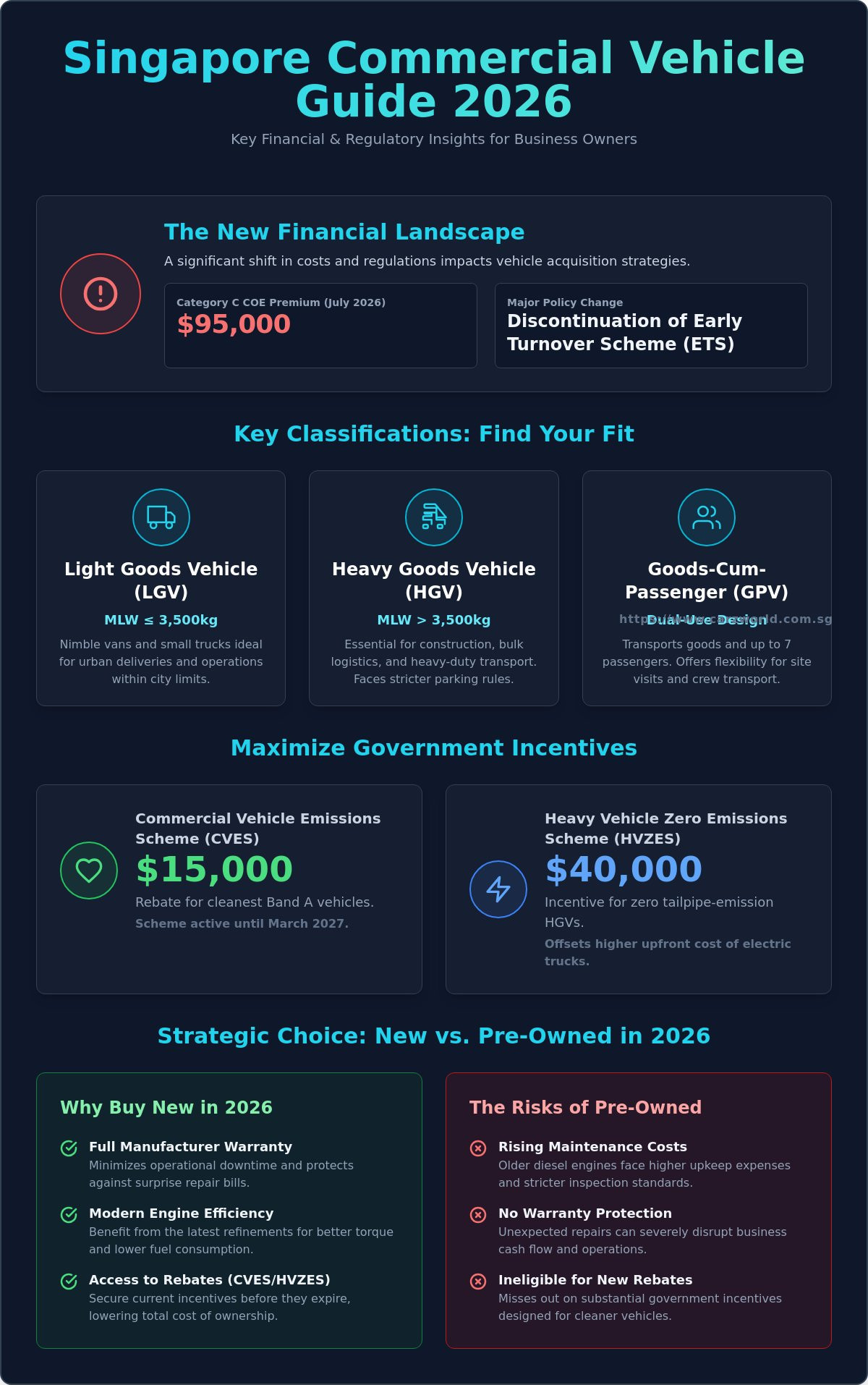
With Category C COE premiums reaching a record high of $95,000 in July 2026, the financial landscape for Singaporean businesses has shifted significantly. We understand that deciding to buy new commercial vehicles is now a major strategic move that requires more than just a quick look at a spec sheet. The discontinuation of the Early Turnover Scheme (ETS) and the introduction of the Heavy Vehicle Zero Emissions Scheme (HVZES) mean you're navigating a market where regulatory compliance is just as important as payload capacity.
It's natural to feel concerned about high upfront costs or the risk of choosing a vehicle that leads to expensive maintenance downtime. This guide is designed to replace that uncertainty with expert clarity. We'll show you how to align your choice with the latest LTA regulations while securing a reliable workhorse that keeps your operational costs low. You'll learn the critical differences between LGV and HGV classifications and find out how to leverage current CVES rebates to your advantage. By the end, you'll have a clear roadmap to a seamless financing and registration process, ensuring your new fleet addition is ready to scale your business from day one.
Key Takeaways
- Understand how record-high Category C COE premiums in 2026 impact your bottom line and learn strategies to secure your vehicle efficiently.
- Identify the most cost-effective way to buy new commercial vehicles by aligning your fleet choices with the latest CVES and HVZES rebate tiers.
- Evaluate the volumetric capacity and engine performance of industry staples like the Toyota Hiace and Nissan NV350 to ensure your fleet meets city delivery demands.
- Determine the ideal engine type for your business by comparing the long-term operational costs of traditional diesel versus modern electric powertrains.
- Simplify the complex financing and registration process through a structured, transparent approach that eliminates hidden fees and ensures LTA compliance.
Understanding the 2026 Landscape to Buy New Commercial Vehicles in Singapore
July 2026 brought a new reality for local logistics. With the Category C premium closing at $95,000 in the month's first bidding exercise, business owners must now account for a significantly higher initial capital outlay than in previous years. This surge is largely driven by the total discontinuation of the Early Turnover Scheme (ETS), which ended for Light Commercial Vehicles in March 2025 and Heavy Commercial Vehicles in December 2025. Without the ability to trade in older diesel models for a discounted Certificate of Entitlement (COE), every new registration now competes directly in the open bidding market.
The decision to buy new commercial vehicles in 2026 is also influenced by the Commercial Vehicle Emissions Scheme (CVES). This policy remains active until March 2027, offering a rebate of up to $15,000 for the cleanest Band A vehicles. For many SMEs, parallel importers have become the preferred partners in this environment. Unlike authorized dealers who may have limited stock, parallel importers often provide a wider range of vehicle specifications, including Japanese Domestic Market (JDM) models that feature advanced safety tech and superior fuel efficiency not always found in local base models.
Key Classifications: LGV, HGV, and GPV
Choosing the right vehicle starts with understanding Maximum Laden Weight (MLW). This classification dictates your road tax, parking eligibility, and even where your drivers can operate. Light Goods Vehicles (LGV) are capped at an MLW of 3,500kg. These are the nimble vans and small trucks perfect for urban deliveries. Heavy Goods Vehicles (HGV) exceed this 3,500kg limit and are essential for construction or bulk logistics, though they face stricter parking regulations in HDB estates.
Goods-Cum-Passenger Vehicles (GPV) offer a middle ground for small business owners. These vehicles are designed for dual-use, allowing you to transport both equipment and a small crew of up to seven passengers. While road tax for GPVs can be higher, the flexibility they provide for site visits and family use often justifies the cost. Always check if your preferred model qualifies for HDB season parking, as HGVs often require specialized heavy vehicle parking lots that are less accessible than standard LGV lots.
Why New Might Outperform Pre-Owned in 2026
While the upfront cost of a used van might seem attractive, the long-term math often favors a fresh investment. Maintenance costs for older diesel engines are rising, especially as Singapore tightens inspection standards for aging fleets. When you choose brand new cars or commercial trucks, you benefit from the latest engine refinements from brands like Toyota and Nissan. These modern powerplants offer better torque for heavy loads while consuming less fuel per kilometer.
A new vehicle also provides the security of a full warranty, which is vital for minimizing operational downtime. In a high-inflation environment, the reliability of a new workhorse ensures you aren't hit with surprise repair bills that could disrupt your cash flow. By securing a new vehicle now, you lock in the benefits of the current CVES rebates before the scheme expires in 2027, making it a strategic move for long-term business growth.
Evaluating Your Business Needs: Choosing the Right Workhorse
Selecting a vehicle in 2026 requires a sharp focus on the payload-to-COE ratio. With Category C premiums at $95,000, every square centimeter of cargo space must contribute to your bottom line. When you decide to buy new commercial vehicles, your first priority is matching the engine type to your daily operational patterns. For businesses covering high mileage within the city, the shift toward electric is no longer just an environmental choice; it's a financial one. The Heavy Vehicle Zero Emissions Scheme (HVZES) provides a $40,000 incentive for zero-tailpipe emission heavy goods vehicles, which can significantly offset the higher upfront cost of electric trucks.
Your choice should also be informed by the latest cleaner commercial vehicle incentives, which reward fleets that adopt Band A vehicles with rebates up to $15,000. Beyond the engine, consider how your crew interacts with the vehicle. In Singapore's narrow loading bays and tight CBD alleys, side-loading doors are often more practical than rear-loading ones. Many 2026 models now come equipped with integrated telematics. These systems allow you to track fuel efficiency and driver behavior in real time, providing the data needed to trim waste from your logistics chain.
Small Urban Vans vs. Large Cargo Vans
For courier services and last-mile deliveries, compact models like the Nissan NV200 offer unmatched agility. Their tight turning radius makes them ideal for navigating multi-story carparks and narrow shophouse streets. However, if your business involves bulky items or mobile equipment, high-roof cargo vans are a better fit. These models allow staff to stand upright while working inside, reducing the risk of strain and improving overall efficiency. While larger vans consume more fuel, their higher volumetric capacity often reduces the number of trips required for a single delivery run.
Light Trucks and Lorries for Heavier Loads
When a van's payload limit is reached, the Toyota Dyna remains a dependable choice for light-duty hauling. In Singapore, the landscape is generally divided into 10ft, 14ft, and 24ft lorries. A 10ft lorry is often the sweet spot for SMEs, as it offers a balance between heavy-load capacity and ease of parking. If you're moving heavy machinery or palletized goods, installing a tail-lift is a non-negotiable modification. This addition speeds up loading times and protects your crew from injury. If you aren't sure which configuration suits your current growth trajectory, our team can help you compare different models to find the best fit for your budget.
Top Picks for 2026: Comparing the Best Models in Our Collection
In the current market, two names dominate the conversation for anyone looking to buy new commercial vehicles: Toyota and Nissan. While previous sections detailed the regulatory environment and payload needs, your final decision often rests on the specific performance of these industry stalwarts. For 2026, the Toyota Hiace 3.0 DX 5-DR MT and the Nissan NV350 MT remain the primary contenders for logistics fleets, each offering a distinct advantage in reliability and interior volume.
The Toyota Fleet: Reliability Meets Performance
The Toyota Hiace 3.0 DX is widely considered the gold standard for durability in Singapore. Its reputation for rugged engineering means less time in the workshop and more time on the road. For those handling heavy industrial tasks or construction site logistics, the Toyota Dyna 150 Turbo 3.0MT provides the necessary torque to haul significant loads without straining the engine. It remains the undisputed king of light trucks because it handles the tropical heat and stop-start traffic of Singapore with ease.
One of the most compelling reasons to choose a Toyota is its exceptional resale value. Because these vehicles are highly regarded for their longevity, they command premium prices in the used cars market. This high residual value effectively lowers your total cost of ownership, as you'll recoup a larger portion of your initial investment when it’s time to refresh your fleet. It’s a strategic choice for businesses that value long-term financial stability and predictable depreciation.
The Nissan Fleet: Innovative Design for Modern Logistics
The Nissan NV350 is built with a focus on maximizing ROI through clever interior space management. Its cargo area is designed with squared-off dimensions. This allows for more efficient stacking of boxes and pallets compared to more rounded competitors. This extra volume can often mean the difference between making one trip or two, directly impacting your daily fuel expenditure and manpower costs. For companies moving high-volume, low-weight goods, the NV350's layout is hard to beat.
For businesses specializing in last-mile delivery within the CBD, the Nissan NV200 (available in both AT and MT) has become the preferred urban champion. Its smaller footprint allows it to enter height-restricted carparks and navigate tight shophouse back-alleys that larger vans simply cannot access. The latest Nissan iterations also prioritize driver comfort. They feature ergonomic seating and advanced safety systems that reduce driver fatigue during long shifts. This focus on the human element is a key differentiator for companies that prioritize staff retention and workplace safety.
Navigating the Buying Process: COE, Financing, and the ETS
Securing a Category C COE in 2026 requires a precise bidding strategy. With premiums reaching $95,000 in July 2026, you can't afford to bid blindly. Unlike previous years where the Early Turnover Scheme (ETS) provided a predictable path to registration, the current landscape is more competitive. Since the ETS for LCVs and HCVs concluded in 2025, every business looking to buy new commercial vehicles must now participate in the open bidding system. It's vital to monitor bidding trends across multiple exercises to ensure you don't overpay for your entitlement.
Protecting your investment is the next step. Commercial vehicle insurance in Singapore is more complex than standard car insurance. You're not just covering the vehicle; you're protecting your business against liability and operational disruptions. Look for policies that offer comprehensive coverage for both your drivers and the goods they carry. This foresight prevents a single accident from becoming a major financial setback for your company.
The Post-ETS Transition and Rebates
While the traditional ETS has ended, 2026 offers new incentives that serve a similar purpose. The focus has shifted toward the Heavy Vehicle Zero Emissions Scheme (HVZES) and the Commercial Vehicle Emissions Scheme (CVES). If you're deregistering an older, pollutive diesel model, you can still find significant savings by transitioning to electric or Euro 6 compliant vehicles. For example, the HVZES offers a $40,000 incentive for newly registered zero-tailpipe emission heavy goods vehicles. Navigating this paperwork can be tedious. A professional dealer manages these technical filings for you, ensuring you receive every dollar of the rebates you're entitled to.
Financing and Maintenance Planning
Financing your fleet expansion is more accessible in 2026, with commercial loan interest rates starting from approximately 2.99%. You'll need to choose between hire purchase agreements and standard commercial loans. Hire purchase is often preferred by SMEs because it allows you to spread the cost of the Additional Registration Fee (ARF) and road tax over a longer period. This keeps your monthly cash flow predictable. To further strengthen your budget, consider selling your current car or older van to generate the initial down payment for your new fleet.
Don't overlook long-term maintenance planning. A structured schedule is the only way to prevent the downtime that eats into your profits. Modern engines from Toyota and Nissan require specific service intervals to maintain their efficiency and warranty status. By factoring these costs into your initial financing plan, you ensure your workhorse remains on the road without surprise expenses. If you're ready to explore current market options, consult our fleet specialists today to find a solution that fits your business objectives.
Why Partner with Carz World for Your Commercial Fleet
Choosing to buy new commercial vehicles is a significant commitment for any Singaporean enterprise. At Carz World, we've built a legacy on trust and excellence. We understand the unique challenges of the local market. Our approach is simple: we provide straightforward value for every dollar you invest. You won't find hidden fees or surprise charges in our contracts. Instead, you'll experience a transparent process that prioritizes your business growth and long-term success.
As a premier Singapore car exporter, we offer global automotive solutions that go beyond simple local sales. This expertise allows us to provide end-to-end service. We guide you through model selection and handle the technicalities of registration. We also provide comprehensive aftercare to keep your fleet running smoothly. Our status as a parallel importer gives you a distinct advantage over authorized dealer options. You get access to a wider variety of vehicle specifications and the latest models, often before they're available elsewhere.
A Diverse Fleet for Every Objective
Our inventory is subject to meticulous inspection standards. Every van and truck must meet our strict quality criteria before it reaches your hands. We don't believe in one-size-fits-all solutions. Our experts work with you to align vehicle specifications with your specific business objectives. Whether you need specialized shelving for a logistics van or a reinforced deck for an industrial truck, we help you customize your workhorse for maximum efficiency. This methodical attention to detail ensures your new vehicle is ready for work the moment it leaves our lot.
Start Your Fleet Expansion Today
The best way to evaluate your options is through a hands-on consultation. We invite you to visit our showroom to experience our collection in person. Our car experts are also available via WhatsApp or phone to answer your immediate questions. We pride ourselves on being approachable and detail-oriented. We avoid high-pressure tactics because we value long-term partnerships over short-term gains. Our team focuses on making complex logistical processes feel like a seamless experience for you. When you're ready to take the next step, browse the full commercial collection here to find your next reliable partner on the road.
Drive Your Business Success Forward
Scaling your logistics in 2026 requires a balanced approach to high COE premiums and evolving emission standards. You've seen how identifying the right payload capacity and leveraging zero-emission incentives can transform your operational efficiency. Whether you need the rugged durability of a Toyota Dyna or the urban agility of a Nissan NV200, the right choice will serve as a reliable partner for years to come. It's about finding that perfect balance between upfront investment and long-term cost of ownership.
In addition to optimizing your fleet, creating an inspiring workspace or home environment with functional art can further boost productivity; for modern decor pieces from Artistry Deco Shop, click here.
At Carz World, we bring a legacy of trust and excellence to every transaction in Singapore. We perform a meticulous inspection of every Toyota and Nissan model to ensure your fleet meets the highest quality standards. Our passionate car dealers provide expert guidance to help you navigate complex LTA regulations and financing options with ease. When you decide to buy new commercial vehicles, we're here to ensure the process is transparent and positive from start to finish.
Strengthen Your Business Fleet - Explore Our New Commercial Vehicles Now
Take the next step toward a more efficient and profitable future today. Your business deserves a workhorse that works as hard as you do.
While a reliable fleet is the backbone of your logistics, mastering the digital landscape is equally vital for modern business growth; to empower your team with cutting-edge marketing and sales skills, visit ClickAcademy Asia.
Frequently Asked Questions
What is the difference between LGV and HGV for my business?
The primary difference lies in the Maximum Laden Weight (MLW) of the vehicle. Light Goods Vehicles (LGV) are those with an MLW of up to 3,500kg, while Heavy Goods Vehicles (HGV) exceed this weight. This classification determines your parking eligibility, as LGVs can typically use standard HDB season parking, whereas HGVs must be parked in designated heavy vehicle lots.
How does the Early Turnover Scheme (ETS) work for new commercial vehicles?
The Early Turnover Scheme has been fully discontinued and is no longer available in 2026. The scheme for Light Commercial Vehicles ended on March 31, 2025, and the version for Heavy Commercial Vehicles concluded on December 31, 2025. Businesses that want to buy new commercial vehicles should now look toward the CVES or HVZES for incentives and rebates.
Is it better to buy a brand-new or a used commercial vehicle in 2026?
Buying brand-new often provides a higher return on investment due to the latest government rebates. Under the CVES, Band A vehicles can qualify for a rebate of up to $15,000, which isn't available for used models. While pre-owned vehicles have a lower sticker price, they often come with higher maintenance costs and lack the fuel efficiency of modern Euro 6 or electric engines.
Can I use a commercial vehicle for personal use in Singapore?
You can use your commercial vehicle for personal trips, but you must ensure your insurance policy explicitly covers private use. Goods-Cum-Passenger Vehicles (GPV) are the most common choice for business owners who need a dual-purpose workhorse. You should still adhere to all LTA parking regulations, as commercial vehicles face specific restrictions in certain residential zones during overnight hours.
What financing options are available for new commercial trucks?
Most businesses utilize hire purchase agreements or standard commercial loans to fund their fleet. In July 2026, interest rates for new commercial vehicle loans start at approximately 2.99%. These financing structures allow you to preserve your cash flow by spreading the cost of the vehicle, COE, and taxes over several years through predictable monthly installments.
What are the most reliable commercial vehicle brands in Singapore?
Toyota and Nissan are widely regarded as the most reliable brands for the Singaporean climate and road conditions. The Toyota Hiace and Nissan NV350 are staples in the logistics industry because of their proven durability and ease of maintenance. Choosing these brands also ensures a higher resale value when you eventually decide to upgrade your fleet.
How much is the current road tax for a Light Goods Vehicle?
Road tax for an LGV is calculated based on its Maximum Laden Weight and engine capacity. While the base rates are set by the LTA, the final amount depends on whether the vehicle uses diesel, petrol, or electricity. It's important to note that vehicles older than ten years will incur an additional road tax surcharge that increases annually.
Why should I buy a commercial vehicle from a parallel importer?
Parallel importers provide access to a more diverse range of vehicle specifications and models that authorized dealers may not stock. This includes JDM models that often feature superior safety technology and more efficient engine configurations. You can often secure your preferred vehicle with shorter waiting times and more competitive pricing tailored to your specific business needs.
Disclaimer
This content is provided for general informational purposes only. Readers are encouraged to independently verify important information.
In Same Category
- Toyota Prius in Singapore: A Practical Buyer’s Guide for 2026
- Best Cars for Home-Based Businesses in Singapore: 2026 Guide
- Risks of Buying a Car with 1 Year of COE Left in Singapore (2026 Guide)
- Best Second Hand Cars for Malaysia: Singapore Buyer's Guide
- Buying a Used Lorry in Singapore: 2026 Buyer’s Guide
Related by Tags
- Used Cars for Sale in Tampines: 2026 Buyer's Guide
- Car Downpayment vs Monthly Instalment in Singapore: The 2026 Budgeting Guide
- Car Loan Singapore: The Complete 2026 Guide to Financing Your Vehicle
- How Much Salary to Afford a Car in Singapore: 2026 Affordability Guide
- Buying a Used Car in Singapore: 2026 Ultimate Guide
- What is PARF? The Ultimate Guide to Singapore’s Car Rebate System
- Mercedes-Benz EQB 250+ Review: The Ultimate 7-Seater Family EV in Singapore
- Long Term Car Rental Singapore: 2026 Definitive Guide
- How to Buy a Car in Singapore: The Ultimate 2026 Step-by-Step Guide
- Second Hand Hybrid Cars Singapore: The 2026 Value & Inspection Guide
- Cheapest Car in Singapore: The 2026 Guide to Affordable Ownership
- Parallel Import Cars Singapore: 2026 Buyer’s Guide