Lemon Law for Used Cars in Singapore Explained: Your Rights as a Buyer

What if that "as-is" clause in your sales agreement doesn't actually mean you're stuck with a mechanical nightmare? For many Singaporeans, the excitement of picking up a pre-owned vehicle is often overshadowed by the fear that they've unknowingly purchased a defective "lemon." It's a common anxiety, and you're right to want clarity on where you stand if things go wrong shortly after delivery.
In this guide, we have the lemon law for used cars singapore explained to help you shop with confidence. You'll understand how the Consumer Protection (Fair Trading) Act safeguards your purchase and how the law views the "satisfactory quality" of a car based on its age and price. We promise to help you distinguish between a genuine legal defect and expected wear and tear, ensuring you don't face unfair repair costs alone.
We will preview the specific steps for making a claim within the critical six-month window and explain how to seek mediation if a dealer is uncooperative. By the end of this article, you'll have a clear roadmap for protecting your investment and your peace of mind.
Key Takeaways
- Understand the "6-month presumption" rule, which legally assumes defects appearing within the first 180 days existed at the time of delivery.
- Learn how to distinguish between a genuine latent defect and standard wear and tear based on the car's age and purchase price.
- Follow a clear 5-step process to file a claim, starting with a formal written notification to the dealer to allow for a reasonable repair.
- See the lemon law for used cars singapore explained regarding major mechanical and electrical failures, including engine, gearbox, and ECU issues.
- Identify your options for mediation through CASE or the Small Claims Tribunal if a dealer fails to provide a satisfactory resolution.
What is the Lemon Law in Singapore for Used Cars?
Having the lemon law for used cars singapore explained starts with its official legal foundation. In Singapore, what we call the Lemon Law is actually a specific set of provisions within the Consumer Protection (Fair Trading) Act (CPFTA). These rules ensure that when you buy a vehicle, it meets the standards of being of "satisfactory quality" and "fit for purpose." It's a consumer right that prevents dealers from selling substandard goods and then walking away from the responsibility of repairs.
The law focuses heavily on latent defects. These are mechanical or electrical issues that exist at the time of delivery but aren't immediately visible during a standard test drive or visual inspection. Because cars are complex machines, the law recognizes that you might not notice a failing transmission or a faulty ECU until you've driven the car for a few weeks. If the car doesn't perform as a reasonable person would expect based on its age and price, the law provides a path for recourse.
To better understand this concept and how it applies to your purchase, watch this helpful video:
The 6-Month Presumption Rule
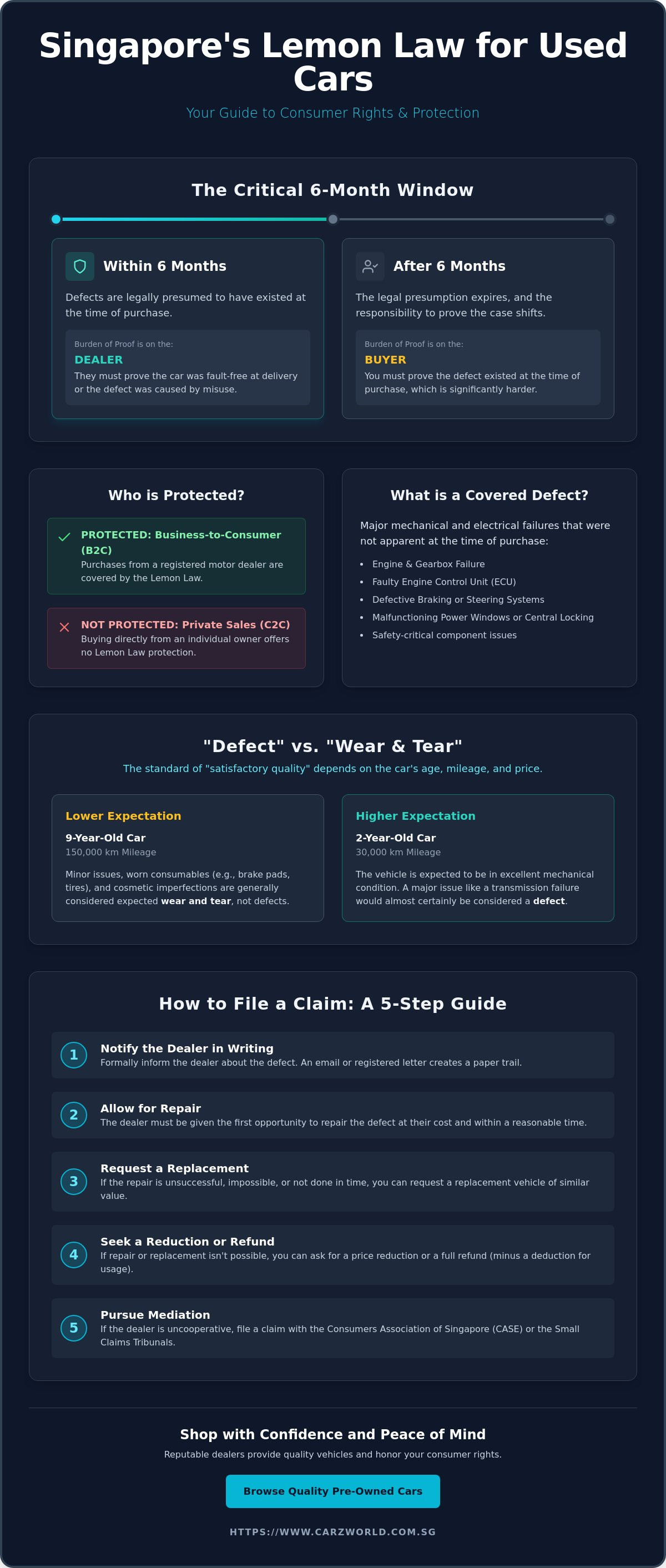
The most critical timeframe for any buyer is the first 180 days. Under the CPFTA, any defect that surfaces within six months of delivery is presumed to have existed at the time of purchase. This is a significant advantage for the buyer because it shifts the burden of proof. You don't have to prove the car was faulty when you bought it; instead, the dealer must prove the car was in good condition and that the defect arose from your own misuse or an external accident. After this six-month window passes, the burden of proof shifts back to you, making it much harder to successfully claim that a fault was pre-existing.
Who Does the Law Apply To?
It is vital to know that the Lemon Law only covers Business-to-Consumer (B2C) transactions. When you buy from a registered motor dealer like Carz World, you are fully protected. However, many buyers fall into the "private sale trap." If you buy a car directly from an individual owner through a classified ad, the Lemon Law does not apply. These "consumer-to-consumer" sales are considered private contracts, and you'll have very little legal leverage if the car breaks down the next day. These protections apply to all vehicle types sold by businesses, including pre-owned vehicles and brand new cars, providing a safety net that private sales simply can't offer.
What Does the Law Cover (and What It Doesn’t)?
The law doesn't offer a universal guarantee for every single component of a vehicle. Instead, it focuses on major systems that make a car roadworthy and safe. Mechanical faults involving the engine, gearbox, and safety-critical components like the braking system or steering are primary targets for claims. If your transmission fails three months after purchase, you're likely covered. Electrical systems are also included. This covers ECU failures, power window motors, and central locking systems that stop working unexpectedly.
There are clear limits to these protections. If a dealer points out a specific dent or a worn-out radio before the sale, you can't later claim it as a "lemon." Similarly, the law won't protect you if the damage is self-inflicted. Unauthorized modifications, such as aftermarket performance tuning that stresses the engine, or general consumer misuse, will void your right to a claim. Having the lemon law for used cars singapore explained helps you realize that while the law is robust, it doesn't replace the need for regular maintenance. If a fault arises because you skipped oil changes or ignored warning lights, the dealer is not obligated to cover the repair.
Satisfactory Quality: The Age and Mileage Factor
The legal definition of "satisfactory" is flexible. A 9-year-old car with 150,000km on the odometer has a different quality bar than a 2-year-old car with low mileage. An academic analysis of the Lemon Law suggests that the purchase price heavily influences what a court considers reasonable. If you pay a premium price for a car, you can legally expect a higher standard of performance. To ensure transparency, many reputable dealers use the Standard Pre-Delivery Inspection Checklist (SDIC). This document records the car's condition at the point of sale, helping both parties understand what is being agreed upon.
Specific Exclusions to Remember
You should keep in mind that cosmetic issues rarely qualify for a claim. Minor scratches, stone chips, or interior leather wear are usually considered part of a car's history rather than a functional defect. Consumables are another major exclusion. Items like tires, brake pads, and wiper blades are expected to wear down through normal use. Unless these parts were defective from the moment of delivery, their replacement is typically the owner's responsibility.
The law only applies to Business-to-Consumer transactions. If you're looking for a vehicle with these legal protections built-in, it's best to explore our inventory of pre-owned cars where transparency is a priority. Buying from a registered entity ensures you have a clear path for recourse if a major mechanical issue surfaces within your first six months of ownership.
"Wear and Tear" vs. "Defect": The Critical Distinction
The most common point of dispute between buyers and dealers is the line between a pre-existing fault and simple aging. To resolve this, CASE and the Small Claims Tribunal use the "Reasonable Expectation" test. This test asks if a reasonable person would expect a car of a certain age, mileage, and price to have that specific issue. You can't expect a car near the end of its 10-year COE cycle to perform like a showroom model. Having the lemon law for used cars singapore explained means recognizing that the law protects you from unfair quality, not from the natural passage of time. The law acknowledges that every used car has a history, and the price you pay usually reflects that history.
If you suspect a defect, an independent third-party inspection is your strongest tool. A report from a professional workshop can provide the technical evidence needed to show that a fault is a latent defect rather than a maintenance issue. This evidence is crucial if you need to escalate your case beyond a simple conversation with the dealer. It provides an objective baseline that moves the conversation away from opinions and toward mechanical facts. Many successful claims rely on these reports to prove that a component's failure was premature and not caused by the driver's habits.
Examples of Genuine Defects
A gearbox that fails just two weeks after you drive off the lot is a classic example of a genuine defect, especially if you've been driving normally. A gearbox failure is a catastrophic event, and the law assumes such a major component shouldn't fail immediately after purchase. Similarly, if your aircon compressor dies within the first month, it's highly likely the component was already failing at the point of delivery. A latent defect is a fault present but hidden at the point of sale. These are the issues the CPFTA was designed to address because they represent a failure of the car to be "fit for purpose."
Examples of Normal Wear and Tear
On the other hand, certain parts are designed to wear out. If you buy a car with 150,000km on the clock and find the brake discs are thin, this is usually considered normal wear and tear. Worn brake discs are a safety item, but they're also a consumable. If the car passed its inspection recently, claiming thin discs as a "lemon" defect is difficult. A battery that starts to struggle after several months of ownership is another common maintenance item that the law typically won't cover. For older models, faded interior leather or rattling plastic panels are expected signs of age and don't qualify as "lemons."
How to File a Lemon Law Claim: A 5-Step Guide
Taking action when you discover a fault requires a methodical approach. Knowing the lemon law for used cars singapore explained helps you move from frustration to a resolution without unnecessary stress. You shouldn't wait for a small issue to become a major breakdown before speaking up. Following a clear sequence of steps ensures you remain within your legal rights and keeps the burden of proof on the dealer.
- Notify the dealer immediately in writing. As soon as you detect a fault, send an email or a formal message to the dealer. This creates a timestamped record of when the problem first surfaced. Don't rely on phone calls alone.
- Allow a "reasonable" opportunity for repair. You must give the dealer a chance to fix the issue. While "reasonable" isn't strictly defined as a specific number of days, it generally means allowing one or two attempts to resolve the same fault.
- Negotiate a price reduction. If a repair isn't feasible, perhaps because a specific part is no longer manufactured, you can ask for a reduction in the purchase price. This allows you to keep the car while being compensated for its lower value.
- Request a refund for failed repairs. If the dealer fails to repair or replace the defective part twice for the same issue, you have the right to request a refund.
- Escalate to CASE or the Small Claims Tribunal (SCT). If negotiations stall, you can approach the Consumers Association of Singapore (CASE) for mediation. If that fails, you can file a claim at the SCT within two years of the dispute arising.
The Three Rs: Repair, Replace, Refund
The dealer usually has the right to choose "Repair" as the first remedy because it is the most practical solution. Replacing a used car is rare. Since no two pre-owned vehicles are identical in wear and mileage, finding an exact match is difficult. If you reach the refund stage, don't expect 100% of your money back. Refunds are typically pro-rated. The dealer is allowed to deduct a "use" fee based on the mileage you've covered and the time you've spent with the car since delivery.
Documenting Your Case
Your paper trail is your strongest asset if you ever need to stand before the Small Claims Tribunal. Keep a detailed log of every interaction, including dates, times, and descriptions of the faults. Collect photos and videos of dashboard warning lights or unusual engine sounds. Diagnostic reports from independent workshops are also vital. They provide the technical evidence needed to prove a fault is a latent defect. When communicating with the dealer, keep your tone professional and direct. This ensures your correspondence is "court-ready" and shows you are a serious, well-informed buyer.
If you are looking for a transparent buying experience where your rights are respected from day one, visit Carz World to browse our vetted inventory.
Buying with Confidence: How Carz World Protects You
Having the lemon law for used cars singapore explained gives you the legal tools for protection, but choosing the right dealer prevents you from needing those tools in the first place. At Carz World, we don't just follow the law; we embrace it as a baseline for our operations. Our commitment to transparency ensures that every vehicle in our inventory meets a high standard of quality before it ever reaches the showroom floor. We believe that a well-informed buyer is a confident buyer.
The Carz World Inspection Standard is our primary defense against "lemons." Every car is vetted by experienced technicians who check for the latent defects mentioned earlier in this guide. We look at the engine health, gearbox performance, and electrical integrity to ensure the car is truly fit for purpose. This proactive approach significantly reduces the likelihood of a claim arising within that critical six-month window. It's about providing a car that's ready for the road, not just ready for sale.
If an issue does occur after your purchase, our reputation for handling problems quickly and fairly is what sets us apart. We understand that a vehicle is a significant investment. Our team is dedicated to providing post-purchase support that prioritizes your safety and satisfaction. We don't hide behind fine print or aggressive tactics. Instead, we work with you to find a resolution that's efficient and professional. You can browse our certified pre-owned collection to see the quality of vehicles we offer.
Transparency in Every Transaction
We believe in full disclosure. During the sales process, we provide a complete history of the vehicle and discuss any known issues openly. We encourage comprehensive test drives and welcome independent inspections from third-party workshops. Our professional staff will guide you through the paperwork and explain your warranty details clearly. This ensures you're fully informed before you sign any agreement. This methodical approach makes complex logistical processes feel like a seamless experience for you.
Why Reputation Matters in the Used Car Market
Trust is the most valuable currency in the automotive industry. Our business model relies on a continuous stream of positive testimonials from satisfied clients who appreciate our honest approach. We maintain a "no-pressure" environment where you can explore your options at your own pace. If you're ready to upgrade your current vehicle, visit our sell/consignment page for a fair and transparent valuation. We value long-term reputation over short-term gains, ensuring your car-buying journey is fluid and positive.
Drive with Confidence and Clarity
Understanding your rights is the first step toward a successful vehicle purchase. You now have the lemon law for used cars singapore explained, from the critical six-month presumption rule to the distinction between normal wear and tear and genuine latent defects. While the legal framework provides a safety net, your best protection is always a transparent transaction with a partner you can trust. By documenting your interactions and prioritizing professional communication, you ensure that your investment remains secure.
At Carz World, we take the stress out of the equation. Our customer-centric service is backed by verified testimonials from drivers who value honesty and competence. We offer a vast inventory of Japanese and Continental models, each vetted to meet our rigorous standards. Our team is ready to help you find a vehicle that fits your lifestyle without the high-pressure tactics found elsewhere. We invite you to browse our transparently vetted Used Car Collection and experience a seamless buying process.
Your next car should be a source of joy, not a legal headache. We're here to make sure your journey on the road is smooth, reliable, and worry-free. Safe driving!
Frequently Asked Questions
Does the Lemon Law apply to used cars bought from private sellers?
No, the Lemon Law only applies to purchases made from registered business entities. Transactions between private individuals, often called consumer-to-consumer sales, are not covered under the Consumer Protection (Fair Trading) Act. If you buy directly from an owner, you're entering a private contract without these specific statutory protections. This is why many buyers prefer the security and professional accountability of a reputable dealer.
How long do I have to make a claim under the Lemon Law in Singapore?
You have a six-month window from the date of delivery to benefit from the "presumption of defect." If a fault appears within this time, the law assumes it existed at the point of sale. This is a key part of how the lemon law for used cars singapore explained protects your investment. You can also file a claim at the Small Claims Tribunal for up to two years from the dispute date.
Can I get a full refund if my used car turns out to be a lemon?
A full refund is possible but rarely results in a 100% return of your original purchase price. The law allows dealers to deduct a reasonable amount for the usage you've already enjoyed. This pro-rated calculation considers the mileage you've clocked and the duration of ownership. Usually, a refund is only granted if the dealer fails to repair or replace the defective component after multiple attempts.
What is the "Standard Pre-Delivery Inspection Checklist" (SDIC)?
The SDIC is a detailed document used by dealers to record the vehicle's condition at the time of delivery. It serves as a mutual agreement on existing wear and tear or minor cosmetic issues. By signing this checklist, both parties have a clear reference point. This transparency helps prevent future disputes about whether a defect was present at the point of sale or occurred due to your driving habits.
Does the law cover defects I was told about before I bought the car?
No, the Lemon Law does not cover any faults or defects that the dealer explicitly pointed out to you before the transaction. If you agree to purchase a car knowing it has a specific issue, you've accepted the vehicle in that condition. This exclusion also applies to defects that should've been reasonably apparent during your own pre-purchase inspection or during a standard test drive at the showroom.
What happens if the dealer refuses to repair the car?
If a dealer refuses to honor their obligations, you should first ensure all your communication is documented in writing. You can then approach the Consumers Association of Singapore (CASE) for mediation services. If mediation doesn't lead to a satisfactory resolution, your next step is filing a claim with the Small Claims Tribunal. These bodies are designed to handle such disputes efficiently without needing expensive legal representation or complex litigation.
Does Lemon Law cover COE cars that are more than 10 years old?
Yes, the law applies to all used vehicles regardless of age, including COE cars over ten years old. However, the standard for "satisfactory quality" is lower for an older vehicle with high mileage. This is how the lemon law for used cars singapore explained handles older models by considering what is reasonable for that age. Major mechanical failures are still covered, but minor rattles likely are not.
Can I still claim if I have already sent the car for repairs at my own workshop?
Claiming becomes very difficult if you've already repaired the fault at an external workshop without the dealer's consent. The law requires you to give the dealer a "reasonable" opportunity to fix the issue first. By repairing it elsewhere, you may have destroyed the evidence of the original defect. Always notify the dealer and wait for their response before authorizing any third-party repairs to keep your legal claim valid.
Disclaimer
This content is provided for general informational purposes only. Readers are encouraged to independently verify important information.
In Same Category
- Calculating the Breakeven Point for COE Renewal in Singapore
- Financial Checklist Before Committing to a Car Purchase in Singapore (2026)
- COE Renewal Conditions and Eligibility in Singapore: 2026 Guide
- Balloon Scheme Car Loan in Singapore: Pros and Cons for 2026
- Getting Car Finance with a New Business in Singapore: A Practical Guide
Related by Tags
- Used Cars for Sale in Tampines: 2026 Buyer's Guide
- Mercedes C-Class Singapore Guide 2026: Specs, COE, and Buying Tips
- Second Hand Hybrid Cars Singapore: The 2026 Value & Inspection Guide
- Cheapest Car in Singapore: The 2026 Guide to Affordable Ownership
- Parallel Import Cars Singapore: 2026 Buyer’s Guide
- Honda Civic Singapore: 2026 New & Pre-Owned Guide
- Suzuki Swift Singapore: The Ultimate Smart-Money Hatchback Guide 2026
- Mazda 3 Singapore Guide 2026: Specs, Prices, and Buying Tips
- The Ultimate Toyota Alphard Singapore Guide: Luxury & Performance in 2026
- Hyundai Ioniq 5 Singapore: The Definitive 2026 Buying & Ownership Guide
- Nissan Qashqai Singapore: Ultimate Buyer’s Guide 2026
- The Ultimate Used Car Buying Guide for Singapore in 2026
- Why Carz World is Your Trusted Used Car Dealer in Singapore (2026 Guide)
- Honda Odyssey Singapore: 2026 Family Buying Guide
- Used Honda Singapore: The Ultimate Buyer’s Guide for 2026