Electric Cars (EV) in Singapore: The Ultimate 2026 Buying Guide
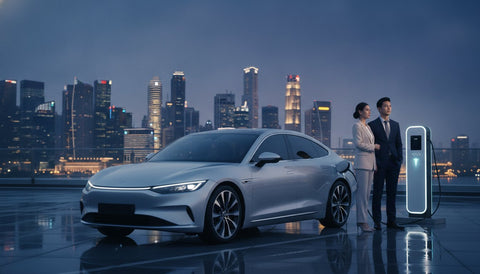
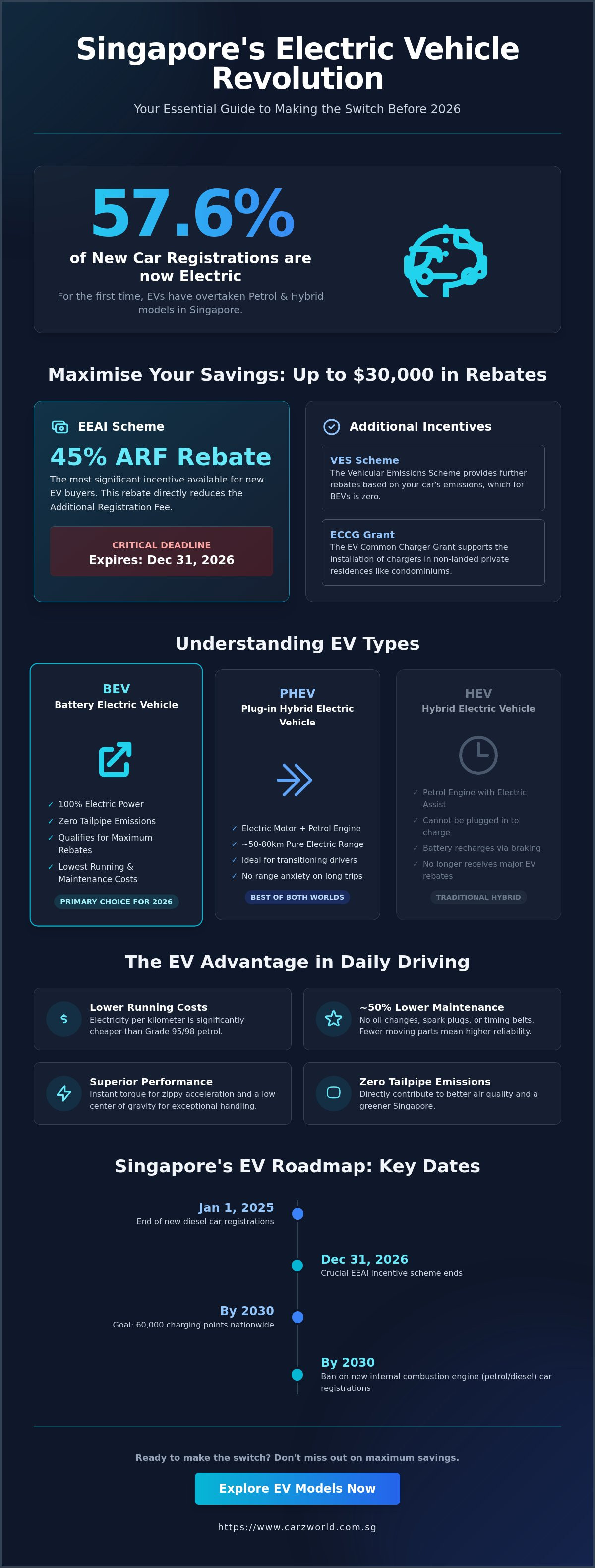
Did you know that 57.6% of all new car registrations in Singapore are now electric? For the first time in history, electric cars (ev) have officially overtaken petrol and hybrid models as the primary choice for local drivers. This shift marks a significant turning point in how we think about mobility and long term vehicle value on our roads.
It's completely natural to feel a bit of pressure to make the switch, especially with the 2030 ban on new internal combustion engine registrations approaching. You might feel confused by the complex ARF rebate calculations or anxious about charging availability at your HDB or condo. The upfront price tag can also seem daunting when compared to the traditional vehicles you have driven for years.
This guide is designed to give you total clarity. You'll discover how to maximize your savings by securing up to $30,000 in combined rebates before the EEAI incentive expires on December 31, 2026. We'll examine the latest technology, compare the most efficient models available today, and show you exactly how to future proof your purchase while significantly reducing your monthly running costs.
Key Takeaways
- Learn the specific steps to maximize the 45% ARF rebate under the EEAI scheme before it concludes at the end of 2026.
- Discover how to transition to electric cars (ev) seamlessly by matching battery capacity to your specific weekly driving patterns.
- Evaluate the "best of both worlds" benefits of PHEVs if you still have concerns about long-distance travel or charging frequency.
- Gain clarity on the ECCG grant and how it supports charging infrastructure for residents in private condominiums.
- Review top-performing models from luxury and budget-friendly brands to ensure your next vehicle meets both your lifestyle and financial goals.
The Shift to Electric Cars (EV) in Singapore: Why 2026 is the Turning Point
2026 is a pivotal year for the Singaporean automotive market. The Singapore Green Plan 2030 has moved from a distant vision to a tangible reality that affects your daily commute. Since the registration of new diesel cars ended on January 1, 2025, the transition to electric cars (ev) has accelerated rapidly. This shift isn't just about government mandates; it's about a fundamental change in how we value our time and money on the road.
A new demographic of drivers is leading this charge. You will find "hip soccer moms" and eco-conscious commuters opting for these vehicles because they offer a seamless blend of style and efficiency. The growing network of charging infrastructure is a major reason for this confidence. The government aims to install 60,000 charging points across the island by 2030, making range anxiety a thing of the past for most residents. This expansion is a key pillar of the broader EV adoption in Singapore, ensuring that charging is as convenient as finding a petrol station.
To better understand this concept, watch this helpful video:
The Environmental and Performance Edge
Driving an EV offers a level of refinement that traditional engines simply cannot match. Zero tailpipe emissions mean you are directly contributing to better air quality in our densely populated urban areas. Beyond the environmental impact, the driving experience is significantly improved. You get instant torque the moment you press the pedal. This makes the car feel much "zippier" when you are moving through stop-start traffic in the CBD. Because the heavy battery pack is located at the base of the car, the low center of gravity provides exceptional handling and stability on tight city streets.
Maintenance and Running Cost Reality
One of the most compelling reasons to switch is the long-term financial benefit. Data shows that maintenance costs for electric cars (ev) are typically 50% lower than petrol vehicles. You no longer have to worry about oil changes, spark plugs, or complex timing belts. With fewer moving parts, there is simply less that can go wrong over the life of the vehicle. This reliability is a core reason why many drivers are now looking at brand new cars in the electric segment.
Your daily running costs also drop significantly. When you compare the cost-per-kilometer of electricity against Grade 95 or 98 petrol, the savings are immediate. Modern regenerative energy technology helps extend your range by capturing energy usually lost during braking and feeding it back into the battery. This is particularly effective in Singapore's traffic, where frequent deceleration actually helps you stay on the road longer.
Understanding EV Types: BEV, PHEV, and HEV Explained
Choosing between different technologies is the first step in your journey toward sustainable driving. While the term "EV" is often used broadly, it actually covers three distinct vehicle types. Each one offers a different balance of fuel efficiency and battery power. Because the government is pushing for a cleaner future, fully electric cars (ev) receive the most generous tax breaks and rebates available in the market today.
Battery Electric Vehicles (BEV) are the primary choice for new buyers in 2026. These cars run entirely on electricity and produce zero tailpipe emissions. They rely on large battery packs that you can fast-charge at public stations or at home. If you want to maximize your savings through Singapore EV incentives, a BEV is your best option. These models qualify for the maximum $30,000 rebate from combined EEAI and VES schemes, whereas petrol and most hybrids no longer receive these specific benefits.
Plug-in Hybrid Electric Vehicles (PHEV) offer a middle ground. They have both an electric motor and a small petrol engine. You can drive approximately 50 to 80 kilometers on pure electricity, which covers most daily trips in Singapore. Once the battery is low, the petrol engine kicks in. This makes them a reliable choice if you frequently drive to Malaysia and feel anxious about finding chargers across the border.
Hybrid Electric Vehicles (HEV) are self-charging models. They use a petrol engine to charge a small battery while you drive. You don't need to plug them in. While they are more efficient than traditional cars, they don't qualify for the same level of rebates as fully electric cars (ev) in 2026. They remain a popular choice for those who aren't ready to commit to a plug-in lifestyle just yet.
Which EV Type Fits Your Lifestyle?
Your choice depends on your living situation and driving habits. If you're a daily commuter with a dedicated charger at home or your office, a BEV is the most logical choice. It offers the lowest running costs and the smoothest drive. For those who live in older HDB estates where charger installation is still in progress, an HEV might feel more practical for now. If you're looking for a cost-effective way to enter the market, you might want to explore our range of pre-owned cars to see which technology fits your budget.
Charging Standards in Singapore
Understanding how to power your car is essential for a stress-free experience. Singapore uses the Type 2 standard for AC charging and CCS2 for DC fast-charging. Most public fast-chargers can take a modern BEV from 0% to 80% in about 30 minutes. You can easily manage this through various smart charging apps that show real-time availability across the island. This network is expanding quickly to meet the 2030 target of 60,000 points, ensuring you're never far from a power source.
Maximizing Singapore EV Incentives and Rebates in 2026
2026 represents the final opportunity to capitalize on some of Singapore's most aggressive financial supports for electric cars (ev). Specifically, the EV Early Adoption Incentive (EEAI) is scheduled to end on December 31, 2026. This scheme currently provides a 45% rebate on the Additional Registration Fee (ARF), capped at $7,500. When you combine this with the $22,500 rebate from the Vehicular Emissions Scheme (VES) for Band A1 vehicles, your total upfront savings can reach $30,000.
These incentives are designed to bridge the price gap between electric and traditional internal combustion engine vehicles. By understanding the technical differences, such as those found when explaining BEV, PHEV, and HEV architectures, you can see why fully electric models receive the highest level of support. While hybrids are efficient, they don't always qualify for the full $30,000 stack. This makes the current window a "sweet spot" for buyers who want to maximize their government subsidies before the 2027 adjustments take effect.
The road tax structure for EVs in 2026 is also uniquely structured. It is based on the motor's power output in kilowatts (kW) plus an Additional Flat Component (AFC) of $700 per year. For most entry level electric cars (ev), you can expect an annual road tax between $700 and $900. This remains highly competitive with petrol cars, especially when you factor in the significantly lower maintenance and fuel costs discussed in previous sections.
Navigating the ARF and COE Landscape
Rebates play a critical role in offsetting high Certificate of Entitlement (COE) prices. In 2026, the ARF floor for electric cars remains at $0. This is a massive advantage. It allows you to apply the full value of your incentives without being blocked by a minimum payment requirement. This makes many of our brand new cars in the electric segment surprisingly accessible. Our team at Carz World helps you navigate these complex loan to value ratios to ensure your financing is as efficient as your new vehicle.
Commercial Vehicle Incentives
Business owners have even more reasons to transition their fleets in 2026. The Commercial Vehicle Emissions Scheme (CVES) provides substantial rebates for those switching to electric vans or light trucks. Additionally, the Heavy Vehicle Zero Emissions Scheme (HVZES) provides specialized support for larger logistics operations. Beyond direct rebates, companies can often benefit from tax write offs for corporate EV fleets. If you are looking to upgrade your business fleet, exploring our commercial vehicles is a strategic move to future proof your operations against rising diesel costs.
Standout EV Models: From Tesla to BMW and Beyond
The variety of electric cars (ev) available in Singapore has expanded significantly as we move through 2026. Drivers are no longer limited to just one or two premium brands. Instead, the market now offers a diverse range of vehicles that cater to different lifestyles, from high performance luxury sedans to practical family SUVs. Choosing the right model requires a careful look at real world performance metrics like WLTP range, curb weight, and transmission efficiency.
Market data from the first quarter of 2026 highlights a major shift in consumer preference. Chinese manufacturers have established a massive presence, with BYD leading the market at a 24.3% share. This growth is driven by a combination of competitive pricing and advanced battery technology. Traditional Japanese manufacturers are also catching up. Toyota is scheduled to release the Urban Cruiser and bZ4X Touring in the third quarter of 2026, providing even more choices for those who value long term brand reliability.
The Premium Experience: Tesla and BMW
Tesla remains a dominant force in the local scene with the Model 3 and Model Y. Their primary advantage is the integrated Supercharger network, which offers unparalleled convenience for quick top ups. Beyond the hardware, Tesla's digital services are a major draw. Features like remote climate control and seamless over-the-air updates ensure the car improves over time.
BMW provides a different approach to the premium segment. The i4 and iX3 models prioritize interior craftsmanship and the "driving machine" heritage that petrol enthusiasts have loved for decades. These cars offer a familiar luxury feel with the added benefit of silent, instant torque. If you appreciate a more traditional cockpit with physical controls and high quality materials, the BMW i-Series is a standout choice.
Best Value for Families: Hyundai and BYD
For the practical Singaporean family, BYD and Hyundai offer some of the best value in 2026. The BYD Atto 3 has become a favorite for many parents because of its spacious rear seat and generous boot capacity. It's an ideal vehicle for school runs and weekend grocery trips. Hyundai's Ioniq series also performs exceptionally well, featuring an award-winning design and ultra-fast charging capabilities that can significantly reduce your time spent at a station.
Explore the Collection
At Carz World, we maintain an extensive collection of over 100 electric vehicles. Whether you are looking for the latest tech or a reliable family cruiser, we have both brand-new and pre-owned options to suit your needs. We invite you to Browse our latest Brand New Cars to see the newest arrivals in the market. If you are looking for a more cost-effective entry into electric mobility, you can also View all Electric Cars for Sale in our pre-owned inventory.
Buying Guide: How to Choose Your Perfect Electric Car
Selecting the right vehicle is a personal process that requires balancing your daily lifestyle with the technical capabilities of modern electric cars (ev). While the shift to sustainable driving is a strategic financial move, the best choice is always the one that fits your routine without adding complexity. We suggest starting with a clear audit of your driving habits to narrow down your options effectively.
Assess your daily mileage with a realistic lens. Most mid range electric cars (ev) now offer a range of approximately 400km on a full charge. For the average Singaporean driver, this distance often covers an entire week of commuting. If your schedule involves multiple cross island trips daily, you might prioritize models with larger battery capacities. This ensures that you only need to visit a charging station once or twice a week, maintaining the convenience you are used to with petrol vehicles.
Charging logistics are equally important. If you reside in a Non-Landed Private Residence (NLPR), we recommend confirming the availability of chargers with your building management. Many condominiums have already utilized government grants to install shared charging points. Having a reliable power source where you park overnight is the single most important factor for a seamless transition. Our expert sales teams at Carz World understand these local nuances. We take the time to learn your driving habits so we can recommend a vehicle that truly matches your needs.
The Pre-Owned EV Opportunity
Buying a 1-2 year old EV can be a very smart financial move in the Singapore market. You can enjoy significant savings on immediate depreciation while still benefiting from relatively new battery technology. We perform comprehensive battery health checks on every unit in our certified inventory. This ensures that the energy storage system meets our high standards for performance and longevity. You can Check out our Pre-Owned EV inventory to find a high quality vehicle that fits your budget.
Next Steps: From Showroom to Road
The best way to appreciate the benefits of electric mobility is to experience it firsthand. We encourage you to book a test drive to feel the instant torque and silent operation for yourself. If you are looking to fund your switch, we can help you Sell your current petrol car through our professional consignment services. This process is designed to be transparent and efficient, allowing you to focus on your new purchase. Finalizing your 2026 EV purchase now allows you to secure current incentives before any potential changes in the coming year.
Secure Your Future on the Road
The transition to electric mobility in Singapore is no longer a distant goal; it's a practical reality for today's drivers. By acting in 2026, you can still secure the maximum $30,000 in combined rebates through the EEAI and VES schemes before the landscape changes. Matching the right technology to your daily mileage and charging access is the most effective way to ensure long term satisfaction and reduced running costs.
At Carz World, we make this complex process feel seamless and rewarding. We maintain over 100+ electric cars (ev) in our inventory, ensuring you have the best variety of brand-new and pre-owned options to choose from. Our expert sales team possesses deep knowledge of the latest EV technology and is ready to guide you through our comprehensive financing and insurance solutions. We're here to help you future-proof your purchase with confidence and ease.
Explore our full selection of Electric Cars and revolutionise your drive today!
Embracing a cleaner, more efficient way to drive has never been more accessible. We look forward to helping you find the perfect vehicle for your next chapter on the road.
Frequently Asked Questions
Is it worth buying an electric car in Singapore in 2026?
Buying an electric car in 2026 is a strategic choice because it's the final year to access the full suite of time-limited government incentives. With electric cars (ev) accounting for 57.6% of new registrations in early 2026, you're joining a majority market. This volume ensures better infrastructure support and a more stable secondary market. It's a professional way to future-proof your transport before the 2030 petrol registration ban takes effect.
How much can I save with the EV Early Adoption Incentive (EEAI) in 2026?
You can save up to $7,500 through the EEAI scheme, which offers a 45% rebate on your Additional Registration Fee. When combined with the $22,500 VES rebate, your total savings can reach $30,000 for qualifying models. This financial support is scheduled to change after December 31, 2026. Securing your vehicle now ensures you maximize these specific government subsidies while they remain at their peak level.
Can I charge my electric car if I live in an HDB flat?
Yes, HDB residents have access to an ever-growing network of chargers located within multi-storey car parks. The government is on track to install 60,000 charging points island-wide by 2030, with a heavy focus on public housing estates. You can easily locate these points using various mobile apps. Charging while you sleep or during weekend errands has become a standard, convenient part of the HDB lifestyle.
What is the difference between AC and DC charging times?
The primary difference lies in the speed of energy delivery to your vehicle. AC charging is typically used for home or overnight sessions and takes several hours for a full charge. DC fast-charging is the preferred choice for quick top-ups at malls or petrol stations. Most modern electric cars (ev) can reach an 80% charge in just 30 minutes using a CCS2 DC connector, making long trips effortless.
How long do electric car batteries last in Singapore’s climate?
Most modern EV batteries are designed to maintain high performance for 8 to 10 years or approximately 160,000 kilometers. Singapore's tropical climate is well-managed by advanced liquid-cooling systems found in current models. These systems keep the battery at an optimal temperature during operation and charging. Most manufacturers provide extensive warranties that protect your investment against significant capacity loss during the initial years of ownership.
Does Carz World offer financing for electric vehicles?
We provide comprehensive financing and insurance solutions tailored specifically for electric vehicle buyers. Our expert sales team understands the unique loan-to-value ratios and rebate structures involved in these transactions. We work with various financial institutions to secure competitive rates that fit your budget. Whether you're interested in brand-new or pre-owned models, we ensure the paperwork is handled with efficiency and professional care.
Are there enough public charging stations in Singapore now?
Singapore's public charging network is now among the densest in the region. With over 7,600 new electric cars registered in the first quarter of 2026 alone, infrastructure providers have accelerated their deployment. You'll find chargers at shopping malls, office buildings, and public car parks across every district. This widespread availability means you're never far from a power source. It makes daily operation feel seamless and reliable for every driver.
What happens to the resale value of EVs in Singapore?
Resale values for EVs are becoming increasingly stable as the technology matures and adoption becomes the norm. As petrol cars face upcoming registration bans, demand for quality pre-owned electric models is expected to rise. We perform rigorous battery health checks on all our inventory to maintain high resale standards. This transparency builds confidence for both current owners looking to sell and new buyers entering the market.
Disclaimer
This content is provided for general informational purposes only. Readers are encouraged to independently verify important information.
In Same Category
- Calculating the Breakeven Point for COE Renewal in Singapore
- Financial Checklist Before Committing to a Car Purchase in Singapore (2026)
- COE Renewal Conditions and Eligibility in Singapore: 2026 Guide
- Balloon Scheme Car Loan in Singapore: Pros and Cons for 2026
- Getting Car Finance with a New Business in Singapore: A Practical Guide
Related by Tags
- Used Cars for Sale in Tampines: 2026 Buyer's Guide
- Car Loan Singapore: The Complete 2026 Guide to Financing Your Vehicle
- Long Term Car Rental Singapore: 2026 Definitive Guide
- Mercedes C-Class Singapore Guide 2026: Specs, COE, and Buying Tips
- Second Hand Hybrid Cars Singapore: The 2026 Value & Inspection Guide
- Cheapest Car in Singapore: The 2026 Guide to Affordable Ownership
- Parallel Import Cars Singapore: 2026 Buyer’s Guide
- Honda Civic Singapore: 2026 New & Pre-Owned Guide
- Suzuki Swift Singapore: The Ultimate Smart-Money Hatchback Guide 2026
- Mazda 3 Singapore Guide 2026: Specs, Prices, and Buying Tips
- The Ultimate Toyota Alphard Singapore Guide: Luxury & Performance in 2026
- Hyundai Ioniq 5 Singapore: The Definitive 2026 Buying & Ownership Guide
- Nissan Qashqai Singapore: Ultimate Buyer’s Guide 2026
- The Ultimate Used Car Buying Guide for Singapore in 2026
- Why Carz World is Your Trusted Used Car Dealer in Singapore (2026 Guide)
- Honda Odyssey Singapore: 2026 Family Buying Guide