Car Depreciation in Singapore: The Ultimate 2026 Guide to Smart Ownership

Did you know that a car registered after February 2026 now faces a PARF rebate cap of just $30,000? With Category A COE prices hitting a record $129,000 in July 2026, the financial stakes of vehicle ownership have reached an all-time high. It's completely understandable if you feel frustrated by complex LTA terminology or worry about overpaying for a vehicle that loses value too quickly. Understanding car depreciation singapore is no longer just about knowing the sticker price. It is about mastering the math that determines your true annual cost in this unique market.
We promise to clear the confusion by breaking down the exact formulas you need to minimize your losses and maximize resale value. You'll discover how the latest tax changes impact your bottom line and which vehicle types offer the best hedge against steep depreciation. This guide provides a clear strategy to lower your total cost of ownership. We want to ensure you have the knowledge to make a smart, confident purchase that protects your financial future.
Key Takeaways
- Master the straight-line calculation method to account for 2026 tax adjustments and accurately track your annual financial loss.
- Discover why purchasing pre-owned vehicles serves as a reliable hedge against the high car depreciation singapore rates seen in the first year.
- Learn how brand selection and mileage management can help preserve your vehicle's value in a shifting market.
- Identify the optimal five-year ownership window and learn how consignment services help you secure a higher resale price.
What is Car Depreciation in Singapore and Why Does It Matter?
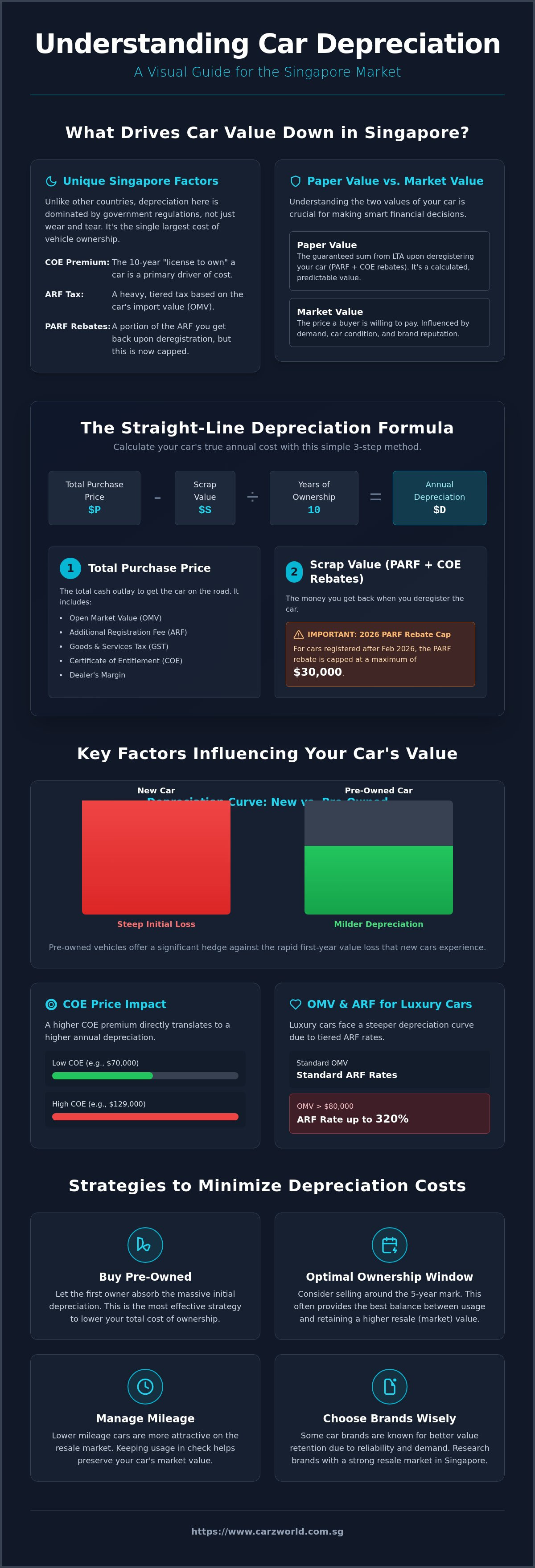
In its simplest form, car depreciation is the annual amount you "lose" on your vehicle as it approaches its 10-year Certificate of Entitlement (COE) expiry. While the general concept of What is Depreciation applies to any asset, the Singapore market is unique. In most countries, a car loses value primarily because of mileage and mechanical wear. In Singapore, your car's value is anchored to government taxes and the COE premium you paid at the start. It is the biggest cost of ownership. It dwarfs other expenses.
Depreciation represents the single largest expense of owning a vehicle here. It often exceeds the combined costs of fuel, insurance, and maintenance. Understanding car depreciation singapore requires looking past the sticker price to see the "daily burn rate." You must also distinguish between "Paper Value" and "Market Value." Paper Value is what the government owes you upon deregistration. Market Value is what a buyer or dealer will pay. Market value is often influenced by the demand for export cars, which can provide a financial floor for your vehicle as it ages.
To better understand how these values shift over time, watch this helpful video from sgCarMart:
The Role of COE in Your Car’s Annual Depreciation
The COE is a massive factor in your car's value. With Category A prices reaching $129,000 in July 2026, the daily cost of just having the car parked in your driveway has risen significantly. If you deregister your car before the 10-year mark, you receive a pro-rated rebate on the unused portion of your COE. A car bought with a $129,000 COE will naturally have a higher annual depreciation than one with a $70,000 COE. This makes the timing of your purchase critical to your long-term wealth. High COE prices inflate the daily "burn rate" of every vehicle on the road.
OMV and ARF: The Hidden Pillars of Car Value
OMV is the actual price paid to the manufacturer before SG taxes. It serves as the baseline for the Additional Registration Fee (ARF), which is a tiered tax. For luxury vehicles with an OMV above $80,000, the ARF rate reaches 320%. This tiered system creates a much steeper depreciation curve for high-end cars. Since your PARF rebate is calculated based on a percentage of the ARF, the recent 2026 policy changes capping these rebates at $30,000 mean that expensive cars now lose value even faster. If you want to avoid these heavy losses, exploring pre-owned cars can be a strategic move to let the first owner absorb that initial tax hit. This is a smart way to manage car depreciation singapore in a high-tax environment.
The Singapore Car Depreciation Formula: How to Calculate It
Savvy owners in Singapore don't just look at the sticker price. They focus on the annual loss. To accurately compare different vehicles, we use the Straight-Line Method. This formula allows you to see past the initial high cost and understand the yearly financial commitment of your purchase. By calculating car depreciation singapore this way, you can determine if a luxury SUV or a compact sedan fits your long-term budget.
The calculation follows three clear steps:
- Step 1: Determine the Total Purchase Price. This includes the car's OMV, ARF, GST, dealer margin, and the COE premium.
- Step 2: Calculate the Scrap Value. This is the total of your PARF rebate and any remaining COE rebate at the end of your ownership period.
- Step 3: The Final Division. Subtract the Scrap Value from the Total Purchase Price, then divide that number by the remaining years of the COE.
Understanding PARF and COE Rebates (The Scrap Value)
The "Scrap Value" acts as a financial floor for your vehicle. It is the guaranteed amount you receive when the car is deregistered. However, you must account for recent changes to PARF rebates that took effect on February 20, 2026. For cars registered after this date, the PARF rebate has been lowered by 45 percentage points and is now capped at $30,000. If you scrap your car before the 10-year mark, you also receive a pro-rated rebate for the unused portion of your COE. This makes early deregistration less financially attractive than it was in previous years.
A Real-World Calculation Example for 2026
Let's look at the numbers for a typical mid-sized vehicle. For instance, a $150,000 car with a $20,000 scrap value over 10 years has a $13,000 annual depreciation, which helps you visualize the yearly financial commitment. If you compare this to a luxury European SUV with a $130,889 Category B COE and a higher ARF, the annual depreciation could easily double. This is why "Annual Depreciation" is a far more effective tool than "Total Price" when shopping for your next vehicle.
Using this formula also reveals the hidden value in the used car market. A three-year-old car has already undergone its steepest value drop. When you calculate its remaining car depreciation singapore, you often find the annual cost is significantly lower than a brand-new model. If you want to bypass the steepest part of this curve, browsing our pre-owned inventory can reveal significant savings while still providing a high-quality driving experience.
New vs. Used Cars: Which Has the Better Depreciation Curve?
The moment you drive a new vehicle out of the showroom, its value shifts. In the Singapore market, most new cars lose between 10% and 20% of their value within the first twelve months. This "drive-off-the-lot" effect is the most expensive period of ownership. You are paying a premium for the status of being the first owner, but you are also bearing the brunt of the initial tax and registration costs. If you want to avoid this steep drop, used cars act as an effective financial hedge. By purchasing a vehicle that is already three years old, you allow the original owner to absorb that primary financial hit.
Data suggests a "sweet spot" for buyers exists between the fourth and sixth year of a car's life. During this window, the annual car depreciation singapore tends to flatten out. The vehicle is still modern enough to be reliable, but the yearly loss in value is significantly lower than a brand-new model. This allows you to enjoy a high-quality driving experience while keeping your annual ownership costs manageable. Choosing a car in this age range is often the smartest move for those focused on long-term wealth preservation.
Parallel Imports vs. Authorized Dealer Depreciation
Choosing between a Parallel Import (PI) and an Authorized Dealer (AD) car impacts your bottom line. PI cars typically offer a lower initial purchase price, sometimes 5% to 10% less than their AD counterparts. This lower entry cost naturally reduces your total depreciation. However, AD cars often command a higher resale price on the secondary market. Buyers often perceive AD vehicles as having more reliable service histories and better warranty support. For those who prioritize the latest technology and manufacturer peace of mind, our selection of brand new cars provides options that balance these factors effectively.
The "COE Remaining" Strategy for Used Car Buyers
Your strategy should also account for the remaining COE life. A car with only two or three years left on its COE is often referred to as a "short-parf" car. These vehicles are excellent for drivers who want a low-risk financial commitment without a long-term loan. You know exactly what your "burn rate" is until the car is scrapped. Conversely, a car with a fresh 10-year COE has a higher upfront cost but offers a longer utility period. Comparing these different timelines is essential for mastering car depreciation singapore. To find a vehicle that fits your specific timeline, exploring a diverse pre-owned cars collection is the best way to compare your potential annual savings.
Factors That Accelerate (or Slow Down) Your Car’s Depreciation
While tax structures and COE prices provide the foundation, individual vehicle factors determine where your car sits on the value spectrum. Two cars with identical paper values can have vastly different market prices based on how they were used. Mileage and condition remain the most significant variables. A high-mileage vehicle often signals impending repair costs, which accelerates car depreciation singapore even if the COE premium was high. Similarly, the "LTA Owner" count matters. A car with one or two previous owners is perceived as better maintained than one that has changed hands four or five times.
Brand perception also dictates resale speed. In the local market, brands like Toyota and Honda are prized for their reliability and the widespread availability of spare parts. This high demand keeps their depreciation lower compared to niche European brands that may have higher maintenance costs. Even your choice of color plays a role. "Safe" colors like white, silver, and black consistently hold their value better in the second-hand market because they appeal to the broadest range of buyers. Radical modifications often have the opposite effect. Non-standard body kits or performance tuning can actually hurt your car’s value by narrowing your pool of potential buyers.
Maintenance Records and the Resale Premium
Keeping a Full Service History (FSH) is one of the most effective ways to slow down value loss. It provides tangible proof of care and reassures the next owner. Small investments in specialized grooming and upkeep can help you recover hundreds, if not thousands, in depreciation losses during the sale. If you are looking to maximize your return, consider our professional valuation and consignment services to ensure your car’s condition is properly marketed to the right buyers. A well-documented car always commands a premium over a neglected one.
Market Trends: EVs and Hybrid Depreciation in 2026
The landscape of car depreciation singapore is shifting as Electric Vehicle (EV) adoption grows. With EVs accounting for 45% of new car sales in 2025, pure internal combustion engine (ICE) cars are beginning to see a faster decline in resale interest. A new metric has emerged for 2026: "Battery Health." Much like mileage, the state of an EV's battery now dictates its second-hand worth. Hybrids currently occupy the "goldilocks" zone. They offer the fuel efficiency buyers want without the range anxiety of full electrics, resulting in some of the most stable depreciation curves in the current market.
How to Manage and Minimize Your Car Depreciation Costs
Managing your vehicle's value requires a proactive approach rather than a passive one. While car depreciation singapore is a fixed reality of the local market, the timing of your exit can save you thousands of dollars. Many experienced owners find that selling at the five-year mark is the most financially sound move. At this stage, the car has typically moved past its steepest value drop but still retains significant market appeal for buyers who want a modern vehicle without the new car price tag. This timing also allows you to settle your loan before interest costs eat further into your equity.
Your choice of selling method also dictates your final return. While a dealer trade-in offers speed, it rarely provides the highest value. Choosing the right financing and insurance packages from the start can also help offset your total ownership costs. By securing a lower interest rate, you reduce the total amount you need to "recover" when it's time to sell. Every dollar saved on interest or premiums is a dollar that stays in your pocket, effectively lowering your annual cost of ownership.
Maximizing Value Through Consignment
Consignment is a powerful tool for owners who want to secure a higher asking price. When you use our selling process, you benefit from professional marketing and high-quality photography that makes your car stand out. We handle the complex paperwork and buyer inquiries on your behalf. This transparency builds trust with potential buyers and often leads to a faster sale at a price point that reflects the true condition of your vehicle. It's a seamless way to ensure you aren't leaving money on the table just for the sake of convenience.
Exploring Export and Scrap Options
When a car reaches the end of its COE life, its value in the local market often drops to its basic scrap value. However, some vehicles are perfect for overseas markets even if they are considered "too old" for Singapore. Our specialized export services can often provide a higher return than the standard LTA rebate alone. We look beyond our borders to find international buyers who value specific models, providing you with a better financial floor for your asset. For 2026 buyers, the ultimate tip is to research car depreciation singapore before ever looking at a monthly installment. Understanding the "burn rate" of your asset is the only way to ensure smart, sustainable ownership in a high-cost environment.
Take Control of Your Car’s Financial Future
Mastering the math behind car depreciation singapore is the first step toward smarter vehicle ownership. By understanding how COE premiums and the latest PARF rebate caps affect your bottom line, you've now got the tools to make informed decisions that protect your wealth. Whether you choose to buy pre-owned to avoid the initial value drop or sell strategically at the five-year mark, you can manage your ownership costs effectively. Every decision should be rooted in data to ensure your vehicle remains a manageable asset rather than a financial burden.
We're here to help you navigate this complex market with confidence. Trusted by thousands of Singaporean drivers, our team offers deep expertise in both local sales and international exports. Our transparent, no-pressure valuation process ensures you understand exactly what your vehicle is worth in today's shifting landscape. Don't leave your resale value to chance. Get a free, professional valuation for your car today and take the guesswork out of your next transaction. You deserve a partner who values your investment as much as you do. We look forward to helping you achieve a seamless and positive ownership experience.
Frequently Asked Questions
How is car depreciation calculated in Singapore?
Car depreciation is calculated by subtracting the vehicle's scrap value from its total purchase price and dividing that amount by the 10-year COE period. The total price includes the Open Market Value (OMV), Additional Registration Fee (ARF), and the COE premium. This annual figure represents your real cost of ownership. It is a more accurate financial metric than the initial showroom price.
Is it better to buy a new or used car to avoid depreciation?
Buying a used car is generally the better strategy to avoid the steepest value loss. New vehicles typically lose 10% to 20% of their value in the first year alone. By choosing a three-year-old car, you let the first owner absorb that initial financial hit. This results in a lower annual "burn rate" for you while still providing a modern and reliable vehicle.
Does a high COE price mean higher depreciation?
Yes, a high COE price directly increases your annual depreciation because it raises the total upfront cost of the vehicle. Since the scrap value of the car does not increase when COE prices rise, the amount you "lose" each year becomes significantly larger. For example, the record $129,000 Category A COE seen in July 2026 has noticeably inflated the daily ownership costs for new car buyers.
What is the PARF rebate and how does it affect my car’s value?
The PARF rebate is a refund of a percentage of your Additional Registration Fee (ARF) given when you deregister your car before it turns 10. For cars registered from February 20, 2026, this rebate is capped at $30,000. This change has a major impact on car depreciation singapore, especially for luxury cars with high ARF. It lowers your guaranteed "paper value" and increases your total annual loss.
Which car brands have the lowest depreciation in Singapore?
Reliable Japanese brands like Toyota and Honda typically maintain the lowest depreciation rates in the local market. Their value stays high because there is a constant demand for them in the second-hand market and spare parts are easily available. Buyers trust these brands for long-term reliability. This high resale demand helps protect owners from the rapid value drops often seen with niche or luxury European brands.
Can I reduce my car’s depreciation after I buy it?
You can slow down your car's market depreciation by maintaining a full service history and keeping the vehicle in excellent physical condition. While the paper value is fixed by LTA, a well-documented and groomed car will always command a higher resale price. Avoiding non-standard modifications and keeping your mileage within reasonable limits also helps you secure a premium when it is time to sell or consign your vehicle.
What happens to depreciation if I renew my COE for another 10 years?
Renewing your COE for 10 years causes you to forfeit your PARF rebate entirely, which resets your vehicle's value to its COE component alone. Your new car depreciation singapore will be calculated based on the cost of the Prevailing Quota Premium (PQP) divided by the 10-year extension. This move can be financially sound if your car is mechanically healthy and the cost of a new vehicle is prohibitively high.
How does the number of previous owners affect depreciation?
A higher number of previous owners typically accelerates market depreciation because it creates a perception of more wear and tear. Buyers generally prefer "one-owner" cars, believing they have been more consistently maintained. If your car has had four or five owners, you may need to lower your asking price to attract interest. Keeping your ownership period longer can help mitigate this effect when you finally decide to sell.
Disclaimer
This content is provided for general informational purposes only. Readers are encouraged to independently verify important information.
In Same Category
- Sell My Car Fast in Punggol: A Practical Guide
- Toyota Prius in Singapore: A Practical Buyer’s Guide for 2026
- Best Cars for Home-Based Businesses in Singapore: 2026 Guide
- Risks of Buying a Car with 1 Year of COE Left in Singapore (2026 Guide)
- Best Second Hand Cars for Malaysia: Singapore Buyer's Guide
Related by Tags
- Used Cars for Sale in Tampines: 2026 Buyer's Guide
- Car Downpayment vs Monthly Instalment in Singapore: The 2026 Budgeting Guide
- Car Loan Singapore: The Complete 2026 Guide to Financing Your Vehicle
- How Much Salary to Afford a Car in Singapore: 2026 Affordability Guide
- Buying a Used Car in Singapore: 2026 Ultimate Guide
- What is PARF? The Ultimate Guide to Singapore’s Car Rebate System
- Mercedes-Benz EQB 250+ Review: The Ultimate 7-Seater Family EV in Singapore
- Long Term Car Rental Singapore: 2026 Definitive Guide
- How to Buy a Car in Singapore: The Ultimate 2026 Step-by-Step Guide
- Second Hand Hybrid Cars Singapore: The 2026 Value & Inspection Guide
- Cheapest Car in Singapore: The 2026 Guide to Affordable Ownership
- Parallel Import Cars Singapore: 2026 Buyer’s Guide