Honda Shuttle vs Toyota Sienta: The Ultimate 2026 Comparison for Singapore Families
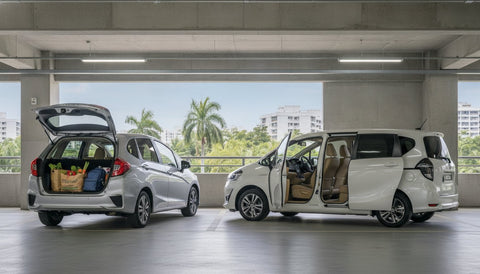
The most expensive car to buy in 2026 might actually be the one that saves you the most on monthly running costs. With Category A COE premiums reaching a staggering S$129,000 and 95-octane petrol prices at S$3.00 per liter, the debate over the honda shuttle vs toyota sienta has become a critical financial decision for Singaporean households. You need a vehicle that fits into tight HDB parking spots while still managing a week's worth of groceries or a full weekend's worth of family members. It's a difficult balance to strike when every centimeter of space and every drop of fuel counts toward your bottom line.
We understand that you want to maximize every dollar spent on your next vehicle without sacrificing reliability or the comfort of your loved ones. This guide will help you discover whether the Honda Shuttle wagon or the Toyota Sienta MPV offers the best value, fuel efficiency, and practicality for your family in 2026. We'll compare cargo capacity against passenger flexibility and break down the long-term ownership costs of these two hybrid favorites. By the end of this comparison, you'll know exactly which model helps you find a reliable pre-owned unit or a fresh parallel import that fits your budget.
Key Takeaways
- Understand the trade-off between the Shuttle’s 570-litre cargo space and the Sienta’s seven-seat flexibility for larger families.
- Compare the responsiveness of Honda’s 7-speed i-DCD gearbox against the seamless efficiency of Toyota’s e-CVT system.
- Evaluate the honda shuttle vs toyota sienta in the context of record-high 2026 Category A COE prices to find the most cost-effective hybrid for your budget.
- Learn how to calculate annual road tax and fuel savings for 1.5L hybrids to manage rising petrol costs in Singapore.
- Access a professional inspection checklist for pre-owned hybrids, focusing on critical components like the hybrid battery and gearbox health.
Honda Shuttle vs Toyota Sienta: Choosing Singapore’s Best Cat A Hero
In the high-stakes environment of 2026, where Category A COE premiums have stabilized at a significant S$129,000, choosing the right family vehicle is about more than just aesthetics. The honda shuttle vs toyota sienta debate represents two distinct philosophies of Singaporean motoring. On one side, you have the Honda Shuttle, a sleek 5-seater station wagon that prioritizes aerodynamic efficiency and massive boot space. On the other, the Toyota Sienta stands as a versatile 7-seater MPV designed for maximum passenger flexibility. Both models dominate the Cat A segment because they offer the perfect blend of fuel economy and urban practicality without crossing into the more expensive Category B tax bracket.
Navigating the Singapore market requires understanding how these cars are sold. The Toyota Sienta is officially distributed, providing a traditional dealership experience. Conversely, the Honda Shuttle has been a Parallel Import (PI) exclusive since authorized dealers ceased sales in Q2 2025. This means buyers looking for a Shuttle will primarily find high-quality units in the pre-owned cars market. Despite their different origins, both vehicles are engineered for our local landscape, featuring compact dimensions that make maneuvering through tight HDB multi-storey car parks a stress-free experience.
To better understand how these compact family movers compare in a real-world setting, watch this helpful video:
Station Wagon vs. Compact MPV: Which Profile Fits You?
The driving experience differs greatly between these two. The Honda Shuttle offers a "car-like" feel with a lower center of gravity, which improves stability on the PIE or KPE. Its standard doors are familiar, but they require more clearance in tight spots. The Toyota Sienta utilizes a taller, boxier frame that provides a "command view" of the road. Its signature dual power-sliding doors are a game-changer for parents. You can easily load children or groceries in narrow parking lots where a traditional door would be restricted. For those interested in the evolution of this design, the Toyota Sienta history and specifications show how it has been refined over three generations to become the ultimate urban tool.
Trim Levels and 2026 Availability
When browsing the 2026 resale market, you'll encounter various specifications. The Honda Shuttle is typically found in G (basic), X (mid-range), and Z (high-spec) trims. The Z trim is particularly popular for its LED headlights and premium interior finishes. For the Toyota Sienta, the Elegance trim remains the gold standard, offering factory-fitted leather seats and additional safety sensors compared to the Standard version. As Singapore moves toward a greener car population, the market has shifted almost entirely toward hybrid-only options. These petrol-electric drivetrains are now the primary choice for families looking to hedge against S$3.00 per liter petrol prices.
Hybrid Performance: Honda i-DCD vs. Toyota Hybrid System
The heart of the honda shuttle vs toyota sienta debate often centers on how they deliver power. Both utilize 1.5L Atkinson cycle engines designed for maximum thermal efficiency. However, they feel remarkably different on the road. The Honda Shuttle Hybrid uses the i-DCD system, which pairs the engine with a high-output motor and a 7-speed dual-clutch transmission. This setup provides a tactile, responsive gear change that feels more engaging during overtakes on the PIE. In contrast, the Toyota Sienta Hybrid employs the Toyota Hybrid System (THS) with an e-CVT. It prioritizes seamless transitions and linear acceleration, making it the smoother companion for stop-start city traffic.
Efficiency is the primary goal for any Singaporean family facing S$3.00 per liter petrol costs. While official figures suggest nearly 30 km/L, real-world conditions on the KPE usually yield closer to 22 to 24 km/L. Both cars excel in EV-only mode, allowing for silent, fuel-free crawling through residential estates or HDB multi-storey car parks. This efficiency is a key reason why these models remain popular despite the high cost of Singapore's Certificate of Entitlement (COE). Choosing between them often comes down to whether you prefer the mechanical engagement of a gearbox or the zen-like simplicity of a CVT.
The i-DCD Gearbox: Myths vs. Reality
Early iterations of Honda's Intelligent Dual-Clutch Drive (i-DCD) faced scrutiny regarding reliability. By 2026, most units in the market have had these teething issues resolved through software updates and improved hardware. To ensure longevity, drivers should avoid "creeping" in heavy traffic, as this can cause the dual-clutch to overheat. Regular maintenance of the hybrid clutch actuator fluid is essential. If you're looking for a unit with a verified service history, browsing our pre-owned cars inventory can give you peace of mind.
Toyota’s Hybrid Reliability
When evaluating the honda shuttle vs toyota sienta for long-term durability, the Sienta Hybrid is often viewed as the safer bet for high-mileage drivers. Toyota's e-CVT lacks the physical clutches of the Honda system, reducing the number of wear-and-tear components. Their battery management is also top-tier. The Sienta features dedicated cooling vents for the hybrid battery, often located under the rear seats. Keeping these vents clear of dust is the only major extra step needed for long-term health. Regenerative braking in the Sienta feels more consistent, whereas the Shuttle can sometimes feel slightly grabby as the dual-clutch downshifts.
Interior Versatility: Magic Seats vs. Seven Seats
The honda shuttle vs toyota sienta comparison often boils down to how you use your cabin space on a daily basis. The Honda Shuttle is the undisputed "litre-per-dollar" champion for cargo. It offers a massive 570-litre cargo cavern that rivals much larger SUVs. This is achieved through a cleverly designed station wagon body that prioritizes depth and width. In contrast, the Toyota Sienta offers a 7-seater layout. While having seven seats sounds better on paper, the third row is often best reserved for children or short trips. For many Singaporean families, the choice is between having a permanent boot cavern or the occasional ability to ferry grandparents.
Flat-folding mechanisms are where these two diverge. The Sienta uses a "dive-in" system where the third-row seats fold and tuck completely under the second row. This creates a flat load floor, but it requires some effort to tumble the middle seats first. The Shuttle is much simpler. Its rear seats drop with a single lever, instantly expanding the already large boot. If you're browsing our pre-owned cars, testing these mechanisms in person is the best way to see which fits your workflow.
Practical Use-Cases for Singaporean Families
Imagine the "IKEA test." The Shuttle’s flat-folding floor allows you to slide in long flat-packs with ease. Honda’s Magic Seats are a standout feature that competitors simply can't match. In "Tall Mode," the rear seat bases flip up toward the headrests. This creates a floor-to-ceiling storage area behind the front seats, perfect for transporting tall potted plants from a nursery, a foldable bicycle without getting grease on the upholstery, or even a full set of golf clubs; you can learn more about professional golf coaching in Singapore to make the most of your weekend outings. "Long Mode" involves folding the front passenger seat flat to accommodate items up to 184cm in length. The Sienta excels during school runs where you might need to separate siblings or carry extra playmates, though boot space becomes almost non-existent when all seven seats are in use.
Cabin Comfort and Technology
If you frequently transport four or five adults, the Shuttle generally wins on second-row legroom. Because it doesn't need to accommodate a third row, the middle bench is positioned further back. Air-con performance is another critical factor in Singapore’s humidity. The Sienta often features ceiling-mounted rear blowers that circulate air directly to those in the back. The Shuttle relies on powerful front vents and cabin airflow. While the Shuttle's system is efficient, the Sienta's dedicated blowers provide faster relief after the car has been parked under the sun. Both 2026 models typically include advanced safety suites like Honda Sensing or Toyota Safety Sense, providing adaptive cruise control and lane-keeping assistance for safer highway driving on the ECP or CTE.
2026 Ownership Costs: COE, Road Tax, and Fuel Savings
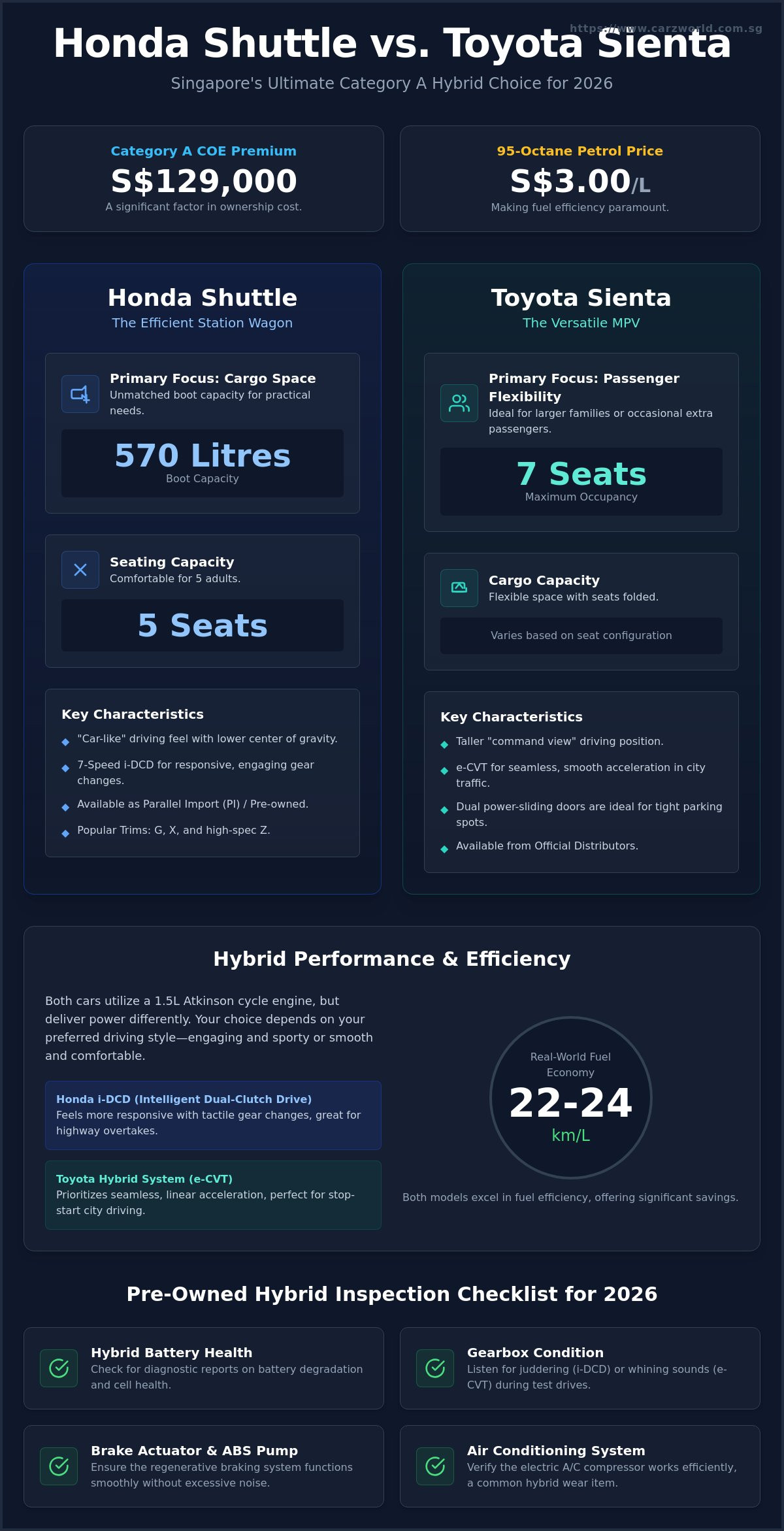
Financial clarity is essential when Category A COE premiums sit at S$129,000. In 2026, the honda shuttle vs toyota sienta comparison isn't just about space; it's about managing a long-term household budget. Both vehicles qualify for the A2 band under the Vehicular Emissions Scheme (VES), which provides a significant S$15,000 rebate. This rebate is already factored into the dealer's pricing, making these hybrids more competitive against traditional petrol models. Annual road tax remains manageable for both. You'll pay approximately S$682 per year for the Honda Shuttle Hybrid, while the Toyota Sienta Hybrid costs slightly more at around S$714 per year due to its specific engine and motor configuration.
Maintenance costs for these hybrids are comparable to standard petrol cars, but they require specific attention to the high-voltage system. Beyond regular oil changes, you should budget for hybrid battery cooling fan cleanings every 40,000km to prevent overheating. While the hybrid components are durable, specialized care ensures the system remains efficient as the vehicle ages. Choosing a well-maintained unit is vital, as it prevents unexpected repairs that could offset your fuel savings.
Fuel Savings Calculator: Hybrid vs. Petrol
With 95-octane petrol priced at S$3.00 per liter in July 2026, the efficiency of a hybrid drivetrain is a powerful hedge against inflation. A traditional 1.6L petrol sedan typically achieves around 12km/L in mixed Singapore traffic. In contrast, both the Shuttle and Sienta reliably deliver 22km/L to 25km/L. If you drive 15,000km annually, a hybrid can save you over S$1,800 in fuel costs each year. Based on current market prices, the fuel savings allow a hybrid to break even on its price premium over a petrol-only equivalent within approximately four years. These savings are further protected against rising 2026 carbon taxes, which continue to drive up the cost of less efficient vehicles.
Financing and Insurance for Hybrids
Securing the right loan is the final piece of the ownership puzzle. For those looking at the pre-owned market, used car loan interest rates in 2026 range from 2.78% to 2.98% p.a. Insurers often favor hybrid wagons and MPVs like the Shuttle and Sienta. These models are associated with family-oriented drivers, which can lead to more favorable premiums compared to sportier hatchbacks. To make your purchase more accessible, you can explore our flexible car financing options to find a plan that fits your monthly cash flow. If you're ready to see how these costs translate into a monthly payment, view our latest Cat A inventory today.
Buying a Pre-Owned Hybrid: Your 2026 Inspection Checklist
With Category A COE prices holding at S$129,000, ensuring the health of a used vehicle is the best way to protect your investment. When evaluating the honda shuttle vs toyota sienta in the resale market, your inspection should go beyond the surface. Hybrid vehicles require a specialized approach to ensure the sophisticated petrol-electric drivetrain remains reliable for years to come. Follow this five-step checklist before committing to a purchase:
- Step 1: Gearbox Service History. Verify that the Honda Shuttle’s 7-speed i-DCD has received regular fluid changes. For the Toyota Sienta, check that the e-CVT operates smoothly without "whining" noises at highway speeds.
- Step 2: Hybrid Battery Health. Check the State of Charge (SoC) on the dashboard. It should fluctuate naturally during your test drive. Ask if the cooling fans have been cleaned to prevent heat-related degradation.
- Step 3: Spotting "PHV Wear". Many of these models served as private hire vehicles. Look for excessive wear on the driver’s seat bolster, shiny steering wheels, or sagging suspension that indicates high-mileage use.
- Step 4: Engine Transitions. Pay attention when the car switches from EV mode to petrol. The transition should be seamless. Any "clutch judder" in a Shuttle or a rough "shudder" in a Sienta could signal aging engine mounts or transmission issues.
- Step 5: High-Voltage Systems. Test the air-conditioning thoroughly. Hybrids use electric compressors; if the air-con blows warm when the engine is off, the inverter or compressor may be failing.
Technical Red Flags to Avoid
There are specific issues that should give you pause. In the Honda Shuttle, keep an eye out for early signs of clutch actuator failure, such as delayed engagement when moving from a standstill. Odometer tampering can also be a concern with parallel import units. Always cross-reference the mileage with the service booklet or LTA inspection records. Finally, verify that critical safety recalls, such as the Takata airbag replacements or fuel pump updates, have been completed by a qualified workshop.
Why a Trusted Dealer Matters in 2026
Buying from a reputable source provides a layer of security that direct-owner sales cannot match. A professional dealership often provides warranty coverage for high-voltage batteries and hybrid components, which are the most expensive parts to replace. We focus on transparency, ensuring every vehicle passes a rigorous multi-point inspection before it reaches our showroom. You can browse our curated range of used Honda Shuttle Hybrids or explore our Sienta inventory to find a unit with a verified history. Choosing a certified pre-owned car means you don't have to worry about hidden defects or unresolved mechanical issues.
Secure Your Family's Future on Singapore Roads
Deciding on the honda shuttle vs toyota sienta ultimately comes down to your household's specific rhythm. If you prioritize massive cargo space and a car-like driving feel, the Shuttle wagon remains a standout choice. For those who need the flexibility of seven seats and the convenience of power-sliding doors in tight HDB car parks, the Sienta MPV is the ideal urban companion. Both models offer a sophisticated hedge against high 2026 COE prices and rising fuel costs, ensuring your family stays mobile without overextending your budget.
At Carz World Pte Ltd, we bring expertise in hybrid battery health and i-DCD maintenance to every vehicle in our showroom. We believe in transparent pricing with no hidden admin fees; it's a commitment backed by over 100 positive customer reviews on Google and Facebook. Our team is here to help you navigate the technical details and find a car that fits your lifestyle perfectly. View our latest Honda Shuttle and Toyota Sienta inventory at Carz World Pte Ltd and take the first step toward a more efficient drive. We look forward to helping you find the perfect fit for your next family adventure.
Frequently Asked Questions
Is the Honda Shuttle Hybrid still in production in 2026?
The Honda Shuttle officially ended production in Japan in 2022 and was phased out by most authorized dealers in Singapore by Q2 2025. In 2026, you can still find brand-new units through specialized parallel importers or browse a wide selection of high-quality pre-owned models. It remains a highly sought-after vehicle in the resale market due to its reputation for efficiency and utility.
Does the Honda Shuttle or Toyota Sienta have better fuel consumption?
When comparing the honda shuttle vs toyota sienta, both cars offer nearly identical efficiency levels. The Toyota Sienta Hybrid is officially rated at 28.5 km/L. The Honda Shuttle Hybrid typically ranges between 25 and 30 km/L according to manufacturer data. In real-world Singapore driving conditions, you can expect both vehicles to average around 22 to 24 km/L during mixed highway and city trips.
How much does it cost to replace a hybrid battery in Singapore?
Replacing a hybrid battery in Singapore typically costs between S$2,500 and S$5,000 depending on the model and whether you opt for a brand-new or reconditioned unit. Most modern hybrid batteries are engineered to last between 8 and 10 years or approximately 150,000km. Keeping the battery cooling vents clean is a simple way to help maximize the lifespan of this component.
Can I use a Honda Shuttle Hybrid for Grab or Gojek in 2026?
Yes, the Honda Shuttle Hybrid continues to be a popular and eligible choice for private hire platforms like Grab and Gojek in 2026. Its Category A COE status and low running costs make it an ideal tool for high-mileage drivers. The station wagon body style is particularly favored by passengers with airport luggage or large grocery hauls from local supermarkets.
What are the main differences between the Honda Shuttle and Honda Vezel?
The main difference lies in the body style and ride height. The Shuttle is a station wagon that sits lower to the ground and offers a deeper, more accessible boot. The Vezel is a compact SUV with higher ground clearance and a more rugged aesthetic. While they share the same 1.5L i-DCD hybrid powertrain, the Shuttle provides more practical cargo-loading capabilities for families.
Is the i-DCD gearbox in the Honda Shuttle reliable?
The i-DCD dual-clutch transmission is reliable provided that it has been maintained with regular fluid changes every 30,000km to 40,000km. Most of the teething issues found in early versions were resolved through manufacturer software updates years ago. It offers a more responsive and engaging drive compared to a traditional CVT, though it requires a more disciplined maintenance schedule.
Which car has a larger boot, the Shuttle or the Sienta?
The Honda Shuttle has a much larger boot when all passenger seats are in use, offering 570 litres of space. The Toyota Sienta has very limited cargo capacity when its third row is upright. To get a comparable amount of luggage room in the Sienta, you must fold the rear-most seats into the floor, which reduces your passenger capacity to five people.
Are spare parts for parallel import Shuttles easy to find in Singapore?
Spare parts for the Honda Shuttle are very easy to find in Singapore because it shares many mechanical parts with the Honda Fit and Jazz. Local stockists and workshops carry a wide range of both original and OEM components. You won't face the long wait times often associated with rarer parallel imports since the Shuttle is one of the most common cars on our roads.
Disclaimer
This content is provided for general informational purposes only. Readers are encouraged to independently verify important information.
In Same Category
- Sell My Car Fast in Punggol: A Practical Guide
- Toyota Prius in Singapore: A Practical Buyer’s Guide for 2026
- Best Cars for Home-Based Businesses in Singapore: 2026 Guide
- Risks of Buying a Car with 1 Year of COE Left in Singapore (2026 Guide)
- Best Second Hand Cars for Malaysia: Singapore Buyer's Guide
Related by Tags
- COE Results Singapore: How to Read the Latest Bidding Outcomes in 2026
- Mercedes-Benz EQB 250+ Review: The Ultimate 7-Seater Family EV in Singapore
- Mercedes C-Class Singapore Guide 2026: Specs, COE, and Buying Tips
- Second Hand Hybrid Cars Singapore: The 2026 Value & Inspection Guide
- Parallel Import Cars Singapore: 2026 Buyer’s Guide
- Toyota Harrier Singapore: The Definitive 2026 Buyer’s Guide