Save for a Car or Take a Loan in 2026? Compare the Costs

Paying cash isn’t automatically the smarter choice, and taking a loan isn’t automatically a mistake. Whether it is smarter to save for a car or take a loan in 2026 depends on the interest you’ll pay, how comfortably the monthly costs fit your budget, and whether waiting to save is practical. The better option is the one that keeps the total cost manageable without putting pressure on your finances.
It’s reasonable to focus on the monthly payment, but that figure alone can hide how much interest you’ll pay over the full loan term. Saving first can reduce the amount you borrow, while financing may let you buy sooner. Both have trade-offs, so compare the total cost rather than judging by one number.
This article explains how credit, interest, financing offers and monthly vehicle costs affect the decision in Singapore. You’ll learn what to weigh when comparing a new or pre-owned car, and how to decide whether to save, borrow or combine the two.
Key Takeaways
- Compare the loan’s total interest with what your savings could earn, not just the monthly instalment.
- Assess financing offers by their full terms and overall cost, rather than focusing on a low advertised rate alone.
- Include insurance, fuel and maintenance in your car budget to see what ownership may really cost each month.
- Consider how a larger down payment and shorter loan term affect your instalments and total interest.
- Use the comparison to decide whether buying a pre-owned car or waiting to save better suits your budget.
How does my credit score affect my auto loan?
For Singapore’s 2026 COE outlook, changes in premiums can shift a car’s purchase cost, so compare current total prices with your need to buy now. New and used car prices, including COE, depend on the model and its applicable COE cost; Singapore-specific loan rates depend on the lender and borrower.
A stronger credit profile may support a more favourable loan assessment. At the same time, keep enough savings for essential expenses and unexpected needs after making a down payment. Don’t use every available dollar to reduce the loan if doing so would leave you without a suitable reserve.
Compare the loan’s total cost with the return your savings could earn over the same period. If the interest you pay exceeds the savings return, borrowing costs more. Using savings, however, means giving up the return those funds might have earned.
Credit Score and Loan Rates
Your credit score helps lenders assess how you’ve managed credit, alongside other details in your application. A stronger profile may help you qualify for better rates, while a weaker one can mean higher borrowing costs or less favourable terms.
Compare written offers for the same loan amount and repayment period. This makes it easier to see whether a rate difference changes the total interest, rather than judging an offer by its monthly instalment alone.
New and Used Car Loan Rates
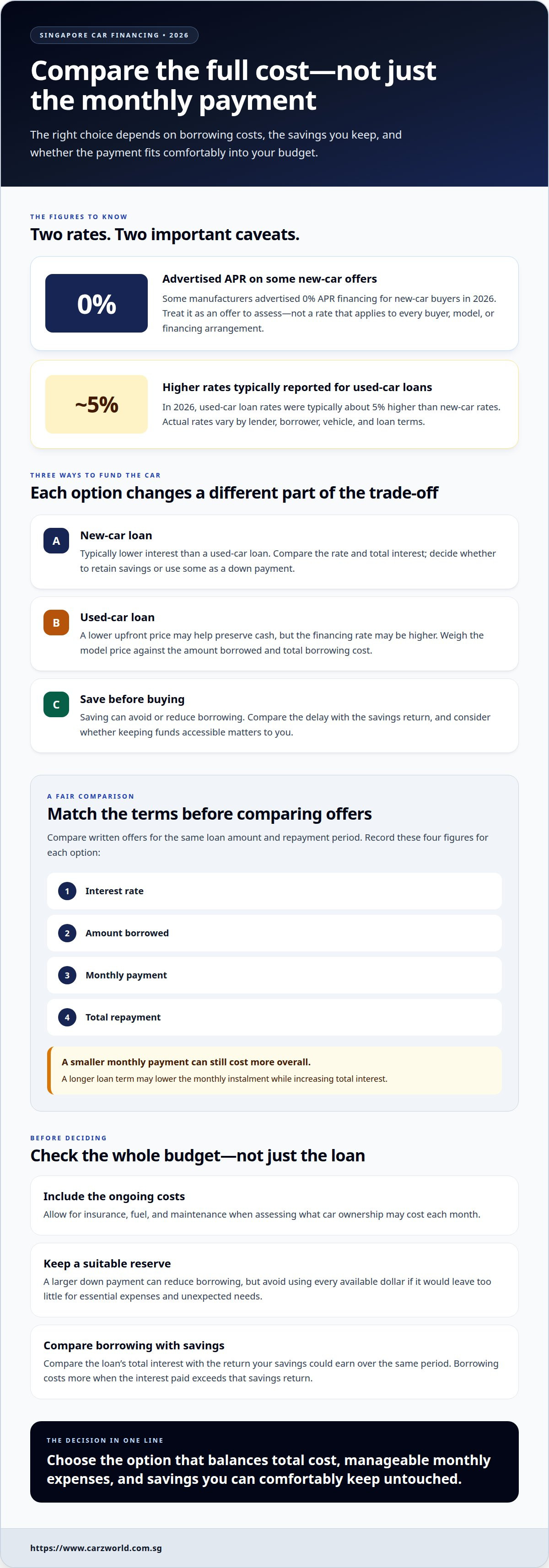
New-car loans typically have lower interest rates than used-car loans because lenders view new cars as lower risk. In 2026, used-car loan rates were typically about 5% higher than new-car rates, so the model’s purchase price is only one part of the comparison.
For a pre-owned car, weigh the lower upfront cost against the financing rate and amount you’d borrow. Compare offers on the same loan amount and term to see which results in the lower overall borrowing cost.
In Singapore, rates can vary by lender, credit profile, vehicle and loan terms. Pre-approval can show what financing is available before you choose a car. Compare the approved rate and repayment schedule with the cost of waiting and saving.
Compare the interest you’d pay with the return on savings you plan to keep. If that return is lower, using some savings for the car may reduce your borrowing costs. If keeping cash accessible matters more, financing part of the purchase can preserve a reserve.
| Option | Rate consideration | Savings consideration | Useful comparison |
|---|---|---|---|
| New car loan | Typically lower than a used-car loan | Retain savings or use a down payment | Compare rate and total interest |
| Used car loan | Typically higher than a new-car loan | Lower upfront spending may help preserve cash | Compare model price and borrowing cost |
| Save before buying | Avoids or reduces borrowing | Funds remain available while saving | Compare delay with savings returns |
Choose by comparing pre-approved loan terms, total interest and how much savings you can comfortably keep untouched.
Manufacturer incentives and low-APR financing
A low advertised rate can change the borrowing calculation, but the payment alone doesn’t show the full cost. In 2026, some manufacturers advertised 0% APR financing for new-car buyers. Treat that as an offer to assess, not as a rate that automatically applies to every Singapore buyer, model, or financing arrangement.
Compare financing with a plan to save. Borrowing at a lower rate may make sense if you want to keep savings available, while saving first can reduce the amount borrowed or avoid interest. Consider how long you’d wait, the interest you’d pay and whether the payment fits your regular expenses. Look beyond a promotional rate to the total amount financed.
- For a new car: A manufacturer incentive may lower borrowing costs on eligible models, but the overall deal still depends on its terms and your loan amount.
- For a used car: Financing can spread the purchase cost over time, while a lower upfront price may reduce the amount you need to borrow. Compare the loan cost against saving for a larger down payment.
- For a certified pre-owned car: Compare its financing offer with other available terms. The certification label alone doesn’t tell you the interest rate or total repayment.
For example, compare written offers for the same car and repayment period. Record each rate, amount borrowed, monthly payment and total repayment, then weigh these against the savings you’d keep. A lower monthly payment may come from a longer term and still cost more overall. Comparing the figures side by side helps you avoid rushing into a decision based on an appealing headline.
Saving up may suit buyers who want to avoid interest or keep more flexibility in their monthly budget. Financing may suit someone who needs a car sooner and can manage the repayments without using essential reserves. A mixed approach, using some savings and borrowing less, can balance those priorities. Choose based on the actual offer and its effect on your cash flow, not just a manufacturer’s promotion.
Before deciding, write down the car’s total purchase cost, the financing total, and the savings you’d retain under each option. That makes the trade-off visible and helps you judge whether a payment would create stress. If you’re weighing a used model against a new one, compare pre-owned car options alongside the financing terms, rather than judging the offer by its headline rate alone.
Credit score and monthly payments
Your credit profile can affect the rate offered, changing both the monthly payment and total interest. Compare written loan offers for the same amount and repayment period. Then check whether the payment still fits your budget if incentives or expected savings don’t materialise.
Set your limit before choosing a car. One conservative guideline is to keep total monthly vehicle costs, including loan payments, insurance, fuel and maintenance, at or below 15% of take-home pay. Some budgeting guidance uses 20% as a ceiling. These are planning guidelines, not lending rules. Use the lower limit if other regular commitments leave little room in your budget.
Don’t set your payment limit using the loan instalment alone. Add expected running costs and leave room for variable expenses such as fuel and maintenance. Account for future maintenance or warranty coverage in your plan. A payment that fits only when every other cost is at its lowest can put pressure on your budget later.
Choosing a down payment
A 20% down payment is one commonly recommended target when buying a car. Putting more down reduces the amount borrowed, which can reduce monthly payments and total interest. But using all your available cash to reach that target can leave too little for emergencies, so compare the interest savings against the value of keeping funds accessible.
You can build a down payment by saving a set amount from each pay period, using savings above the reserve you want to keep, or combining both approaches. A trade-in may also contribute toward the purchase. In every case, work out the remaining loan amount before agreeing to a payment.
Lenders assess repayment risk when setting loan terms, so your credit history matters. A stronger profile may help you access more favourable rates; a weaker one may mean higher borrowing costs. Compare offers with your own credit position rather than assuming another buyer’s quoted payment will apply to you.
Check your full debt commitments, too. A household whose annual debt exceeds 33% of gross income may feel financially strapped. This is a warning sign for budgeting, not a universal approval threshold. List existing obligations alongside the proposed car payment, then assess the combined monthly burden against take-home pay.
Use a simple final test: write down the proposed monthly payment, estimated running costs, down payment, and savings left afterward. If the total vehicle budget exceeds 15% of take-home pay, consider a less expensive model, a larger down payment, or delaying the purchase to save more. Keep any warranty or incentives separate from the core budget unless their terms are clear.
Insurance, fuel and maintenance costs
The purchase price and loan payment show only part of a vehicle’s cost in Singapore. Add insurance, fuel and maintenance to estimate your total monthly outlay, then compare it with your take-home pay. A car that seems affordable at purchase can strain your budget once regular running costs are included.
Start by getting an insurance estimate for the specific vehicle you’re considering. Premiums depend on factors such as the car, driver and chosen coverage, so a general estimate may not suit your situation. Compare each model before deciding: a different vehicle can change the premium and the overall ownership cost, even if the loan payment is similar.
Fuel costs vary with how often and how far you drive, as well as the vehicle’s fuel use. Maintenance depends on the vehicle’s age, condition and use. For a useful comparison, list expected monthly fuel and insurance costs alongside an allowance for future maintenance. Keep these separate from the loan instalment so they don’t disappear inside one headline figure.
Depreciation matters because a car can lose value even while you’re paying for it. A new car can lose 20-30% of its value in its first year. That potential loss is one factor to weigh against a new car’s features and your expected ownership period. In Singapore, include COE in the purchase-cost comparison, and consider how depreciation affects the value you may retain when selling.
To compare new and pre-owned cars fairly, use the same ownership period and include the same cost categories for each. A pre-owned car may require less upfront spending, while a new car’s first-year depreciation can make an early sale more costly. Base insurance and maintenance estimates on each specific vehicle instead of assuming one category always costs less to run.
- Purchase: Record the vehicle price and COE component.
- Monthly use: Add insurance and expected fuel spending.
- Future upkeep: Include maintenance and any warranty coverage you plan to budget for.
- Resale: Consider depreciation over the period you expect to own the car.
Use your take-home pay as a budgeting check. Add the loan payment to insurance, fuel and maintenance, then compare the total with your income. If it feels too high, consider a lower-cost vehicle or a longer saving period. A complete cost estimate is more useful than judging affordability by the monthly loan payment alone.
Loan terms and total interest
In Singapore, the maximum loan amount and available tenure depend on the financing terms for the vehicle and borrower. Use the actual loan offer to identify both, then compare how the repayment period affects total interest.
A longer term generally lowers the monthly payment but increases the interest paid over the life of the loan. A shorter term can mean higher monthly payments but less time for interest to accrue. Compare offers for the same amount borrowed and interest rate, looking at both the instalment and total repayment. The smaller payment isn’t automatically the lower-cost choice.
For a practical comparison, use three steps:
- Record the amount borrowed, interest rate and repayment period for each offer.
- Compare the monthly payments, then add up the scheduled repayments over the full term.
- Set that total beside the car’s purchase cost and the savings you would use instead.
As a planning guide, a car loan rate of 4-6% may suit a hybrid approach with at least a 20% down payment. If the rate is 7% or higher, financing as little as possible can limit interest costs. These are decision guides, not Singapore-wide rate quotes; the terms in your offer determine your actual cost.
If the rate is mediocre, aiming for a term close to 36 months can help limit how long interest accumulates. Compare that with a longer term over five years: the longer schedule may ease monthly cash flow, but generally increases total interest. Choose the shortest term whose payment still fits comfortably alongside your other expenses.
A dealership’s monthly figure can make an offer easier to scan, but it doesn’t show the full borrowing cost. Find out the amount financed, applicable interest rate and total due across the repayment schedule. If offers cover different vehicle prices or borrowed amounts, adjust the comparison first so you’re assessing equivalent financing.
The available cars can also affect your decision. If a car suits your needs and its financing terms fit your budget, delaying solely to save may not be worthwhile. If borrowing costs are high, consider a larger down payment, a less expensive car or more time to save. Compare these choices by total repayment, not just the first payment.
Use the loan schedule to decide how much interest you’re willing to pay for buying sooner. Compare available vehicle options while weighing the purchase against the financing cost.
The maximum loan amount and available tenure depend on the financing terms for the vehicle and borrower. Check the actual loan offer for both.
Carz World Pte: Pre-Owned Cars
Carz World Pte Ltd offers pre-owned cars for buyers weighing the cost of purchasing now against saving longer. A pre-owned car may require less upfront spending than a new one, potentially reducing the amount you need to borrow. Before deciding whether it is smarter to save for a car or take a loan in 2026, compare the full purchase cost with the loan amount, interest and monthly running expenses.
If you’re weighing a specific car against your budget, consider how its price and financing needs fit your savings plan. Carz World Pte Ltd also offers brand new cars and car rental for different buying and driving needs.
Review the available pre-owned cars as part of your comparison, then contact Carz World Pte Ltd to discuss your options.
Make Your Next Move With Confidence
Before committing, decide what you need a car for in your day-to-day life. A clear use case can help you distinguish a necessary purchase from one that can wait, turning a broad financial choice into a practical decision.
To decide whether it is smarter to save for a car or take a loan in 2026, set a limit you can live with and a point at which you’ll reassess. Consider what would change your decision, such as a shift in household priorities or a different vehicle requirement. That gives you a reasoned plan rather than leaving the choice open indefinitely.
If you’re ready to explore your next step, speak with Carz World Pte Ltd. Take the time to choose an option that supports your needs and keeps your finances on a steady path.
Frequently Asked Questions
Should I Buy a Car in 2026?
Buy in 2026 if having a car meets a real need and the full ownership cost fits your finances. Whether it is smarter to save for a car or take a loan in 2026 depends partly on how soon you need reliable transport. Consider whether regular work, caregiving or family travel makes access essential. If your need is flexible, waiting gives you more time to compare models and prepare funds.
How do I figure out how much car I can afford?
Work backwards from what you can spend each month after essential household commitments. List the proposed instalment, insurance, fuel, parking and expected upkeep, then compare the total with your available cash flow. Next, account for the upfront payment and the savings you’d have left. A car is outside your comfortable range if buying it leaves no room for routine expenses or unexpected bills.
How do down payment and monthly instalments compare for saving versus financing a car?
Saving before you buy lets you build a larger down payment, so you can borrow less or avoid a loan. Financing spreads the unpaid balance into instalments but adds interest and a recurring commitment. For a clear comparison, call the purchase total P and your down payment D: the amount financed is P minus D. Then compare the repayment schedule with how long it would take to save D.
How do car loan interest rates and flat-rate calculations affect the total amount repaid?
A flat-rate calculation applies the quoted rate to the original loan principal throughout the stated term. To estimate interest, multiply the principal by the flat rate and the term, then add the interest to the principal. Don’t compare a flat rate directly with another loan’s effective rate. Compare total repayment and the repayment schedule, because different rate methods can make headline percentages look comparable when they aren’t.
What are the risks of taking a car loan in Singapore, including depreciation and negative equity?
The main risk is owing more than you could get by selling the car. This is called negative equity, and it can happen when the vehicle loses value faster than the loan balance falls. Depreciation, a small down payment and a long repayment schedule can increase your exposure. Before borrowing, consider how you’d manage the debt if your income changed or you needed to sell earlier than planned.
When is it financially smarter to save up, buy a cheaper car, or take a car loan in Singapore?
To judge whether it is smarter to save for a car or take a loan in 2026, consider how soon you need transport and what your cash flow can support. Save first when waiting is practical and avoiding borrowing matters more than getting a car immediately. Choose a cheaper car if your preferred models stretch your budget. A loan can fit when transport is needed sooner and repayments remain manageable.
How much emergency savings should you keep before buying a car in Singapore?
Keep enough savings for essential expenses and unexpected needs after making your down payment. The amount depends on your circumstances, so don’t use every available dollar to reduce the loan.
Disclaimer
This content is provided for general informational purposes only. Readers are encouraged to independently verify important information.
In Same Category
- COE Rebate for Early Deregistration: How Much Can You Get Back
- Pre-owned cars with memory seats in Singapore: asking prices
- How to Check If You Can Use CPF to Pay for COE Renewal
- Luxury pre-owned cars Toa Payoh: Compare listings, mileage and prices
- Is a Car an Asset or a Liability in Singapore? How It Affects Your Net Worth
Related by Tags
- Is a Car an Asset or a Liability in Singapore? How It Affects Your Net Worth
- Save for a Car or Take a Loan in 2026? Compare the Costs
- Can I Sell a Car That Is Still Under Financing in Singapore?
- Second hand car lots in Choa Chu Kang: dealers and prices
- Compare car financing options with no credit history in SG
- Car Loan Hidden Fees: Which Application and Setup Charges Are Reasonable
- What to Do If Your Car Loan Is Rejected and Find Options
- Sell My Car Fast in Punggol: A Practical Guide
- Best Cars for Home-Based Businesses in Singapore: 2026 Guide
- Risks of Buying a Car with 1 Year of COE Left in Singapore (2026 Guide)
- Financial Planning for Your First Car in Singapore
- Best Time to Renew COE in 2026: A Practical Singapore Guide
- COE Renewal for 5 Years vs 10 Years: Pros and Cons in Singapore
- Pros and Cons of Buying a High PARF Car in Singapore
- Car Valuation Services in Bukit Merah: A Seller’s Guide
- Calculating the Breakeven Point for COE Renewal in Singapore
- Financial Checklist Before Committing to a Car Purchase in Singapore (2026)
- Used Electric Cars in Singapore: 2026 Buyer's Guide
- What Happens to My Car Loan If I Lose My Job in Singapore? (2026 Guide)
- Pre-Owned Vehicle Showroom in Hougang: Your Complete 2026 Buying Guide
- Mazda CX-5 Singapore Review: Buyer Guide, Specs & Ownership (2026)
- Car Financing for Singapore Gig Workers: 2026 Guide
- Financial Checklist Before Buying a Car in Singapore: 2026 Expert Guide
- 2026 Guide: Planning for a Second Family Car in Singapore