How to Check If You Can Use CPF to Pay for COE Renewal
You can’t use CPF savings directly to pay for COE renewal. If you’re asking, “can I use my CPF to pay for COE renewal?”, the key distinction is that your latest six months of CPF records may support a loan application as proof of income, but they cannot pay the renewal charge. You’ll need another payment method or a borrowing option.
It’s understandable to look for ways to manage a large renewal expense, but the right option also depends on how long you plan to keep the vehicle. This guide explains how vehicle lifespan affects eligibility, why a five-year renewal costs 50% of the applicable PQP while a ten-year renewal costs the full PQP, and what to consider before deciding whether to renew or move on from the vehicle.
Key Takeaways
- CPF savings can’t be used directly to pay the COE renewal PQP, but CPF records may support a loan application as an income document.
- Compare the renewal period with your plans: five years costs 50% of the applicable PQP, while ten years costs the full PQP.
- Check how your vehicle’s category and statutory lifespan affect its renewal options, including whether another renewal is possible.
- Plan around the COE expiry date. Renewal is allowed before expiry or within one month after, with a late renewal fee.
- Use the renewal rules and your vehicle’s remaining lifespan to decide whether to renew or consider another vehicle option.
What is the COE renewal process and deadline in Singapore?
-
Identify your COE expiry date. A Singapore vehicle’s COE lasts 10 years. Before it expires, its owner must decide whether to renew the COE or deregister the vehicle. Use the expiry date as your planning deadline, not the date you hope to make payment. Driving a vehicle with an expired COE is illegal, so don’t continue using it after expiry while deciding what to do.
Start early to find out the renewal amount and arrange payment. That gives you time to decide whether renewal suits your needs, instead of having to make the decision after the COE expires.
-
Estimate the renewal amount using the PQP. A COE renewal costs the Prevailing Quota Premium, or PQP, for the vehicle’s category. The PQP is calculated as a moving average of COE prices from the last 3 months in which bidding exercises were conducted. It is therefore tied to the vehicle category and recent bidding prices, rather than one fixed renewal charge.
Use the applicable PQP to understand the amount you need to fund. If considering a loan, distinguish the loan application evidence from the payment itself. The latest 6 months of CPF records can be one possible income document for local applicants. A personal loan can be used to pay the Land Transport Authority for a COE renewal.
-
Choose a payment method and allow time for processing. The PQP is payable to the Land Transport Authority as part of renewal. If applying by mail, send the renewal application at least 2 weeks before the COE expires. Processing takes approximately 1 week, so mailing close to the expiry date leaves little room for delays in handling or payment.
Allow time for processing. Submitting an application does not mean the renewal is complete. Keep the expiry date in view as you arrange funds and submit the application.
-
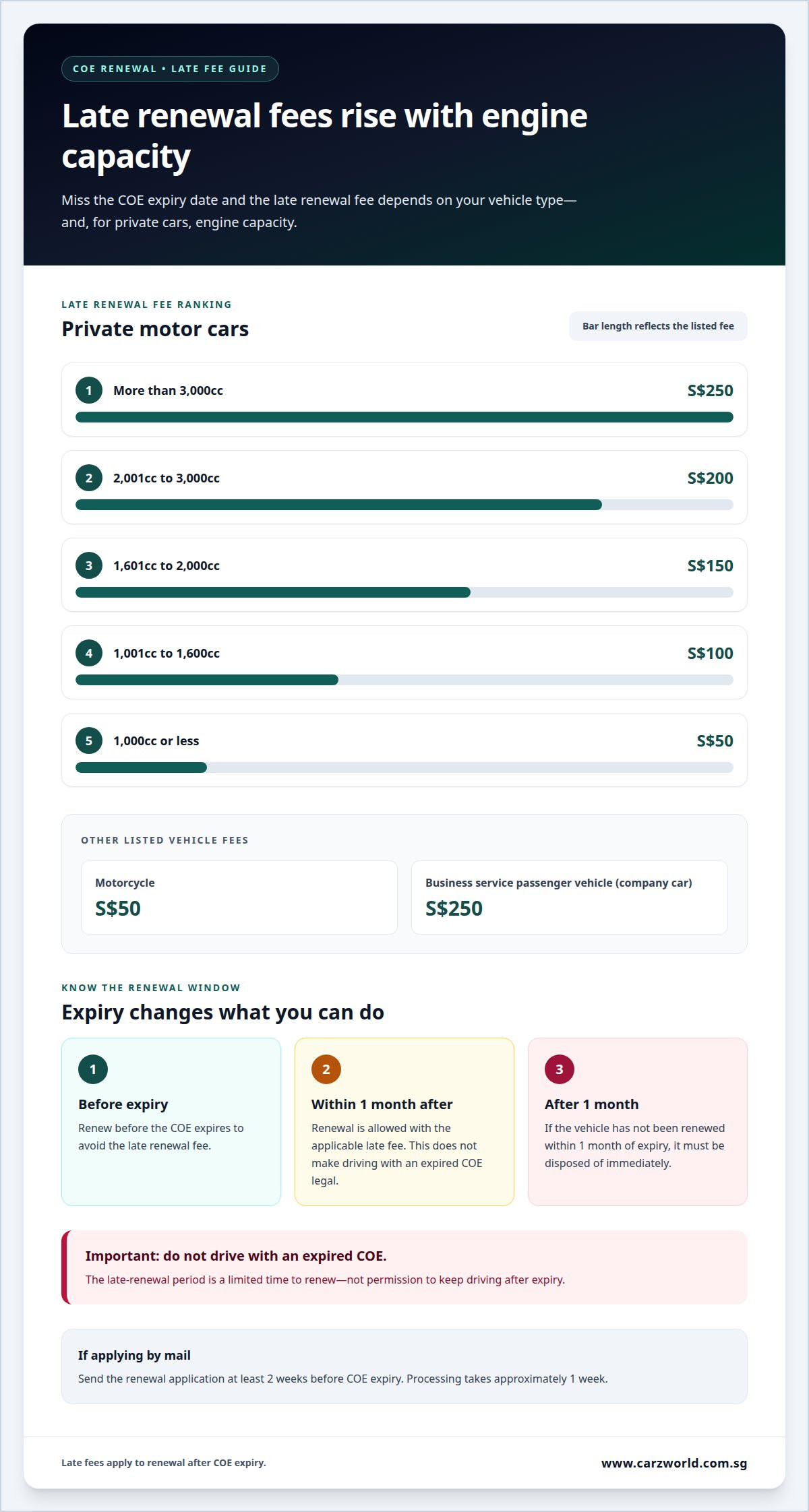
Submit before expiry whenever possible. In Singapore, a vehicle owner may renew a COE before its expiry or within 1 month after expiry, with a late renewal fee. Treat that extra month as a limited late-renewal period, not an extension that makes driving with an expired COE legal. The rules on renewal timing and the legality of driving are separate matters.
Where the application is mailed, allow at least 2 weeks before expiry. Since processing takes approximately 1 week, an earlier submission gives more time for the application to be handled before the original COE ends.
-
Account for the late fee if you miss expiry. Late fees for private motor cars depend on engine capacity. The fee is S$50 for 1,000cc or less, S$100 for 1,001cc to 1,600cc, S$150 for 1,601cc to 2,000cc, S$200 for 2,001cc to 3,000cc, and S$250 for more than 3,000cc. A motorcycle’s late renewal fee is S$50. A business service passenger vehicle, or company car, has a S$250 late fee.
These fees apply to late renewal, so include the relevant amount when planning to renew after expiry. They do not change the separate requirement to stop driving while the COE is expired.
-
Do not let the one-month period pass. If the vehicle is not renewed within 1 month of its COE expiry, it must be disposed of immediately. That deadline makes a delayed decision consequential: after the period ends, keeping the vehicle for later renewal is not an available route under the stated rule.
If you decide to renew, act within the allowed period and budget for the applicable late fee. If you won’t renew, plan for deregistration or disposal instead of continuing to use the vehicle.
Your funding choice matters when comparing borrowing options. Personal loans in Singapore typically have effective interest rates well above those of purpose-built COE renewal loans. Compare total borrowing costs and repayment terms before relying on a personal loan to fund the PQP, and arrange access to funds early enough to protect the renewal deadline.
Do not assume that new-car financing limits automatically apply to a COE renewal. In Singapore, a personal car loan may finance up to 70% of a new vehicle's Open Market Value when its OMV is $20,000 or less. That figure concerns financing a new vehicle, so it should not be treated as the amount available to pay a renewal premium. Check which loan product applies to your situation before making plans.
Your renewal
-
Separate CPF evidence from the renewal payment. CPF savings aren’t a direct payment method for the COE renewal PQP. For local loan applicants, the latest 6 months of CPF records can be one possible income document. That means the records may support an assessment of income, while the renewal amount still needs to be paid through a payment method accepted for the transaction.
Keep these roles distinct when planning. Recorded CPF contributions don’t settle the PQP or guarantee loan approval. They may help document income in an application, alongside other relevant information.
-
Work out the amount you need to fund. The renewal payment is based on the PQP for the vehicle category. These are dated examples, not fixed prices for future renewals. The applicable amount depends on the category and renewal timing.
Use the current amount for your vehicle when deciding how to pay. Don’t base your plan on a previous month’s PQP: the renewal figure follows the prevailing premium and is not a permanent charge.
-
Compare borrowing with paying from available funds. You can use a personal loan to pay the Land Transport Authority for COE renewal. A COE renewal loan is secured against the vehicle, while a personal loan is unsecured. Compare repayment amounts, interest costs and total borrowing costs before choosing. A loan can spread the payment over time, but it also means repayments continue after renewal.
COE renewal loans can finance up to 100% of the PQP. These terms help frame the decision, but the amount borrowed should reflect what you can repay.
-
Match the loan term to your intended renewal period. For a five-year COE renewal, a loan’s repayment tenure can be up to 5 years. For a ten-year COE renewal, the loan tenure can be up to 7 years. The loan period and COE period are not necessarily identical, so consider whether repayments will remain manageable throughout the term.
For example, a longer repayment period can lower each instalment, but may mean paying for longer. Compare the full repayment commitment instead of choosing based only on the monthly instalment.
-
Check the application conditions before relying on borrowing. Loan approval takes 1 to 3 days. These conditions can affect whether a loan is a workable payment plan. If you’re using CPF records as income evidence, include them as documents for the loan assessment, not as a substitute for the PQP payment.
Base your loan decision on both eligibility and affordability. Approval timing and any required guarantor condition matter when coordinating the application with the renewal process.
-
Account for early repayment and the vehicle’s future. Early redemption incurs a 2% charge on the outstanding amount, in addition to the stated Rule of 78 interest rebate calculation. If you may sell or deregister the vehicle before the loan ends, include this charge and the repayment method in your calculations. Borrowing should be assessed against how long you expect to keep the vehicle, not just the immediate renewal expense.
Before committing, compare the amount you need for the PQP with your available cash, loan repayments and expected ownership period. This gives you a clearer basis for deciding whether renewal is financially suitable.
Treat that range as a prompt to assess affordability, not as a guaranteed offer or an amount every applicant will need. Allow for the repayment schedule in your budget and compare it with the cost of using available funds. Even a manageable instalment must fit alongside your other commitments.
Timing matters too: renewing a COE early forfeits the vehicle’s remaining PARF and COE rebate. Before committing, weigh the value of those remaining rebates against the benefit of renewing sooner, and check whether the renewal date suits your vehicle plans. Include this trade-off in your funding decision, rather than focusing only on loan size or monthly payments.
Years renewal
-
Confirm which renewal periods your vehicle can use. In Singapore, vehicle owners can renew for 5 or 10 years, depending on the vehicle category and statutory lifespan. The choice is not simply between a cheaper short term and a longer commitment. First establish which periods apply to your vehicle, then assess the financial and ownership consequences of each eligible option.
That distinction matters because a renewal period can affect both the premium payable and how long the vehicle may remain on the road. A vehicle’s category and lifespan shape the decision before personal plans come into play.
-
Calculate the five-year renewal amount. A five-year renewal costs 50% of the applicable PQP, rounded up to the nearest dollar. Use the PQP for your vehicle’s category when working out the premium. For example, if the applicable PQP calculation produces an amount with cents after taking half, the payable figure is rounded up to the next dollar.
This option lowers the renewal premium compared with paying the full PQP, but allows a shorter period of continued use. For Categories A, B and D, a five-year renewal is permitted only once. Factor in that restriction when considering future renewal plans.
-
Account for the five-year end point. A vehicle renewed for 5 years must be deregistered at the end of that period. This makes the option a defined final period, rather than a shorter renewal that can automatically be extended again. Consider how the vehicle’s age, expected use, and replacement plans fit within that limit.
For Categories A, B and D, the one-time restriction means you can’t use a five-year renewal as a temporary bridge to another five-year renewal. Plan your next vehicle decision before choosing this term.
-
Compare the ten-year premium with the longer use period. A ten-year renewal costs the full PQP for the vehicle category. It provides a longer renewal period than the five-year option, but requires funding the full applicable premium. Compare the total amount due with how long you expect to keep the vehicle, rather than focusing only on the longer validity.
A ten-year renewal can be renewed again for Category A, B or D vehicles, but not for Category C vehicles. Consider this difference when planning the vehicle’s longer-term future.
-
Check the statutory lifespan before committing. A COE renewal does not remove a vehicle’s statutory lifespan limit. A goods vehicle has a statutory lifespan of 20 years and cannot renew its COE after reaching that limit. Check the remaining lifespan alongside the proposed renewal period, so the selected term does not exceed the time the vehicle may legally remain in service.
The lifespan rule can change the practical value of a longer renewal. A ten-year term offers little benefit if the vehicle reaches its statutory limit sooner.
-
Apply the relevant lifespan rule to buses and taxis. An omnibus has a statutory lifespan of 17 years. An excursion bus, private bus, private hire bus or school bus has a statutory lifespan of 20 years. An electric taxi registered from 15 September 2022 has a statutory lifespan of 10 years.
These limits vary by vehicle type. Use the vehicle’s exact classification and registration timing to work out how much of a five-year or ten-year renewal period can be used.
-
Make the choice using both eligibility and intended use. Set out the applicable PQP, the vehicle’s category, any statutory lifespan limit, and whether another renewal is allowed. Then compare the five-year cost at 50% of PQP with the ten-year cost at full PQP. The best fit depends on how long you need the vehicle and which renewal route remains available.
For example, a Category C owner considering a ten-year renewal must account for the fact that another ten-year renewal is unavailable. A Category A, B or D owner should weigh the one-time five-year option against the possibility of another ten-year renewal.
Carz World Pte
Carz World Pte Ltd can help with your next vehicle decision if renewing your current COE no longer suits your plans. If you’re considering a replacement, explore its pre-owned cars or brand new cars. Car rental is another option to consider if you need a vehicle without choosing a replacement immediately. For owners considering a different route, Carz World Pte Ltd also offers car export services.
Choose the option that fits how you intend to use a vehicle after deciding about your COE. Contact Carz World Pte Ltd to discuss your vehicle needs.
Choose the vehicle plan that fits your next step
Once you’ve settled the COE question, consider what you want your transport arrangements to look like next. If you’re weighing renewal against changing vehicles, think about your expected use, preferred ownership approach and whether you need a vehicle immediately or only for a period. Keeping these needs in view can make your next decision more practical.
If you’re still asking, “can I use my CPF to pay for COE renewal?”, keep the CPF question separate from your vehicle choice. CPF records may help document income for a loan application; your next step is to decide how you want to meet your transport needs. Carz World Pte Ltd offers pre-owned cars, brand new cars and car rental, giving you options as you plan beyond your current COE.
Contact Carz World Pte Ltd to discuss your vehicle needs. Take the next step with a clear view of the choice that works for you.
Frequently Asked Questions
Yes, you can, but should you?
CPF records may support a loan application, but CPF savings aren’t a direct way to pay for COE renewal. Whether borrowing makes sense depends on whether the repayments fit your budget and how long you plan to keep the vehicle. Compare the full repayment commitment with the cost of replacing the vehicle or arranging transport another way. The practical choice is the one that suits both your finances and your future vehicle needs.
Can CPF savings be used to pay for COE renewal in Singapore?
No, CPF savings can’t be used directly to pay the COE renewal amount. If you’re asking, “can I use my CPF to pay for COE renewal?”, the distinction is that local loan applicants may use their latest 6 months of CPF records as one possible income document. Those records may support a loan application, but they aren’t the payment itself and don’t guarantee loan approval.
Which payment methods does LTA accept for COE renewal?
SGQR PayNow can be used to pay a COE renewal PQP above S$100,000. A personal loan can also be used to pay the Land Transport Authority for renewal, though borrowing is a way to fund the payment rather than an LTA payment channel. For example, the SGQR PayNow option applies when the PQP exceeds the stated threshold. These examples don’t establish a complete list of payment methods.
Can CPF Ordinary Account savings be withdrawn for vehicle expenses?
CPF Ordinary Account savings aren’t a direct way to pay COE renewal. The relevant CPF connection here is documentation: local loan applicants may provide their latest 6 months of CPF records as one possible income document. That’s different from withdrawing savings to cover a vehicle expense. For budgeting, treat the renewal payment and any loan repayments separately from CPF records used to support an application.
What are the rules for renewing a COE for 5 or 10 years?
A 5-year renewal costs 50% of the applicable PQP, rounded up to the nearest dollar; a 10-year renewal costs the full PQP. Categories A, B and D can use a 5-year renewal once. A 10-year renewal can be renewed again for Categories A, B and D, but not Category C. Vehicle category and statutory lifespan affect which option makes sense.
Disclaimer
This content is provided for general informational purposes only. Readers are encouraged to independently verify important information.
In Same Category
- COE Rebate for Early Deregistration: How Much Can You Get Back
- Pre-owned cars with memory seats in Singapore: asking prices
- How to Check If You Can Use CPF to Pay for COE Renewal
- Luxury pre-owned cars Toa Payoh: Compare listings, mileage and prices
- Is a Car an Asset or a Liability in Singapore? How It Affects Your Net Worth
Related by Tags
- How to Check If You Can Use CPF to Pay for COE Renewal
- How to Plan for Your 5-Year COE Renewal to End
- How to Renew Your COE and Account for Fees and Deadlines
- Risks of Buying a Car with 1 Year of COE Left in Singapore (2026 Guide)
- Best Time to Renew COE in 2026: A Practical Singapore Guide
- COE Renewal for 5 Years vs 10 Years: Pros and Cons in Singapore
- Scrap Car vs Export Car in Singapore: How to Choose the Better Option
- Pros and Cons of Buying a High PARF Car in Singapore
- Calculating the Breakeven Point for COE Renewal in Singapore
- COE Renewal Conditions and Eligibility in Singapore: 2026 Guide
- Balloon Scheme Car Loan in Singapore: Pros and Cons for 2026
- Singapore Car Loan Guide for EP Holders (2026)