Calculating the Breakeven Point for COE Renewal in Singapore

Renewing your COE may look cheaper than replacing your car, but the PQP alone won’t tell you which option costs less. When calculating breakeven point for COE renewal, also account for the PARF rebate you may give up, the value of your current car, and the costs of keeping each vehicle on the road.
It’s understandable to focus on the renewal payment: the PQP is a large upfront commitment, and it can change over time. For example, the October 2026 Category A PQP for a 10-year renewal is S$128,715. But renewal means forfeiting the car’s PARF rebate, while replacing it means comparing the purchase cost with what you may receive from selling or deregistering your current car.
This guide gives you a Singapore-specific framework for comparing both options over the same ownership period. Use your own figures for PQP, PARF, depreciation, and expected maintenance, and consider how a five-year or ten-year renewal affects the comparison. The result is a more useful breakeven estimate, whether you’re considering keeping your car or replacing it with a pre-owned option.
Key Takeaways
- Define your comparison period first so renewal and replacement costs are measured on equal terms.
- Use a clear formula for calculating breakeven point for COE renewal, and separate confirmed figures from estimates.
- Compare cash outlay, financing, running costs, and estimated end value to see what could shift the result.
- Gather your car’s expiry date, mileage, condition, and financing details before working through the numbers.
- Use the result alongside your ownership plans and comfort with risk to decide whether to keep your car or explore replacement options.
COE renewal breakeven: what are you comparing?
The breakeven point is where the estimated total cost of renewing your current car and the total cost of replacing it are similar over the same period. It isn’t simply a comparison between the renewal payment and the purchase price of another car. A sound calculation also considers what you give up by renewing, what you may recover if you replace the car, and the costs of using each vehicle during the comparison period.
The result depends on your circumstances. It can shift with how long you plan to keep the car, how much you drive, the vehicle’s condition, and your assumptions about its value at the end of the period. Treat the calculation as a decision aid, not a promise about future resale value or repair costs.
What COE renewal changes in your ownership decision
A COE gives the owner the right to use a vehicle in Singapore for a defined period under the Vehicle Quota System. For a foundational overview, see Certificate of Entitlement (COE). Renewing extends the vehicle’s permitted use, but it also changes what happens when you eventually deregister it.
For cars in Categories A and B, owners can choose a five-year or ten-year renewal, subject to current LTA rules. A five-year renewal is terminal: the car must be deregistered at the end of that period and cannot be renewed again. A ten-year renewal can be followed by another renewal, subject to the prevailing requirements and payment. Check the applicable LTA conditions for your vehicle before deciding.
Renewal also means giving up the vehicle’s PARF rebate. If you deregister instead, any rebate or other end-of-life value depends on the car’s eligibility and timing. Use the figures that apply to your specific vehicle rather than assuming an advertised or earlier rebate estimate still applies.
Why the breakeven period matters
Set the comparison period to the time you realistically expect to use your next car. If you expect to drive for five more years, compare five years of ownership costs for both choices. Comparing a renewal that covers a longer period with only a short slice of replacement costs can make either option appear artificially attractive.
Separate the upfront cash needed from the total cost across that period. PQP and a replacement purchase create different initial outlays, but financing, running costs, and estimated end value affect the overall comparison. When calculating breakeven point for COE renewal, test uncertain assumptions instead of relying on a single forecast:
- Repairs: Compare a lower-cost case with a higher-cost case based on the car’s condition.
- Fuel: Adjust for expected mileage and the vehicles being compared.
- Resale or end value: Test more than one estimate, since the actual amount may differ.
This gives you a clearer view of the trade-offs without treating uncertain future costs as guaranteed.
How to calculate the breakeven point for COE renewal
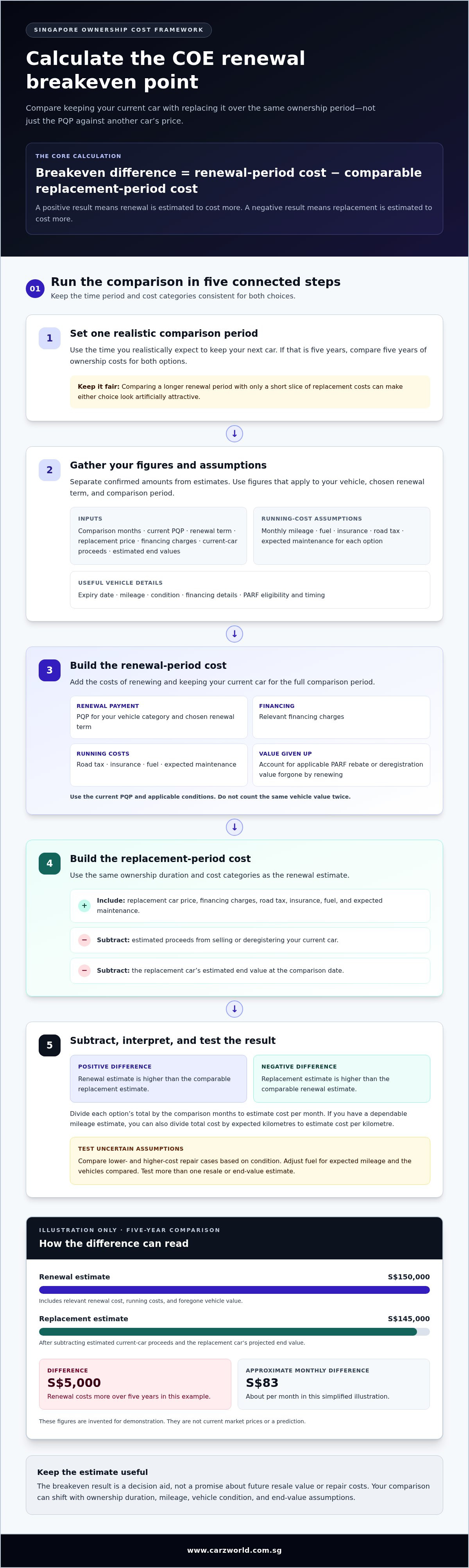
Compare the estimated cost of keeping your current car with the cost of replacing it over the same number of months. A practical starting formula is:
Breakeven difference = renewal-period cost − comparable replacement-period cost
A positive result means the renewal estimate is higher; a negative result means the replacement estimate is higher. The difference is a guide, not a guaranteed saving. Keep confirmed figures, such as a quoted purchase price, separate from estimates for repairs or future resale.
Build the renewal-cost total
Start with the PQP for your vehicle category and chosen renewal term. Check the current amount and conditions in the official LTA guidelines on COE renewal. Add relevant financing charges, road tax, insurance, fuel, and expected maintenance for your chosen period. Also account for any PARF rebate or deregistration value you would give up by renewing, based on your vehicle’s eligibility and timing. Avoid counting the same value twice.
Build the replacement-cost total
Include the replacement car’s price, financing charges, and expected road tax, insurance, fuel, and maintenance. Subtract a realistic estimate of what you could receive for your current car, then subtract the replacement car’s estimated end value at the comparison date. Use the same ownership duration and cost categories as in the renewal calculation.
Hypothetical example only: Imagine a five-year comparison. The renewal estimate totals S$150,000, including the relevant renewal cost, running costs, and foregone vehicle value. The replacement estimate totals S$145,000 after subtracting the current car’s estimated proceeds and the replacement car’s projected end value. In this simplified illustration, renewal costs S$5,000 more over five years, or about S$83 per month. These figures are invented for demonstration and aren’t current market prices or a prediction.
Use this compact worksheet with your own figures:
- Inputs: Comparison months, current PQP, renewal term, replacement price, financing charges, current-car proceeds, and estimated end values.
- Assumptions: Monthly mileage, fuel, insurance, road tax, and maintenance for each option.
- Results: Total renewal cost, total replacement cost, difference, and each total divided by comparison months for cost per month.
If you have a dependable mileage estimate, divide each option’s total cost by expected kilometres over the period to estimate cost per kilometre. Otherwise, use the monthly comparison and test higher and lower repair, fuel, and resale assumptions. For a replacement scenario, you can also explore selling or consigning your current car as part of estimating its value.
Renew or replace? Compare the costs that change the result
Use the same ownership period for both options, such as the number of years you expect to keep your next car. Include the costs during that period and a realistic estimate of each car’s value at the end. A cost comparison between renewing and replacing also shows why a decision shouldn’t rest on the renewal payment alone.
Use this table to organise your figures. Enter amounts in S$ and use the same period and cost assumptions in both columns.
| Cost item | Renew current car | Replace car |
|---|---|---|
| Cash outlay | PQP and other upfront renewal costs | Replacement purchase cost, less proceeds from current car |
| Financing | Interest and charges for renewal financing | Interest and charges for replacement financing |
| Running costs | Road tax, insurance, fuel, and expected maintenance | Road tax, insurance, fuel, and expected maintenance |
| Estimated end value | Any applicable deregistration value at the comparison date | Estimated resale or deregistration value at the comparison date |
| Total cost | Costs minus estimated end value | Costs minus estimated end value |
Account for PARF and deregistration value
If you renew, you forgo any PARF rebate you might otherwise receive by deregistering the car while eligible. Treat that potential rebate as an opportunity cost of keeping the vehicle, not as a guaranteed amount. Eligibility and value depend on the specific car and deregistration timing under current LTA rules. Use the applicable figures in your comparison, and don’t count the same proceeds both as a reduction in replacement cost and as a separate credit.
Condition matters, too. A car in good shape may need less maintenance during the comparison period, while expected repairs can make renewal less attractive. A replacement car has its own running-cost and value assumptions, so include those rather than treating a newer vehicle as cost-free to maintain.
Test assumptions instead of relying on one estimate
Try low, expected, and high maintenance scenarios based on the car’s known condition. Then adjust mileage, financing charges, fuel use, and future resale estimates. This sensitivity check makes calculating breakeven point for COE renewal more useful because it shows whether one option remains preferable when assumptions change.
Finally, weigh practical needs alongside the totals. Reliability, comfort, safety features, and changes in family or work travel can matter as much as a small cost difference. If the numbers are close, convenience and confidence in the car’s condition may reasonably guide your choice.
A practical checklist for making your COE renewal decision
A useful comparison starts with accurate inputs and clear assumptions. Before calculating breakeven point for COE renewal, collect the figures for your current car and a realistic replacement, then assess both over the same ownership period. Use current LTA information for the applicable PQP, renewal conditions, and PARF eligibility rather than relying on an old estimate.
The figures to gather before comparing
Keep confirmed amounts separate from estimates. Use this checklist to organise your information:
- COE details: Record the expiry date, vehicle category, applicable PQP, and renewal term you’re considering. Refer to current LTA rules for renewal requirements and any rebate implications.
- Current car: Note its mileage, condition, expected annual mileage, and current costs for insurance, road tax, and fuel. Estimate maintenance over the comparison period based on the vehicle’s condition.
- Financing: Record any outstanding loan commitments and the financing assumptions for renewal or replacement, including interest and charges where relevant. Keep the vehicle price or renewal amount separate from financing charges to avoid counting the same cost twice.
- Replacement option: Use a specific vehicle’s purchase price and comparable financing, running-cost, and maintenance assumptions. Avoid comparing a general market impression with detailed figures for your current car.
- End values: Estimate possible proceeds from deregistering or selling the current car, and the replacement’s value at the end of the period. Label these as estimates and check rebate eligibility against current LTA rules.
Choose one ownership period for both options, such as the time you expect to keep your next car. Record the source or basis for each figure, and use a range for uncertain items such as maintenance, fuel use, and resale value. For example, compare lower, expected, and higher maintenance estimates instead of treating one forecast as certain.
How to interpret a close breakeven result
A narrow difference in estimated cost may not outweigh reliability, potential downtime, comfort, or changing transport needs. If your current car is important for daily travel, the practical cost of unexpected disruption may matter even if it doesn’t appear neatly in the calculation. There’s no universal answer: the result depends on your inputs and priorities.
Revisit the comparison if your expected ownership period changes, the car’s condition worsens, or you revise your mileage or financing assumptions. A result that favours renewal under one set of estimates may change when those inputs shift. Keep the assumptions visible so you can update them as circumstances change.
If replacement looks more suitable, explore car options and compare choices against the same budget and ownership needs used in your calculation.
After the calculation: plan your next car move with confidence
Your breakeven result is a guide to a decision, not a verdict on its own. Consider the estimated total cost alongside your car’s condition, how long you plan to keep your next vehicle, and how much uncertainty you’re comfortable taking on. A car that costs less on paper may not suit your travel needs, while a replacement may offer features or reliability that matter to you.
Before deciding, revisit the assumptions that have the greatest effect on your comparison. If a repair estimate or future resale value changes, update the totals. Also consider whether you expect your mileage, household needs, or regular journeys to change. A choice that makes sense for a short ownership period may not suit a longer one.
If replacing the car fits your calculation
Compare replacement options against the same budget, expected usage, and ownership horizon used in your calculation. A pre-owned vehicle may be worth considering if it fits your needs and planned costs. Browse pre-owned cars in Singapore and compare suitable choices based on factors such as vehicle condition, expected running costs, and how long you intend to keep the car.
A brand-new vehicle is another route. Consider whether its purchase cost and expected ownership costs fit your budget and plans, then explore brand-new cars. Comparing both categories can help you assess which option makes sense beyond the initial price.
If you decide to sell your current car
Selling or consigning your current car can form part of the replacement plan. Include a realistic estimate of the proceeds in your comparison, and keep it separate from any PARF or deregistration value so you don’t count the same value twice. Carz World offers direct purchase and consignment options for owners selling their cars.
Use the figures to narrow your choices, then consider what matters most in day-to-day ownership. If replacement is the better fit, explore Carz World’s available car options. A clear comparison can help you move forward with confidence, whether you renew or choose another vehicle.
Make your next car decision with confidence
A sound COE decision comes from comparing total ownership costs over the same period, not from looking at the PQP or replacement price alone. Include likely running costs and maintenance, and account for the value you may give up or recover when you keep or deregister your car. The result of calculating breakeven point for COE renewal is a guide, so weigh it alongside your vehicle’s condition, ownership plans, and comfort with uncertainty.
If replacement fits your budget and needs better, compare pre-owned and brand-new cars as part of your next step. Carz World sells both in Singapore, as well as offering direct purchase and consignment options if you’re selling your current vehicle.
Explore available cars and plan your next move. With your figures and priorities in view, you can choose the path that feels right for your next stage of car ownership.
Frequently Asked Questions
How do I calculate the breakeven point for COE renewal?
Compare the total cost of renewing your car with the total cost of replacing it over the same ownership period. Include PQP, financing, road tax, insurance, fuel, expected maintenance, and realistic end-of-period value for each option. Account for any relevant rebate or deregistration value you may give up by renewing. Use your own vehicle and financing figures, and label estimates clearly. This makes calculating breakeven point for COE renewal a practical comparison, not a guarantee.
Is it cheaper to renew COE or buy another car?
Neither option is always cheaper; the result depends on your car, costs, and plans. Renewal may compare favourably if your car is in good condition and still suits your needs. Replacement may be a better fit if expected repair costs, reliability concerns, or changing transport needs weigh more heavily. Compare both choices over the same period, including financing, running costs, and potential deregistration value, before deciding.
What costs should I include when calculating COE renewal?
Start with the applicable PQP and renewal duration, then include relevant financing charges, road tax, insurance, fuel, maintenance, and likely repairs across your chosen period. Compare these with equivalent costs for a replacement car, including its purchase and financing costs. Account for realistic end values and any rebate value you may forgo. Check current LTA rules and vehicle-specific eligibility, since renewal and rebate details can affect your figures.
Does renewing COE affect PARF rebate?
Renewing COE can affect your vehicle’s PARF rebate eligibility and how its deregistration value is treated. The outcome depends on vehicle details, the renewal choice, timing, and current LTA rules, so don’t assume a standard rebate applies. Use the current requirements and information for your specific car. If renewing means giving up a rebate you could otherwise receive, include that foregone value as part of the cost comparison.
Is a five-year or ten-year COE renewal better?
The better choice depends on how long you plan to keep the car, its condition, and the costs you’re prepared to take on. Compare each renewal option against your expected ownership period, rather than choosing based only on upfront cash outlay. A five-year renewal for a car is terminal, while a ten-year renewal may allow another renewal, subject to current LTA rules. Check the latest guidance before deciding.
What happens if renewing and replacing cost almost the same?
A close result means you should review your assumptions, not that either option is automatically best. Test different estimates for maintenance, mileage, financing, fuel use, and future resale value. Then consider reliability, possible downtime, vehicle features, and how long you expect to keep the car. If a small change in one estimate reverses the result, focus on which option better fits your circumstances and tolerance for uncertainty.
Disclaimer
This content is provided for general informational purposes only. Readers are encouraged to independently verify important information.
In Same Category
- Calculating the Breakeven Point for COE Renewal in Singapore
- Financial Checklist Before Committing to a Car Purchase in Singapore (2026)
- COE Renewal Conditions and Eligibility in Singapore: 2026 Guide
- Balloon Scheme Car Loan in Singapore: Pros and Cons for 2026
- Getting Car Finance with a New Business in Singapore: A Practical Guide
Related by Tags
- Calculating the Breakeven Point for COE Renewal in Singapore
- COE Renewal Conditions and Eligibility in Singapore: 2026 Guide
- Used Electric Cars in Singapore: 2026 Buyer's Guide
- What Happens to My Car Loan If I Lose My Job in Singapore? (2026 Guide)
- Pre-Owned Vehicle Showroom in Hougang: Your Complete 2026 Buying Guide
- Mazda CX-5 Singapore Review: Buyer Guide, Specs & Ownership (2026)
- Car Financing for Singapore Gig Workers: 2026 Guide
- 2026 Guide: Planning for a Second Family Car in Singapore
- Buying a Used Car in Singapore: 2026 Ultimate Guide