Financial Planning for Your First Car in Singapore

Could the car you can afford to buy still put too much pressure on your monthly budget? In Singapore, the advertised price is only part of the commitment. Financial planning for your first car in singapore should start with the full cost of ownership, not just the down payment.
It’s understandable to focus first on the purchase price or monthly loan instalment. But you’ll also need to budget for costs such as COE, insurance, road tax, fuel, parking and ongoing upkeep. MAS rules limit car loan financing to 60% or 70% of the purchase price, depending on the vehicle’s OMV, with a maximum loan tenure of seven years.
This guide will help you build a realistic budget before you start shopping. You’ll learn how to weigh upfront and recurring costs, compare a new car with a pre-owned option on the same basis, and consider how financing may affect your cash flow. We’ll also cover practical next steps for exploring suitable vehicles, including the brand-new and pre-owned cars available through Carz World.
Key Takeaways
- Use a whole-ownership budget to separate upfront cash, regular expenses and future commitments before shortlisting a car.
- Compare new and pre-owned cars by upfront commitment, intended ownership period and flexibility, not by advertised price alone.
- Set a monthly affordability boundary and organise your costs in a simple worksheet before you browse.
- Sound financial planning for your first car in singapore means choosing a vehicle that fits your budget, rather than borrowing up to the maximum available.
- Compare Carz World’s brand-new and high-quality, well-maintained pre-owned options against your plan before deciding which vehicles to explore.
Financial planning for your first car in Singapore starts beyond the sticker price
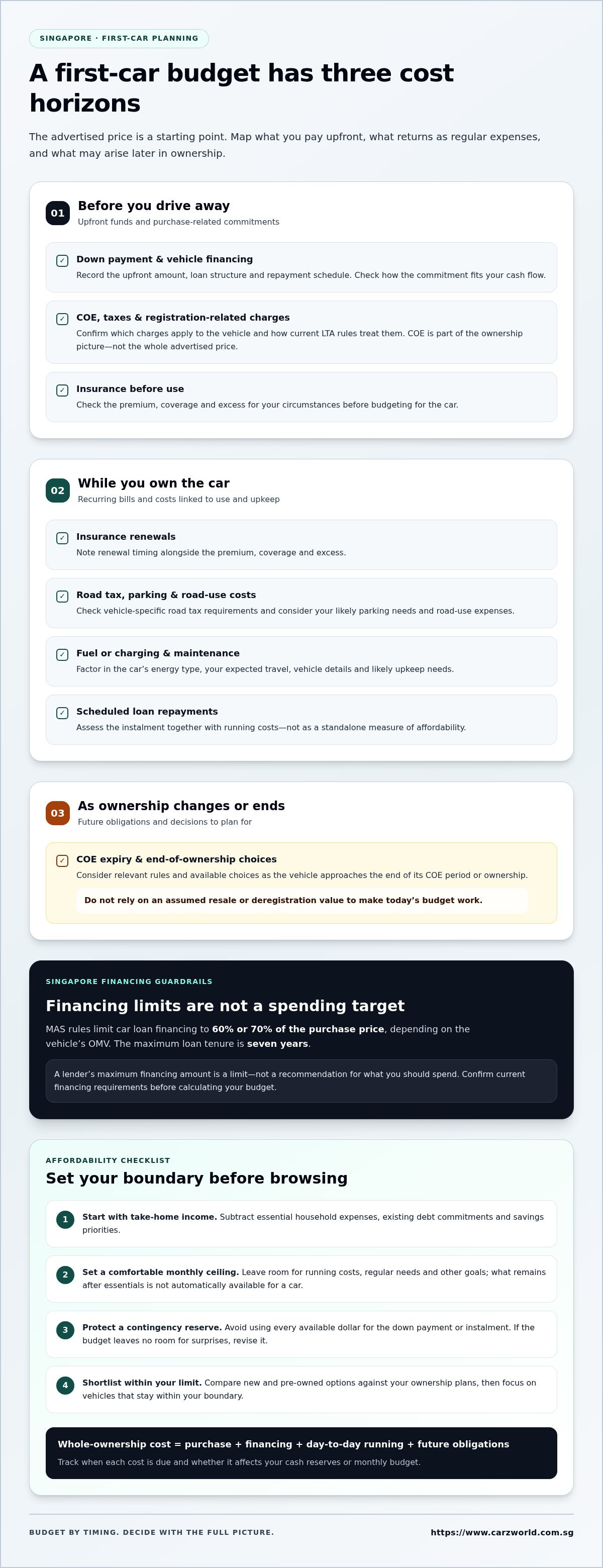
The advertised price is a useful starting point, but it doesn’t show the full financial commitment of owning a car. A first-car budget should cover three areas: the funds needed to buy the vehicle, the costs of running it, and future obligations that may arise during ownership. This broader view helps you judge whether a car fits your finances, rather than relying on its price tag alone.
A manageable monthly instalment can still leave too little room for insurance, road tax, fuel, parking and other regular expenses. Your plan should also account for money paid upfront and a contingency reserve for unexpected costs. For sound financial planning for your first car in singapore, map the costs, compare vehicle options, set a personal limit, and then shortlist cars.
What should a first-car budget include?
Separate the purchase and financing commitment from routine ownership expenses. Upfront funds may include your down payment and other purchase-related charges. Recurring costs include insurance, road tax, fuel, parking and road-use charges. Future obligations may include costs associated with keeping, renewing or eventually deregistering the vehicle. Exact charges and rules depend on the car and current regulations.
In Singapore, the Certificate of Entitlement (COE) is a key part of the vehicle ownership system. Include it in your understanding of the vehicle’s overall cost rather than treating the advertised price as the whole picture. Note when each cost is due and whether it will affect your cash reserves or monthly budget.
- Upfront: Record the purchase commitment, down payment and applicable charges.
- Recurring: Set aside room for insurance, road tax, fuel, parking and road-use costs.
- Future: Account for later ownership decisions. Avoid relying on an assumed resale or deregistration value to make today’s budget work.
Set a personal affordability boundary before browsing
Start with your take-home income, then subtract essential household expenses, existing debt commitments and savings priorities. What remains is not automatically available for a car. Set a monthly ceiling that leaves room for your other goals and regular needs, even after running costs are included. A lender’s maximum financing amount is a limit, not a recommendation for what you should spend.
Protect your budget with a contingency reserve. Unexpected expenses can arrive alongside routine bills, so avoid using every available dollar for the down payment or instalment. If the figures only work when you leave no room for surprises, revise the vehicle budget before shopping.
Use this decision sequence to prepare:
- Map upfront, recurring and future costs.
- Compare new and pre-owned options against your ownership plans.
- Set a comfortable spending limit and preserve your reserve.
- Shortlist vehicles that stay within that boundary.
Singapore first-car costs: separate upfront, monthly, and future commitments
A car’s advertised price gives you a starting point, not a complete comparison. Total ownership cost is the combined cost of purchase, financing, day-to-day running, and future obligations over the period you own the car. Sorting expenses by when they arise makes it easier to see whether a vehicle fits your cash on hand as well as your ongoing budget.
Singapore-specific charges, including COE and registration-related fees, can affect the overall purchase decision. Applicable amounts and rules depend on the vehicle and current regulations. For background on car ownership cost categories, see DBS Bank’s guide to car ownership costs. Check current LTA information and financing rules before relying on specific figures or limits.
| Cost category | When paid | What to verify |
|---|---|---|
| Down payment and vehicle financing | At purchase and through scheduled repayments | Upfront amount, loan structure, repayment schedule, and how the commitment fits your cash flow |
| COE, taxes, and registration-related charges | As part of the purchase or registration process | Which charges apply to the vehicle and how current LTA rules treat them |
| Insurance | Before use and at renewal | Premium, coverage, excess, and renewal timing for your circumstances |
| Road tax and parking | At required payment or usage intervals | Vehicle-specific road tax requirements and your likely parking needs |
| Fuel or charging and maintenance | As you use and care for the car | Energy type, expected travel, vehicle details, and likely upkeep needs |
| COE expiry and end-of-ownership choices | As the vehicle approaches the end of its COE period or ownership | Relevant rules, available choices, and the assumptions behind any future-value estimate |
Which costs can arise before you drive away?
Before collection, account for the vehicle payment structure, the portion funded upfront, applicable taxes and registration-related charges, and insurance. A larger upfront payment may reduce the cash you have left after purchase. Financing spreads payment over time but creates scheduled repayments, so assess the instalment alongside other costs rather than in isolation. COE and charges such as ARF can also affect the overall vehicle price. Check their current treatment with LTA and confirm applicable financing requirements before calculating your budget.
Which recurring and future costs belong in the plan?
Estimate routine costs based on your intended driving, parking and vehicle details. Include road tax, insurance, parking, fuel or charging, and maintenance. These expenses vary by vehicle and use, so avoid applying one estimate to every car. Record when bills are due as well as their expected amounts: several expenses falling close together can put pressure on cash flow.
COE expiry also calls for a future decision. Depending on the circumstances and applicable rules, an owner may consider options such as renewal or ending ownership. Don’t build your budget around a predicted resale or rebate value. For a practical comparison, explore Carz World’s vehicle options using the costs and assumptions you’ve recorded.
New or pre-owned car in Singapore: compare the financial trade-offs
Neither a brand-new nor a pre-owned car is automatically the better financial choice. Compare each option against the same monthly affordability limit and the ownership period you expect. A lower advertised price alone doesn’t establish better value: upfront funds, financing, running costs and how long you plan to keep the car all affect the decision.
| Comparison point | Brand-new car | Pre-owned car |
|---|---|---|
| Upfront commitment | Assess the full purchase commitment and the cash needed at the start. | Assess the specific vehicle’s total price and upfront funds on the same basis. |
| Expected ownership horizon | Consider how long you intend to own it and the future obligations within that period. | Consider your intended ownership period alongside the vehicle’s remaining ownership horizon. |
| Flexibility | Check whether the commitment leaves room for savings goals and changing needs. | Check whether the overall commitment and planned ownership period suit your circumstances. |
When might a pre-owned car fit a first-car budget?
A pre-owned option may suit your plan if its full commitment fits your cash-flow ceiling and leaves room for other priorities. Look beyond the advertised price: consider the specific vehicle’s condition and remaining ownership horizon, then include financing and running costs in your comparison. Carz World’s Pre-Owned Cars are described as high quality and well maintained. Browse the pre-owned car selection as part of your assessment.
How should you assess a brand-new car financially?
Assess whether the full commitment fits your savings priorities, monthly expenses and intended ownership period. A new car may align with a longer ownership plan, but that depends on your circumstances and the vehicle, not simply its new status. Carz World offers brand-new cars described as the latest models in pristine condition. Compare them with pre-owned options using the same budget measures.
Keep the comparison fair by holding your assumptions constant. Use the same monthly spending limit, planned ownership period and running-cost categories for both options. Then compare each vehicle’s upfront commitment and financing structure. Don’t assume that a smaller instalment means a lower overall cost. Carz World offers vehicle financing; assess any financing scenario against your own budget and the applicable terms rather than assuming approval or a particular outcome.
This side-by-side approach supports financial planning for your first car in singapore because it puts each option in context with your intended use and affordability boundary. Record what you know, identify details that could change the comparison, and don’t rely on a future resale value to make an otherwise tight budget appear workable.
Build a first-car budget in Singapore with a simple decision process
Turn your cost list into a working budget before viewing cars. A responsible budget must leave room for essential expenses and savings, not just the vehicle payment. This gives you a clear affordability boundary for comparing cars and financing options.
- Calculate monthly capacity. Start with take-home income, then account for essential spending, debt commitments and savings priorities. The amount left is a starting point, not a car budget until you’ve included vehicle expenses.
- Reserve cash. Set aside a contingency reserve and protect funds needed for near-term obligations. Don’t plan to use every available dollar for the upfront payment.
- Model ownership costs. Add expected instalments to insurance, road tax, parking, fuel or charging, and other costs relevant to the vehicle and your use.
- Compare options. Apply the same ownership period, upfront contribution and cost categories to each car. Recheck current Singapore vehicle and financing rules when comparing specific vehicles.
- Shortlist within your limit. Keep only options that fit both your monthly ceiling and available upfront funds without relying on future income growth.
How do you find a sustainable monthly limit?
Write down take-home income, essential spending, debt commitments and savings contributions. Decide what must remain available for an emergency reserve, then calculate the amount you can comfortably allocate to car ownership. Include the instalment alongside running costs, not instead of them. Finally, test the budget against a less favourable month, such as one with higher essential expenses, and check whether it still leaves your priorities intact.
How can a financing comparison stay fair?
Compare financing options using the same vehicle price, upfront contribution and loan duration. Review the total repayment assumptions as well as the monthly instalment, and read the stated rate, fees, repayment schedule and early-settlement conditions. Carz World offers vehicle financing, but approval and terms depend on the financing arrangement. Use the details presented for each option rather than assuming two similar instalments mean the same overall commitment.
Use this blank worksheet to make your assumptions visible. Fill in your own figures in Singapore dollars and update them as you compare specific cars:
- Monthly take-home income: S$________
- Essential expenses and debt commitments: S$________
- Savings priorities and reserve contribution: S$________
- Comfortable monthly vehicle limit: S$________
- Available upfront funds after reserve: S$________
- Estimated instalment and financing details: S$________ / __________
- Insurance, road tax, parking and energy costs: S$________
- Other vehicle-specific costs and assumptions: __________
This practical approach supports financial planning for your first car in singapore by making your limit clear before you browse. Update the worksheet when a vehicle’s details or financing assumptions change, and verify applicable rules with the relevant Singapore authorities before deciding.
Explore vehicle options with Carz World once your budget and comparison assumptions are ready.
Turn your first-car plan into a confident shortlist with Carz World
You’re ready to move from budgeting to browsing when your figures are written down, ownership costs have been considered, and you’ve compared suitable options on the same basis. Keep your shortlist within your personal affordability boundary. A maximum loan is not a spending target, and financing approval wouldn’t by itself show that a car fits your household budget.
Use your plan as a filter, not a reason to stretch. If an option leaves too little room for essential expenses, savings or your contingency reserve, remove it from the shortlist. This keeps financial planning for your first car in singapore tied to your priorities and intended ownership, rather than the largest amount you might be able to borrow.
What to prepare before discussing a car purchase
Bring a documented budget, your preferred ownership horizon and a clear picture of how you expect to use the car. Consider typical journeys, passenger needs and how often you expect to drive. These details help you focus on options suited to your actual use instead of comparing vehicles on price or appearance alone.
Write down questions about financing, then compare the stated repayment structure with your household plan. Consider how the upfront contribution affects your available cash and whether repayments and running expenses fit your monthly limit. Carz World offers vehicle financing; use the details of a financing option to assess how it fits your plan without assuming approval or particular terms.
Before deciding, check that the figures still work when you account for the vehicle’s specific costs and your intended ownership period. Carz World offers brand-new cars and high-quality, well-maintained pre-owned cars, giving you two types of options to compare against the same affordability boundary. A quote request or test-drive option can be a practical next step once you’ve identified vehicles worth considering.
When a trade-in could form part of the plan
If you already own a car, an estimate of its current worth can be one input in your planning. Treat it as an estimate, not guaranteed purchase funds, and don’t rely on it to make an otherwise tight budget work. Keep the replacement car affordable based on your available cash and ongoing capacity, even if the estimate changes.
Carz World offers a way to estimate your car’s current worth, which can help you consider a trade-in as part of your vehicle decision. Use the valuation as a planning input, then review your shortlist with the rest of your budget in view.
A considered shortlist should leave you comfortable with both the car and its financial commitment. Explore available cars or request a quote from Carz World when you’re ready to compare your options.
Take the next step with a budget-led shortlist
Your budget can guide the search rather than being adjusted to fit the first car that catches your eye. Set a clear boundary, then focus on vehicles that suit your priorities and intended ownership. That’s the practical value of financial planning for your first car in singapore: you can make the next decision with greater clarity and less pressure to stretch.
Carz World offers brand-new and high-quality, well-maintained pre-owned cars to compare. You can also explore vehicle financing, request a quote, arrange a test drive or use a trade-in valuation as a planning input if you already own a car. Keep your shortlist focused on options that work for your budget, not simply the maximum a lender may offer.
Explore cars that fit your first-car plan and take the next step at a pace that feels right. A clear plan makes it easier to choose with confidence.
Frequently Asked Questions
How much should I save before buying my first car in Singapore?
Save enough to meet the upfront commitment while keeping essential savings available for household needs and unexpected expenses. The target depends on the vehicle, financing arrangement and your finances, so a generic savings figure may be misleading. Before deciding how much cash to put in, consider how the remaining loan payments and regular car expenses fit alongside your other commitments. If the plan uses your whole reserve, consider a lower-cost option.
What costs should I include when budgeting for a car in Singapore?
Include the purchase and financing commitment, applicable registration-related charges, insurance, road tax, parking, fuel or charging, maintenance and future ownership decisions. Make the list useful by noting each cost’s due date and whether it is a one-off or recurring expense. For example, separate bills due near purchase from regular monthly spending. Check current official information and details for the specific vehicle, since applicable charges can vary.
Is a pre-owned car always cheaper to own than a new car?
No. A lower advertised price doesn’t, by itself, show which option will cost less over your ownership period. Compare specific cars using the same assumptions for financing, intended ownership period and routine expenses. For a pre-owned car, include its condition and remaining ownership horizon in your assessment. A new car may suit another buyer’s plans. Choose based on the full comparison, not a blanket rule about either category.
How do COE and PARF affect first-car financial planning?
COE, or Certificate of Entitlement, relates to the vehicle’s permitted ownership period in Singapore. PARF is a rebate that may apply when an eligible car is deregistered before it reaches the relevant age threshold. Both can affect how you assess a vehicle’s costs and future choices. Their treatment depends on current rules and the specific car, so check the latest LTA information rather than relying on an old example.
Should I use all my savings for a car down payment?
It’s generally prudent to keep funds available for essential expenses and unexpected needs rather than committing all your savings upfront. Compare the cash contribution with the resulting loan commitment and the money you’ll still need for household priorities. A larger down payment may change the amount financed, but it isn’t automatically the best choice if it leaves you without a reserve. Review the specific financing terms before deciding.
Can I include a trade-in when planning my first-car budget?
Yes. If you already own a vehicle, its estimated value can be one planning input. Treat the estimate as provisional, not guaranteed money, until the transaction details are settled. Avoid using it to justify a purchase that would otherwise exceed your budget. Carz World offers a service to estimate a car’s current worth, which can help you consider how an existing vehicle may fit into your purchase plan.
What should I compare when reviewing car financing options?
Compare the stated rate, fees, upfront contribution, loan duration, repayment schedule and any early-settlement conditions. Use the same vehicle and assumptions for each scenario so the comparison is meaningful. Look beyond the instalment to understand the full repayment commitment and its effect on your monthly finances. A useful checkpoint in financial planning for your first car in singapore is whether repayments remain manageable alongside running costs and other household commitments.
Disclaimer
This content is provided for general informational purposes only. Readers are encouraged to independently verify important information.
In Same Category
Related by Tags
- Risks of Buying a Car with 1 Year of COE Left in Singapore (2026 Guide)
- Best Second Hand Cars for Malaysia: Singapore Buyer's Guide
- Buying a Used Lorry in Singapore: 2026 Buyer’s Guide
- Financial Planning for Your First Car in Singapore
- Understanding the MAS Car Loan Restrictions in Singapore (2026)
- Pros and Cons of Buying a High PARF Car in Singapore
- Calculating the Breakeven Point for COE Renewal in Singapore
- Financial Checklist Before Committing to a Car Purchase in Singapore (2026)
- Used Electric Cars in Singapore: 2026 Buyer's Guide
- Electric Vehicle Guide 2026: Types, Charging and Buying in Singapore
- COE Results Singapore: How to Read the Latest Bidding Outcomes in 2026
- What Happens to My Car Loan If I Lose My Job in Singapore? (2026 Guide)
- Singapore Car Loan Guide for EP Holders (2026)
- Pre-Owned Vehicle Showroom in Hougang: Your Complete 2026 Buying Guide
- Car Financing for Singapore Gig Workers: 2026 Guide
- Calculating the Real 5-Year Cost of Car Ownership in Singapore (2026 Guide)
- 2026 Guide: Planning for a Second Family Car in Singapore
- Parallel Import Singapore: The Ultimate 2026 Buyer’s Guide
- How to Buy a Car in Singapore: The Ultimate 2026 Step-by-Step Guide
- Mercedes C-Class Singapore Guide 2026: Specs, COE, and Buying Tips
- Honda Civic Singapore: 2026 New & Pre-Owned Guide
- Mazda 3 Singapore Guide 2026: Specs, Prices, and Buying Tips