Compare car financing options with no credit history in SG

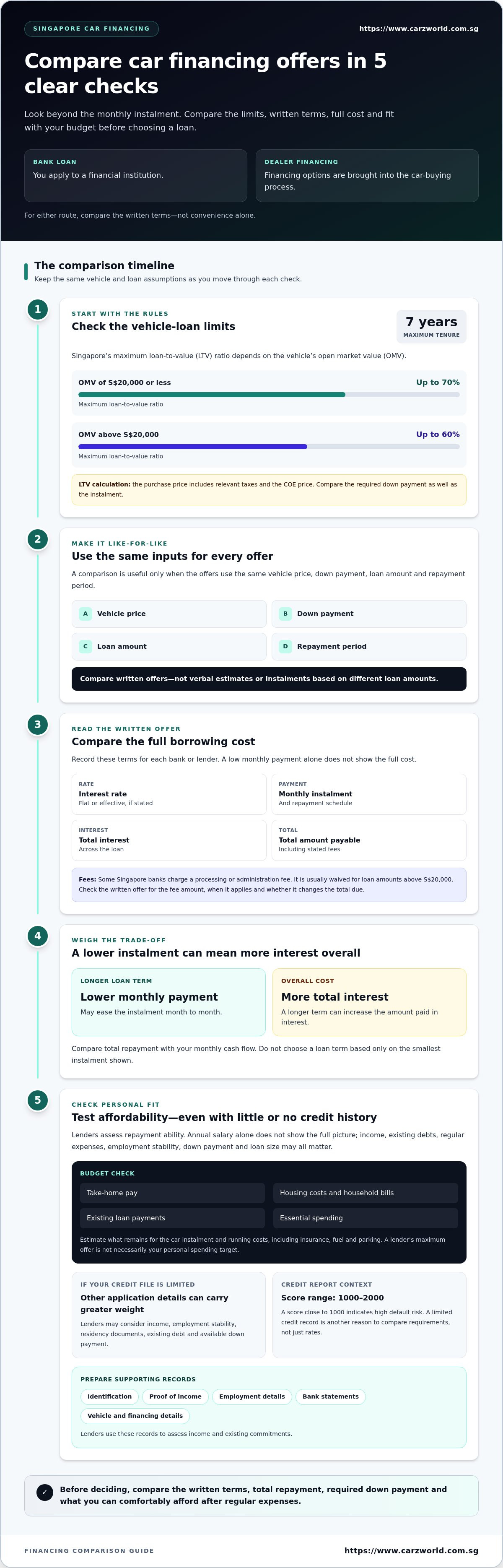
A bank loan and dealer financing are different routes, but both sit within Singapore’s motor-vehicle loan limits. For a vehicle with an open market value of S$20,000 or less, the maximum loan-to-value ratio is 70%, according to the Monetary Authority of Singapore. Above S$20,000, the maximum is 60%, and the maximum motor-vehicle loan tenure is 7 years.
It’s understandable to wonder whether having no credit history will make financing harder, or whether your income can support the repayments. Getting car financing with no credit history in Singapore starts with comparing the full cost and terms, not just the monthly instalment. A longer loan can lower monthly payments while increasing the total amount payable.
This guide compares bank and dealer financing, explains what lenders may consider when assessing income and repayment ability, and shows how to weigh a loan against your budget. It also covers practical ways to avoid committing to a car that leaves too little room for other expenses.
Key Takeaways
- Compare bank and dealer financing by looking beyond the monthly instalment to the full loan terms and total repayment.
- Understand how lenders assess income and repayment capacity, and why a single annual income threshold may not tell the whole story.
- Review the motor-vehicle financing limits that apply in Singapore before deciding how much to borrow.
- Build a realistic car budget that leaves room for other expenses, rather than choosing a loan term based only on lower monthly payments.
- Learn how to approach a financing application without a credit history and what factors may help demonstrate your ability to repay.
1. Bank loans versus dealer financing
With a bank loan, you apply to a financial institution. Dealer financing brings financing options into the car-buying process. Either way, compare the written terms rather than choosing based on convenience alone.
For a buyer getting car financing with no credit history in Singapore, the lender still needs to assess repayment ability. Singapore’s credit report score ranges from 1000 to 2000, and a score close to 1000 indicates high default risk.
To understand how Singapore lenders assess consumer loans, including vehicle financing, watch this CNA guide:
Bank and dealer routes remain subject to Singapore’s vehicle-loan limits. For open market value (OMV) of S$20,000 or less, the maximum loan-to-value ratio is 70%; above S$20,000, it is 60%. The Monetary Authority of Singapore sets the 70% cap, while the 60% cap applies above that OMV threshold. The maximum motor-vehicle loan tenure is 7 years.
For loan-to-value calculations, the purchase price includes relevant taxes and the COE price. Compare the required down payment as well as monthly instalments. A lower instalment from a longer term can mean more interest overall. Ask for the interest rate, repayment schedule, total amount payable, and any processing or administration fee in writing. Some Singapore banks charge such a fee, usually waived for loan amounts above S$20,000.
What documents do Singapore lenders require for car loans? Prepare identification, proof of income, employment details and bank statements, along with the vehicle and financing details. Lenders use these records to assess your income and existing commitments.
Do Singapore banks approve car loans for foreigners or new residents with no credit history? Foreigners and new residents can apply, but lenders assess income, employment stability, residency documents, existing debt and available down payment. With a limited local credit record, these other details can carry greater weight in the application.
Can a guarantor or co-borrower help secure car financing in Singapore? A co-borrower’s income and debt commitments may be considered as part of the application. A guarantor may provide additional reassurance about repayment, but their responsibility depends on the agreement’s terms.
How can you build credit history in Singapore before applying for car financing? Use a credit account responsibly, make payments on time and keep balances manageable. Consistent repayment records give lenders more evidence to consider than an empty credit file.
What risks and extra costs come with dealer financing or a car loan for a first-time borrower in Singapore? A longer term can increase total interest, and fees can add to borrowing costs. Compare the total repayment and avoid an instalment that leaves too little for insurance, fuel, parking and other regular expenses.
2. Comparing offers from banks and lenders
Compare each written offer using the same loan amount and repayment period. Check the interest rate, monthly instalment, total interest, total repayment and any processing or administration fees. A low monthly figure alone doesn’t reveal the full borrowing cost. Use the same vehicle price and down payment for every comparison so you’re assessing like-for-like offers.
A longer term lowers the monthly payment but costs more in total interest.
That difference matters when deciding whether a lower instalment genuinely fits your budget. Compare total repayment with your monthly cash flow, then choose a term you can manage without relying on the smallest payment shown.
Some banks in Singapore may charge a car-loan processing or administration fee. The fee is usually waived for loan amounts above S$20,000. Include any stated fee in your comparison rather than treating it as separate from the borrowing cost. Read the offer for the fee amount, when it applies, and whether it changes the total due.
Use a simple comparison sheet before choosing:
- Record each lender’s interest rate and whether the offer states a flat or effective rate.
- Write down the loan amount, repayment period, monthly instalment, and total interest.
- Add processing or administration fees to the total cost.
- Compare the required down payment and the cash you’ll retain after purchase.
- Check whether the offer’s terms match your income and existing monthly commitments.
With little credit history, compare the lender’s document requests and application requirements as well as the rate. A lower rate won’t help if the repayment schedule strains your monthly budget. Keep copies of offers and compare the same figures, not verbal estimates or instalments based on different loan amounts.
Vehicle price also affects how much you need to finance. If you’re weighing a lower purchase price against the loan amount, browse pre-owned car options as part of your budget comparison. A smaller loan can change the down payment and repayment calculation, so assess the vehicle and financing together.
3. Minimum annual income thresholds
A lender assesses whether your income can support the proposed car-loan instalment. Annual salary matters, but it doesn’t show your full repayment capacity. Existing debts, regular expenses, employment stability, down payment and loan size all affect affordability. In Singapore, compare the instalment with your actual take-home income, not just your gross annual pay.
Set a monthly budget before settling on a car price. List your take-home pay, housing costs, household bills, existing loan payments and essential spending. Then estimate what remains for a car instalment and running costs. This gives you a practical borrowing limit and helps prevent a lender’s maximum offer from becoming your personal spending target.
Income consistency can matter as much as the amount you earn. A fixed salary provides a clearer monthly pattern than income that varies with commissions, overtime, freelance work or seasonal demand. If your earnings fluctuate, use a cautious estimate based on income you reasonably expect to continue. Don’t build your car budget around an unusually strong month or a one-off bonus.
Existing commitments reduce the income available for a new loan. For example, someone with the same salary but fewer monthly debt payments may have more room for a car instalment. Include credit-card repayments and other loans in your budget, and leave a buffer for essential costs that can change, such as medical bills or household expenses.
Use these steps to estimate a manageable instalment:
- Calculate monthly take-home income from regular earnings.
- Subtract housing, household essentials, and existing debt payments.
- Set aside money for car ownership costs beyond the loan instalment.
- Choose an instalment that leaves room for savings and unexpected expenses.
A bigger down payment reduces the amount borrowed and can lower the instalment for the same repayment period. Choosing a more affordable vehicle can also reduce the loan required. Compare both options against your monthly budget rather than relying on income alone. Repayments should remain manageable in ordinary months, not just when earnings are at their highest.
If you’re applying without a long credit record, present a clear picture of your dependable income and existing commitments. Organise your employment and income information so the lender can understand how you earn and whether your income is steady. Keep the requested loan amount within your budget. A smaller loan that fits your cash flow is more sustainable than stretching for a higher-priced car.
4. Avoiding unaffordable car purchases
Loan approval doesn’t mean the instalment fits your household budget. Before committing, work out what remains after your income covers existing debts and essential spending. Then include the car-loan payment and ownership costs in your monthly plan. Job loss or medical bills can disrupt repayments, so leave room for unexpected expenses.
Singapore’s motor-vehicle financing limits apply to purchase agreements dated on or after 27 May 2016, according to the Monetary Authority of Singapore. For a vehicle with an open market value of S$20,000 or less, the maximum loan-to-value ratio is 70%; above S$20,000, the cap is 60%. These are borrowing limits, not recommendations for how much to borrow.
For the loan-to-value calculation, the purchase price includes relevant taxes and the COE price. So the cash needed upfront depends on more than the vehicle’s listed price. Work out the deposit and other immediate costs before choosing a car, while keeping enough savings for ordinary household needs.
A longer loan term can reduce each monthly payment while increasing the total amount payable. Compare both figures before deciding. Singapore’s maximum motor-vehicle loan tenure is 7 years, but choosing the longest available term simply to lower the instalment can leave you paying for longer. Test the payment against your take-home income, existing commitments, and expected running costs.
Use this affordability check before signing:
- List monthly take-home income and existing debt repayments.
- Set aside essential household spending and savings before calculating the car budget.
- Add the proposed instalment and expected ownership expenses to that budget.
- Consider whether the payment remains manageable if income falls or medical bills rise.
- Compare the upfront payment and total repayment, not only the monthly instalment.
For example, a household with variable earnings should avoid basing its budget on its strongest month. Use a cautious estimate of regular income and check whether the instalment still fits. If it only works when every month goes well, reduce the amount borrowed or reconsider the purchase. A smaller loan can help protect the household budget from sudden changes.
Some financing limits have a defined scope. Singapore’s motor-vehicle loan limits do not apply to motorcycles or commercial vehicles, or to a motor vehicle for a person with a physical disability or their caregiver. These exceptions don’t remove the need for a workable repayment plan. For an ordinary car purchase, assess the loan, deposit and ongoing household budget together.
5. Can you get car financing in Singapore with no credit history?
Yes, you can apply for car financing without an established credit history. A lender still needs to assess whether your income and finances support repayment. Without past borrowing records, your application offers less evidence of how you manage credit. Clear income documents, steady earnings, manageable commitments and a realistic loan amount are therefore especially useful.
Singapore’s credit report score is a four-digit score ranging from 1000 to 2000. A score close to 1000 indicates high default risk. No credit history isn’t the same as having a record of missed repayments, but it may leave lenders with fewer details to assess. Your application should make other aspects of your financial position easy to understand.
Prepare a consistent set of records before applying. Gather identification, employment details, proof of income and bank statements. Make sure the income in your documents matches the figures in your application. If your earnings vary, organise records that show the pattern over time. Clear, consistent information helps explain your ability to make regular payments.
Keep the requested loan within your budget. Calculate your take-home income after regular expenses and existing repayments, then decide what instalment you can sustain without relying on occasional bonuses or unusually strong earnings. A larger down payment reduces the amount borrowed, while a less expensive car can also lower the financing required.
Before applying, take these practical steps:
- Review your credit report for errors or accounts you don’t recognise.
- Pay existing bills and credit commitments on time.
- Avoid taking on new debt that could reduce your repayment capacity.
- Keep income and employment documents organised for the application.
- Compare written offers by total repayment, fees, and monthly instalment.
Building a credit record takes consistent financial habits. Using credit responsibly and paying on time can create a clearer repayment history. Don’t open accounts simply to borrow more. The aim is to demonstrate reliable financial management, not accumulate credit. If you already have regular financial commitments, managing them consistently can provide useful evidence over time.
Getting car financing with no credit history in Singapore is therefore possible to pursue, but the application needs a credible affordability picture. Focus on income, documents, existing commitments, and a loan amount that fits your budget. Explore your car-buying options with affordability in mind before deciding what financing to pursue.
Carz World Pte Ltd: Pre-Owned Cars
Carz World Pte Ltd offers Pre-Owned Cars for buyers comparing vehicle choices against a realistic financing budget. If your income or savings points to a smaller loan, considering pre-owned vehicles can help you focus your search on options that fit your planned borrowing amount.
Before choosing a car, compare its purchase cost with the down payment you can afford and the monthly repayment you can sustain. Leave room in your budget for household expenses and car ownership costs. Carz World Pte Ltd also offers Brand New Cars, Car Rental, Car Export Services and Commercial Vehicles for different needs.
Explore Carz World Pte Ltd’s Pre-Owned Cars, or contact Carz World Pte Ltd to discuss your next step.
Make your next car decision with your budget in view
First, decide what kind of car fits your needs before focusing on a particular loan. Keep your monthly budget in view as you compare vehicles, and leave room for everyday ownership costs. This gives you a clear spending limit and helps prevent the available loan from shaping your budget.
For anyone getting car financing with no credit history in Singapore, choosing a vehicle carefully can keep the borrowing decision grounded in affordability. Carz World Pte Ltd offers Pre-Owned Cars and Brand New Cars for buyers considering a purchase, as well as Car Rental for those exploring another way to use a car. Take time to identify the option that suits your plans and finances.
When you’re ready to consider your next step, contact Carz World Pte Ltd to discuss your options. A clear budget and a considered choice can help you move forward with greater confidence.
Frequently Asked Questions
Car loan rates in Singapore: how do car loans work in Singapore?
A car loan lets you borrow part of a vehicle’s purchase cost and repay it over an agreed term with interest. The lender’s offer sets the rate, repayment schedule and total amount payable. Compare offers using the same loan amount and term, then check how the rate and fees affect the overall cost. A lower monthly instalment alone doesn’t show which offer costs less.
Not qualified for Bank Loans?
If a bank doesn’t approve your application, consider whether a lower loan amount, larger down payment or co-borrower could improve affordability. Dealer-arranged financing is another option to compare, but it doesn’t guarantee approval. Read the written terms carefully, including the repayment schedule and total payable. If borrowing would stretch your budget, consider postponing the purchase or using rental instead of taking on a car loan.
What is the minimum income or employment history needed for a car loan in Singapore?
There is no single income figure or employment period that establishes eligibility with every lender. Lenders assess how dependable your earnings are and how much remains after existing commitments. A salaried applicant can document regular pay, while a commission-based applicant can organise records showing income patterns. Prepare employment and income documents that match your application, then base the repayment amount on take-home income rather than gross annual salary.
What are Singapore's car loan limits and maximum loan tenures under MAS rules?
For a vehicle with an open market value of S$20,000 or less, the maximum loan-to-value ratio is 70%, according to the Monetary Authority of Singapore. Above S$20,000, the maximum is 60%, and the maximum motor-vehicle loan tenure is 7 years. The limits apply to purchase agreements dated on or after 27 May 2016, according to the Monetary Authority of Singapore. The purchase-price calculation includes relevant taxes and COE.
Are there alternatives to a bank car loan for buyers with no credit history in Singapore?
Yes. You can compare dealer-arranged financing, apply with a co-borrower or reduce the amount you need to borrow with a larger down payment. Each option still needs to fit your income and repayment capacity. Renting is another way to use a car without taking out a purchase loan. Compare the commitments involved, and don’t treat a different financing route as a substitute for an affordable budget.
Disclaimer
This content is provided for general informational purposes only. Readers are encouraged to independently verify important information.
In Same Category
- Compare car financing options with no credit history in SG
- Find reliable low maintenance second hand cars in Singapore by mileage
- Car Trade-In Services in Sengkang for Comparing Offers
- Car Loan Hidden Fees: Which Application and Setup Charges Are Reasonable
- What to Do If Your Car Loan Is Rejected and Find Options
Related by Tags
- Compare car financing options with no credit history in SG
- Risks of Buying a Car with 1 Year of COE Left in Singapore (2026 Guide)
- Financial Planning for Your First Car in Singapore
- Calculating the Breakeven Point for COE Renewal in Singapore
- What Happens to My Car Loan If I Lose My Job in Singapore? (2026 Guide)
- Pre-Owned Vehicle Showroom in Hougang: Your Complete 2026 Buying Guide
- Car Financing for Singapore Gig Workers: 2026 Guide
- 2026 Guide: Planning for a Second Family Car in Singapore