Financial Checklist Before Buying a Car in Singapore: 2026 Expert Guide

In 2026, the true cost of owning a vehicle in Singapore isn't found on the showroom price tag. It's hidden within a decade-long commitment that requires more than just a simple monthly budget check. You likely already know that securing a set of wheels here is one of the most significant financial decisions you'll ever make. The stress of volatile COE prices and complex tax structures like ARF can make even the most seasoned buyer feel uncertain about their next move.
This expert guide provides the definitive financial checklist before buying a car singapore to help you move forward with confidence. We'll show you how to master the complex layers of car finance, including MAS loan caps and the total cost of ownership. You'll gain a clear breakdown of upfront cash requirements, recurring fees, and loan eligibility rules. We also explore how to maximize your future resale value so your investment remains sound throughout your ownership journey.
Key Takeaways
- Calculate your Debt-to-Income ratio and understand MAS loan-to-value limits to determine your true borrowing capacity.
- Utilize a comprehensive financial checklist before buying a car singapore to prepare for upfront costs like the 30% to 40% cash downpayment.
- Budget for recurring "hidden" expenses, including engine capacity-based road tax and insurance premiums, to ensure long-term affordability.
- Evaluate how VES rebates and PARF returns impact your total cost of ownership and final resale value at the end of the 10-year cycle.
- Compare the value of lower depreciation in pre-owned vehicles against the warranty benefits of brand-new parallel imports.
Assessing Your Monthly Cash Flow and Loan Eligibility
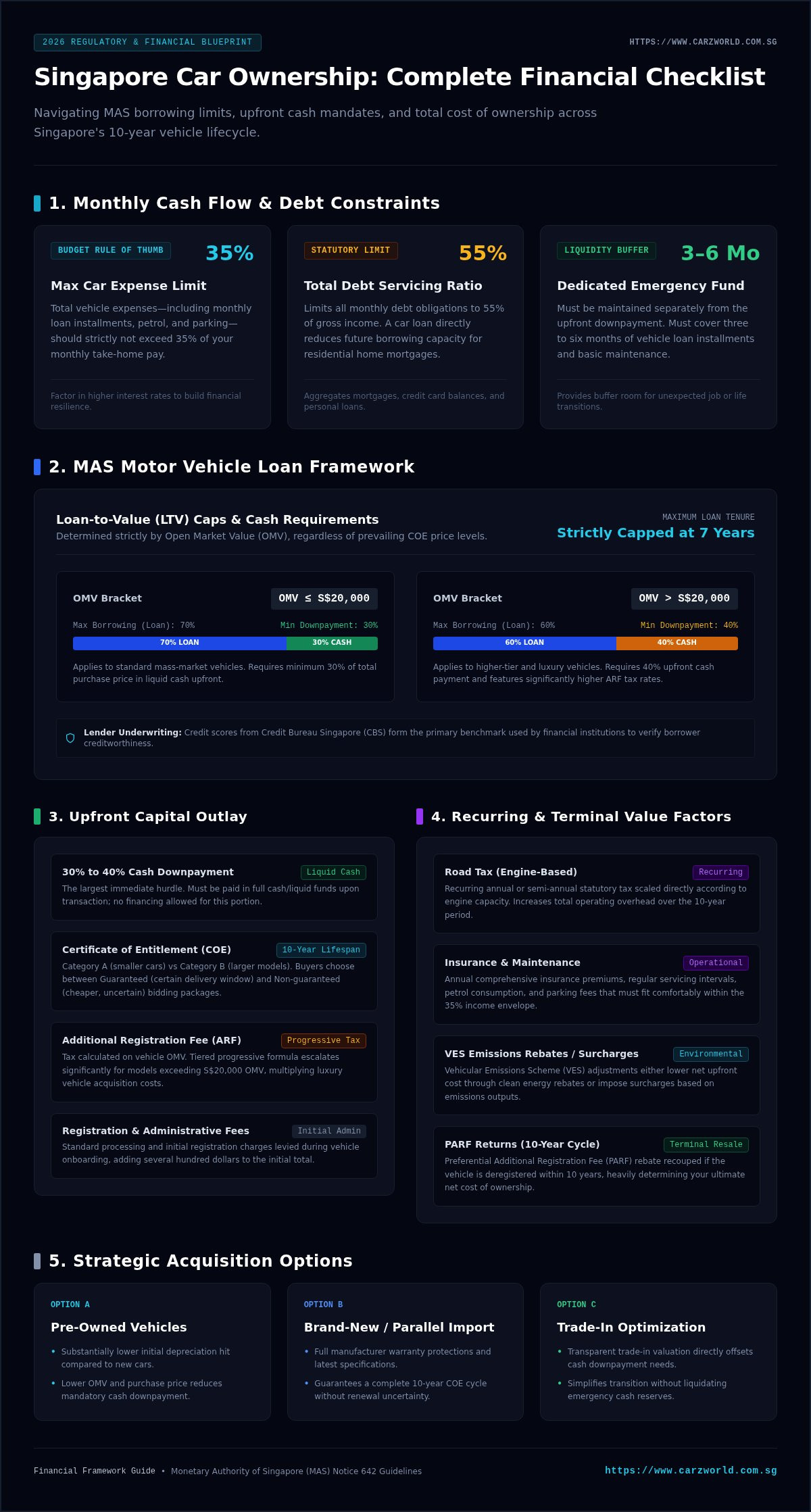
Owning a vehicle in Singapore is a significant long-term commitment. Before you step into a showroom, your first step is a thorough audit of your monthly cash flow. This assessment is the cornerstone of any reliable financial checklist before buying a car singapore. A practical rule of thumb is the 35% limit. Your total car-related expenses, including installments, petrol, and parking, shouldn't exceed 35% of your monthly take-home pay. Since interest rates can fluctuate in the 2026 financial climate, building your budget on a slightly higher rate ensures your finances remain resilient.
The MAS Loan Framework for 2026
The Monetary Authority of Singapore (MAS) maintains strict loan-to-value (LTV) limits to ensure financial stability. If the car's Open Market Value (OMV) is S$20,000 or less, you can borrow up to 70% of the purchase price. For vehicles with an OMV above S$20,000, the borrowing cap drops to 60%. These limits apply regardless of the Certificate of Entitlement (COE) system prices at the time of purchase. Remember that the maximum loan tenure is strictly capped at 7 years. While shorter tenures mean higher monthly installments, they significantly reduce the total interest you'll pay over the life of the loan. Your credit score from the Credit Bureau Singapore (CBS) is the primary document lenders use to assess your reliability. Check your report early to resolve any discrepancies before applying.
Total Debt Servicing Ratio (TDSR) Considerations
A car loan isn't an isolated expense. It directly impacts your Total Debt Servicing Ratio (TDSR), which currently limits your total monthly debt obligations to 55% of your gross income. This calculation includes existing mortgages, credit card balances, and personal loans. Taking a large car loan today could reduce the amount you can borrow for a home mortgage in the future. It's wise to leave "buffer room" for life transitions or unexpected job changes. We recommend maintaining a dedicated car emergency fund separate from your 30% or 40% downpayment. This fund should cover at least three to six months of installments and basic maintenance. For those looking to optimize their cash flow, exploring high-quality pre-owned cars can often provide a more manageable entry point without sacrificing reliability or performance.
Navigating Upfront Costs: COE, Downpayment, and Taxes
The financial checklist before buying a car singapore starts with understanding that the sticker price is just the beginning. High upfront costs are a reality in our local market. You'll need substantial liquid cash before you can drive off the lot. Most buyers are surprised by the volume of taxes and fees required during the initial registration process. Preparing for these expenses early prevents unexpected hurdles during the transaction.
The most significant hurdle is the downpayment. According to MAS motor vehicle loan rules, you must provide at least 30% to 40% of the purchase price in cash. This requirement depends on the vehicle's Open Market Value (OMV). Beyond the downpayment, first-time buyers often overlook registration fees and administrative costs. These can add several hundred dollars to your initial bill. Luxury car buyers in 2026 should also account for higher tax tiers that apply to premium models.
COE Bidding Strategies for 2026
The Certificate of Entitlement (COE) is the most volatile part of your budget. Category A is for smaller cars, while Category B covers larger models. You'll see "Guaranteed" and "Non-guaranteed" COE packages. A guaranteed package ensures you get a COE within a specific timeframe. Non-guaranteed packages are cheaper but less certain. Tracking monthly trends helps you time your purchase. Since a COE lasts 10 years, plan for the eventual choice of renewing the certificate or scrapping the car.
The ARF and OMV Relationship
The Additional Registration Fee (ARF) is a tax based on the car's OMV. It's a progressive system. For cars with an OMV above S$20,000, the ARF rate increases significantly. This makes luxury vehicles much more expensive. If the upfront cash requirement feels overwhelming, consider using Carz World’s trade-in services. Trading in your vehicle provides a transparent valuation that can offset your next purchase. Our team at Carz World can guide you through these complex calculations to ensure a smooth transition.
Estimating the "Hidden" Recurring Costs of Ownership
The monthly loan installment is only one part of the total ownership equation. A truly effective financial checklist before buying a car singapore must account for the secondary costs that keep your vehicle on the road. These recurring expenses often surprise new owners who only planned for the downpayment and the monthly bank repayment. From annual statutory requirements to daily operational fees, these "hidden" costs can add thousands of dollars to your yearly budget. You need to look at the 10-year horizon to understand if a specific model fits your lifestyle.
Insurance and Road Tax Nuances
In 2026, the LTA vehicle tax structure has evolved to ensure parity between electric vehicles (EVs) and internal combustion engine (ICE) cars. This means EV owners now face road tax calculations that align more closely with traditional engine capacity-based models. When selecting insurance, you'll choose between "Any Workshop" and "Authorized Workshop" policies. Choosing an authorized workshop policy often lowers your premium, but it limits your repair options. Maintaining a high No Claims Discount (NCD) is essential. A 50% NCD can slash your annual premium significantly, making it one of the most effective ways to manage your recurring budget.
Parking, Petrol, and ERP 2.0
Operational costs vary based on your lifestyle and housing. HDB season parking is relatively predictable, but commercial parking in the CBD can quickly drain your wallet. The full implementation of ERP 2.0 in 2026 introduced satellite-based pricing. This system tracks your distance and time spent on congested roads, which directly impacts high-mileage drivers. You should also compare energy costs. While charging an EV remains generally cheaper than pumping petrol, the gap has narrowed due to rising electricity tariffs. Don't forget to budget for major maintenance milestones at 30,000, 60,000, and 100,000 km. These visits often involve replacing wear-and-tear parts that aren't covered by basic servicing packages. If you're concerned about these long-term costs, exploring car rental options can provide a fixed-cost alternative where maintenance and insurance are handled for you.
Understanding VES Rebates and Future Resale Value
A car in Singapore is often viewed purely as a depreciating asset, but it actually holds a specific "floor" value that acts as a future financial cushion. Including a projection of your vehicle's end-of-life value is a vital part of any financial checklist before buying a car singapore. While you pay a high price upfront, the government's rebate systems ensure you get a portion of your money back when the vehicle is de-registered. Understanding these incentives helps you calculate the net cost of ownership rather than just the purchase price.
Depreciation is the largest cost for any car owner. In the Singapore market, certain brands hold their value better due to high demand in the resale market and perceived reliability. When you calculate your 10-year roadmap, consider the historical resale performance of Japanese versus Korean or continental models. A car with a lower initial price might actually cost more over ten years if its annual depreciation is significantly higher than a premium alternative.
Maximizing the VES Benefit
The Vehicular Emissions Scheme (VES) plays a massive role in your bottom line. In 2026, the scheme continues to reward owners of cleaner vehicles with significant rebates. Models in Band A1 and A2 receive rebates that are offset against the Additional Registration Fee (ARF). Conversely, vehicles in Band C1 or C2 incur surcharges that increase your upfront cash requirement. Choosing a "sweet spot" model in the A1 or A2 categories can save you thousands of dollars immediately. These savings aren't just one-off; cleaner vehicles often enjoy better fuel economy, which lowers your recurring operational costs over time.
The PARF/COE Cash-Back System
The Preferential Additional Registration Fee (PARF) rebate is your guaranteed "money back" at the end of the 10-year cycle. If you scrap your car at the 10-year mark without renewing the COE, you're entitled to a PARF rebate, typically 50% of the ARF paid. This "Paper Value" should be treated as a future asset in your financial plan. If you decide to de-register your car earlier, you also receive a pro-rated COE rebate for the remaining unused period. This system provides a safety net if your financial situation changes and you need to exit car ownership early.
To find the best balance between OMV and ARF, it's worth consulting experts on brand new parallel imports. These models often offer competitive pricing and tax structures that maximize your future PARF value. Understanding these nuances ensures you don't just buy a car, but manage a long-term investment. If you're ready to see how these rebates impact your next purchase, view our latest inventory at Carz World and let our consultants handle the complex math for you.
Strategic Choices: New vs. Pre-Owned vs. Rental
The final decision in your financial checklist before buying a car singapore involves choosing the ownership model that best aligns with your long-term goals. Brand new cars appeal to those who value the latest technology and the security of a full manufacturer warranty. These vehicles offer the highest reliability but also come with the steepest initial depreciation. For many buyers, the high upfront cost of a new car requires a larger cash commitment under MAS loan rules, making the initial financial hurdle quite high.
A smart transition strategy involves leveraging your current vehicle's value. Trading in your car allows you to use the realized equity to offset the upfront costs of your next purchase. This simplifies the logistics of switching cars while maximizing your available cash for the downpayment. Our team provides transparent valuations to ensure you get a fair price that reflects current market conditions.
The Financial Logic of Pre-Owned Vehicles
Many experts consider a three-year-old vehicle to be the "value peak" in Singapore. By this age, the car has already undergone its most aggressive depreciation phase, yet it remains modern enough to offer reliable performance. When exploring used car collections, you'll notice that the entry price is significantly lower than new equivalents. This lower price point means a smaller loan and reduced monthly installments. You must account for the fact that interest rates for used car loans are typically higher than those for new car financing. Always insist on a certified inspection. This step is crucial to avoid financial traps related to hidden mechanical issues.
Leasing as a Financial Alternative
Ownership isn't the only path to mobility. Long-term rental car options offer a predictable monthly fee that appeals to expats, businesses, or low-mileage users. With a rental, your monthly payment covers insurance, road tax, and maintenance. This eliminates the risk of unexpected repair bills or market volatility in COE prices. It's a "no-strings-attached" way to manage your transport budget without a long-term debt commitment.
To conclude your 2026 car buying journey, keep this 10-point recap in mind:
- Check your CBS credit score early.
- Calculate your TDSR including all existing debts.
- Verify your LTV limit based on the car's OMV.
- Budget 30% to 40% in liquid cash for the downpayment.
- Compare Category A vs Category B COE trends.
- Factor in the tiered ARF tax structures.
- Estimate annual road tax and insurance premiums.
- Account for ERP 2.0 and seasonal parking costs.
- Project your future PARF and COE rebates.
- Choose the ownership model that fits your 10-year roadmap.
Securing Your Automotive Future with Confidence
Securing a vehicle in Singapore is a long-term financial journey that rewards those who plan with precision. By following a detailed financial checklist before buying a car singapore, you ensure your monthly cash flow remains healthy while accounting for the complex web of COE, ARF, and recurring operational costs. Car ownership isn't just about the initial downpayment. It's about managing a decade-long investment that includes "paper value" assets like PARF rebates.
At Carz World, we've been trusted by thousands of Singaporean drivers for over a decade to simplify this process. We provide a one-stop shop for financing, insurance, and trade-ins, all delivered with transparent pricing and no hidden admin fees. Whether you're eyeing a brand-new parallel import or a high-quality pre-owned model, our expert team is here to handle the logistics so you don't have to.
Browse our latest inventory of certified pre-owned cars and get a financial consultation today! You've done the research; now it's time to take the driver's seat with a partner you can rely on.
Frequently Asked Questions
How much downpayment do I need for a car in Singapore in 2026?
In 2026, you generally need a downpayment of 30% or 40% in liquid cash. This percentage depends on the Open Market Value (OMV) of the vehicle. For cars with an OMV of S$20,000 or less, you must pay 30% upfront. If the OMV exceeds S$20,000, the requirement increases to 40%. This is a critical step in your financial checklist before buying a car singapore to ensure you have sufficient liquidity.
What is the difference between PARF and COE rebates?
PARF and COE rebates are two distinct types of "paper value" you receive upon de-registration. The Preferential Additional Registration Fee (PARF) rebate is a percentage of the ARF you paid during registration. It only applies if the car is less than 10 years old. In contrast, the COE rebate is a pro-rated refund of the quota premium for the remaining time left on your 10-year certificate.
Can I use my CPF to pay for a car loan in Singapore?
No, you cannot use your Central Provident Fund (CPF) savings to pay for a car loan or any related automotive expenses. CPF funds are strictly reserved for retirement, healthcare, and approved housing purchases. All costs associated with vehicle ownership, including the downpayment and monthly installments, must be settled using cash or private financing. It's essential to plan your liquid assets accordingly before committing to any purchase.
Is it cheaper to buy a used car or a new car when COE is high?
Buying a pre-owned vehicle is often more cost-effective when COE prices are at record highs. Used cars have already absorbed the initial steep depreciation hit that occurs in the first few years. Additionally, some older models might have been registered when COE premiums were lower, resulting in a more manageable "paper value." This choice helps lower your total debt commitment while still providing reliable mobility.
What are the latest VES tiers for 2026?
The 2026 Vehicular Emissions Scheme (VES) uses five distinct tiers based on environmental impact. Tiers A1 and A2 offer significant rebates that offset your Additional Registration Fee (ARF). Tier B remains neutral with no financial incentive or penalty. Tiers C1 and C2 carry surcharges that increase your upfront costs. Checking the specific VES band for your chosen model is a vital part of your financial checklist before buying a car singapore.
How does the TDSR affect my car loan eligibility?
Your Total Debt Servicing Ratio (TDSR) currently limits your total monthly debt repayments to 55% of your gross monthly income. This includes your car loan, home mortgage, and any personal credit lines. If your existing debt obligations are already high, you might be offered a smaller car loan than expected. Lenders use this calculation to ensure you don't overextend your finances and can comfortably manage all your monthly repayments.
What happens to my finances if I sell my car before the 10-year COE expires?
If you sell your car before the 10-year mark, your financial return depends on the current market value and the vehicle's "paper value." You'll receive a pro-rated rebate for the unused portion of your COE. Additionally, if the vehicle is de-registered, you're entitled to the PARF rebate based on the ARF paid. These amounts can be used to settle your outstanding loan or serve as a downpayment for your next vehicle.
Are there specific tax benefits for buying an electric vehicle in 2026?
Electric vehicle (EV) buyers in 2026 can benefit from the EV Early Adoption Incentive (EEAI) and significant VES rebates. These incentives are designed to lower the Additional Registration Fee (ARF), making EVs more price-competitive with traditional cars. While road tax structures have evolved toward parity with combustion engines, the upfront tax savings and lower daily charging costs still provide a compelling financial argument for many Singaporean drivers today.
Disclaimer
This content is provided for general informational purposes only. Readers are encouraged to independently verify important information.
In Same Category
- Financial Checklist Before Buying a Car in Singapore: 2026 Expert Guide
- Calculating the Real 5-Year Cost of Car Ownership in Singapore (2026 Guide)
- 2026 Guide: Planning for a Second Family Car in Singapore
- Used Cars for Sale in Tampines: 2026 Buyer's Guide
- Car Downpayment vs Monthly Instalment in Singapore: The 2026 Budgeting Guide