Luxury pre-owned cars Toa Payoh: Compare listings, mileage and prices
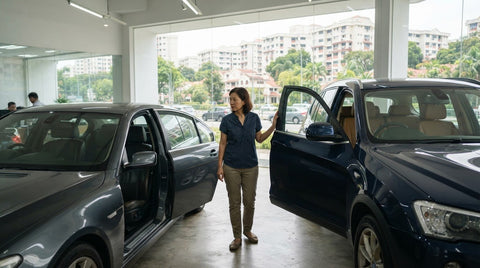
The lowest asking price isn’t always the best value. When comparing luxury pre-owned cars in Toa Payoh, consider each listing’s mileage, ownership history, transmission, fuel type and price together. These details help you see how vehicles differ and narrow your choices around what matters to you.
Price matters, but a car’s age, mileage and ownership history also affect how well it may suit your needs. This guide explains how to compare those details across listings and build an informed shortlist. You’ll also learn how transmission and fuel type relate to your driving preferences, and what to consider when assessing asking prices in Singapore. A clear comparison helps you identify which luxury pre-owned cars in Toa Payoh deserve a closer look.
Key Takeaways
- Compare complete listings rather than judging a car by its asking price alone.
- Use mileage alongside a car’s age and condition to assess how well it may suit your needs.
- Read the number of previous owners as one part of the vehicle’s history, not as a standalone verdict.
- Match transmission and fuel type to your driving preferences and everyday use.
- Compare asking prices across different models and years to understand what may be shaping the difference.
1. Luxury-car listings
When comparing luxury pre-owned cars in Toa Payoh, review listings from dealerships in the area and nearby estates. Look for the make, model, registration year, mileage, ownership history, transmission, fuel type and asking price. Use those details to shortlist comparable cars rather than relying on the model name alone.
Singapore listings have included a Tesla Model 3 Performance, Mercedes-Benz E350 A, Mercedes-Benz C 180, Audi A5 Sportback, BMW 216i GC Sport, and Porsche Taycan II 4+1. These examples show how widely luxury listings can differ. A model’s presence in Singapore listings doesn’t mean it’s currently available from a Toa Payoh dealer.
Which dealers sell luxury pre-owned cars in or near Toa Payoh? Start with used-car dealerships in Toa Payoh and nearby neighbourhoods, then compare their current listings. Check the location and vehicle details for each listing, as a dealership’s wider inventory may include cars displayed elsewhere.
What makes and models are available? Singapore listings have included Mercedes-Benz, BMW, Audi, Tesla, Porsche and Jaguar models. Options range from executive sedans to electric and sportier cars, but the selection changes as cars sell and new listings appear.
Look beyond the headline. Compare registration year and mileage, then review details about previous owners, transmission and fuel type. Two Mercedes-Benz listings, for example, may be different models or years, so the brand name alone doesn’t make them comparable.
Do dealers offer warranties, servicing or financing? These are separate terms, not features to assume from a used-car listing. A warranty describes stated coverage, servicing concerns vehicle care, and financing relates to payment arrangements. Read each term in context before comparing offers.
Parallel-imported luxury cars may differ from models supplied through official distribution, including in equipment specifications and warranty arrangements. Consider how those differences affect your preferences and where support is available. Compare the stated specification, service records and warranty terms rather than assuming the badge means the cars have identical features.
To arrange a test drive and inspection, choose a specific listing and contact the dealer to set an appointment. Confirm which car you’ll view, bring your driving licence and plan a route that reflects ordinary driving conditions. During the viewing, compare the car with its listing and review its documents before deciding.
Older luxury cars may need more maintenance because age and wear accumulate. Consider the asking price alongside mileage, ownership history and the car’s recorded condition. A clear listing gives you a stronger basis for deciding which vehicles merit a closer look.
Compare used-car dealerships in Toa Payoh and nearby neighbourhoods. Check each listing’s location, as a dealership’s inventory may be displayed elsewhere.
2. Mileage
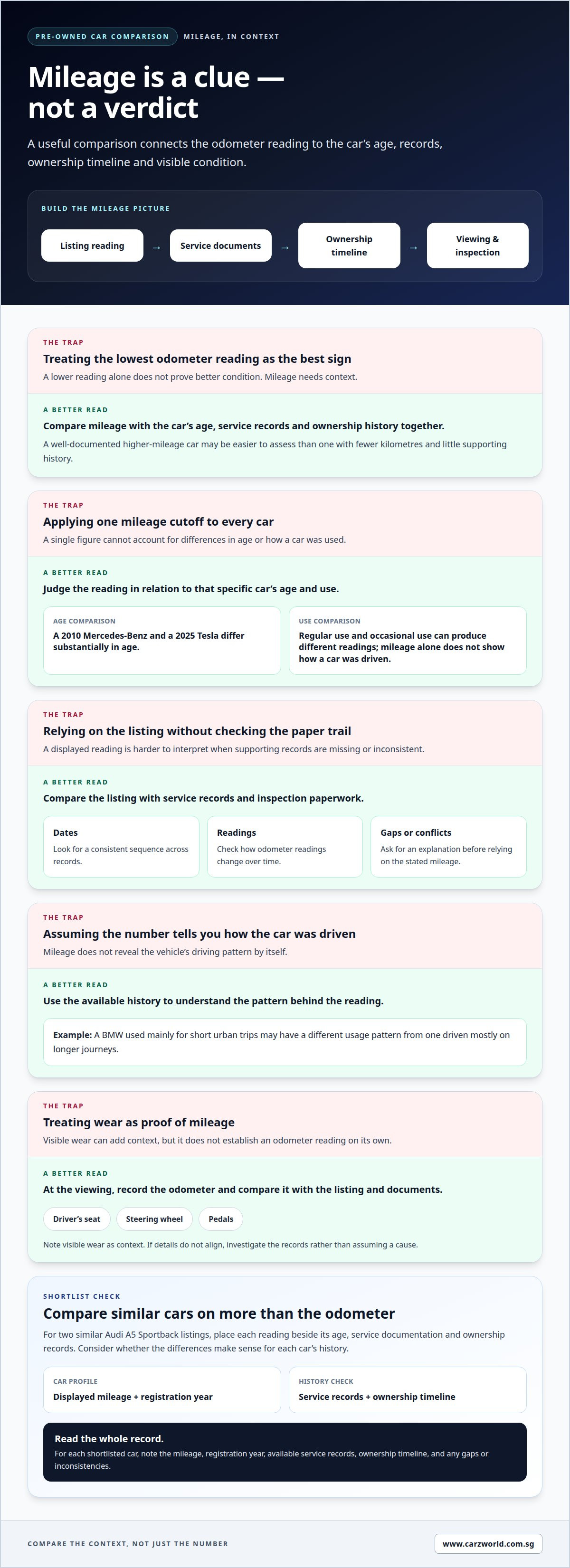
Compare the odometer reading with the car’s age, service records, and ownership history together. A lower reading alone doesn’t prove better condition, while a higher reading needs context. For example, a 2010 Mercedes-Benz and a 2025 Tesla differ substantially in age, so mileage should be considered alongside each car’s use and records.
Start with the mileage shown in the listing, then compare it with readings in service documents and inspection paperwork. Look for a consistent sequence of dates and readings. If a service record conflicts with the current odometer, ask for an explanation before relying on the stated mileage.
Assess mileage in relation to the vehicle’s age instead of applying a universal cutoff. A car driven regularly may have a higher reading than one used occasionally, but mileage alone doesn’t show how either car was driven. A BMW used mainly for short urban trips, for example, may have a different usage pattern from one driven mostly on longer journeys.
Service history helps put mileage into context. Check whether records include dates, readings and completed work. Missing periods make it harder to understand how the odometer changed over time. Records that align with the displayed mileage provide a clearer timeline, but they don’t replace an assessment of the car’s current condition.
Ownership changes can also help explain shifts in mileage patterns. A Mercedes-Benz that changed hands, for example, may have been used differently by each owner. Compare ownership dates with available service entries and mileage records. A consistent timeline is easier to interpret than unexplained gaps or sudden changes.
At the viewing, record the odometer reading and compare it with the listing and documents. Note visible wear on the driver’s seat, steering wheel and pedals. These details provide context but don’t establish mileage on their own. Treat inconsistencies as reasons to investigate the records, not as proof of a particular cause.
For two similar Audi A5 Sportback listings, compare their mileage alongside age, service documentation, and ownership records. Then consider whether the differences make sense for each car’s history. Don’t rank them by the odometer alone. A well-documented higher-mileage car may be easier to assess than one with fewer kilometres and little supporting history.
For each shortlisted car, note the displayed mileage, registration year, available service records, ownership timeline and any gaps or inconsistencies. This makes differences easier to spot across listings. When comparing luxury pre-owned cars in Toa Payoh, focus on what the mileage means for that specific car, rather than simply seeking the lowest figure.
3. Number of previous owners
In Singapore, compare the stated owner count with the car’s registration documents and available ownership records. Check service invoices and inspection findings for matching dates and registration details. To review accident history, look for repair records and signs of repaired damage during the vehicle inspection.
Owner count provides context, not a verdict. A Mercedes-Benz with fewer previous owners may have a simpler ownership timeline, but the count alone doesn’t reveal how it was driven or maintained. A BMW with several recorded owners may still have consistent service documents that explain its history.
Record the owner count shown in each listing, then compare it with the available documents for that car. If the listing and paperwork differ, ask why and review the vehicle’s records before deciding. A clear explanation can help you understand whether the difference reflects an update or an incomplete listing.
Build a timeline from ownership periods, service invoices and recorded mileage. Check that the dates make sense together. For example, a service invoice should relate to the vehicle during the ownership period it describes. Gaps don’t prove a problem, but they leave less evidence for assessing how the car was used.
Review accident history separately. Look for repair invoices, details of panel or paint work, and inspection observations. During a viewing, check whether the body panels appear aligned and the paint finish is consistent across the car. These observations can guide your questions, but a visual check alone can’t establish the full repair history.
Service records provide detail that an owner count cannot. Review invoices for dates, mileage and work performed, and check that the vehicle details match the car you’re considering. A sequence of records can explain how maintenance was handled across ownership changes; unrelated documents may be harder to interpret.
Ask specific questions about gaps. If a Mercedes-Benz has a long interval between available service invoices, for example, ask what records cover that period. If paperwork describes accident repairs, compare it with the car’s current condition and inspection findings. Keep your assessment grounded in documents and observable details.
For each shortlisted car, note the stated owner count, available ownership documents, service history, accident-related records and any unresolved differences. This makes the evidence easier to compare without treating a lower owner count as proof of a better car. Documented history lets you assess more than the listing summary.
4. Transmission and fuel type
Transmission and fuel type affect how a car fits your daily routine. Compare the exact details shown for each listing, then consider how you drive around Toa Payoh. A Mercedes-Benz sedan and a Tesla Model 3 may suit different preferences, so compare their stated specifications rather than assuming every luxury car offers the same setup.
Start with the transmission listed for the car, such as automatic or manual. When comparing two vehicles, note each transmission alongside its model and year. Consider how comfortable you are with the controls, particularly in stop-start traffic or on a longer drive. A test drive can show how the car feels in everyday conditions.
During the drive, notice how the transmission behaves as you move off, slow down and accelerate. In an automatic, observe whether gear changes feel smooth and predictable. In a manual, consider whether you’re comfortable using the clutch and changing gears. These observations help you assess personal fit, but don’t establish the car’s mechanical condition.
Next, compare the fuel type recorded in each listing. Common categories include petrol, diesel, hybrid, and electric. Don’t infer fuel type from the badge or body style. Read the vehicle’s details directly. For example, a listing for a Tesla Model 3 can be compared with a petrol-powered executive sedan only after you understand the stated fuel information for both.
Consider your usual journeys before choosing. Someone who regularly travels across Singapore may weigh refuelling or charging routines differently from someone making shorter local trips. Think about where and how you normally refuel or charge, and whether that routine suits the car. Your actual driving pattern matters more than a general preference for one category.
For each shortlisted car, note the make and model, transmission, fuel type and intended use. Add what you liked during the drive. For example, record whether an automatic felt easy to handle in traffic or whether an electric car’s charging routine suits your plans.
Fuel types aren’t interchangeable labels: each describes a different way the car is powered, with different practical considerations. Match the stated fuel type to your driving habits and, where possible, compare cars within the same category. When comparing different categories, focus on how each fits your routine.
Before deciding, revisit the listing and confirm that its transmission and fuel descriptions match the vehicle you drove. For luxury pre-owned cars in Toa Payoh, this keeps your comparison focused on the specific car, not just its model name. Combine those details with your test-drive observations to create a shortlist that reflects how you’ll use the vehicle.
5. Used-car prices
Asking prices for luxury cars in Singapore vary by model, registration year and remaining COE. These are individual asking prices, not a market average or a quote for another car.
First compare cars with similar model years and specifications. The prices aren’t directly comparable if the vehicles differ in model, age, condition, mileage or COE position.
The examples show why a badge alone doesn’t explain a price. Compare registration years and vehicle details, then review the stated condition and history in each listing.
COE and PARF also affect how buyers assess a car’s value. To calculate annual depreciation, subtract the PARF rebate from the purchase price, then divide the result by the years of COE remaining. The remaining COE period is part of the calculation, while the PARF rebate changes the starting amount.
What fees and taxes apply when buying a pre-owned luxury car in Singapore? Separate the agreed vehicle price from any applicable charges and taxes shown in the transaction documents. Review the itemised terms to understand the total payable rather than assuming the listing price covers everything.
For each listing, note the asking price, registration year, remaining COE and PARF rebate information, then compare cars with similar details. A lower asking price may reflect a different age or COE position, so it doesn’t establish better value on its own.
Use the figures as comparison points, not promises of current availability. Listings change, and a different car’s price depends on its own details. To review current pre-owned car listings, compare the vehicle information against your shortlist and budget.
Other Singapore listings show further variation by model and registration year.
These asking prices are examples, not proof that one make or model is consistently cheaper. Before deciding whether a listing suits your budget, consider the car’s condition, mileage, equipment, service history and remaining COE alongside its registration year. Confirm the stated price and transaction terms with the seller, and compare vehicles with similar specifications. This gives you a more useful basis for assessing value than comparing badges or prices alone.
Carz World Pte Ltd: Pre-Owned Cars
Carz World Pte Ltd offers pre-owned cars for buyers comparing listings, mileage, ownership history and price factors. Its listings give shoppers narrowing their choices, including those comparing luxury models with other vehicles, a practical next step.
Use the criteria in this guide to assess each listing on its own details. Compare the model, stated mileage, previous-owner information, transmission, fuel type and asking price before deciding which cars suit your needs. If you’re also considering a new vehicle or another way to access a car, Carz World Pte Ltd offers brand new cars and car rental.
Visit Carz World Pte Ltd online to explore its pre-owned cars.
Make your shortlist work for you
Choosing luxury pre-owned cars in Toa Payoh is about finding a vehicle that fits your priorities, not simply picking the most impressive listing. Before taking the next step, decide which trade-offs you’re comfortable with. One buyer may value a particular driving feel, while another may prioritise a car suited to daily routines. Your shortlist is more useful when it reflects how you’ll use the car, rather than what looks appealing online.
Consider how the vehicle will fit your plans over time. Think about who will drive it, where you’ll usually use it and which features matter most. These preferences can help distinguish options that seem similar at first glance. Keep your preferred choices together and note any questions that still affect your decision.
A focused shortlist gives you a practical starting point for your next conversation. It also helps keep the decision centred on your needs instead of pressure to choose quickly. If you’re ready to discuss your options, contact Carz World Pte Ltd today. Take the next step at your own pace, with a clear sense of what matters to you.
Frequently Asked Questions
What are the prices of luxury pre-owned cars in Toa Payoh?
Prices for luxury pre-owned cars in Toa Payoh vary by vehicle, so there’s no single standard figure. Set your budget around the model and variant you want, then consider the car’s condition and costs beyond its asking price. Compare listings with similar registration years and specifications rather than judging two cars by their badges alone. Advertised prices can change as listings are updated.
How do prices compare with other Singapore areas?
Compare luxury pre-owned cars in Toa Payoh with closely matched listings elsewhere in Singapore. Use the same make, model, variant, registration year and COE position as comparison points, then note each seller’s location. A listing in another district may differ because of its specifications or history, not location alone. Matching vehicle details makes an area-by-area comparison more useful.
Which dealers sell luxury pre-owned cars in or near Toa Payoh, Singapore?
Start with used-car dealerships in Toa Payoh and nearby neighbourhoods, then compare current listings. Check each listing’s location, as a dealership’s inventory may include cars displayed elsewhere.
Disclaimer
This content is provided for general informational purposes only. Readers are encouraged to independently verify important information.
In Same Category
- COE Rebate for Early Deregistration: How Much Can You Get Back
- Pre-owned cars with memory seats in Singapore: asking prices
- How to Check If You Can Use CPF to Pay for COE Renewal
- Luxury pre-owned cars Toa Payoh: Compare listings, mileage and prices
- Is a Car an Asset or a Liability in Singapore? How It Affects Your Net Worth