Car Loan Hidden Fees: Which Application and Setup Charges Are Reasonable

A low monthly instalment can disguise a more expensive car loan. To spot hidden fees in a car loan agreement, compare the full borrowing cost, including interest, application or arrangement charges, and any other fees, rather than judging the deal by its monthly payment alone. APR reflects the yearly cost of borrowing, including interest and lender fees.
It’s reasonable to want a clear answer about whether an application or setup fee is fair. The label matters less than what the fee covers, whether it’s disclosed, and how it changes the total you’ll repay.
This guide explains how APR, application and arrangement fees, agreement terms, and common add-ons can affect the cost of a car loan in Singapore. Learn what to look for before signing, which charges deserve closer scrutiny, and how to compare the overall cost of different offers.
Key Takeaways
- Compare the total amount repayable, not just the monthly instalment, to see how interest and recurring charges affect the loan’s overall cost.
- Assess application and arrangement fees by checking what each charge covers, when it is payable, and whether it is included in the loan or billed separately.
- Read the agreement for early-settlement charges, payment fees, and any costs that apply at the end of the loan.
- Separate optional add-ons from the loan itself so you can understand what you are paying for and decide whether you want them.
- Before signing, compare the written fee breakdown and loan terms with the headline rate to identify charges that could change the deal.
1. What are car loan hidden fees?
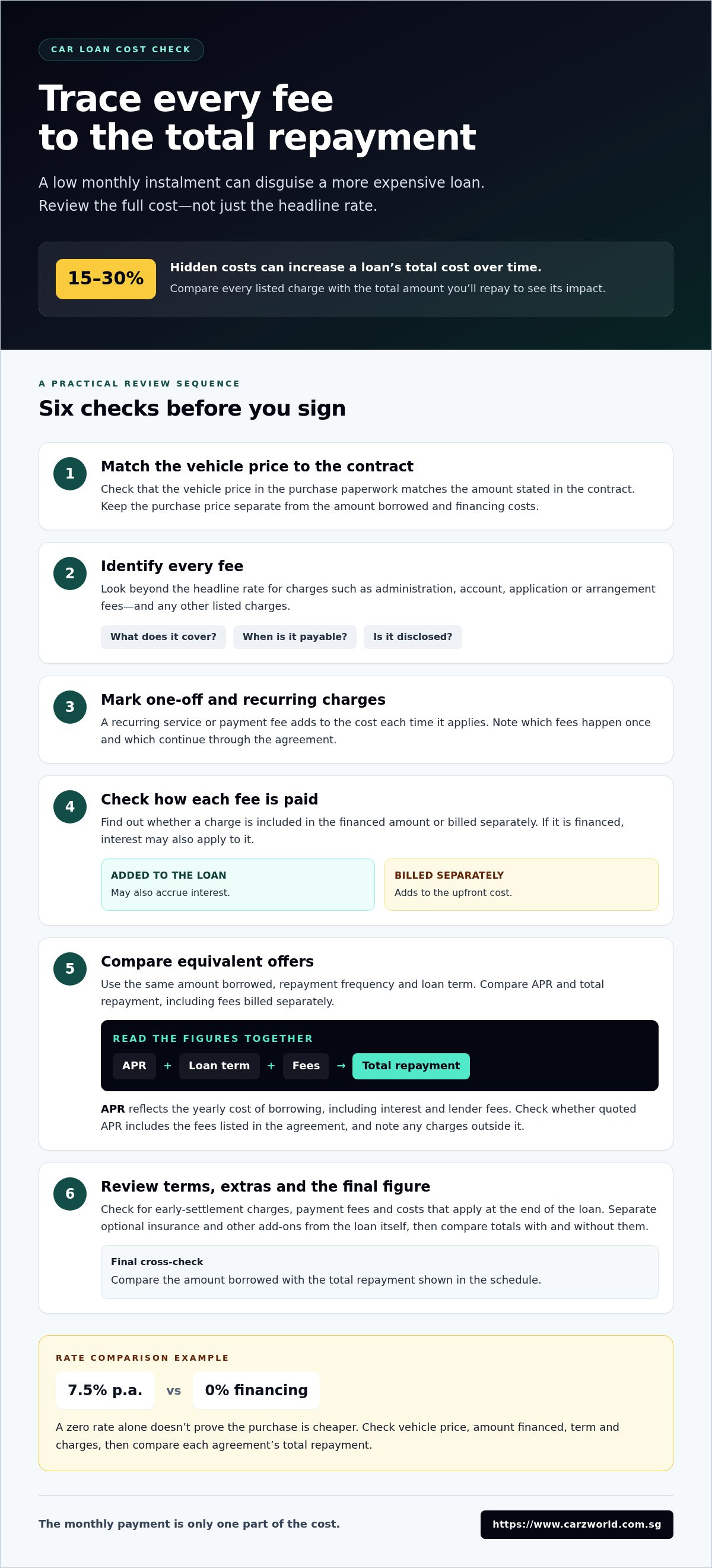
Hidden fees are charges that sit beyond a car’s advertised price or headline interest rate. They may appear in the loan, payment schedule, or purchase paperwork under labels such as administration, account, or optional add-on fees. Their impact adds up: hidden costs can increase a loan’s total cost by 15–30% over time. To spot them, compare every listed charge with the total amount you’ll repay.
APR gives a broader view than the interest rate alone. It reflects the yearly cost of borrowing, including interest and lender fees. A lower interest rate may still mean a higher overall cost if fees are added to the loan or charged separately. Check the APR, loan term, amount financed, and total repayment together, rather than treating any single figure as the full price.
For a practical overview of how charges can be bundled into auto financing, watch this video:
A small recurring charge matters because it applies with each payment. For example, a monthly service fee adds to the total paid over the agreement, even if it looks minor beside the instalment. Ask whether each fee is one-off or recurring, and whether it’s included in the financed amount. If it is financed, interest may also apply to it.
Optional insurance and other add-ons can also raise borrowing costs. Check whether each product is optional, then compare the loan totals with and without it. Monthly instalments can hide the difference, especially when several charges are combined. Separate the vehicle purchase price from the amount borrowed and the extra costs attached to financing.
To compare a dealer-arranged car loan with a bank loan, use the same borrowing amount and repayment term for both. Compare each offer’s total repayment, including interest and fees, and account for any charges billed separately. Transparent dealerships such as Tom Whiteside Chrysler Dodge Jeep Ram emphasize the importance of reviewing the complete finance breakdown before committing. The lower monthly payment isn’t necessarily the cheaper option if its term is longer or its fees are higher.
Before paying or signing, follow a simple review sequence: match the vehicle price to the contract, identify every fee, mark recurring charges, and compare the total repayment with the amount borrowed. This makes it easier to see which charges change the loan’s cost and ask clear questions about any line that affects the final figure.
That’s how to spot hidden fees in a car loan agreement: read beyond the headline rate and trace each charge through to the total repayment. APR, payment frequency, loan length, and optional extras all shape what paying for the car will actually cost.
2. APR and loan interest
In Singapore, don’t treat one advertised interest rate as a universal benchmark or financing limit. A car loan’s rate depends on the lender, the borrower’s credit profile, and the loan term. Compare the written offer’s rate and repayment obligations together. The agreement should make clear how much is financed, how interest is charged, and what the borrower must repay.
APR helps compare borrowing costs because it reflects the yearly cost of finance, including interest and lender fees. The stated interest rate, by contrast, is the rate used to calculate interest. A lower rate may not mean a cheaper loan if additional charges raise the overall cost. Check whether the quoted APR includes the fees listed in the agreement, then review any separate charges outside it.
Use the same inputs when comparing offers. Match the amount borrowed, repayment frequency, and loan term, then compare APR and total repayment. A dealer-arranged offer and a bank offer aren’t directly comparable if one includes fees or uses a different term. Write down each figure separately so a lower monthly payment doesn’t distract from a higher overall borrowing cost.
A longer term can reduce each payment while increasing the total interest paid. Interest is paid over more time, even if the annual rate stays unchanged. A shorter term can reduce interest over the loan’s life, but raises the regular payment. Choose a term based on the total cost and an instalment that fits your budget.
For example, compare a 7.5% per annum loan with a 0% financing offer only after checking the vehicle price, amount financed, term, and charges. A zero rate alone doesn’t prove the purchase is cheaper. If the offers differ in price or fees, calculate each agreement’s total repayment before deciding. Don’t compare promotional rates in isolation.
The offered rate can also vary with the borrower’s credit score, lender, and chosen term. Two people may receive different finance terms for a similar vehicle. To assess an offer, note the rate, whether it’s annual, any fees included in the calculation, and the payment schedule. Then compare equivalent offers from banks and dealership-arranged finance.
Knowing how to spot hidden fees in a car loan agreement means tracing each charge through the repayment schedule. A fee added to the amount financed may itself accrue interest, while a separately paid fee increases the upfront cost. Check the schedule for the amount borrowed, each instalment, and the final total. This also shows whether an attractive rate delivers savings once charges and term length are considered.
Use the same careful comparison to spot hidden fees in a car loan agreement across offers. List the annual rate, loan term, included lender fees, and separate charges side by side. This makes differences easier to identify and helps you judge the full cost of finance, not just the headline rate.
There is no single advertised interest rate to treat as a universal benchmark or financing limit. The rate offered depends on the lender, the borrower’s credit profile, and the loan term. Review the written agreement for the amount financed, how interest is charged, fees, and repayment obligations. Compare equivalent offers by APR and total repayment.
3. Administration and arrangement fees
Administration and arrangement fees are charges for setting up or managing car finance. The label alone doesn’t explain the service or show whether the charge is reasonable. For each fee, identify who receives it, what work it covers, when it’s payable, and whether it’s one-off or recurring. A clear breakdown should link each amount to a specific service in the agreement.
Start with the fee schedule and find every line labelled administration, processing, documentation, account, or arrangement. Match those lines against the loan quotation and repayment schedule. If a setup charge appears in both documents, check whether they describe one fee or separate services. Don’t assume different labels justify two separate charges.
Payment timing affects the cost. Some lenders add administration fees to monthly repayments, while others require separate payment. A fee rolled into the loan increases the financed balance, and interest may then apply to it. A separately paid fee adds to the upfront amount needed to buy the car. Compare both treatments using the total amount paid, not just the instalment.
Look closely at percentage-based charges. A percentage fee rises with the amount financed, even if the administrative work stays similar. A fixed fee doesn’t change with the loan balance. Ask how the lender calculates the charge, what figure the percentage applies to, and whether the amount is included in the repayment total.
Calculate recurring account fees separately. Multiply each monthly charge by the number of scheduled payments, then add the result to any one-off fees. For example, if an agreement lists a monthly account charge, count each occurrence across the full repayment schedule. This shows how a small regular amount can add up, or reach thousands when combined with interest and other charges.
Check for duplication between lender fees and dealer paperwork. A documentation line on a purchase contract may cover a different task from a finance arrangement fee, but the agreement should make that distinction clear. Compare the descriptions, payment recipient, and timing. If the same stated task appears twice, ask for an itemised explanation before signing.
Follow this review sequence: mark every setup and administration charge, classify it as upfront, financed, or recurring, then calculate its full repayment impact. Compare lenders using the same loan amount and term. Keep optional services separate from mandatory finance charges so you can see what each fee covers. This simple audit makes vague labels easier to question and shows which fees materially change the cost of borrowing.
4. Checking agreement terms before signing
Before signing, read the contract alongside the repayment schedule and written loan offer. Compare the vehicle price, amount financed, interest rate, instalments, and total repayment. Then scan every line containing a number, including fees and dates. A charge can be costly even when it sits outside the headline rate.
For a Singapore car loan, review the documents for the amount borrowed, interest calculation, repayment schedule, fees, and consequences of late payment, default, or early settlement. These details let you compare the offer’s full cost and obligations. Don’t rely on a verbal summary if a term or charge affects what you must pay.
Read the late-payment, default, and early-settlement clauses separately. The contract should explain what happens after a missed payment, how default is handled, and how an early-settlement amount is calculated. Some lenders charge late-payment fees, and an early-settlement fee may be fixed or based on the remaining amount payable. The wording and calculation in your agreement determine the cost.
Check the agreement for insurance and other optional products. Look for separate product names, premiums, service charges, and any amount added to the loan balance. Compare the total repayment with and without each product. If an add-on is included in the financed amount, it can increase both the amount borrowed and the interest charged.
Use this focused review before accepting the offer:
- Match the vehicle price and deposit against the contract.
- Identify each administration, setup, and recurring charge.
- Find the late-payment, default, and early-settlement terms.
- Separate optional insurance and add-ons from required loan costs.
- Compare the total repayment with the quoted monthly instalments.
Then read each end-of-agreement clause. If the loan includes a final payment, confirm its amount and due date. If the arrangement involves returning a vehicle, identify any mileage limit, condition standard, or return charge that applies. These terms can affect the real cost even when regular payments seem manageable.
Pay special attention to wording such as “may apply,” “at the lender’s discretion,” or “subject to charges.” Find the clause explaining when the charge is triggered and how it’s calculated. Note the page and line, then compare them with the fee schedule. You should understand a charge before signing, not discover it after a missed payment or early repayment.
For a final review, compare the contract with the offer you agreed to. Confirm that the loan amount, rate, term, repayment frequency, and named add-ons match. Ask for an explanation of any unclear number before signing. Keeping the written offer and signed contract together also helps you track the terms that govern each payment.
5. Common car-loan rip-offs
Questionable charges often hide behind labels that sound routine. Check application fees, dealer handling, vehicle preparation, and optional products separately. A useful warning sign is an application fee exceeding 5% of the loan amount. That threshold doesn’t prove wrongdoing, but it signals a charge that deserves close scrutiny before you agree to the loan.
Can dealers add loan referral, handling, or early-repayment fees to a car purchase? A dealer-arranged offer may include referral or handling charges, and the finance agreement may set an early-settlement fee. Check each charge’s purpose, amount, and calculation in the written terms before signing. Don’t assume a fee is part of the vehicle price.
Watch for dealer preparation or reconditioning fees that appear late in the purchase process. These may be presented as necessary vehicle costs, although the description might not specify the work covered. Customer-focused dealerships such as MyCar demonstrate how transparent vehicle pricing should work without unexpected charges. Compare any fee with the original written quote and ask whether it’s already included in another line, as a new charge added after you agree on the price changes the deal.
Bundled add-ons can also increase the loan balance without making the monthly payment look much higher. Finance products such as gap insurance or extended service contracts may be spread across 60- or 72-month loan terms. Review the agreement for product names and separate costs, then compare the repayment total with and without each add-on. Decide based on its terms, not a small-looking instalment increase.
Pay attention to early-settlement charges if you might repay the loan ahead of schedule. The fee may be a fixed amount or a percentage of the remaining amount payable. Find the settlement clause and how the lender calculates the fee. A charge that seems modest at signing can affect the difference between the original repayment plan and the amount needed to close the loan early.
Use this quick screening checklist before accepting a quote:
- Flag application fees above 5% of the loan amount.
- Compare every new handling or preparation charge with the written vehicle price.
- Identify optional products included in the financed balance.
- Read how early-settlement charges are calculated.
Be cautious if the seller focuses on the monthly payment while changing the loan term or adding products. Compare the vehicle price, amount financed, term, and total repayment as one package. A longer term can make a fee seem smaller per month while increasing what you pay overall. Ask for a revised written breakdown when a charge changes.
If you’re weighing vehicle options alongside financing, explore commercial vehicles and assess the purchase cost separately from loan charges. Keeping those figures distinct makes it easier to spot add-ons that alter the agreement.
Carz World Pte Ltd: Pre-Owned Cars
Carz World offers pre-owned cars for buyers comparing vehicle choices after reviewing loan costs. Consider the vehicle purchase separately from financing: compare the car’s price with the loan amount, repayment terms, and listed charges.
If you’re considering a pre-owned vehicle, browse pre-owned cars and apply the agreement checks in this guide when reviewing financing terms. Contact Carz World Pte Ltd to discuss your vehicle options.
Make Your Next Vehicle Decision With Clarity
Reviewing a loan is also a chance to pause and consider what kind of vehicle suits your plans. If you’re weighing ownership against short-term use, think about how long you need a vehicle and how a purchase fits your budget. Keeping that decision separate from financing makes it easier to assess each option on its own terms.
Carz World offers pre-owned cars, brand new cars, and car rental. If you’re considering your next vehicle, use what you’ve learned about how to spot hidden fees in a car loan agreement as you review your options and financing documents.
Contact Carz World Pte Ltd to discuss your vehicle options and take your next step with confidence.
Frequently Asked Questions
Application and Establishment Fees: What’s Reasonable?
A reasonable fee should have a clear purpose, amount, and payment timing in the written offer. No single fee amount suits every loan, so compare the lender’s description with the service provided and the effect on total repayment. Check whether it’s payable once, repeated, or added to the loan balance. If the label is unclear, ask what work it covers before agreeing.
What are car loan hidden fees?
Hidden car loan fees are financing-related charges that can be easy to miss when you focus only on the advertised rate or monthly payment. They may appear under unfamiliar descriptions or in sections of the agreement you haven’t compared with the quotation. Distinguish whether a charge is part of the loan, optional, or separate from financing. This helps you understand what you’re paying for.
What fees are commonly hidden in car loan agreements in Singapore?
Look for administration or setup charges, recurring account fees, payment-processing charges, late-payment fees, early-settlement charges, and optional insurance or other add-ons. Labels vary between agreements, so search for terms such as “service,” “processing,” and “settlement.” A fee may also appear outside the loan schedule on purchase paperwork. Compare both documents to catch charges that aren’t obvious in the instalment amount.
How do I calculate the total cost of a car loan in Singapore, including fees and interest?
Add the scheduled loan repayments and any loan fees paid separately to calculate the total paid under the financing arrangement. To calculate the full vehicle purchase outlay, also add the deposit and other purchase costs. Don’t count financed fees twice: they’re already reflected in the repayments. Use the agreement’s payment schedule, and check whether the total changes if an optional product is removed.
What processing, administrative, documentation, or disbursement fees can lenders charge?
A loan agreement may list processing, administration, documentation, or disbursement charges, but the label alone doesn’t explain the service. Read the fee description and note who receives it, when it’s due, and whether it’s financed or paid separately. Compare similar labels across the quotation and contract to spot possible duplication. The agreement’s wording determines which charges apply to your offer, so clarify unclear terms before accepting.
What questions should I ask the lender before signing a car loan agreement in Singapore?
Ask for the total repayment and a written breakdown of every charge. Find out which fees are one-off, recurring, optional, or included in the financed amount. Ask how late-payment and early-settlement charges are calculated, and whether payment methods carry fees. Also confirm the repayment dates and what happens after a missed instalment. Clear answers help you compare offers using the same loan amount and term.
What disclosures must banks and finance companies provide for car loans in Singapore?
The written offer and agreement should show the amount financed, how interest is charged, the fees, and the repayment obligations. Check the fee breakdown and repayment schedule, including any charges billed separately.
Disclaimer
This content is provided for general informational purposes only. Readers are encouraged to independently verify important information.
In Same Category
Related by Tags
- Car Loan Hidden Fees: Which Application and Setup Charges Are Reasonable
- What to Do If Your Car Loan Is Rejected and Find Options
- Understanding the MAS Car Loan Restrictions in Singapore (2026)
- Getting Car Finance as a Freelancer in Singapore: 2026 Guide
- Financial Checklist Before Buying a Car in Singapore: 2026 Expert Guide
- 2026 Guide: Planning for a Second Family Car in Singapore