How to Plan for Your 5-Year COE Renewal to End

A five-year COE renewal is not an open-ended extension. For Category A, B or D vehicles, it can be taken only once; when it ends, the vehicle must be deregistered, so another five-year renewal isn’t an option. The renewal costs 50% of the prevailing quota premium (PQP). That’s the key point in understanding what happens at the end of a 5-year COE renewal.
Plan ahead: COE expiry affects whether you can use the vehicle on the road and which options remain. You can renew a COE before it expires or within the one-month period after expiry, with a late renewal fee.
This guide explains how the five-year renewal cost is determined, what the grace period and late fees mean, and what happens when a COE expires. It also explains the different rules for Category C vehicles, so you can compare renewal options and plan for the end of the renewed term.
Key Takeaways
- Estimate a five-year renewal using 50% of the prevailing quota premium, then weigh its shorter term against a ten-year renewal.
- Plan your next move before a five-year renewal ends: for Category A, B or D vehicles, the vehicle must be deregistered at the end of that term.
- Mark your COE expiry date and understand the one-month late-renewal window, including the fee and restrictions that apply.
- Check your vehicle category and statutory lifespan, as these affect whether another renewal is possible.
- Compare renewing with replacing the vehicle so you can make a considered decision before the COE ends.
COE renewal costs and trade-offs
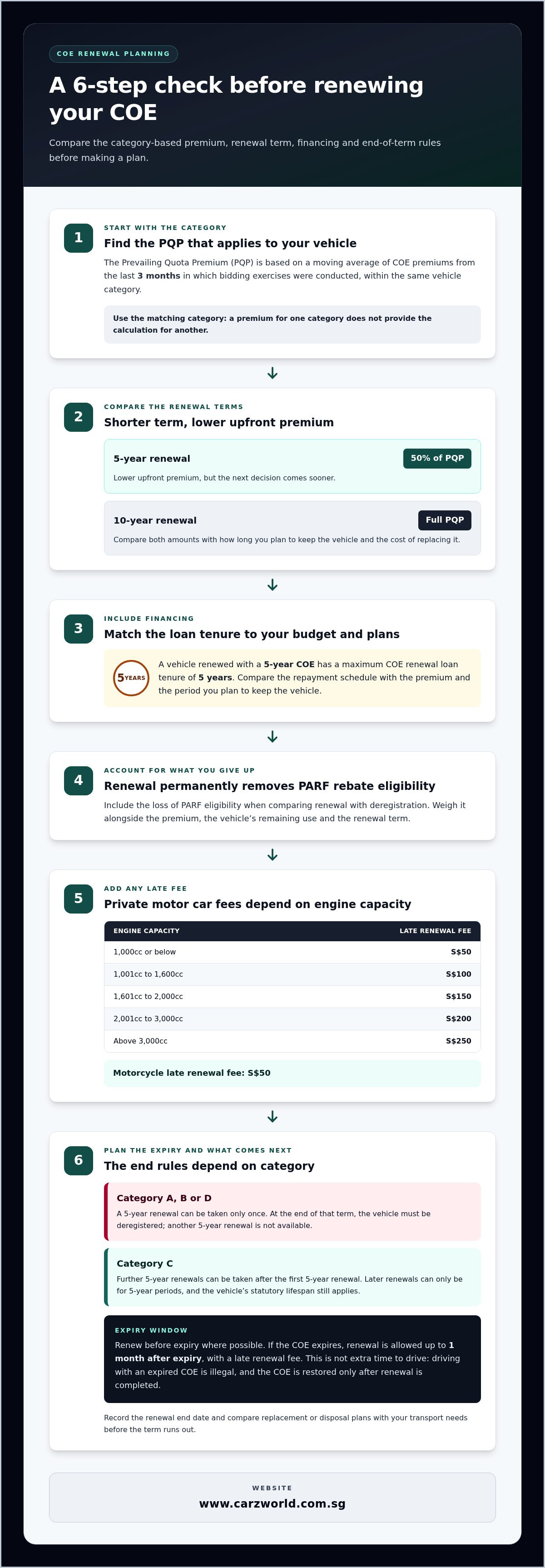
- Start by identifying your vehicle category and the PQP that applies. The Prevailing Quota Premium is based on a moving average of COE premiums from the last 3 months in which bidding exercises were conducted, within the same vehicle category. This means the renewal figure moves with recent category prices. A premium for one category won’t give you the calculation for another.
- Compare the two renewal terms before deciding. A five-year COE renewal costs 50% of the prevailing quota premium, while a 10-year renewal requires the full PQP for the vehicle category. The shorter term has a lower upfront premium, but it also brings the next decision closer. Compare both amounts against how long you plan to keep the vehicle and the cost of replacing it.
- Include financing in your comparison. A vehicle renewed with a five-year COE term has a maximum COE renewal loan tenure of five years. Consider whether repayments fit your budget and plans for that period. Compare the loan schedule with the premium, since the repayment commitment depends on the loan tenure.
- Account for the loss of PARF eligibility. Renewing a vehicle’s COE permanently removes its eligibility for a PARF rebate. Consider this when comparing renewal with deregistration. The decision involves more than the premium: weigh the vehicle’s remaining use, the renewal term and the rebate eligibility you give up.
- Add any applicable late renewal fee to your cost estimate. For a private motor car with an engine capacity of 1,000cc or below, the fee is S$50; for 1,001cc to 1,600cc, it is S$100; for 1,601cc to 2,000cc, it is S$150; for 2,001cc to 3,000cc, it is S$200; and above 3,000cc, it is S$250. The fee for a motorcycle is S$50. Use the vehicle’s engine capacity to identify the applicable fee, then compare the full renewal cost with your planned ownership period.
The Prevailing Quota Premium (PQP) for COE renewal is calculated from a moving average of recent COE prices in the same vehicle category. Treat the renewal premium as category-specific, not as one figure for every vehicle. Make sure the amount you use matches your vehicle’s category, since a figure from another category does not reflect the stated calculation basis. Because the calculation uses a moving average, the premium reflects recent prices rather than one individual price. Keep this in mind when weighing the renewal amount against the other costs and trade-offs.
What happens when a 5-year COE renewal ends
For Category A, B or D vehicles, a five-year COE renewal can be taken only once. At the end of that term, the vehicle must be deregistered. Another five-year renewal is not available for these categories. Knowing what happens at the end of a 5-year COE renewal helps you plan your next transport arrangement before the term runs out.
- Confirm the vehicle category. Check whether the vehicle is in Category A, B, C or D before deciding what to do next. The rules differ, so don’t assume the outcome for a private car applies to a commercial vehicle. Category A, B and D vehicles can have a five-year renewal only once. Category C follows a different renewal path, subject to its statutory lifespan.
- Record the renewal’s end date. Keep the end date with your vehicle records and set a reminder well ahead of it. This gives you time to plan for deregistration or an eligible renewal, rather than leaving the decision until the final days. Understanding what happens at the end of a 5-year COE renewal starts with knowing exactly when the renewed term finishes.
- Plan for replacement or disposal. If your vehicle is in Category A, B or D, include deregistration in your plan. Consider whether you’ll need another vehicle and when. List your transport needs, such as regular commuting or business use, then compare suitable arrangements before the current term ends.
- Check the Category C rules separately. A Category C vehicle can have further five-year COE renewals after its first five-year renewal, but later renewals can only be for five-year periods. Its statutory lifespan still applies. For example, check a goods vehicle’s applicable lifespan before planning another term.
- Compare timing with your transport needs. If you’ll need a replacement, consider how much time you need to choose and arrange your next vehicle. A household that relies on daily transport may plan differently from an owner who uses a vehicle occasionally. Comparing your needs early can help coordinate the next step with the COE end date.
- Explore suitable vehicle options. If replacement is part of your plan, compare your needs with available vehicle options. Consider the type of journeys you make and whether your requirements have changed since the original COE period. Keep the vehicle category and renewal rules in view while deciding, so your next arrangement fits both your needs and the vehicle’s eligibility.
What happens when a COE expires
- Mark the expiry date and decide before it arrives. In Singapore, renew the COE before expiry where possible. If you miss that date, you have up to 1 month after expiry to renew, with a late renewal fee. Treat this as a limited window, not extra time to keep driving. Set a reminder ahead of the recorded expiry date and decide whether renewal or disposal suits your plans.
- Keep the vehicle off the road after expiry. An expired COE can affect whether a vehicle may be used on Singapore roads, so check its status before driving. Driving with an expired COE is illegal. Arrange transport without using that vehicle while you consider the available options. A renewal within the permitted 1-month period restores the COE only after the renewal is completed.
- Use the correct month’s PQP for a late renewal. If you renew after expiry, the required PQP is the amount for the month the COE expires, not the month when you complete the late renewal. Include the applicable late renewal fee too. For example, if the COE expires in one month and you renew during the next, use the expiry month’s PQP.
- Complete renewal within the 1-month window. Make the renewal decision early enough to complete payment before that period ends. The late renewal fee depends on the vehicle type and, for private motor cars, engine capacity. Use the correct category when estimating the payment. If the COE is renewed successfully, the vehicle can be used on the road again; until then, it must remain off-road.
- Arrange disposal if the window passes. A vehicle whose COE is not renewed within 1 month of expiry must be disposed of immediately. If you aren’t renewing, the vehicle must be deregistered, scrapped or exported. Don’t treat the late-renewal period as an indefinite extension. Decide which disposal route fits your situation and make arrangements before the deadline, so the vehicle’s status is clear.
- Keep the steps in sequence. First, confirm the COE expiry date. Next, choose renewal or disposal. If renewing late, use the PQP for the expiry month and account for the late fee. Keep the vehicle off Singapore roads until its COE is renewed. If the 1-month period ends without renewal, proceed with immediate disposal instead of continued use.
Can a 5-year COE be renewed for another 5 years?
- Identify the vehicle category first. The answer depends on whether the vehicle is in Category A, B, C or D. Singapore’s rules do not give every vehicle the same renewal options. Before planning another term, confirm the category and check whether the vehicle has a statutory lifespan. These details determine whether another five-year renewal is possible.
- For Category A, B or D, plan for deregistration. These vehicles can have a five-year COE renewal only once. They must be deregistered when that renewed term ends, so another five-year renewal is not available. Plan for replacement or disposal before the current renewal expires.
- For Category C, assess the next five-year term. A Category C vehicle can have further five-year COE renewals after its first five-year renewal. Later renewals can only be for five-year periods. This is the key exception to the Category A, B and D rule, but it does not mean every Category C vehicle can renew indefinitely.
- Check the Category C statutory lifespan. A Category C vehicle cannot renew its COE after reaching the end of its statutory lifespan and must then be deregistered. Category C goods vehicles have a statutory lifespan of 20 years. Apply the lifespan rule alongside the renewal-term rule, since an available five-year term cannot extend a vehicle beyond its statutory limit.
- Distinguish five-year and 10-year choices. A vehicle’s renewal term can be five years or 10 years, depending on its category and statutory lifespan. Category C vehicles following a five-year renewal path are limited to five-year periods for later renewals. Don’t assume a 10-year renewal becomes available simply because the first five-year term has ended.
- Map the remaining ownership period. Write down the current COE end date, the vehicle category, and any applicable statutory lifespan. Then compare the remaining eligible renewal period with how long you intend to keep the vehicle. For example, a Category C goods vehicle approaching its 20-year statutory lifespan needs a different plan from one with more eligible time remaining.
- Choose the next step before the term ends. If your category and statutory lifespan allow another five-year renewal, plan for that term and its eventual end. If renewal is not available, prepare for deregistration. Checking the category first clarifies whether another five-year COE is possible and helps you avoid planning around a renewal the vehicle cannot take.
What are the restrictions on a vehicle after 5-year COE renewal?
- Check the vehicle category before assuming another renewal is possible. A five-year COE term does not give every vehicle the same options. Category A, B and D vehicles can have a five-year renewal only once. Category C has a different renewal path, but statutory lifespan limits still apply. Start your planning by checking the category.
- For Category A, B or D, plan for the end of the renewed term. These vehicles must be deregistered when their one-time five-year renewal ends. They cannot have another COE renewal after that term. Include deregistration in your plan rather than relying on a further renewal to keep the vehicle in use.
- For Category C, track both renewal terms and lifespan. Further five-year renewals are possible after the first five-year renewal, but later renewals can only be for five-year periods. A Category C vehicle must be deregistered when it reaches the end of its statutory lifespan. Both rules matter when planning continued use.
- Match the Category C vehicle type to its statutory limit. Category C goods vehicles have a statutory lifespan of 20 years. An omnibus has a statutory lifespan of 17 years. An excursion bus, private bus, private hire bus or school bus has a statutory lifespan of 20 years. For example, an omnibus must be assessed against its 17-year limit, not the goods-vehicle limit.
- Separate COE renewal eligibility from the vehicle’s full lifespan. A renewal term does not override a statutory lifespan. If a Category C vehicle reaches that limit, it cannot renew its COE and must be deregistered. Consider the vehicle’s category, type and lifespan before assuming a possible five-year renewal allows you to use it for the entire term.
- Understand the longer-term route for eligible categories. Vehicles in Categories A, B and D with no statutory lifespan can renew repeatedly in 10-year periods. Private cars have no statutory lifespan and may renew repeatedly if each renewal is for 10 years. This does not change the one-time restriction on a five-year renewal; the selected term affects future options.
- Plan replacement around the applicable limit. Write down the vehicle category, body type and relevant COE end date, then compare them with the statutory lifespan. If a commercial vehicle replacement is part of your plan, explore vehicle options alongside your timing and operational needs. This helps you plan around the vehicle’s actual renewal eligibility.
Carz World Pte: Pre-Owned Cars
Carz World Pte Ltd offers pre-owned cars for drivers planning a replacement after a COE renewal ends. Compare your everyday transport needs with the available options when deciding whether to replace your vehicle. A pre-owned car may suit your needs, while a brand new car is another option. Car rental can provide temporary transport while you consider a longer-term decision.
Choose what suits your next step, whether you need a replacement vehicle or short-term transport. Contact Carz World Pte Ltd to discuss your vehicle needs.
Make your next vehicle decision with confidence
Use the end of a COE term as a chance to reassess how you want to travel, not just what you want to replace. Knowing what happens at the end of a 5-year COE renewal can help you plan a transition that fits your everyday needs and avoid a last-minute decision. Consider whether you need a vehicle for the long term, a temporary option while you decide, or a different way to manage your transport needs.
Carz World Pte Ltd offers pre-owned cars, brand new cars and car rental, giving you options to consider as your plans take shape. The right choice depends on how you expect to use your next vehicle and what works for your situation. Explore your options at Carz World Pte Ltd, and take your next step when you’re ready.
Frequently Asked Questions
What happens when a 5-year COE expires in Singapore?
At the end of a five-year renewal, the next step depends on the vehicle category. Category A, B and D vehicles must be deregistered when their one-time five-year renewal ends. Category C vehicles may have further five-year renewals, subject to their statutory lifespan. Before the term ends, identify the category and vehicle type, then plan for another eligible renewal or deregistration rather than assuming every vehicle has the same options.
What is the COE renewal amount payable in Singapore?
The amount depends on the vehicle category’s prevailing quota premium (PQP) and the renewal term. A five-year renewal costs 50% of the PQP, while a 10-year renewal requires the full PQP. The PQP is calculated using recent COE premiums from the same category, so the payable amount can change over time. To estimate your renewal, identify the vehicle category and term, then apply the relevant percentage to its PQP.
What happens if a vehicle owner does not renew COE before expiry?
An owner can still renew within 1 month after expiry by paying the applicable late renewal fee. The late renewal uses the PQP for the month the COE expired, not the month of payment. During this period, the vehicle cannot be driven on Singapore roads unless its COE has been renewed. If the owner misses the 1-month window, the vehicle must be disposed of immediately.
Can a vehicle with an expired COE be driven or renewed in Singapore?
No, an expired-COE vehicle cannot be driven legally on Singapore roads. It is automatically deregistered and remains off the road until its COE is renewed. Renewal is possible before expiry or within 1 month afterward, with a late fee applying to a renewal after expiry. For example, arrange other transport while completing a late renewal; don’t drive the vehicle during that process.
Is renewing a COE for 5 years or 10 years more cost-effective?
Neither term is automatically more cost-effective; compare the upfront premium with how long you plan to keep the vehicle. A five-year renewal costs half the category’s PQP, while a 10-year renewal costs the full PQP. Also factor in eligibility: Category A, B and D vehicles can take a five-year renewal only once. Renewing removes PARF rebate eligibility, so include that trade-off in your decision.
Disclaimer
This content is provided for general informational purposes only. Readers are encouraged to independently verify important information.
In Same Category
- How to Plan for Your 5-Year COE Renewal to End
- How Much to Budget for Car Maintenance Annually in Singapore
- Used Commercial Vehicle Dealer in Bukit Batok for Your Needs
- Is a car a good investment in Singapore compared with other ways to travel?
- Second hand car lots in Choa Chu Kang: dealers and prices
Related by Tags
- How to Plan for Your 5-Year COE Renewal to End
- How to Renew Your COE and Account for Fees and Deadlines
- Risks of Buying a Car with 1 Year of COE Left in Singapore (2026 Guide)
- Best Time to Renew COE in 2026: A Practical Singapore Guide
- COE Renewal for 5 Years vs 10 Years: Pros and Cons in Singapore
- Scrap Car vs Export Car in Singapore: How to Choose the Better Option
- Pros and Cons of Buying a High PARF Car in Singapore
- Scrapping Your Car Before 10 Years in Singapore: What Happens?
- Calculating the Breakeven Point for COE Renewal in Singapore
- COE Renewal Conditions and Eligibility in Singapore: 2026 Guide
- Getting Car Finance as a Freelancer in Singapore: 2026 Guide
- Financial Checklist Before Buying a Car in Singapore: 2026 Expert Guide