Best Time to Renew COE in 2026: A Practical Singapore Guide

The month with the lowest PQP isn’t always the best time to renew COE in 2026. Waiting for a more favourable figure may seem sensible, but PQP changes monthly and reflects past quota premiums. Your car’s condition and how long you expect to use it matter just as much.
It’s understandable to feel uncertain about whether to renew now, wait, or move on to another vehicle. The right choice depends on more than the premium. You’ll also need to consider your car’s age, potential PARF rebate forfeiture, rising road tax for older cars, and how long you plan to keep driving it.
This guide explains how to assess the renewal month and compare the available five-year and 10-year terms. You’ll also learn how to weigh renewing against selling or replacing your car, using current LTA information and your own circumstances. The aim is to make a practical decision based on the numbers and the vehicle you have, rather than a guess about where COE prices might go.
Key Takeaways
- The best time to renew COE in 2026 depends on your expiry date, applicable PQP and plans for the car, not a confident prediction of future premiums.
- Learn how to check the current PQP for your vehicle category and understand why it differs from the latest COE bidding result.
- Compare renewing, selling and replacing your car based on its condition, expected years of use and your budget.
- Use a simple sequence to organise your decision: confirm the expiry date, check official LTA information, assess the vehicle and weigh your options.
- Understand how the five-year and 10-year renewal terms can affect your plans before taking the next step.
Best time to renew COE in 2026: start with your expiry date and priorities
The best timing depends on the Prevailing Quota Premium (PQP) that applies when you renew and what you plan to do with your vehicle. The Certificate of Entitlement (COE) system in Singapore sets the period a vehicle can be used on the road, but deciding whether and when to renew is a personal choice. Start by checking your vehicle’s recorded COE expiry date and the current Land Transport Authority (LTA) instructions for your vehicle.
Break the decision into three parts: whether you want to keep and renew the car, which renewal term is suitable, and when to complete the renewal. Considering these questions in order helps prevent a market headline from driving a decision before you’ve assessed your plans.
Why a single best month to renew COE does not fit every owner
Owners have different expiry dates, budgets and replacement timelines. The PQP applicable in a renewal month determines the premium under prevailing LTA rules. It isn’t a forecast of what the premium will be later. A future month could have a lower PQP, but there’s no guarantee. Plan by comparing the current applicable figure with your deadline and ownership needs, rather than trying to predict the market.
COE premiums in 2026 can’t be reliably predicted. Track published figures to understand how they change, but don’t treat a recent rise or fall as proof of what comes next.
The 2026 decision starts with the vehicle, not the market headline
Before interpreting a PQP figure, write down the information that puts it in context. This gives you a practical starting point for comparing renewal with a change of vehicle:
- Your recorded COE expiry date and vehicle category.
- The car’s present condition and how much longer you expect it to meet your needs.
- How long you expect to keep driving it if you renew.
- When you would prefer to replace it, if you’re considering a different vehicle.
These details help you distinguish an affordable-looking premium from a decision that fits your circumstances. For example, renewal may deserve closer consideration if you expect to keep the car and its condition supports continued use. If you already plan to change vehicles soon, compare that timeline with the renewal commitment before acting. This is a comparison, not a recommendation to renew or replace.
Check current LTA guidance for your vehicle’s eligibility, available renewal term and timing requirements. LTA allows owners to renew up to three months before the COE expires, according to the current guidance referenced in this guide. Leave enough time to follow the applicable instructions rather than relying on a last-minute decision.
The best time to renew COE in 2026 is when the applicable PQP, your vehicle’s condition and your intended ownership period make sense together. First establish whether renewal fits your plans. Then identify the permitted term and decide when to act under current LTA instructions.
How PQP and COE renewal timing work in Singapore
A Certificate of Entitlement (COE) gives a vehicle the right to be used on Singapore roads for a set period. For renewal, the Prevailing Quota Premium (PQP) is the published premium reference for the relevant vehicle category and renewal period. Under prevailing LTA rules, renewal uses the applicable PQP, not a prediction based on the next COE bidding exercise.
The distinction matters. COE bidding results show premiums from a particular exercise, while PQP is a separate, category-specific figure calculated from quota premiums over the preceding three months. LTA publishes PQP figures monthly, so the figure relevant to your renewal may differ from the latest bidding result. Check the applicable month and vehicle category on OneMotoring before making a decision.
What PQP tells you, and what it cannot predict
A published PQP tells you the reference premium for the relevant renewal period. Looking at earlier figures can show how the PQP has moved, but it can’t establish what the next figure will be. Historical PQP data provides context, not a promise that premiums will rise or fall in the next period.
A past PQP movement describes an earlier period; it does not guarantee the premium for a future renewal.
How renewal term and vehicle category affect the choice
LTA’s renewal options include five-year and 10-year terms, subject to the vehicle category and current eligibility rules. A five-year renewal costs 50% of the applicable PQP. For Categories A, B and D, it is a one-time option, and the vehicle must be deregistered at the end of that term. A 10-year renewal costs 100% of the PQP and allows subsequent renewals.
Choose a term based on how long you expect to keep the vehicle, not just the upfront premium. Before deciding, check the current LTA instructions for your vehicle’s category, eligibility, restrictions and the consequences of each term. Rules and vehicle-specific conditions matter, so don’t assume an option available for one category applies to another.
For a useful check, record your vehicle category and intended renewal month, then compare the PQP shown for that period with the term you’re considering. Confirm the details on OneMotoring close to your decision, as published figures change monthly. The best time to renew COE in 2026 depends on the applicable PQP and your plans, not on treating past movements as a forecast.
If the figures lead you to consider changing vehicles instead, you can also review vehicle options from Carz World as part of that comparison.
Renew COE or replace the car? Compare the full ownership picture
Renewal is only one part of the decision. Compare what you would commit to by keeping your current car with what selling it and changing vehicles would mean for your needs and budget. The applicable PQP matters, but it doesn’t show the full ownership picture on its own.
Compare the renewal commitment with the realistic value and usefulness of the vehicle. Consider how well the car serves your daily needs, how long you expect to use it, and whether the renewal term fits that period. Then compare those answers with the practical and financial implications of moving to another car.
| Option | What to weigh | Questions to ask |
|---|---|---|
| Renew the COE | Vehicle condition, applicable PQP, renewal term and budget | Does the car still suit your daily needs, and how long do you expect to keep it? |
| Sell or trade the car | Its realistic value, your exit timing and what you will drive next | Are you ready to change vehicles, and how does selling fit your plans? |
| Replace it with another vehicle | The different vehicle’s suitability, purchase budget and intended ownership period | Would a different car better fit your current needs and future plans? |
When renewal may fit your car and ownership plans
A dependable car that continues to meet your practical needs may be worth assessing for renewal. Consider the journeys you make, the number of years you hope to keep it, and your tolerance for potential upkeep as it ages. Review the PQP and term alongside the car’s condition. Renewal isn’t automatically cheaper than replacing the vehicle, so compare the full commitment rather than relying on the premium alone.
When selling or replacing may deserve equal consideration
A change in family or work needs, concerns about the car’s condition, or an upgrade already in your plans can make selling or replacing it relevant alternatives. Explore pre-owned cars in Singapore as one way to consider a different vehicle, and compare that choice with keeping your current car. If you’re weighing an exit, Carz World’s sell your car in Singapore option is relevant to that decision.
Make the comparison specific to your situation. Write down the PQP for your vehicle category and renewal month, the period you expect to keep the car, and the replacement timing you have in mind. Add the vehicle’s realistic value and your budget for either route. This gives you a clearer basis for deciding whether renewal, selling or replacement matches your priorities, without assuming one option is best for every owner.
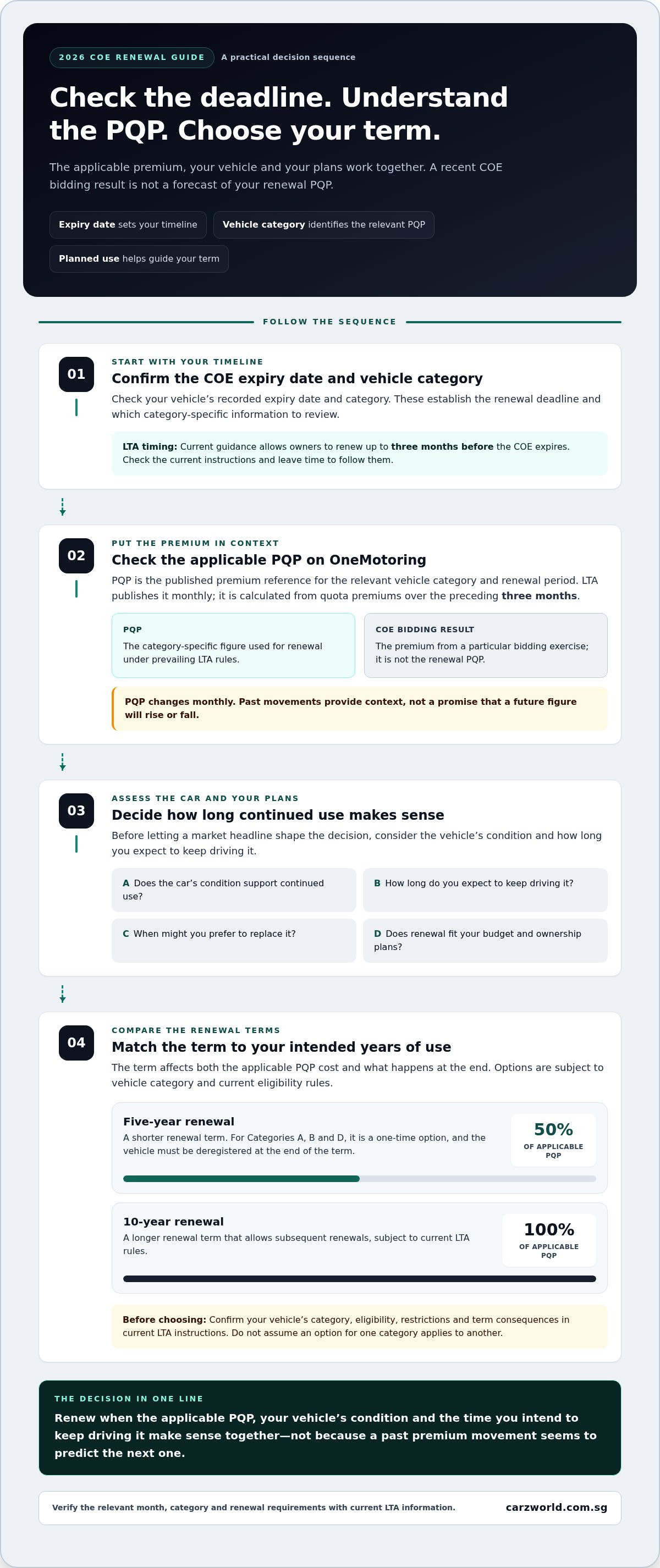
A practical 2026 checklist for choosing when to renew COE
A checklist helps keep your decision grounded in your vehicle, plans and the current published figures. Follow the steps in order, and note the information you used so you can reassess if the PQP changes before you decide.
Five checks to complete before selecting a renewal month
- Confirm the expiry date. Check your vehicle’s recorded COE expiry date and note the month you’re considering for renewal. LTA’s current guidance allows renewal up to three months before expiry, so use the available window to plan rather than leaving the decision until the last moment.
- Record the vehicle category. Write down the category shown for your vehicle. This matters because PQP figures are category-specific, and renewal terms and conditions can differ by category.
- Check current LTA instructions and PQP. Use OneMotoring to review the applicable published figure and current renewal instructions for your vehicle. Record the date you checked, the category and the renewal month. This makes it easier to compare like with like if you revisit the figures later.
- Assess the car and your likely use. Consider its condition, whether it still suits your everyday needs, and how long you expect to continue using it. Be realistic about your willingness to keep an older vehicle, rather than basing the decision on the premium alone.
- Compare your alternatives before acting. Weigh renewal against your selling or replacement plans and budget. Consider the renewal term and intended ownership period together, then follow the current LTA process if renewal remains your preferred option.
| Factor | What to check | How it affects the choice |
|---|---|---|
| Expiry and timing | Recorded expiry date and the renewal month under consideration | Sets your planning window and helps you avoid a rushed decision. |
| Category and PQP | Vehicle category and current applicable published PQP | Identifies the relevant renewal reference; it doesn’t predict a later figure. |
| Vehicle condition | Whether the car remains suitable for your expected use | Helps assess whether keeping it fits your practical needs. |
| Ownership and budget | How long you plan to keep the car and the budget for each option | Lets you compare renewal with selling or changing vehicles on a consistent basis. |
How to act if you’re still undecided
Set a personal decision date that leaves enough time to review the current official requirements and complete the process within the permitted window. If the PQP changes before then, return to OneMotoring and update your comparison. Don’t assume that waiting will improve the figure.
Market commentary can describe trends, but it can’t guarantee a favourable renewal month. Waiting is a risk decision: a later PQP could be lower or higher, so decide whether that uncertainty fits your plans and deadline.
Still weighing a replacement? Explore vehicle options from Carz World as part of your comparison with renewal.
Your next steps: renew, sell, or choose another car
Make the decision by considering four things together: the current PQP for your vehicle category, the car’s condition, how long you intend to keep it, and whether your needs point towards a replacement. No single figure can make the choice for you. A clear plan helps you act without relying on a market prediction or feeling pressured to commit before comparing the alternatives.
Start by writing down your preferred outcome and the latest date by which you need to decide. If you’re leaning towards renewal, compare the applicable PQP and permitted term with your intended ownership period. If you’re considering a change, outline what selling and replacing the vehicle would involve, including the needs your next car should meet.
If keeping the vehicle is the right fit
Use your car’s condition and continued usefulness to decide whether renewal deserves serious consideration. If it still suits your daily journeys and you expect to keep it for a period that matches the selected term, check the current LTA rules and instructions for your vehicle category. Confirm the applicable PQP and timing, then complete the required process within the permitted window. The decision should fit your circumstances, not pressure to act.
If changing vehicles is the better fit
A planned upgrade or changing transport needs may make selling and choosing another vehicle a more suitable route. Compare the likely sale or consignment timeline with your COE expiry and replacement plans before deciding. This gives you time to consider what you want next, whether a pre-owned or brand-new car, and how the change fits your budget. Treat it as an alternative to assess, not an automatic recommendation.
Before settling on either route, make a short comparison:
- Renew: Record the current category-specific PQP, available term and LTA timing instructions. Check that the expected ownership period makes sense for your plans.
- Sell: Consider your preferred exit timing and how the vehicle’s realistic value fits into the next step. A sale or consignment can form part of a replacement plan.
- Replace: Note the vehicle type that would meet your needs and the budget you’re comfortable with. Compare the change with the commitment involved in keeping your current car.
Keep the comparison practical. If the current car remains useful and the renewal term suits your intended ownership period, follow LTA’s current instructions for your vehicle and complete the process on time. If your needs have changed, compare selling and replacement options before the COE expires, so your next step is based on a plan rather than a last-minute reaction.
The best time to renew COE in 2026 is the point when the applicable PQP, your car’s condition and your ownership plans align. If you’re considering a different vehicle, explore Carz World’s vehicle options as part of your comparison.
Make your next car decision with confidence
Before committing, turn your preferred option into a simple plan: note what you’ll do, when you need to do it, and what information you’ll use to make the final call. That gives you a steady reference point if market commentary becomes noisy or your plans shift. The best time to renew COE in 2026 isn’t a date that suits every owner. It’s the point when the choice fits your vehicle and the way you expect to use it.
If replacing your car is part of that plan, Carz World offers pre-owned and brand-new cars, along with car purchase and consignment options. Explore the available vehicle choices and consider how a change might fit your next step.
Explore cars available from Carz World, and move forward at a pace that feels right for you.
Frequently Asked Questions
What happens if my COE expires before I renew it?
Once your COE expires, don’t drive the vehicle on public roads unless its status has been regularised under current LTA rules. Check OneMotoring promptly for the steps that apply to your vehicle, and don’t assume you can simply continue using it while deciding. If you’re close to expiry, make your renewal or replacement plan in advance to avoid an unexpected interruption to your transport arrangements.
Can I renew my COE more than once?
Yes, a 10-year COE renewal allows subsequent renewals, subject to the rules applying at the time. A five-year renewal has different restrictions: for Categories A, B and D, it’s a one-time option, and the vehicle must be deregistered when that term ends. Because conditions depend on the vehicle category and renewal choice, check current LTA guidance before relying on a future renewal as part of your ownership plan.
Is COE renewal financing available in Singapore?
Some finance providers in Singapore advertise loans for COE renewal, but approval and terms depend on the provider and borrower. Compare the interest rate, repayment period, total amount repayable and any conditions with the cost of paying the PQP without a loan. A lower monthly repayment doesn’t necessarily mean a lower overall cost. Carz World also provides vehicle financing as a related service for customers considering a vehicle purchase.
Does renewing my COE change my car’s age?
No, renewing the COE extends the vehicle’s permitted use period; it doesn’t make the car newly registered or reset its age. For example, a car that was already more than 10 years old remains an older vehicle after renewal. Keep its original registration history in mind when considering resale, insurance and road tax, and check LTA records if you need to confirm vehicle-specific dates.
Will COE renewal affect my car insurance or road tax?
Renewal doesn’t automatically set your insurance premium or policy terms. Tell your insurer about relevant changes and confirm how the vehicle’s age, value and use affect your cover. Road tax is separate: under current rules, cars older than 10 years incur a 10% surcharge for each additional year, capped at 50% from the 15th year onwards. Check your vehicle’s exact road tax with LTA.
Can I sell my car after renewing its COE?
Yes, you can consider selling after renewal, but compare the remaining COE period and the vehicle’s realistic value with your plans before committing. Renewal also means forfeiting any PARF rebate you would have received by deregistering the car before it reaches 10 years old. If you may sell soon, factor that loss into your decision and check the transfer and vehicle requirements that apply at the time.
Disclaimer
This content is provided for general informational purposes only. Readers are encouraged to independently verify important information.
In Same Category
- Best Time to Renew COE in 2026: A Practical Singapore Guide
- COE Renewal for 5 Years vs 10 Years: Pros and Cons in Singapore
- Understanding the MAS Car Loan Restrictions in Singapore (2026)
- Scrap Car vs Export Car in Singapore: How to Choose the Better Option
- Pros and Cons of Buying a High PARF Car in Singapore
Related by Tags
- Best Time to Renew COE in 2026: A Practical Singapore Guide
- COE Renewal for 5 Years vs 10 Years: Pros and Cons in Singapore
- Scrap Car vs Export Car in Singapore: How to Choose the Better Option
- Pros and Cons of Buying a High PARF Car in Singapore
- Car Valuation Services in Bukit Merah: A Seller’s Guide
- Scrapping Your Car Before 10 Years in Singapore: What Happens?
- Calculating the Breakeven Point for COE Renewal in Singapore
- COE Renewal Conditions and Eligibility in Singapore: 2026 Guide
- Used Electric Cars in Singapore: 2026 Buyer's Guide
- Mazda CX-5 Singapore Review: Buyer Guide, Specs & Ownership (2026)
- Calculating the Real 5-Year Cost of Car Ownership in Singapore (2026 Guide)
- Buying a Used Car in Singapore: 2026 Ultimate Guide