COE Renewal for 5 Years vs 10 Years: Pros and Cons in Singapore

The lower upfront payment may not be the lower-cost choice over time. If your car is nearing the end of its COE, weighing the COE renewal for 5 years vs 10 years pros and cons means looking beyond the initial payment. Consider how long you plan to keep the vehicle, its condition and what you might do when the renewed term ends. A shorter commitment may feel safer if you’re unsure about an ageing car, but it can also limit your options later.
This guide explains how each renewal term works in Singapore and the key restrictions. A five-year renewal costs 50% of the Prevailing Quota Premium (PQP), but for most vehicles it can’t be renewed again after those five years. A ten-year renewal costs the full PQP and may preserve the option of renewing again, subject to the rules for that vehicle category.
Compare the upfront payment with your intended ownership period, vehicle condition and future plans. You’ll also find guidance on weighing renewal against selling or replacing your car, so you can decide based on more than the smaller initial bill.
Key Takeaways
- Understand how the Prevailing Quota Premium (PQP) determines the renewal payment: five years is based on 50% of PQP, while ten years uses the full PQP.
- Compare the COE renewal for 5 years vs 10 years pros and cons against your intended ownership period, not just the upfront payment.
- Check the renewal limits that apply to your vehicle category before choosing a term.
- Weigh your car’s condition and possible future upkeep against how long you expect to keep driving it.
- Compare renewing with selling or replacing your car to find an option that better fits your plans.
COE renewal for 5 years vs 10 years: what are you choosing?
When your car’s COE nears expiry, you can renew for another term or replace the vehicle. The choice affects your transport costs and plans for years, so look beyond the payment due now. Compare the renewal rules with your car’s condition and how long you expect to keep it.
In Singapore, the Land Transport Authority (LTA) sets the rules for COE renewal. Five-year and ten-year renewals differ in duration, payment basis and what you can do when the renewed period ends. The rules also vary by vehicle category, so the same term can have different implications for different vehicles.
For a visual overview of the longer-term renewal decision, watch this video:
What does renewing a car's COE mean?
A Certificate of Entitlement (COE) gives a registered vehicle the right to be used in Singapore for a set period. Renewing extends the legal use of the existing vehicle after its current COE period, subject to LTA requirements. This differs from bidding for a new COE, which is part of registering a vehicle with a new entitlement. For background on the Certificate of Entitlement (COE) system in Singapore, see this overview.
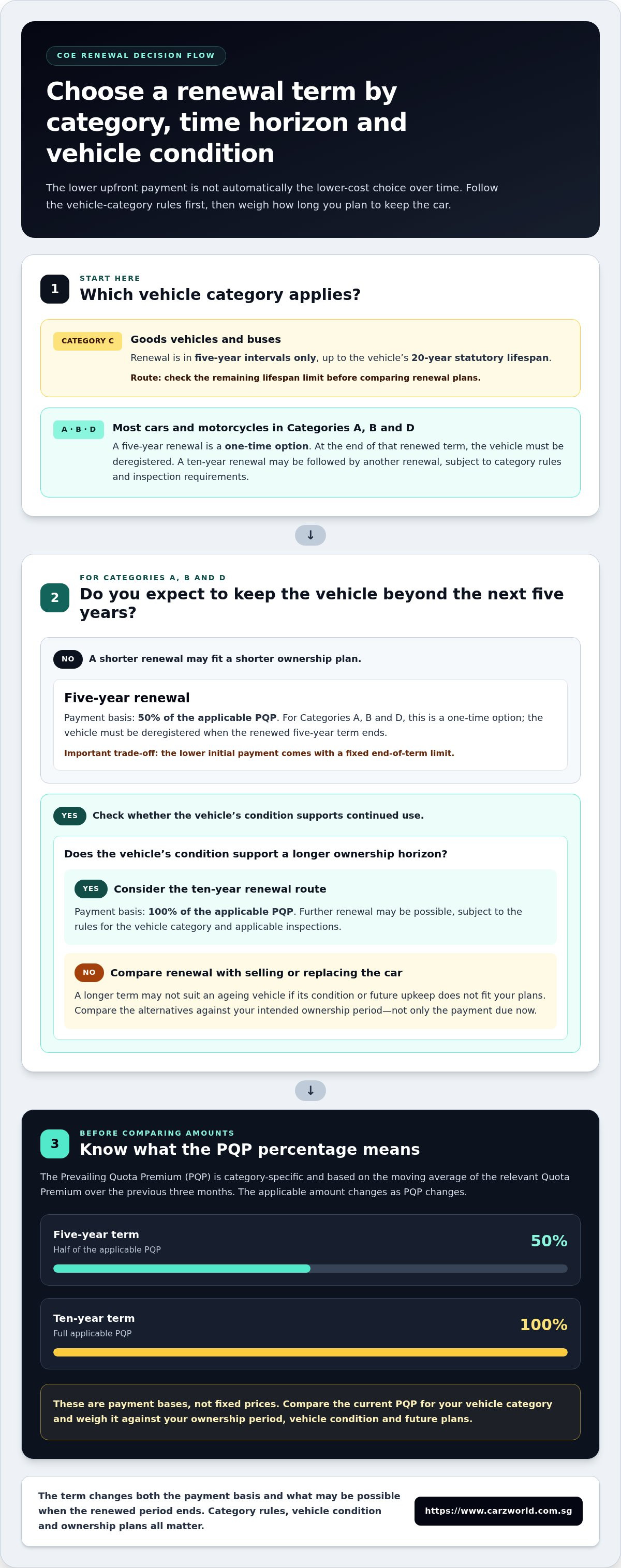
The renewal payment is based on the Prevailing Quota Premium (PQP), the moving average of the relevant Quota Premium over the previous three months. The renewal term is generally five or ten years, with the payment calculated using 50% or 100% of PQP, respectively. Your vehicle’s category affects the applicable premium and renewal rules.
Why do owners compare five-year and ten-year renewals?
The decision comes down to three practical questions: how much you’re prepared to commit now, how long you want to keep the vehicle, and whether its condition supports continued use. The COE renewal for 5 years vs 10 years pros and cons can’t be judged by payment alone. A shorter term has a lower initial payment, but it isn’t simply a ten-year renewal split in half. The rules at the end of the term can be different.
- For most cars and motorcycles in Categories A, B and D, a five-year renewal is a one-time option. The vehicle must be deregistered when that renewed period ends.
- A ten-year renewal for those categories allows further renewals, subject to applicable rules and inspections.
- Category C goods vehicles and buses have a 20-year statutory lifespan and can be renewed in five-year intervals only up to that limit.
Your ownership horizon matters. Someone who plans to keep a vehicle for only a few more years may value a shorter commitment differently from an owner aiming for long-term use. Neither term is automatically better before you account for category rules, vehicle condition and your plans.
How five-year and ten-year COE renewals work under LTA rules
The PQP determines the renewal amount, but your chosen term affects more than the payment due. It also determines how long you can use the vehicle under that renewal and, for some categories, whether another renewal is possible when the term ends.
How is the renewal amount calculated?
PQP is category-specific and based on the moving average of the Quota Premium (QP) from the previous three months of COE bidding. The applicable amount depends on your vehicle’s COE category. A five-year renewal uses 50% of that category’s PQP; a ten-year renewal uses the full PQP. These are standard payment bases, not fixed prices, so the payable amount changes as PQP changes.
Before making plans, check the current PQP, eligibility conditions and payment instructions through LTA’s OneMotoring service. Use the amount for your vehicle category and the latest renewal information, not an older quote or a PQP figure from another month.
What happens after each renewal term ends?
For Categories A, B and D, the five-year renewal is a one-time option. The vehicle must be deregistered when that renewed term ends. A ten-year renewal can be followed by another renewal, subject to the rules in force at that time and applicable inspection requirements. Category C goods vehicles and buses have a statutory lifespan of 20 years and may renew in five-year intervals only up to that limit.
Check your vehicle category before applying. Category-specific eligibility, deadlines and administrative steps matter, and LTA guidance is the reference for current requirements. As of October 2026, renewal is permitted up to one month after the COE expiry date, but a late renewal fee applies. Check the expiry date and LTA instructions early rather than relying on that window as extra planning time.
| Renewal term | Payment basis | Future renewal option | Key limitation |
|---|---|---|---|
| Five years | 50% of the applicable PQP | Not for Categories A, B and D | For those categories, the vehicle must be deregistered at the end of the term. Category C is subject to its lifespan limit. |
| Ten years | 100% of the applicable PQP | Further renewal may be possible | Any subsequent renewal remains subject to category rules and inspection requirements. |
The COE renewal for 5 years vs 10 years pros and cons involve both the payment formula and the end-of-term rules. A five-year term may mean a smaller payment now, but it can also set a final date for using the vehicle. A ten-year term requires the full PQP and offers a longer horizon, without guaranteeing that the car will suit your needs throughout it.
Compare the applicable PQP with your intended ownership period, then check your vehicle’s category and LTA requirements. If replacing the car is part of your comparison, you can explore car options.
Five-year vs 10-year COE renewal: pros, cons, and trade-offs
The key difference is not just how much you pay upfront. A five-year term means a shorter commitment, while a ten-year term gives you a longer period of use. The right fit depends on the car’s condition, how you use it and whether you’re comfortable with the rules that apply when the renewed term ends.
| Factor | Five-year renewal | Ten-year renewal |
|---|---|---|
| Payment basis | 50% of the applicable PQP | 100% of the applicable PQP |
| Flexibility | Shorter commitment, but limited future options for most private cars | Longer commitment, with the possibility of renewing again under applicable rules |
| Ownership horizon | Five more years, then an end-of-term decision | Ten more years, with a longer period to plan around |
| Key limitation | For Categories A, B and D, the vehicle must be deregistered after this one-time renewal | Future renewal depends on category rules and inspection requirements |
Category C goods vehicles and buses have a statutory lifespan of 20 years and may renew in five-year intervals only up to that limit. Check the rules for your vehicle category instead of assuming every vehicle has the same options.
When could a five-year renewal make sense?
A five-year renewal may suit an owner who expects to need the car for only a limited period or wants a smaller immediate COE payment. It may also fit a plan to change vehicles after a few more years. But for Categories A, B and D, the renewed term is a one-time option. You’ll need to be prepared to deregister the vehicle when those five years end.
A smaller upfront commitment doesn’t automatically make five years cheaper overall. Consider the full period you expect to own the car, likely running costs and what you may do next. For Categories A, B and D, you can’t treat a five-year renewal as the first half of a ten-year term.
When could a ten-year renewal make sense?
A ten-year term may be worth considering if the vehicle is in suitable condition and you expect to keep using it much longer. It gives you a longer ownership horizon and, for Categories A, B and D, allows the possibility of further renewal under the rules then in force. The trade-off is a larger immediate COE payment, based on the full PQP.
Longer use doesn’t guarantee trouble-free or suitable use. Future repair needs, changes to work or family routines, and your transport needs can all shift over time. Weigh those uncertainties against the commitment before deciding.
For a fair comparison, consider the car’s condition and intended use alongside the renewal payment. If replacement seems more suitable, include pre-owned car options in your comparison. The COE renewal for 5 years vs 10 years pros and cons depend on your circumstances, not just the term with the lower initial payment.
How to decide: vehicle condition, ownership plans, and renewal limits
Start with your car and your plans, then apply the renewal rules and PQP. Separate confirmed details, such as your vehicle’s category and renewal limits, from estimates about future upkeep or how long you’ll want the car. This prevents an uncertain repair forecast or a lower initial payment from becoming the whole decision.
Your car’s condition and intended use matter alongside PQP: a renewal term only makes sense if the vehicle can serve your needs for the period you’re committing to.
- Assess the car. Review its condition, service history, current reliability and foreseeable repair needs. Consider how you use it and whether it still fits your day-to-day requirements. Age alone doesn’t establish how much useful life remains, and no estimate can guarantee future reliability.
- Set an ownership horizon. Decide how long you realistically expect to keep driving this car. Think about likely changes to your work, household or transport needs, while recognising that plans can change.
- Compare the terms. Match your ownership horizon to the applicable renewal rules and PQP. For most private cars in Categories A and B, a five-year renewal is a one-time option that ends in deregistration; a ten-year renewal may allow another renewal, subject to current requirements.
- Assess alternatives. Compare the renewal commitment with selling the car and choosing a replacement. Include the time and practical steps involved, not only the financial figures.
Assess whether the car is worth keeping
Look at the whole ownership picture, not one recent repair or the car’s age in isolation. Review its condition and service records, note issues that may need attention, and consider whether it has been dependable for your usual journeys. A car that meets your needs now may still require more upkeep over an extended ownership period. Treat future needs as personal estimates, not guaranteed costs or a promised lifespan.
Also account for the opportunity cost of renewing. When you renew a car’s COE, its Preferential Additional Registration Fee (PARF) rebate is forfeited. For cars reaching the 10-year mark in 2026, the PARF rebate is 50% of the Additional Registration Fee paid, capped at S$30,000. Check current LTA guidance for the treatment that applies to your vehicle and circumstances before comparing renewal with deregistration.
Compare renewal with replacing the vehicle
If keeping the car no longer fits your plans, compare renewal with selling it and moving to another vehicle. Owners considering this route can sell their car and review pre-owned cars as replacement choices. Compare the available information about your current car and the replacement with the PQP and the period you expect to own the next vehicle. The COE renewal for 5 years vs 10 years pros and cons become clearer when replacement is part of the comparison.
Use your ownership horizon and vehicle condition to guide the decision, then explore your vehicle options with Carz World Pte Ltd if you’re considering a change.
Your next steps before renewing or changing cars in Singapore
Before committing, make a short list of facts about your car and your plans. Start with the vehicle’s expiry date and category, then check current LTA requirements and the applicable PQP. Once you know the official payment basis for each term, weigh it against the car’s condition and how long you realistically expect to keep driving it.
A simple checklist before committing
- Confirm the COE expiry date and category. Use your vehicle records and LTA’s OneMotoring guidance to identify the relevant deadline, category and current renewal requirements. Category rules affect which terms are available and what happens when a renewed period ends.
- Record the current PQP. Check the amount for your vehicle category through official LTA channels. Compare the five-year payment basis of 50% of PQP with the ten-year basis of the full PQP, and follow LTA’s current payment instructions instead of relying on an old figure.
- Review the car’s condition and expected use. Consider its service history, current reliability, foreseeable repair needs and whether it still suits your regular journeys. These are owner-specific estimates, not guarantees about future costs or how long the vehicle will remain suitable.
- Decide what happens at the end of the term. Check the renewal limits for your category and be clear about whether you’re comfortable with the resulting ownership horizon. For most private cars in Categories A and B, a five-year renewal is a one-time option that ends with deregistration.
- Check rebate treatment and compare alternatives. COE renewal means forfeiting the PARF rebate. Verify the latest LTA treatment for your vehicle, then compare the renewal commitment with selling or replacing the car.
Keep confirmed LTA rules separate from your own forecasts. The expiry date, category, applicable PQP and renewal conditions are facts to verify. Future maintenance, how long you’ll need the car and whether your transport needs may change are estimates to consider carefully.
If replacing the car fits better
Renewal isn’t the only route. If the car’s condition or your plans make continued ownership less suitable, selling it can be part of your replacement decision. Compare that path with the cost and ownership period of renewal, taking into account the relevant rebate treatment and the type of vehicle you’d need next.
Carz World Pte Ltd supports owners exploring vehicle purchase or sale, including direct car purchase and consignment options. If you’re ready to sell your car, consider how the sale could fit into your replacement plans. You can also include pre-owned cars in your comparison of possible next vehicles.
There’s no need to decide based on the renewal payment alone. Review your figures, plans and vehicle condition, then explore your vehicle options with Carz World Pte Ltd if changing cars looks like a better fit.
Make your next car decision with confidence
Build a clear basis for deciding before committing to a renewal or moving on from your current vehicle. The COE renewal for 5 years vs 10 years pros and cons matter most when considered alongside your car’s condition, how long you expect to keep it and what you want from your next stage of ownership. If your plans change, replacing the car can be a sensible choice.
Carz World Pte Ltd is a Singapore dealership offering pre-owned and new cars, as well as car purchase and consignment options for owners. Compare those possibilities with keeping your current vehicle and take the time you need to choose what fits.
Explore cars at Carz World Pte Ltd and take the next step that best fits your plans.
Frequently Asked Questions
Can I renew my COE for five years more than once?
No, not for a private car in Category A or B. A five-year renewal is a one-time option for these categories, and the car must be deregistered when that renewed period ends. Category D motorcycles follow the same five-year limit. Category C goods vehicles and buses have different rules, including a statutory lifespan, so check your vehicle’s category before relying on this answer.
Can I change from a five-year COE renewal to a ten-year renewal later?
No, a private car in Category A or B can’t extend a five-year renewal into a ten-year term later. That five-year choice is terminal, so plan for deregistration when it ends. Don’t assume you can pay the difference or switch terms midway through the renewed period. Category C vehicles have separate renewal rules, so confirm the applicable requirements with LTA for that vehicle.
What happens if my car's COE expires before I renew it?
LTA allows renewal up to one month after expiry, but a late renewal fee applies. Treat this as a limited grace period for completing the renewal, not extra time to keep driving: once the COE has expired, don’t use the car on the road unless its entitlement has been renewed. Check the latest LTA instructions promptly, as missing the deadline can affect your options.
When can I renew my car's COE in Singapore?
You can renew before the current COE expires; check LTA’s current process for the applicable timing and payment steps. The PQP used for the renewal depends on the month in which you renew, so waiting may mean a different amount applies. For example, a PQP published for one month shouldn’t be assumed to apply in a later month. Confirm the current figure and expiry date through OneMotoring.
Is a five-year COE renewal available for every vehicle category?
No, the rules depend on the vehicle category and its remaining statutory lifespan. A five-year renewal is available for Categories A, B and D, but for these categories it’s a one-time option. Category C goods vehicles and buses may renew in five-year intervals only within their statutory lifespan. Check your vehicle record and current LTA guidance before assuming a term is available.
Does renewing a COE affect a car's PARF rebate?
Yes. Renewing the COE forfeits the car’s PARF rebate, so include that lost rebate when comparing renewal with deregistration. The amount that might otherwise apply depends on the car and current rebate rules, and should not be confused with the COE renewal payment. Check LTA’s latest PARF calculation for your vehicle before deciding, especially if you’re comparing renewal against selling or deregistering.
Can I sell a car after renewing its COE?
Yes, you can consider selling a car after renewal. The remaining COE period forms part of the vehicle’s ownership value, but the buyer’s interest and the car’s condition may affect its appeal. Remember that COE renewal forfeits the PARF rebate, so don’t include a future PARF payout in your sale calculations. Compare the likely sale proceeds with the commitment you made to keep the car.
Disclaimer
This content is provided for general informational purposes only. Readers are encouraged to independently verify important information.
In Same Category
- COE Renewal for 5 Years vs 10 Years: Pros and Cons in Singapore
- Understanding the MAS Car Loan Restrictions in Singapore (2026)
- Scrap Car vs Export Car in Singapore: How to Choose the Better Option
- Pros and Cons of Buying a High PARF Car in Singapore
- Car Valuation Services in Bukit Merah: A Seller’s Guide
Related by Tags
- COE Renewal for 5 Years vs 10 Years: Pros and Cons in Singapore
- Pros and Cons of Buying a High PARF Car in Singapore
- Car Valuation Services in Bukit Merah: A Seller’s Guide
- Scrapping Your Car Before 10 Years in Singapore: What Happens?
- Calculating the Breakeven Point for COE Renewal in Singapore
- COE Renewal Conditions and Eligibility in Singapore: 2026 Guide
- Used Electric Cars in Singapore: 2026 Buyer's Guide
- Mazda CX-5 Singapore Review: Buyer Guide, Specs & Ownership (2026)