How Much to Budget for Car Maintenance Annually in Singapore
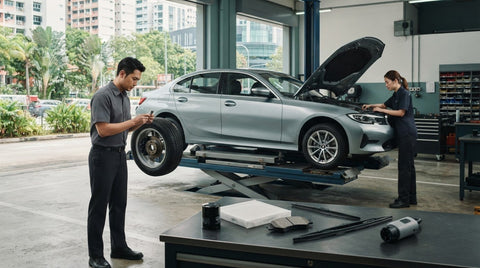
Treat these as planning buffers, then account for routine servicing and wear-and-tear costs, which vary by vehicle type.
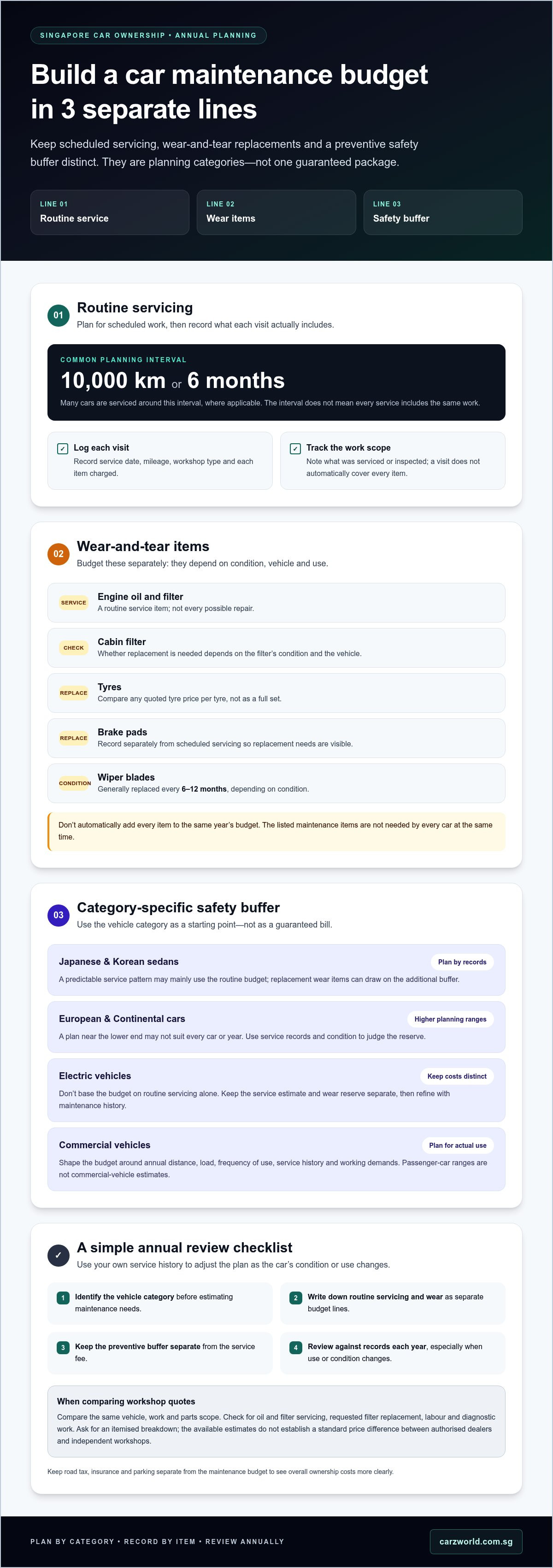
It’s easy to focus on the yearly total and overlook the service schedule that shapes it. This guide explains how budgets vary by vehicle category and what to plan for across the year, including routine servicing, common wear items, and maintenance timing. Many cars are serviced around every 10,000 km or six months, where applicable, while wiper blades generally need replacement every 6-12 months depending on their condition. Knowing what comes due, and why costs can differ, makes it easier to set a practical budget.
Key Takeaways
- Separate routine servicing from unexpected wear-and-tear repairs so your annual plan accounts for both.
- Compare common cost drivers such as oil and filter servicing, cabin filters, tyres, and brake pads.
- Maintenance needs differ across petrol cars and electric vehicles, so tailor your budget to your vehicle type.
- When reviewing servicing costs, consider what work is included and whether it suits your vehicle’s needs.
- Keep road tax, insurance, and parking separate from your maintenance budget to see your overall ownership costs more clearly.
Annual maintenance budgets by vehicle category
Annual planning works best when routine servicing and wear-and-tear are tracked separately. In Singapore, a preventive safety buffer gives owners room for maintenance needs beyond scheduled services. The figures below distinguish that buffer from estimated servicing and wear costs, so they should not be treated as one quoted package. Actual needs depend on the vehicle’s condition, usage and service history.
Japanese and Korean sedans
These are separate planning figures, not one guaranteed total. A sedan with predictable service needs may mainly use its routine budget, while replacement wear items can draw on the additional buffer.
European and Continental cars
European and Continental cars have higher planning ranges. The broad ranges matter: a budget near the lower end may not suit every vehicle or year. Use the car’s service records and condition to judge where your planned reserve should sit.
Electric vehicles
These figures show why an EV budget should not be based on routine servicing alone. Keep the service estimate and wear reserve distinct, then use the vehicle’s maintenance history to refine your annual plan.
Commercial vehicles and usage
Commercial vehicles need a budget shaped around their actual operating pattern. Annual distance, load and frequency of use affect how quickly maintenance needs arise. The passenger-car ranges above should not be applied as commercial-vehicle estimates. Instead, separate scheduled servicing from wear-related work and build the plan around the vehicle’s service history and working demands. This keeps business use distinct from private-sedan assumptions.
To plan, first identify the vehicle category, then record its estimated routine servicing range and annual wear range separately. Add the category-specific preventive buffer as a reserve, rather than treating it as a service fee. Review the figures against the vehicle’s service records each year, especially when usage or condition changes.
How Much Does Car Maintenance Cost in Singapore?
Common maintenance items can add costs beyond scheduled servicing in Singapore. Their prices vary by item, and tyres are priced per tyre.
Common Maintenance Item Prices
Common maintenance-item prices are estimates for individual replacement or inspection needs. They matter because one worn item can change the amount set aside for the year.
- This covers a routine service item, not every repair a car might need.
- The exact need depends on the filter’s condition and the vehicle.
- Compare this figure per tyre, not as a full set.
- The estimate applies to the item, while the vehicle and work required affect the final bill.
- Replacement timing depends on their condition.
- This is an inspection or diagnostic cost, not a repair estimate.
Use these prices as separate budget lines rather than adding every item automatically. The listed estimates do not mean every car needs each item during the same year.
Scope matters. Engine oil and filter servicing is a service task; tyres and brake pads are replacement items. Keeping those categories distinct helps show whether a larger bill came from scheduled work or a component needing replacement. Record each item by date and type, then compare the next invoice with the relevant category.
Dealer and Independent Workshop Costs
Dealer and independent workshop costs refer to charges for servicing or repairs through different workshop channels. Comparing them helps drivers understand what each quoted job includes.
A fair comparison starts with the same vehicle, work and parts scope. Check whether each quote includes oil and filter servicing, any requested filter replacement, labour and diagnostic work. For example, a quote covering only engine oil and filter work should not be compared directly with one that also includes a cabin filter or inspection.
The available Singapore estimates give item prices, but do not establish a standard price difference between authorised dealers and independent workshops. Do not assume one option is always cheaper. The vehicle, specified parts, labour and included checks shape the quoted total. Ask for an itemised breakdown to compare the scope, then match each line to the planned work.
For a clear annual record, note the workshop type, service date, mileage and each item charged. Compare like with like at the next service.
Differences in maintenance costs by vehicle type
Maintenance costs differ because routine servicing and wear-and-tear are separate budget categories. The earlier vehicle comparison shows that Japanese and Korean sedans, European and Continental cars, and electric vehicles have different planning ranges. Use those ranges as starting points, then refine your estimate using the car’s service records, condition and annual use.
Routine servicing versus wear-and-tear
Routine servicing covers planned work, while wear-and-tear covers items that need attention as the vehicle is used. Many cars are serviced around every 10,000 km or six months, where applicable. This interval helps owners plan regular visits, but it doesn’t mean every service includes the same work. Keep scheduled servicing separate from replacement needs in your budget.
For example, an owner can record each routine service separately from tyre or brake-pad replacement. That makes it easier to see whether annual spending followed the service schedule or rose because of worn components. Unplanned repairs like windshield damage also fall under wear-and-tear rather than routine servicing; auto specialists such as Pinnacle Auto Glass illustrate how addressing small chips early prevents costlier replacements across personal and commercial vehicles. Electric vehicles also need this distinction: compare their routine servicing estimate with their separate wear-and-tear range instead of treating them as one cost.
Why vehicle categories differ
Vehicle category is a useful starting point, not a complete description of a car’s needs. A European or Continental car and a Japanese or Korean sedan can have different planning ranges, as can an electric vehicle. Within each category, condition and usage still shape which maintenance items arise. A car with a documented service history gives owners a clearer basis for planning than category alone.
Use the category estimate to set a broad annual reserve, then review past invoices. If a vehicle’s records show repeated wear-related work, give that history more weight than a general category label. For a commercial vehicle, factor in its working use and service records rather than applying passenger-car figures. Load, distance and frequency of use influence when maintenance becomes due.
Ways to manage long-term costs
Consistent records help reveal patterns without assuming every vehicle will need the same repairs. Use a simple log with the service date, mileage, work completed and any replaced item. Compare routine servicing and wear costs separately each year. This shows whether a change in spending followed increased use, a new maintenance need or the vehicle’s existing service pattern.
- Track mileage against the applicable 10,000 km or six-month service interval.
- Record wear-related work separately from scheduled servicing.
- Note wiper-blade condition; replacement is generally needed every 6-12 months.
- Review the vehicle’s service records before setting the next annual reserve.
These steps support a more realistic budget because they connect each planned expense to a vehicle, date or maintenance need. A sedan used differently from an electric vehicle or commercial vehicle should have a budget based on its own records, not a one-size-fits-all estimate.
What are the costs of servicing a car at an authorised dealer versus an independent workshop in Singapore?
There is no one cost that applies to every authorised dealer or independent workshop in Singapore. Compare quotes for the same vehicle and work, then examine what each charge covers. That approach makes differences in scope visible without treating either workshop type as automatically cheaper.
Compare the same service scope
Start with two itemised quotes for the same car and service. Check whether both include engine oil, an oil filter, labour, and any inspection or diagnostic work. If one quote includes a cabin filter and the other does not, their totals do not represent equivalent jobs. Ask for the listed tasks and parts to be shown separately.
Then compare each line, not just the final total. A quote that includes additional work may cost more because its scope is wider. For example, compare an oil-and-filter service with another oil-and-filter service, rather than with a package that also includes filter replacement and diagnostics. This identifies what explains the difference.
What can change the total
The vehicle’s make, model, condition and required work can all shape a servicing quote. The parts specified, labour involved and diagnostic work also affect the job’s scope. For example, a basic scheduled service and a visit that includes investigating a warning light are different tasks. Keep those needs separate when comparing workshop totals.
Workshop type alone does not tell you which quote represents better value. An authorised dealer quote and an independent workshop quote can differ in the work included, so check the task list before drawing a conclusion. A lower total may cover fewer items; a higher total may include additional work. The itemised breakdown shows what each price represents.
Build an annual comparison
For an annual view, record each service date, vehicle mileage, workshop type and completed task. Separate scheduled servicing from wear-related replacements and diagnostic visits. This creates a like-for-like record across the year. It also helps show whether a change in total reflects a different workshop, a different service scope or maintenance needs that arose between scheduled visits.
Before choosing between quotes, use this short comparison:
- Match the vehicle: compare quotes for the same make and model.
- Match the work: check oil, filters, labour, inspections, and diagnostics line by line.
- Separate added tasks: distinguish scheduled work from repairs or replacement items.
- Keep the record: note the date, mileage, workshop type, and completed work.
This method gives Singapore drivers a clearer basis for comparing authorised dealers and independent workshops. It avoids assuming a fixed price gap and keeps each annual cost tied to the service actually performed.
Which Singapore vehicle costs are separate from maintenance, such as road tax, insurance, and parking?
Road tax, insurance and parking belong in a car ownership budget, but they are separate from maintenance. For example, an oil service is maintenance, while an insurance premium is a separate ownership expense. Keeping these categories apart shows whether a higher total comes from vehicle upkeep or another part of owning and using the car.
Road tax and insurance
Road tax and insurance are recurring ownership costs, not workshop tasks. Record them separately from servicing invoices so the maintenance budget reflects repairs and scheduled work only. A spreadsheet can use distinct rows for road tax, insurance, servicing and replacement items. That simple separation makes it easier to compare one year’s upkeep with the next without mixing premiums into repair spending.
Insurance is distinct from maintenance because it concerns coverage, not routine work such as replacing a filter. Keep the policy premium and any maintenance invoice as separate entries. For example, if the car needs brake work during the same period as an insurance renewal, record each expense under its own category. This gives a clearer view of what the car cost to maintain.
Parking and usage costs
Parking is tied to where and how the car is used. A driver who parks at home, at work or during regular trips may face different parking expenses. Track parking separately from workshop visits. This helps distinguish the cost of keeping the car somewhere from the cost of keeping its components in working condition.
Usage can also affect how you interpret the budget. For example, regular commuting may involve parking expenses alongside maintenance visits, but those costs have different causes. Record parking by location or purpose if that helps explain changes. Do not classify parking charges as repairs simply because both appear in the same month’s records.
Build a complete ownership budget
Use separate categories for maintenance, road tax, insurance and parking. Add other vehicle-related expenses as distinct entries rather than folding them into maintenance. Then review the categories together to understand total ownership spending, while keeping the maintenance figure clear for comparison across years.
- Maintenance: record scheduled servicing, diagnostics, and replacement work.
- Road tax: keep this separate from workshop charges.
- Insurance: record the premium apart from repairs and servicing.
- Parking: track charges by location or purpose when useful.
This breakdown gives drivers a practical way to compare like with like. If you’re weighing vehicle options alongside ongoing ownership costs, explore available vehicle choices as part of your planning.
Carz World Pte: Pre-Owned Cars
Carz World Pte Ltd offers pre-owned cars for drivers considering a vehicle change after reviewing ownership costs. Comparing vehicle options alongside expected maintenance needs can help you choose a car that fits your plans. Carz World Pte Ltd also offers brand new cars and car rental.
If your current car’s upkeep is affecting your decision, use your service records to clarify what you want from your next vehicle. Consider whether a pre-owned car, a brand new car or car rental best suits your situation.
Contact Carz World Pte Ltd to discuss your vehicle needs.
Make Your Next Vehicle Decision with Confidence
A maintenance plan can help you decide whether your current vehicle still suits your needs. As you consider how much to budget for car maintenance annually in Singapore, factor in your expected use and ownership plans. Revisit how much to budget for car maintenance annually in Singapore whenever your circumstances or vehicle needs change.
If you are exploring your next step, compare the type of vehicle that fits your routine. Carz World Pte Ltd offers pre-owned cars, brand new cars and car rental for different vehicle needs.
Contact Carz World Pte Ltd for advice as you consider your options. A clear plan can help you move forward with confidence.
Frequently Asked Questions
What Factors Affect Car Servicing Costs?
Car servicing costs depend on the vehicle category, work required, parts used and condition. A routine oil-and-filter service differs from a visit that also replaces filters or includes diagnostics. Mileage and usage affect when work is due, while the service history helps reveal recurring needs. For example, a car with documented replacement work may need a different annual reserve than one with a simpler maintenance record.
What is the average annual car maintenance cost in Singapore?
There is no average that fits every vehicle category and maintenance need. Wear-and-tear costs are separate, so do not treat servicing estimates as a complete annual total.
How much does routine car servicing cost in Singapore?
These are annual estimates for routine servicing, not a price for additional repairs. A service that includes replacement parts or diagnostics involves different work, so keep those expenses distinct in your yearly records.
What are typical prices for engine oil, filters, and spark plugs in Singapore?
Spark-plug pricing depends on the vehicle and the parts required, and no price range is available here. Keep spark plugs as a separate maintenance line rather than assuming they are included in an oil service. The service scope determines which items appear on an invoice.
How much do common car repairs and replacement parts cost in Singapore?
These figures cover different kinds of work, so they should not be combined as one standard repair bill. For example, diagnostics are not a repair part, and a tyre estimate applies per tyre.
How much should Singapore drivers budget annually for tyres, battery, and brakes?
No battery price range is included in the available estimates, so keep battery needs separate rather than assigning an unsupported amount. These items do not necessarily arise together. A useful budget records each replacement when it occurs and tracks tyres per tyre, rather than assuming a full set is due annually.
How do maintenance costs differ between Japanese, Korean, European, and luxury cars in Singapore?
The available figures do not establish a separate luxury-car range, so luxury status alone cannot provide a specific estimate. Compare the vehicle’s actual category, service record and completed work instead of assuming every model within a broad class costs the same.
How do car age, mileage, and usage affect annual maintenance costs in Singapore?
Age, mileage and usage influence when maintenance needs arise and which work a vehicle requires. A car driven frequently can reach its applicable service interval sooner than one used less often. Higher mileage also makes the service record especially useful for spotting recurring replacements. Compare the car’s current mileage and past invoices when planning the next year, separating scheduled services from parts replaced because of wear.
Disclaimer
This content is provided for general informational purposes only. Readers are encouraged to independently verify important information.
In Same Category
- How Much to Budget for Car Maintenance Annually in Singapore
- Used Commercial Vehicle Dealer in Bukit Batok for Your Needs
- Is a car a good investment in Singapore compared with other ways to travel?
- Second hand car lots in Choa Chu Kang: dealers and prices
- How to Renew Your COE and Account for Fees and Deadlines
Related by Tags
- How Much to Budget for Car Maintenance Annually in Singapore
- Is a car a good investment in Singapore compared with other ways to travel?
- Used Electric Cars in Singapore: 2026 Buyer's Guide
- Mazda CX-5 Singapore Review: Buyer Guide, Specs & Ownership (2026)
- Calculating the Real 5-Year Cost of Car Ownership in Singapore (2026 Guide)