COE Rebate for Early Deregistration: How Much Can You Get Back

Understanding the COE rebate for early deregistration starts with a pro-rated calculation: the QP or PQP paid for the 10-year COE is multiplied by the unused COE period and divided by 120 months. If you deregister a vehicle for export within 2 years of registration, its COE rebate is capped at 80% of the QP paid.
It’s understandable to expect that more unused COE time means a larger rebate. The amount also depends on the premium paid and, for an early export, whether the cap applies. The unused period is counted in full calendar months, with 30 days treated as one full month.
This guide explains how to estimate the rebate, what to check before deregistration, and which disposal deadlines apply. It also covers the early-export cap and what happens to a rebate after deregistration, so you can understand the calculation before deciding how to dispose of your vehicle.
Key Takeaways
- Review your vehicle’s registration date and rebate details before deregistration, as PARF eligibility and amounts depend on the applicable rules.
- For an exported PARF-eligible vehicle, submit disposal documents to LTA within the required deadline.
- Submit an application to encash PARF or COE rebates within 12 months of the vehicle’s deregistration date.
- For cars registered from Feb 2026 onwards, the PARF rebate is capped at S$30,000, according to the Land Transport Authority of Singapore.
- Check the rebate’s validity period and whether you’ll encash it or use it towards another vehicle’s registration.
Calculating a pro-rated COE rebate
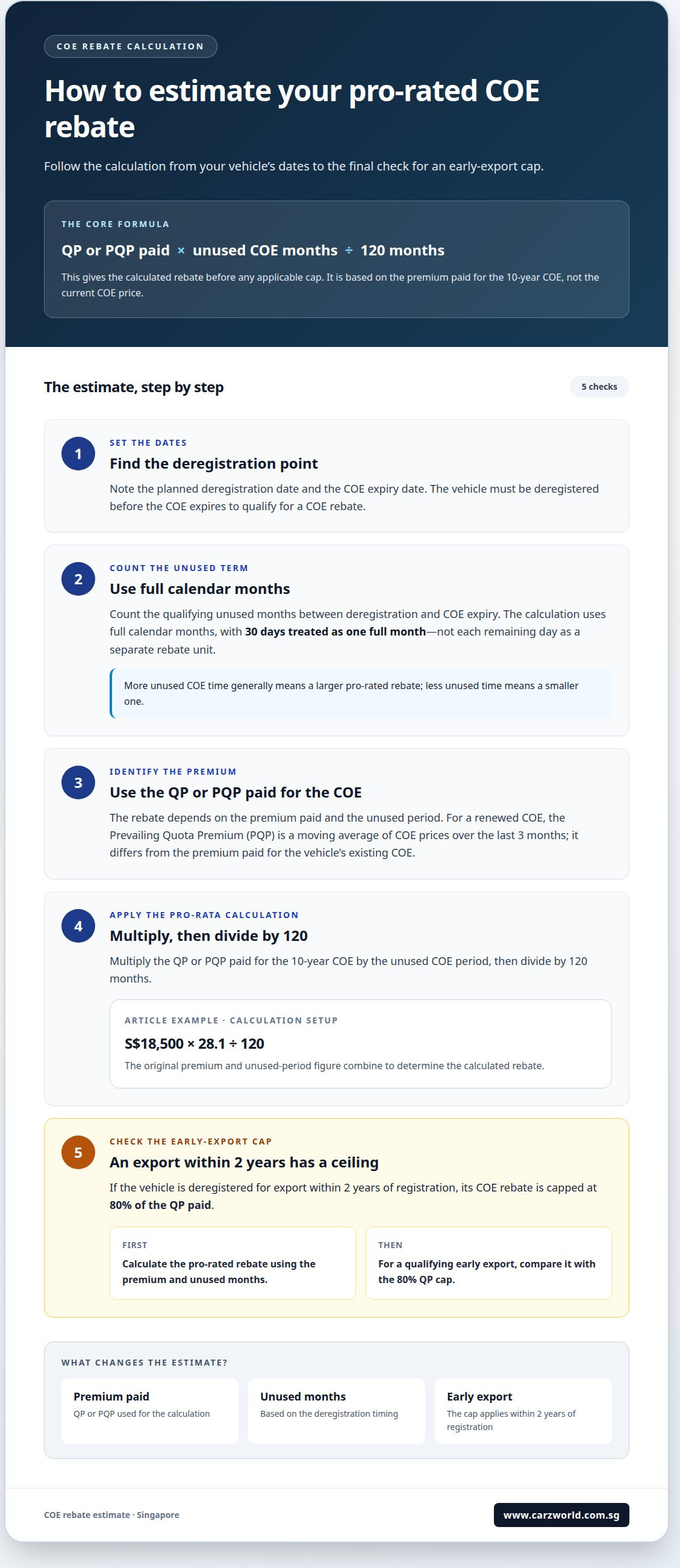
In Singapore, estimate your vehicle’s COE rebate by multiplying the QP or PQP paid for its 10-year COE by the unused COE period, then dividing by 120 months. The amount depends on the premium paid and remaining time before the COE expiry date; early export within 2 years of registration also brings an 80% cap based on the QP paid.
Determining the Unused COE Period
The unused COE period is the remaining COE term when the vehicle is deregistered. It matters because more unused time generally produces a larger pro-rated rebate, while less time produces a smaller one. In Singapore, the calculation uses full calendar months, with 30 days counted as one full month. The vehicle’s registration date and COE expiry date help establish the term still unused at deregistration.
To estimate the rebate, identify your planned deregistration date and count the qualifying unused months up to the COE expiry date. Use the full-calendar-month method rather than treating each remaining day as a separate rebate unit. The unused-month count and COE premium are both important inputs. Even a small change in the unused period affects the result because the formula allocates the premium across the COE term.
Applying the Pro-Rata Rebate Calculation
The pro-rata calculation allocates the premium paid across 120 months, then applies the unused months. Multiply the QP or PQP paid for the 10-year COE by the unused COE period, then divide by 120. The result is the calculated rebate before any applicable cap. This method links the estimate to the premium actually paid, not the current COE price.
For example, a vehicle’s calculated COE rebate depends on its original premium and unused COE period. The arithmetic is S$18,500 multiplied by 28.1, divided by 120. This example shows how the unused period and original premium combine. A different premium or unused-month figure changes the outcome.
Understanding the COE rebate for early deregistration also means accounting for the export cap. If a vehicle is deregistered for export within 2 years of registration, its COE rebate is capped at 80% of the QP paid. The pro-rated calculation provides an estimate, while the cap limits the rebate for qualifying early exports. Compare the calculated amount with that ceiling when estimating the rebate.
Deregistration must take place before the COE expires for the vehicle to qualify for a COE rebate. Use the planned deregistration date when estimating the remaining term, since the unused period is tied to that timing. If you are considering an export, include both the 2-year registration threshold and the 80% cap in your calculation. That gives you a clearer estimate before making a disposal decision.
Checking rebate details before deregistration
Whether early deregistration makes financial sense depends on the rebate, your vehicle’s sale value, and the alternative of renewing its COE. Compare the potential rebate with likely sale proceeds and the cost of keeping the vehicle after renewal. The better option depends on your plans and the vehicle’s remaining COE term.
Start with the vehicle’s registration date and COE expiry date. These dates help establish which rebate rules apply and how much COE time remains. Then identify the QP or PQP used for the COE. A renewal uses the Prevailing Quota Premium, which is a moving average of COE prices over the last 3 months. This differs from the premium paid for the vehicle’s existing COE.
Review PARF separately from the COE rebate. PARF eligibility and amount depend on the car’s registration and deregistration details. For cars registered before Feb 2023, the stated PARF rebate for deregistration at no more than 5 years old is 75% of ARF paid, with no rebate cap. A car deregistered more than 10 years after registration receives no PARF rebate.
- Confirm the dates: Note the registration date, planned deregistration date, and COE expiry date.
- Identify the premium: Use the QP or PQP relevant to the COE calculation, not a current bidding price.
- Review PARF eligibility: Consider the car’s age at deregistration and the schedule that applies to its registration.
- Compare options: Set the rebate against likely sale proceeds or the cost and intended use of a renewed COE.
Renewal can extend a vehicle’s COE for 5 or 10 years. A 5-year renewal cannot be renewed again. Consider how long you intend to keep the vehicle, along with the applicable PQP, before choosing renewal over deregistration. A rebate estimate alone doesn’t show the full financial effect of continuing to own and use the car.
For a sale comparison, consider the amount you could receive for the vehicle alongside any rebate available through deregistration. The right comparison is between the outcomes available to you, not simply the rebate and the original purchase price. If selling is one option, review the steps for selling your vehicle as part of that decision.
Before deciding, bring together the relevant dates, premium basis, PARF eligibility, and your intended next step. This makes it easier to see what affects the rebate and whether renewal or sale better fits your plans. If you are considering early export, also factor in the separate COE rebate cap discussed in this guide.
Disposal documents and submission deadlines
In Singapore, your disposal route determines where to send documents and when to present the vehicle. To deregister early and claim rebates, complete deregistration, follow the document process for your chosen disposal route, and apply to encash the rebate before the applicable deadline.
For a PARF-eligible vehicle exported from Singapore, upload the disposal documents to LTA within 1 month from the deregistration date. The deadline runs from deregistration, not from the date the vehicle reaches its destination. Keep the submission timeline tied to the recorded deregistration date so the export paperwork does not slip beyond the required period.
Owners exporting a vehicle who aren’t eligible for Singpass must submit disposal documents to the LTA Customer Service Centre within 1 month from deregistration. This is a separate submission route for owners without Singpass eligibility. Plan around the same one-month window, and make sure the documents relate to the vehicle’s export and deregistration.
For a non-PARF-eligible vehicle authorised for disposal at an LTA-appointed scrapyard or Export Processing Zone, the vehicle must be brought to that location within 8 calendar days. This is a physical delivery deadline, distinct from the one-month document deadline for exported PARF-eligible vehicles. Confirm which disposal category applies before arranging transport, because the deadline and required action differ.
- For a PARF-eligible export: Upload the disposal documents to LTA within 1 month from deregistration.
- For an export without Singpass eligibility: Submit the documents to the LTA Customer Service Centre within 1 month from deregistration.
- For an authorised non-PARF disposal: Bring the vehicle to the appointed scrapyard or Export Processing Zone within 8 calendar days.
Keep the original disposal records and copies of submitted documents together. Calculate the relevant deadline from the vehicle’s deregistration date, and retain proof of submission or delivery. These records help establish whether export documents were submitted or the vehicle reached its appointed disposal location on time.
Disposal paperwork and rebate encashment are related but separate tasks. According to the Land Transport Authority of Singapore, an application to encash PARF or COE rebates must reach LTA within 12 months of the vehicle’s deregistration date. Completing the export document process doesn’t itself replace that application. Keep both deadlines on your timeline, since one concerns disposal and the other concerns receiving the rebate.
For example, an owner exporting a PARF-eligible vehicle must track the one-month document deadline from deregistration, then separately track the 12-month encashment deadline. An owner using an LTA-appointed scrapyard for an authorised non-PARF vehicle instead needs to meet the 8-calendar-day delivery deadline. Identifying the route first helps prevent applying the wrong deadline to the disposal.
Encashing or using rebates after deregistration
After deregistration, you can apply to encash eligible PARF or COE rebates, or use a rebate towards another vehicle. The Land Transport Authority of Singapore requires an encashment application to reach LTA within 12 months of the vehicle’s deregistration date. The deadline applies to the application’s arrival, so submitting it near the end leaves little room for delays.
How long does LTA take to pay a COE rebate? For an online encashment without a valid GIRO refund bank account, the rebate is credited through PayNow within 14 working days. This stated timeframe applies to that payment method and account situation; it shouldn’t be assumed for other payment arrangements.
Eligible claimants can encash a COE rebate online using Singpass. If you aren’t eligible for Singpass, you can apply at an LTA counter. Choose the route that fits your eligibility, and keep the deregistration date in view when planning the application. The 12-month window is the key deadline for encashment.
Taking a rebate as an offset rather than cash may suit someone registering another vehicle. A COE rebate can offset the PQP for another vehicle, but a PARF rebate cannot. The two rebate types therefore serve different purposes, even when both are available after deregistration.
- Encashment: Submit an application that reaches LTA within 12 months of deregistration.
- Online claim: Use Singpass if eligible; PayNow applies within 14 working days when there’s no valid GIRO refund bank account.
- Use towards another vehicle: A COE rebate may offset PQP, but a PARF rebate cannot.
Check the rebate’s validity period before deciding whether to encash it or use it towards another vehicle. Keep that expiry period separate from the payment timeline: the validity period determines how long you have to act, while 14 working days describes a particular PayNow credit timeframe. An unused rebate expires when its validity period ends.
Before choosing, consider whether you need cash or expect to register another vehicle within the rebate’s validity period. If you plan to offset a future registration cost, note which rebate you hold and what it can be used for. A COE rebate may be used towards the PQP for another vehicle; a PARF rebate can’t. Applying within the 12-month window preserves the available encashment option.
Keep the vehicle’s deregistration date and rebate type with your application records. These details help you track the deadline and distinguish a COE rebate from a PARF rebate. For online encashment without valid GIRO details, also account for the 14-working-day PayNow credit period when planning your finances.
What are the current rules and eligibility requirements for COE rebates in Singapore?
COE and PARF rebates have different eligibility rules in Singapore. To qualify for a COE rebate, deregister the vehicle before its COE expires. PARF eligibility depends on factors such as the car’s registration history and age at deregistration.
For PARF eligibility, a car must have been registered new, or as a used imported car registered on or after 1 September 2007. A car that has been laid up doesn’t meet the stated PARF eligibility criteria. These conditions matter separately from the COE rebate, which is tied to the vehicle’s remaining COE term.
Registration timing also determines which PARF schedule applies. For cars registered between Feb 2023 and Feb 2026, the stated PARF rebate cap is S$60,000. According to the Land Transport Authority of Singapore, for cars registered from Feb 2026 onwards, Singapore’s PARF rebate is capped at S$30,000.
- Cars registered before February 2026: At no more than 5 years old, the stated PARF rebate is 75% of ARF paid. From 5 to 10 years old, the percentage decreases by 5 percentage points for each completed age band.
- Cars registered from February 2026: The schedule starts at 30% of ARF paid for deregistration at no more than 5 years old, then decreases by 5 percentage points for each age band through 10 years.
- COEs obtained from the second February 2026 bidding exercise onwards: The revised PARF schedule applies to cars with these COEs.
For the revised schedule, the listed percentages are 30% at no more than 5 years, then 25%, 20%, 15%, 10%, and 5% across successive age bands up to 10 years. Each percentage is subject to the S$30,000 cap. For cars registered before February 2026, a car deregistered after 9 and up to 10 years old receives 50% of ARF under the stated schedule.
Age at deregistration changes the PARF amount. A car deregistered more than 10 years after registration receives no PARF rebate. Taxis must be deregistered within their statutory lifespan of 8, 9 or 10 years to qualify for PARF. Check the applicable registration schedule against the car’s age before comparing rebate outcomes.
For an early export, the COE rebate has a separate limit: deregistration within 2 years of registration caps it at 80% of the QP paid. Keep that export rule distinct from the PARF cap, since they apply to different rebate calculations. If a vehicle change is part of your decision, explore vehicle options alongside the rebate rules.
Carz World Pte Ltd
If deregistration leads you to consider exporting your vehicle or choosing what to drive next, Carz World Pte Ltd offers relevant options. Its Car Export Services are for owners considering export, while Pre-Owned Cars, Brand New Cars, and Car Rental can meet different vehicle needs.
Use your rebate estimate, eligibility, and deadlines to guide your decision before choosing your next move. If you are weighing export against another vehicle option, Carz World Pte Ltd can help you explore its relevant offerings. LTA rules still determine your rebate.
Contact Carz World Pte Ltd to discuss which vehicle option fits your plans.
Make Your Next Vehicle Decision With Clarity
Understanding the COE rebate for early deregistration can help you make a decision that fits your next stage, whether you plan to replace your vehicle, use temporary transport, or stop owning a car. Consider the rebate alongside your wider transport needs instead of treating the amount as the only factor.
Carz World Pte Ltd offers Pre-Owned Cars, Brand New Cars, and Car Rental to meet different vehicle needs. These options can help you plan what comes after deregistration, while LTA rules govern the rebate process. Choose the path that suits your plans and take the next step at your own pace.
Contact Carz World Pte Ltd to discuss your next vehicle option and move forward with a choice that works for you.
Frequently Asked Questions
What is a COE rebate for early vehicle deregistration in Singapore?
A COE rebate is the unused portion of the premium paid for a vehicle’s Certificate of Entitlement. Early deregistration can make a rebate available if it happens before the COE expires. The amount is separate from the vehicle’s resale value and any PARF rebate. For an early export within 2 years of registration, the COE rebate is capped at 80% of the QP paid.
How is the COE rebate calculated when a vehicle is deregistered early?
The calculation uses the QP or PQP paid for the 10-year COE and the vehicle’s unused COE period. Multiply the premium by the unused months, then divide by 120. For instance, if deregistration happens earlier than planned, the unused period may be longer, increasing the calculated amount before any applicable cap. The vehicle must be deregistered before its COE expires to qualify.
What is the COE rebate formula based on the remaining COE period?
The formula is: COE premium paid × unused COE months ÷ 120 months. Use the QP or PQP that applies to the vehicle’s COE, not a current bidding price. The unused period is counted in full calendar months, with 30 days treated as one full month. This gives a pro-rated estimate; an early-export cap may limit the amount.
How do I check my vehicle’s COE rebate amount using LTA services?
Use the vehicle’s COE premium and remaining COE period to prepare an estimate, then use LTA’s online rebate process to encash the rebate with Singpass if eligible. If you are not eligible for Singpass, you can apply at an LTA counter. Keep the deregistration date and vehicle details handy when making the claim, as they determine the rebate and application deadline.
What happens to the COE rebate if I export, scrap, or transfer ownership of my vehicle?
Exporting within 2 years of registration caps the COE rebate at 80% of the QP paid. Scrapping or another disposal route doesn’t remove the need to meet the rebate’s eligibility and claim requirements. A vehicle ownership transfer is different from transferring a rebate.
What are the risks, deadlines, or forfeiture rules for claiming a COE rebate?
A COE rebate requires deregistration before the COE expires. The Land Transport Authority of Singapore requires an application to encash PARF or COE rebates to reach LTA within 12 months of the vehicle’s deregistration date. PARF and COE rebates are valid for 12 months from deregistration, so an unused rebate expires after that period. Export disposal documents have their own submission deadlines.
Disclaimer
This content is provided for general informational purposes only. Readers are encouraged to independently verify important information.
In Same Category
- COE Rebate for Early Deregistration: How Much Can You Get Back
- Pre-owned cars with memory seats in Singapore: asking prices
- How to Check If You Can Use CPF to Pay for COE Renewal
- Luxury pre-owned cars Toa Payoh: Compare listings, mileage and prices
- Is a Car an Asset or a Liability in Singapore? How It Affects Your Net Worth
Related by Tags
- COE Rebate for Early Deregistration: How Much Can You Get Back
- How to Plan for Your 5-Year COE Renewal to End
- Risks of Buying a Car with 1 Year of COE Left in Singapore (2026 Guide)
- Best Time to Renew COE in 2026: A Practical Singapore Guide
- COE Renewal for 5 Years vs 10 Years: Pros and Cons in Singapore
- Scrap Car vs Export Car in Singapore: How to Choose the Better Option
- Pros and Cons of Buying a High PARF Car in Singapore
- Scrapping Your Car Before 10 Years in Singapore: What Happens?
- Calculating the Breakeven Point for COE Renewal in Singapore
- COE Renewal Conditions and Eligibility in Singapore: 2026 Guide