Pros and Cons of Buying a High PARF Car in Singapore

Could a car with a larger PARF rebate still cost more to own? The pros and cons of buying a high PARF car depend on more than its potential rebate. Depreciation, the time left before COE expiry and how long you plan to keep the car all affect the calculation.
A higher rebate can look like a useful safety net, but PARF rates depend on a car’s age and registration details. Revised rates apply to cars with COEs obtained from the second February 2026 bidding exercise onwards. As a result, two similar-looking cars may have different rebate prospects and ownership costs.
This guide explains the main advantages and drawbacks of high PARF cars in Singapore. You’ll learn how PARF value changes as a car ages, why COE timing matters and how to compare a high PARF car with a lower PARF or renewed-COE car. We’ll also look at ownership timelines and exit options to help you judge whether the car’s potential value fits your budget and plans.
Key Takeaways
- Understand how a car’s age, ARF paid and applicable LTA rules shape its potential PARF rebate.
- Weigh the possible rebate and remaining COE against the car’s purchase price and depreciation.
- Use your intended ownership period to compare high PARF, lower PARF and renewed-COE cars.
- The pros and cons of buying a high PARF car become clearer when you compare likely costs and exit options, not just the potential rebate.
- Before deciding, check the vehicle’s registration details, ARF information and COE expiry, then compare realistic ownership scenarios.
What does high PARF mean when buying a car in Singapore?
PARF stands for Preferential Additional Registration Fee. It’s a rebate that may be payable when an eligible car is deregistered. The amount depends on the ARF paid, the vehicle’s age and the rules that apply to its registration. Buyers use “high PARF” to describe a car with a potentially substantial rebate, but the phrase doesn’t promise a particular payout.
PARF value is a potential deregistration rebate, not the car’s market price or a guaranteed resale profit. The asking price reflects the seller’s valuation of the vehicle, while its potential PARF rebate is determined under LTA rules. A large rebate figure alone doesn’t show whether the total purchase price represents good value.
How PARF, ARF and COE relate to one another
ARF is a vehicle registration tax calculated using the car’s Open Market Value. The ARF paid matters because the PARF rebate is calculated as a proportion of it, subject to the applicable age-based rate and any cap. The Certificate of Entitlement (COE), by contrast, sets the permitted registration period. Its remaining time is separate from the PARF calculation.
Some listings use “paper value” to mean the potential PARF rebate plus any remaining COE rebate. Paper value is not the same as the vehicle’s advertised price. A renewed-COE car is different again: once a car’s COE has been renewed after 10 years, it is no longer eligible for a PARF rebate. Renewal and deregistration therefore involve different ownership and exit considerations.
What makes a car high PARF?
In everyday buying language, a high PARF car is generally an eligible car with a meaningful potential rebate remaining. The amount depends on its registration details, ARF paid and age when it is deregistered. A younger eligible car may fall into a higher rebate band than an older one, but the actual figure is specific to that vehicle. “High” is a useful comparison, not a guarantee of value.
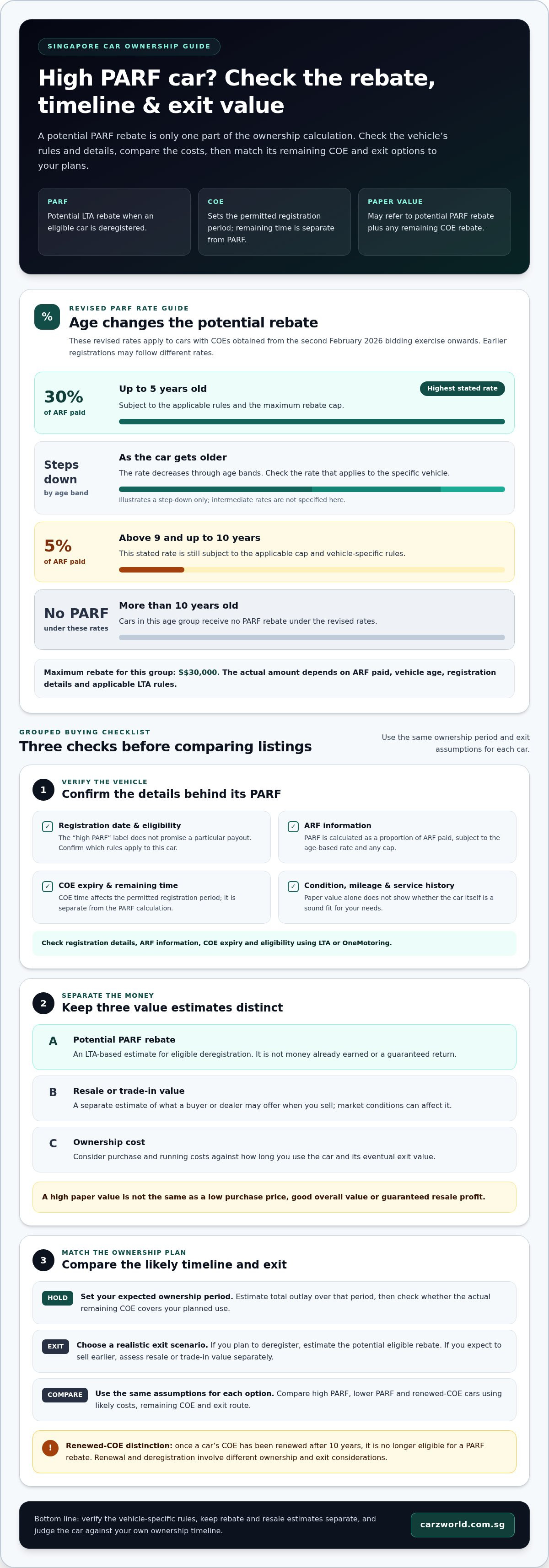
For cars with COEs obtained from the second February 2026 bidding exercise onwards, revised PARF rates apply. The rebate is 30% of ARF paid at up to 5 years old, then steps down through age bands to 5% above 9 and up to 10 years. Cars more than 10 years old receive no PARF rebate under these rates. The maximum rebate for this group is capped at S$30,000. Earlier registrations may be subject to different rates, so don’t assume the revised schedule applies to every used car.
Before comparing listings, verify the vehicle’s registration date, ARF information, COE expiry and eligibility using LTA or OneMotoring. The applicable treatment depends on the individual vehicle and the rules that apply to it. These details are the starting point for assessing the pros and cons of buying a high PARF car, before weighing its price against how long you plan to own it.
The pros of buying a high PARF car: value, age and flexibility
A high PARF car can have a useful exit-value component if you deregister it while it remains eligible. That possibility can help you plan ownership costs, especially if you already have a rough idea of when you expect to change cars. But the rebate is only one part of the decision. The purchase price, depreciation and the car’s condition still determine whether it represents good value overall.
Potential residual value at deregistration
Include a potential PARF rebate in your exit estimate, but don’t treat it as money you have already earned. A private resale or trade-in value is a separate figure, influenced by the car and the market when you sell. For a fair comparison, use LTA’s current calculation for the specific vehicle, then assess its resale or trade-in value separately.
This distinction helps you compare different ownership paths. If you plan to keep a car for a defined period and then deregister it, an eligible rebate may form part of your estimated return at that point. If you expect to sell earlier, compare the estimated market value instead. Neither figure is certain: eligibility, applicable rules and market conditions can affect the outcome.
To compare options, estimate your total outlay over the period you expect to own the car, then assess likely exit routes. Keep these figures separate:
- Potential PARF rebate: an LTA-based estimate for eligible deregistration.
- Resale or trade-in value: an estimate of what a buyer or dealer may offer when you sell.
- Ownership cost: purchase and running costs considered against the period you use the car and its eventual exit value.
Keeping these figures distinct helps prevent a high paper value from making a car seem more affordable than it is.
A newer car and a clearer ownership window
A newer vehicle may have more COE time remaining than an older alternative, giving you a longer window before its current COE expires. Compare the actual remaining duration and vehicle age rather than assuming a larger PARF figure means more usable time. If you have a clear ownership end point in mind, check whether the car’s remaining COE covers your planned use.
Knowing when you expect to reassess or exit gives you a practical basis for budgeting. Consider whether the remaining COE fits your plans and whether you’re more likely to resell, trade in or deregister the car. This won’t remove uncertainty, but it helps you compare options consistently. The pros and cons of buying a high PARF car are easier to judge when the potential rebate fits your ownership plan rather than driving it.
PARF eligibility doesn’t tell you whether the car itself is a sound purchase. Review its condition, mileage and service history alongside its age and COE details. Two cars with similar paper values can still differ in how well they suit your needs and expected use. Once you’ve set your budget and holding period, browse pre-owned car options as part of your comparison.
The cons of a high PARF car: depreciation, price and rule-sensitive value
A higher potential PARF rebate can look reassuring, but it doesn’t automatically make a car the better buy. Consider the purchase price, how quickly the car may depreciate and how much of its current COE period will remain while you own it. A rebate may form part of your eventual exit value, but it can’t by itself make up for paying too much upfront.
Compare total ownership assumptions, not headline PARF value alone. Estimate your likely costs and exit route over the period you expect to own the car, then compare those assumptions with another vehicle. The pros and cons of buying a high PARF car depend on the specific vehicle and your plans, not just the figure shown in a listing.
Why a high PARF figure can create a misleading impression
A potential PARF rebate is not guaranteed resale proceeds or an investment return. It may matter if you deregister an eligible car, but it won’t tell you what a buyer may pay if you sell or trade it in. Your intended exit date matters: a rebate estimate is less relevant if you expect to sell before deregistration, while a later exit could fall under different age-based rules.
Registration details also matter. Cars can receive different PARF treatment depending on the COE obtained for them and the rules that apply to that vehicle. Don’t transfer a figure quoted for one car to another just because the models, ages or asking prices seem similar. Check the vehicle’s records and use current LTA information for your estimate.
Depreciation and COE timing risks
Depreciation is the value lost over the time you own the car. A high potential rebate doesn’t cancel that loss, and a higher purchase price may still leave you with a higher overall cost. Compare expected depreciation over your planned ownership period instead of treating the potential rebate as a discount on today’s asking price.
COE timing adds another constraint. If expiry is approaching, you may have less time to use the car before deciding whether to sell, deregister or consider an available renewal route. These choices affect your budget and exit plan. A car with less remaining COE may not suit a buyer whose intended holding period extends beyond that window.
Renewed-COE cars need a separate comparison. They have different PARF treatment, and a car whose COE has been renewed after 10 years is no longer eligible for a PARF rebate. Don’t compare its price with an eligible PARF car as if both offer the same deregistration value. Verify the specific vehicle’s status and applicable LTA rules before relying on an estimate.
Before deciding, write down your expected purchase outlay, ownership duration, likely exit route and estimated depreciation. Then assess potential PARF value as one conditional part of the picture. This makes the trade-offs clearer and keeps a prominent rebate figure from overshadowing the costs and timing that matter to you.
How to compare a high PARF car with other Singapore car options
Compare three options side by side: a high PARF car, a lower PARF car and a car with a renewed COE. The right choice depends on more than the potential rebate. Compare each vehicle’s purchase price, remaining COE, possible deregistration value and fit with your planned holding period. Use the table as a starting framework, then check the details of each car you’re considering.
| Option | Purchase price | Remaining COE | Potential deregistration value | May suit |
|---|---|---|---|---|
| High PARF car | Compare the asking price with the car’s age, condition and estimated ownership cost. | Check the actual COE expiry date and how it fits your planned use. | Potential PARF rebate if eligible, subject to vehicle details and applicable rules. | Buyers whose expected exit plan and holding period align with the car’s remaining COE. |
| Lower PARF car | Assess whether its price reflects its age, condition and lower potential rebate. | Compare its remaining COE directly with the high PARF option. | Potential rebate may be lower; verify the vehicle-specific estimate. | Buyers who prioritise the overall purchase and ownership calculation over a larger rebate. |
| Renewed-COE car | Compare the asking price and expected ownership costs on their own terms. | Check the current COE period and applicable renewal details. | Different PARF treatment applies; don’t assume a PARF rebate is available. | Buyers considering a different ownership timeline and exit plan. |
Which option fits your ownership timeline?
If you expect to own the car for a shorter period, focus on near-term depreciation and the exit route you’re most likely to use. A potential deregistration rebate may matter less if you plan to sell before deregistration. For longer ownership, compare your planned holding period with the remaining COE and consider the choices you’ll face as expiry approaches. If your plans are uncertain, compare more than one exit scenario instead of relying on a single future-value estimate.
A simple total-ownership comparison
Use the same assumptions for every vehicle. Record the purchase outlay, any financing assumptions that apply to you, your expected holding period and likely exit route. Estimate depreciation and potential exit value separately. Keep running costs on their own line so they don’t blur the comparison between PARF and resale estimates. The aim isn’t to predict an exact future price. It’s to see which option remains suitable across reasonable scenarios.
This framework makes the pros and cons of buying a high PARF car easier to weigh against alternatives. Once you’ve set your budget and timeline, compare pre-owned cars using each vehicle’s actual details. Review current LTA information for PARF eligibility and COE treatment. Explore car options that fit your comparison.
A practical high PARF car buying checklist and next steps
A clear process helps keep a large potential rebate from overshadowing the details that affect your ownership experience. Start with how long you expect to keep the car, then check its records, compare realistic cost scenarios and narrow your choices by budget and use. The pros and cons of buying a high PARF car are easier to assess when you consider the vehicle details alongside your own plans.
Five checks before committing to a high PARF car
Work through these checks for each car on your shortlist. Applying the same approach to every option makes it easier to compare like with like instead of relying on a prominent PARF figure.
- Set your ownership period. Decide how long you expect to use the car and whether you’re more likely to sell, trade it in or deregister it at the end.
- Verify its key dates. Check the registration date, COE expiry and the vehicle’s PARF eligibility details.
- Review the rebate basis. Confirm the ARF information and use current LTA or OneMotoring guidance to understand the treatment that applies to this specific vehicle.
- Assess the car itself. Compare its condition, mileage and service history with its asking price. A favourable rebate estimate doesn’t replace a careful vehicle review.
- Model your exit scenario. Apply consistent assumptions to your holding period, expected depreciation and likely exit route. Keep possible PARF value separate from estimated resale or trade-in proceeds.
These checks distinguish details you can verify now, such as registration and COE dates, from future estimates that may change. If information in a listing differs from the vehicle record, use the applicable LTA information to assess eligibility and potential rebate.
Turn your comparison into a shortlist
Remove cars that don’t fit your budget, intended ownership period or daily needs. Then compare the remaining options using the same assumptions for purchase outlay, time owned and exit route. This makes it easier to see whether a high PARF car suits your situation better than a lower PARF or renewed-COE alternative.
Keep the shortlist practical. Note each car’s asking price, remaining COE, condition, mileage, service history and verified PARF details in one place. If your plans are flexible, consider more than one possible exit route instead of relying on a single projected value. A car that looks attractive under only one assumption may not be the strongest fit overall.
Once you’ve set your budget and ownership timeline, browse pre-owned cars as a starting point for comparing vehicles. If you’re replacing your current car, Carz World also offers car purchase and consignment services. Compare the details and choose the option that fits your plans as well as your numbers.
Choose the car that fits your next chapter
The right decision comes from matching the car to the way you’ll use it, not chasing the largest projected value. Set your budget and ownership timeline first, then compare vehicles using the same assumptions. That gives you a clearer basis for weighing the pros and cons of buying a high PARF car against other options.
Once you have a shortlist, compare pre-owned and brand-new cars from Carz World with your priorities in mind. If you’re also planning to move on from your current vehicle, Carz World provides car purchase and consignment services to support that next step.
Explore car options with Carz World and take the next step at a pace that feels right. A considered comparison can help you choose with confidence.
Frequently Asked Questions
Is buying a high PARF car worth it?
It can be, if the car’s price, condition and remaining COE suit your budget and expected ownership period. For example, someone planning to keep a car until deregistration may value a potential rebate differently from a buyer who expects to sell earlier. Compare the likely total cost under your own exit plan. The pros and cons of buying a high PARF car depend on those assumptions, not the rebate label alone.
How is the PARF rebate calculated in Singapore?
The rebate is based on a percentage of the ARF paid, subject to the vehicle’s age, eligibility and applicable cap. For cars with COEs obtained from the second February 2026 bidding exercise onwards, rates range from 30% of ARF at up to 5 years old to 5% above 9 and up to 10 years old; the cap is S$30,000. Other registration cohorts may follow different rates, so check LTA’s vehicle-specific calculation.
Can I get a PARF rebate if I renew my car’s COE?
No PARF rebate is available after a car’s COE has been renewed after 10 years, according to the applicable PARF rules. Renewal changes the vehicle’s status for PARF purposes, so don’t treat a potential rebate shown before renewal as an amount you can still claim afterward. Before choosing a renewal or deregistration route, review the car’s current status and applicable LTA guidance.
What happens if I keep a high PARF car until its COE expires?
At COE expiry, consider whether you’ll deregister the car or renew its COE under the rules then in force. If you deregister, any PARF rebate depends on eligibility and the car’s age and records at that time. If you renew after 10 years, it won’t remain PARF-eligible. Check the specific expiry date and LTA instructions before making plans, especially if your decision is close to the deadline.
Is a high PARF car better than a renewed-COE car?
Neither option is automatically better. A high PARF car may offer a potential rebate if it is eligible and deregistered, while a renewed-COE car has different PARF treatment and may suit a different ownership plan. Compare each car’s price, condition, remaining COE period and likely exit route. A buyer planning to keep a car longer may weigh those factors differently from someone expecting to change cars sooner.
What should I check before buying a high PARF car?
Check the registration date, ARF information, COE expiry and vehicle-specific PARF eligibility using LTA or OneMotoring records. Then compare the car’s condition, mileage and service history with its asking price. Finally, estimate costs for your intended holding period and consider whether you’re more likely to sell, trade in or deregister. Use the same assumptions for each shortlisted car so the comparison stays fair.
Disclaimer
This content is provided for general informational purposes only. Readers are encouraged to independently verify important information.
In Same Category
- Pros and Cons of Buying a High PARF Car in Singapore
- Car Valuation Services in Bukit Merah: A Seller’s Guide
- Scrapping Your Car Before 10 Years in Singapore: What Happens?
- Calculating the Breakeven Point for COE Renewal in Singapore
- Financial Checklist Before Committing to a Car Purchase in Singapore (2026)
Related by Tags
- Pros and Cons of Buying a High PARF Car in Singapore
- Car Valuation Services in Bukit Merah: A Seller’s Guide
- Scrapping Your Car Before 10 Years in Singapore: What Happens?
- Calculating the Breakeven Point for COE Renewal in Singapore
- COE Renewal Conditions and Eligibility in Singapore: 2026 Guide
- Used Electric Cars in Singapore: 2026 Buyer's Guide
- Electric Vehicle Guide 2026: Types, Charging and Buying in Singapore
- COE Results Singapore: How to Read the Latest Bidding Outcomes in 2026
- Singapore Car Loan Guide for EP Holders (2026)
- Mazda CX-5 Singapore Review: Buyer Guide, Specs & Ownership (2026)
- Calculating the Real 5-Year Cost of Car Ownership in Singapore (2026 Guide)
- Parallel Import Singapore: The Ultimate 2026 Buyer’s Guide
- Buying a Used Car in Singapore: 2026 Ultimate Guide
- How to Buy a Car in Singapore: The Ultimate 2026 Step-by-Step Guide