Risks of Buying a Car with 1 Year of COE Left in Singapore (2026 Guide)

A low asking price can hide an expensive next decision. The risks of buying a car with 1 year of COE left are less about the time remaining today and more about what you’ll need to do when the COE expires. Before committing, consider whether renewal, deregistration or replacing the car will fit your budget and plans.
The purchase price is only one part of the calculation. COE renewal brings an additional cost, while an older car may also mean higher road tax and more frequent inspections. Financing and resale can be harder to assess when the car’s remaining time on the road is limited. A low price may still make sense, but only if you have a practical plan for the end of the current COE term.
This guide covers the financial and ownership trade-offs, including what to consider before renewal or deregistration. It also offers a framework for comparing a short-COE car with other pre-owned options or a brand-new car. Compare total costs, your likely ownership period and your next step, rather than judging the decision by the asking price alone.
Key Takeaways
- The risks of buying a car with 1 year of COE left depend on your ownership plans, not just the car’s asking price.
- Separate the COE expiry date from the vehicle’s age, condition and registration details when assessing its remaining usefulness.
- Compare buying a short-COE car, renewing its COE and choosing a vehicle with more COE by ownership horizon, decision timing and flexibility.
- Review the car’s official registration and COE details against current LTA guidance before deciding on renewal or deregistration.
- Use your end-of-COE plan to compare pre-owned alternatives and decide what to assess next.
What does buying a car with 1 year of COE left mean?
In Singapore, the Certificate of Entitlement (COE) gives the holder the right to own and use a vehicle for a set period. A car described as having one year of COE left has roughly a year remaining on its current certificate before it expires. This describes the COE term, not the car’s age or mechanical condition. Understanding the Certificate of Entitlement (COE) system in Singapore helps put the remaining time in context.
A one-year-COE car has about a year left on its current entitlement, so buyers need to plan for what happens at expiry before judging its value. The car could be older or newer than you expect, and its registration details and condition need separate review. The asking price alone won’t tell you how long it will suit your needs or what decision you’ll face next. That’s why the risks of buying a car with 1 year of COE left depend on more than the deal in front of you.
For a visual overview of the decision, watch this video:
What changes when the COE is close to expiry?
An approaching expiry creates a decision point; it doesn’t automatically make the car worthless or unusable before that date. What happens after expiry depends on the owner’s next action and the rules that apply at the time. Renewal or deregistration may be options, but eligibility, deadlines and requirements are subject to current LTA guidance.
Before relying on a date in an advertisement or sales discussion, compare it with the vehicle’s official records and relevant LTA information. Confirm the exact COE expiry date and understand the steps and timing that apply to that vehicle. This helps you avoid treating an approximate description as a complete ownership plan.
Why the remaining COE term matters to a buyer
Start with your intended ownership horizon. If you need a car for a short, defined period, the remaining term may align with your plans. If you expect to keep it longer, work out what decision you’ll face at expiry and whether you’re prepared for that outcome. Don’t assume renewal will automatically be affordable or suitable.
Then compare the vehicle’s current condition with the time you expect to use it. A well-presented car still needs careful assessment, and a car that suits your immediate needs may not fit your longer-term plans. Practical usefulness today and future resale or renewal value are separate questions. Treat resale assumptions as uncertain, considering the remaining COE, the car’s condition and your likely next step.
- Check the exact COE expiry date, rather than relying only on a rounded “one year left” description.
- Assess the car’s condition and registration details separately from its COE term.
- Decide how long you need the car and what you would do when the current COE ends.
The main risks of buying a car with 1 year of COE left
The main risks of buying a car with 1 year of COE left come from having little time to decide what happens next. A low purchase price may be offset by renewal costs, replacing the car sooner than planned or uncertainty about resale. None of these outcomes is guaranteed, but each can affect whether the car fits your budget and plans.
The remaining COE makes ownership a time-sensitive decision. Before buying, understand the options and requirements that may apply when the current term ends. Consider four areas:
- Financial exposure: Renewal may involve a substantial payment. Include it in your ownership planning rather than judging affordability by the purchase price alone.
- Limited ownership time: If you need a car beyond the current COE term, you’ll need a workable plan for renewal, replacement or another next step.
- Resale uncertainty: A future buyer’s interest and the amount you could sell for aren’t assured. The short remaining term can affect how you think about resale value.
- Decision pressure: Leaving the end-of-COE plan until later may narrow your practical choices and make it harder to arrange a replacement in time.
Renewal and end-of-COE uncertainty
Don’t treat renewal as automatic. Renewal options, eligibility, deadlines and requirements depend on the vehicle and current LTA rules. Check the relevant details on OneMotoring before committing, and base your decision on the rules and PQP that apply at the time, not an old estimate.
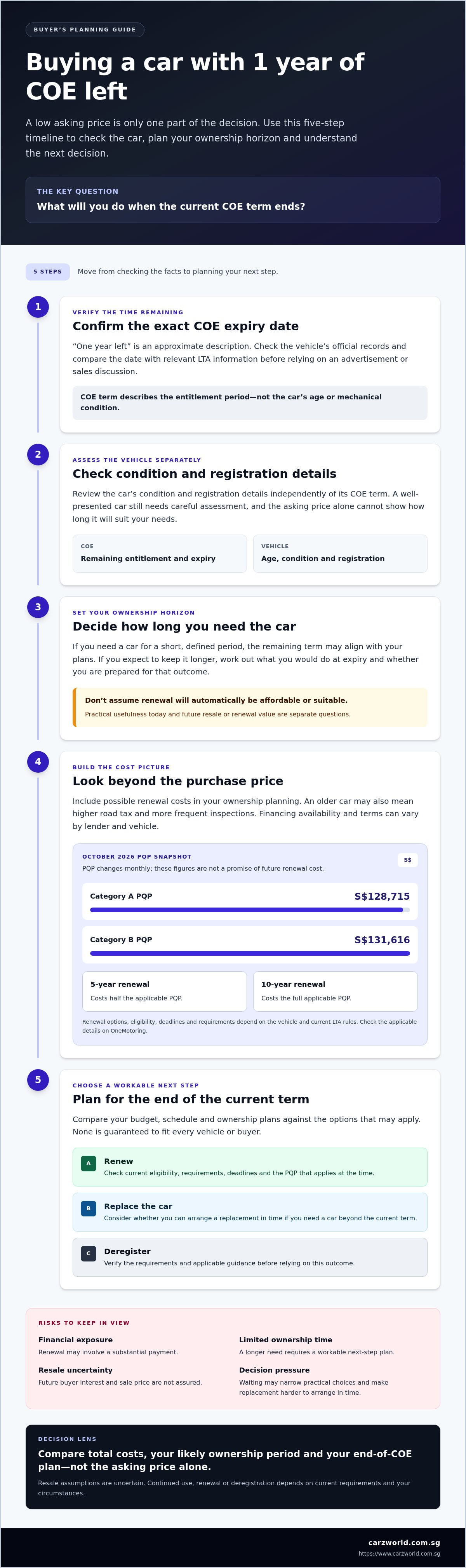
For context, October 2026 PQP for Category A cars was S$128,715, while Category B was S$131,616. A five-year renewal for either category costs half the applicable PQP, while a 10-year renewal costs the full amount. PQP changes monthly, so these figures are a snapshot, not a promise of future renewal cost.
Resale, financing and ownership-horizon concerns
Resale value and timing are uncertain, so avoid relying on a specific future sale price to make the purchase work. Financing availability and terms can also vary by lender and vehicle. Consider the remaining term alongside your intended holding period. If you need the car for longer, decide whether you can manage the next step if renewal isn’t suitable.
Compare the car’s likely practical use with the time you expect to keep it. If your plans could change, consider whether you have room in your budget and schedule to respond. Continued use, renewal or deregistration depends on current requirements and your circumstances, so verify the applicable LTA guidance before relying on a particular outcome.
Once you’ve mapped out your ownership horizon, compare it with other pre-owned car options at Carz World.
One year of COE left vs renewal or a longer-COE car
Compare the options by asking how long you need the car, when you must make the next decision and how much flexibility you want. A short-COE car can suit a defined, limited ownership period, but its asking price alone doesn’t show whether it fits. Renewal may extend the vehicle’s use, subject to current LTA rules and the specific car. A vehicle with more COE remaining gives you a longer current ownership horizon, though you should still assess its condition and total costs.
Use this framework to compare the paths without assuming one is automatically cheaper or better:
| Option | Ownership horizon | Decision timing | Uncertainty and flexibility |
|---|---|---|---|
| Buy with one year of COE left | Short under the current COE; your longer-term plan depends on what you do at expiry. | Plan for the end-of-COE decision from the start of ownership. | There’s less time before you need to act. It may fit a deliberate short-term need, but leaves less room to postpone planning. |
| Renew the COE | Potentially extends the period you can use the vehicle, depending on the renewal term available and applicable requirements. | Review renewal requirements and costs before the current COE expires. | Suitability depends on the vehicle, current LTA rules and your circumstances. Renewal isn’t an automatic assumption. |
| Choose a car with more COE remaining | A longer current COE term may better match a longer planned holding period. | The expiry decision is further away, although it still belongs in long-term planning. | More time before the next COE decision can offer flexibility, but doesn’t remove the need to assess condition, costs and future plans. |
For any option, compare the full ownership plan rather than a single headline figure. Consider what you’ll spend to buy and use the car, how long you expect to keep it, and what choices you could realistically make at the end of its current term. The risks of buying a car with 1 year of COE left are easier to judge when renewal and replacement are considered alongside the short-term use case.
When a short-COE car could fit your plans
A short-COE car may be worth considering if you need transport for a clearly limited period and can manage the end-of-COE decision within that plan. For example, someone with a temporary need for a car could compare the expected useful period with the time left on the COE. Don’t rely on a lower asking price alone; include the next step in your budget and schedule from day one.
When renewal or a longer-COE car may deserve comparison
If you expect to keep a car beyond the current COE term, compare renewal with buying a vehicle that already has more COE remaining. Check renewal options and requirements against current LTA guidance, and consider whether the particular car suits extended use. You can also compare pre-owned car options with brand-new cars, based on your planned ownership period and priorities.
Ask the same questions for each path: How long will I use it? What decision comes next, and when? What would make me change plans? Clear answers give you a more useful comparison than a decision based on the purchase price alone.
How to assess a one-year-COE car before you commit
A sound decision needs two separate reviews: confirm the COE and registration details, then assess the vehicle itself. One doesn’t prove the other. Use this process to check the facts, set your ownership plan and compare alternatives before committing. The risks of buying a car with 1 year of COE left are easier to manage when you record what you know, what you’re assuming and what still needs an answer.
- Verify the COE and registration details. Review reliable, current vehicle records for the exact COE expiry date and vehicle particulars. Compare these details with the sale information, then use LTA guidance and OneMotoring to understand the rules and requirements relevant to renewal, expiry or deregistration. Don’t base a decision on a rounded description such as “about a year left.”
- Set your ownership plan. Decide how long you realistically expect to use the car and what you intend to do when its current COE ends. Write down whether you would consider renewal, replacing the vehicle or another option. Treat each as a plan to investigate, not a guaranteed outcome.
- Assess the vehicle separately. Review the car’s condition, available ownership and service records, and any information about its history. During a viewing and test drive, pay attention to how it starts, handles and operates. Note anything that needs clarification or further assessment. COE duration alone doesn’t tell you whether the car is in good condition.
- Compare alternatives using the same criteria. Put the short-COE car beside vehicles with more COE remaining, and consider renewal only after checking the current requirements for that specific vehicle. Compare intended use, condition, ownership horizon and the timing of future decisions, rather than relying only on the asking price.
- Decide with your assumptions in view. List unanswered questions, expected next steps and the assumptions behind your choice. If your plan depends on renewal or resale, make that dependency explicit and consider whether you could adapt if circumstances change.
Check the COE and vehicle information
Keep the paperwork review distinct from the condition review. Confirm the expiry date and vehicle particulars against reliable records, then check LTA’s current guidance for relevant rules and deadlines. If any detail differs between records and sale information, resolve that discrepancy before making a decision. Don’t infer the car’s condition, future usefulness or value from the COE term alone.
Match the car to your ownership plan
Compare the car’s condition and intended use with the time you expect to keep it. For example, a vehicle that meets an immediate transport need may still be a poor fit if you need it for longer and haven’t considered what happens at expiry. Write down the renewal, replacement or disposal path you’d consider, along with the assumptions it depends on.
Once you’ve completed your checks, compare your plan with Carz World’s pre-owned car options and consider what best fits your intended ownership period.
Choose your next step with Carz World
A clear next step starts with three things: know the car’s exact COE expiry date, assess its condition and decide what you’ll do as the COE term ends. That plan helps you compare vehicles on the same basis instead of letting a low asking price make the decision for you. The risks of buying a car with 1 year of COE left depend partly on whether the car suits your needs and your plan for the time after its current COE.
Compare suitable pre-owned options
Use your intended ownership period as a filter. Compare each car’s remaining COE and condition with how long you expect to use it, and note what you would do at expiry. Carz World offers high-quality, well-maintained pre-owned cars to compare as you refine your shortlist. Browse the pre-owned cars with your COE timeline and ownership plan in mind.
Keep the practical details together as you compare. Record each vehicle’s expiry date, condition notes, intended use and likely next decision. This makes it easier to see whether a car fits your plans or whether the short remaining term creates a decision you’d rather avoid. If you’re considering a car with little COE left, include the end-of-COE plan in your comparison from the outset.
Consider your alternatives and take action
A short-COE car isn’t the only category to consider. If you expect to keep a vehicle for longer, compare its ownership timeline with other pre-owned options and brand-new cars. Assess each option against your intended use, budget and preferred ownership horizon. No category is automatically the better choice; the right comparison depends on your circumstances.
Before deciding, make sure you can explain your next steps clearly: when the COE expires, what you understand about the vehicle’s condition, and whether you’re planning for renewal, replacement or another route. If key assumptions remain unanswered, resolve them before committing. This keeps the decision grounded in your needs rather than resale expectations or an unverified renewal plan.
Once you’ve narrowed your options, you can request a quote or schedule a test drive with Carz World. A test drive lets you experience a car firsthand, while a quote gives you information to consider alongside your ownership plan. Compare your choices, then choose the option that best fits the way you intend to use a car.
Make your next car decision with confidence
Let your ownership plan guide the next step, rather than letting an attractive asking price set the pace. The risks of buying a car with 1 year of COE left are easier to weigh when you compare actual options against how long you need a vehicle and what you’re prepared to do when its COE ends.
Carz World describes its pre-owned cars as high quality and well maintained. Browse the available options, then request a quote or schedule a test drive to assess a vehicle against your needs. If you’re changing cars, you can also request an estimate of your current car’s worth as part of planning your next move.
Browse pre-owned cars with Carz World and compare your choices against your ownership plan. When you’re ready, request a quote or schedule a test drive to take the next step.
Frequently Asked Questions
Can I still drive a car after its COE expires?
Generally, don’t treat a car with an expired COE as road-usable unless the applicable requirements have been met. Check current Land Transport Authority (LTA) guidance before the expiry date, since the process depends on the vehicle’s status and current rules. If you’re buying a car for daily commuting, plan how you’ll travel if it can’t be used as expected. Don’t assume you can keep driving while sorting out the next step.
Can I renew a car’s COE when only one year is left?
COE renewal may be an option, but it isn’t automatic. Applicable requirements, renewal terms and payment rules depend on current regulations and the vehicle’s circumstances. Before purchase, check the relevant LTA guidance and consider whether renewal fits your budget and ownership plans. Compare it with replacing or deregistering the car, too. This helps you avoid treating a possible renewal as a settled part of the deal.
Is a car with one year of COE left always a bad buy?
No. It can suit someone who expects to use the car for a limited period and has considered what to do when the COE ends. The risks of buying a car with 1 year of COE left increase if you expect to keep it longer but haven’t planned for renewal or replacement. Compare the COE timeline with when you’ll need reliable transport, not just the asking price.
Can I sell a car after its COE has expired?
The options depend on the vehicle’s status and current requirements, so don’t assume an expired-COE car can be sold, transferred or used in the same way as one with an active COE. Before purchase, identify the possible end-of-COE routes and check the latest LTA guidance for the vehicle. If you may need to exit ownership by a particular date, plan that decision before expiry rather than relying on a last-minute sale.
Will a bank finance a car with one year of COE left?
Possibly, but eligibility and terms vary with the lender, vehicle and buyer’s circumstances. Don’t budget on the assumption that a short-COE car will receive the same loan terms as a car with more COE remaining. Before committing, confirm your financing position and compare the repayment plan with the car’s remaining term. A monthly payment that looks manageable may not reflect the full ownership decision you’ll face later.
What should I check before buying a car with one year of COE left?
Check the exact COE expiry date and vehicle particulars, then assess the car’s condition separately. Review available records and note any details that don’t match the sales information. Next, decide how long you expect to own it and what you would do at expiry. Check current LTA guidance for relevant requirements. Keeping the COE review and vehicle assessment separate helps prevent one from being mistaken for proof of the other.
Disclaimer
This content is provided for general informational purposes only. Readers are encouraged to independently verify important information.
In Same Category
Related by Tags
- Risks of Buying a Car with 1 Year of COE Left in Singapore (2026 Guide)
- Best Second Hand Cars for Malaysia: Singapore Buyer's Guide
- Buying a Used Lorry in Singapore: 2026 Buyer’s Guide
- Financial Planning for Your First Car in Singapore
- Best Time to Renew COE in 2026: A Practical Singapore Guide
- COE Renewal for 5 Years vs 10 Years: Pros and Cons in Singapore
- Pros and Cons of Buying a High PARF Car in Singapore
- Scrapping Your Car Before 10 Years in Singapore: What Happens?
- Calculating the Breakeven Point for COE Renewal in Singapore
- Financial Checklist Before Committing to a Car Purchase in Singapore (2026)
- COE Renewal Conditions and Eligibility in Singapore: 2026 Guide
- Used Electric Cars in Singapore: 2026 Buyer's Guide
- What Happens to My Car Loan If I Lose My Job in Singapore? (2026 Guide)
- Pre-Owned Vehicle Showroom in Hougang: Your Complete 2026 Buying Guide
- Car Consignment Services in Bedok: 2026 Selling Guide
- Mazda CX-5 Singapore Review: Buyer Guide, Specs & Ownership (2026)
- Car Financing for Singapore Gig Workers: 2026 Guide
- 2026 Guide: Planning for a Second Family Car in Singapore
- Buying a Used Car in Singapore: 2026 Ultimate Guide
- Mercedes C-Class Singapore Guide 2026: Specs, COE, and Buying Tips
- Honda Civic Singapore: 2026 New & Pre-Owned Guide
- Mazda 3 Singapore Guide 2026: Specs, Prices, and Buying Tips