Pre-owned cars with memory seats in Singapore: asking prices
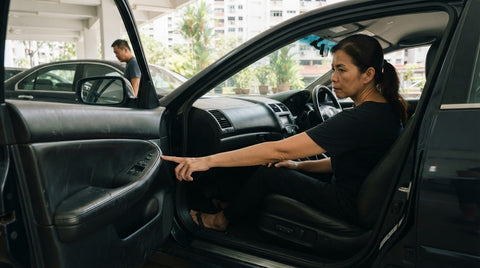
Asking prices for pre-owned cars with memory seats in Singapore vary by model, age, remaining COE and mileage. There is no single price for the whole market. Compare listings with similar vehicle details, and treat each asking price as a starting point for your assessment.
It is easy to focus on the seat feature, but a car’s age and condition matter just as much. Mileage adds useful context: two cars of a similar age may have travelled different distances, so do not judge their asking prices by age alone.
This guide explains how to compare asking prices, narrow your options with search filters and weigh mileage alongside other listing details. Use these steps to identify suitable cars and decide which ones merit a closer look.
Key Takeaways
- Compare asking prices alongside a car’s registration year and remaining COE, rather than judging the figure on its own.
- Use search filters to narrow listings, then review each vehicle’s full details to avoid overlooking a relevant option.
- Read mileage in context with a car’s age; it adds useful comparison detail but doesn’t tell the whole story by itself.
- Check the exact model year and trim when researching memory seats, since equipment can differ between versions.
- During a viewing, test the seat-memory controls and confirm the seat returns to its saved position.
Asking prices
Asking prices differ across Singapore’s pre-owned car listings. Compare the same model, year, trim, mileage and remaining COE. Memory seats alone do not determine a listing’s value. Treat the asking price as one part of your comparison, not the full cost of ownership.
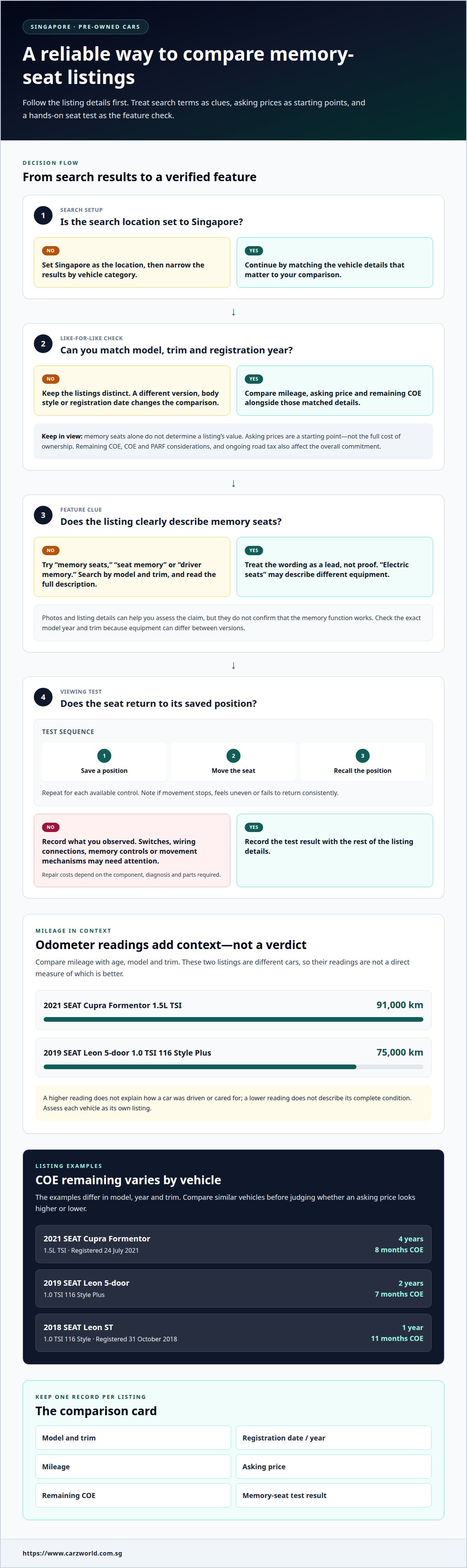
Three SEAT examples show why vehicle details matter. A 2021 SEAT Cupra Formentor 1.5L TSI had 4 years and 8 months of COE remaining. A 2019 SEAT Leon 5-door 1.0 TSI 116 Style Plus had 2 years and 7 months remaining. A 2018 SEAT Leon ST 1.0 TSI 116 Style had 1 year and 11 months remaining.
Those examples differ in model, year, and COE. The Formentor was registered on 24 July 2021. The Leon ST was registered on 31 October 2018. Compare like with like before deciding whether one asking price looks higher or lower. A different body style or registration date changes the comparison.
How do COE, PARF, road tax and remaining COE affect cost? Remaining COE affects how long the car can be used before renewal or deregistration decisions arise. COE and PARF relate to the car’s certificate and potential deregistration value, while road tax is an ongoing ownership cost. Include these factors when comparing the overall commitment, not just the asking price.
For a practical comparison, note these details together:
- 2021 Cupra Formentor: 1.5L TSI, registration date, and 4 years and 8 months of COE remaining.
- 2019 Leon 5-door: 1.0 TSI 116 Style Plus and 2 years and 7 months of COE remaining.
- 2018 Leon ST: 1.0 TSI 116 Style and 1 year and 11 months of COE remaining.
Power memory seats add another inspection point. Common areas to check include the seat switches, wiring connections, memory controls and movement mechanisms. A fault can affect saving, recalling or moving a position. Repair costs depend on the component, diagnosis and parts required. Compare seat operation alongside the car’s asking price.
During a viewing, test each available memory setting. Save a position, move the seat, then recall that position. Repeat for each control. Note whether movement stops, feels uneven or fails to return consistently. These observations help distinguish a working feature from one that may need attention.
Keep a simple comparison record for each listing: model and trim, registration date, mileage, remaining COE, asking price and memory-seat test result. The SEAT examples show how specifications can vary between years and body styles. Matching these details makes price comparisons clearer and keeps ownership costs in view.
Used-car search filters
Set Singapore as the location, then narrow results by model, trim, registration year, mileage and asking price. These filters remove unrelated listings and make it easier to compare similar vehicles.
Listings may describe memory seats in different ways. Try phrases such as “memory seats,” “seat memory” and “driver memory.” Search by model name and trim as well, since equipment details may appear in the vehicle description rather than the headline. Treat search terms as a starting point, not proof that the car has the feature.
Build a shortlist using the filters that matter to your decision:
- Model and trim: Match both details. A model name alone may cover several versions.
- Registration year: Narrow by year, then compare specific listings.
- Mileage: Use a range that suits your needs. Review each odometer reading alongside vehicle age.
- Asking price: Set a budget range. Keep similar models and trims together.
- COE remaining: Compare listings with similar remaining periods.
- Seat feature: Search multiple descriptions, then inspect the listing details.
What should you check when comparing used cars with memory seats in Singapore? Compare the model, trim, registration year, mileage, asking price and remaining COE. Then look for a clear description of the seat-memory function and test it during a viewing.
Apply filters in stages. First, select Singapore and the vehicle category. Next, choose a model or body style. Add a year range and price range, then refine by mileage and COE details. This keeps the results useful without relying on a single search term.
Where can you find Singapore listings for used cars with memory seats? Search online used-car marketplaces and vehicle-dealer inventory pages serving Singapore. Apply the same model, trim and feature terms across listings to create a consistent set of results to assess.
Keep a shortlist instead of relying on one result. Record each listing’s model, trim, year, mileage, asking price and remaining COE. Note whether the description mentions memory seats. For example, distinguish a clear description of the feature from a general “electric seats” claim, since the terms may refer to different equipment.
Before arranging a viewing, read the full listing. Check photographs and equipment details for clues, but do not treat images as confirmation. Use the stated trim to refine your search. At the viewing, test the memory function and compare its operation with the description. A structured search helps you focus on cars that match your priorities.
Vehicle mileage
Odometer readings add context to a used-car comparison. One 2021 SEAT Cupra Formentor 1.5L TSI listing showed 91,000 km. A 2019 SEAT Leon 5-door 1.0 TSI 116 Style Plus showed 75,000 km. Those figures describe two different cars, not a mileage threshold for judging condition.
Compare mileage alongside registration year, model and trim. The Formentor and Leon differ in all three details, so their odometer readings are not a direct measure of which car is better. Use mileage to frame questions about each vehicle’s use and condition.
A higher reading doesn’t, by itself, explain how a car was driven or cared for. A lower reading doesn’t describe its complete condition either. For example, the 91,000 km Formentor and 75,000 km Leon need to be assessed as separate listings. The model, use history, and overall condition all add context.
For each listing, record the details together:
- Model and trim: Note the exact name, such as the Formentor 1.5L TSI.
- Registration year: Keep the 2021 Formentor separate from the 2019 Leon.
- Odometer reading: Record kilometres exactly as displayed.
- Other listing details: Include asking price and remaining COE for a fuller comparison.
- Viewing notes: Record what you observe during the vehicle inspection.
This record makes comparisons clearer. It also prevents mileage from becoming the only deciding factor. A listing with 75,000 km isn’t automatically a stronger choice than one showing 91,000 km. Their specifications and condition still need individual assessment.
At a viewing, compare the displayed odometer reading with the listing details. Record the reading and viewing date. If you assess several cars, write each reading beside the matching model and trim to avoid mixing up vehicle details.
Memory-seat operation is another useful observation during a viewing. Test whether the seat saves and recalls a position, and note any inconsistent movement alongside the odometer reading. This gives you a practical record of both mileage and feature operation, without treating either as a complete picture of the car.
Use the 2021 Formentor and 2019 Leon as examples of how readings need context. Compare each with similar models and trims, then consider its registration year, COE, listing details, and observed condition. This approach helps you assess mileage as one part of a sound comparison, rather than a standalone verdict.
Treat the 75,000 km figure as a recorded point of comparison, not as an explanation of the Leon’s past use. Keep it attached to the listing’s exact model and trim when reviewing other cars, and verify that the displayed reading matches the listing at the viewing. If details differ, note the discrepancy rather than assuming which entry is right.
Mileage is most useful when it prompts further questions and observations. Pair the odometer reading with your inspection notes and the listing details, then assess the car on its own merits. This keeps a single figure from carrying more meaning than it can support and makes comparisons between vehicles more consistent.
Which used car models in Singapore offer memory seats by trim and model year?
A model name alone does not establish which seat equipment a car has. Trim matters, and equipment can vary between model years. Compare the exact version shown in each Singapore listing, check the stated equipment and test the seat controls in person.
The available SEAT examples illustrate useful comparison details. They include a 2021 SEAT Cupra Formentor 1.5L TSI, a 2019 SEAT Leon 5-door 1.0 TSI 116 Style Plus, and a 2018 SEAT Leon ST 1.0 TSI 116 Style. These names identify specific versions, but don’t establish whether those cars have memory seats.
Use each listing as a starting point, not a model-wide claim. A 2019 SEAT Leon 5-door and a 2018 SEAT Leon ST have different body styles and trims. Keep those details attached to their individual listings. Don’t assume equipment transfers between them.
When comparing a candidate, record the details that distinguish its version:
- Make and model: For example, SEAT Leon or SEAT Cupra Formentor.
- Model year: Record the year shown in the listing.
- Body style: Note 5-door or ST where stated.
- Trim and engine: Keep labels such as 1.0 TSI 116 Style Plus intact.
- Seat feature: Look for an explicit memory-seat description.
Next, match the written description to the vehicle itself. Ask for a demonstration of the memory function during the viewing. Save a seat position, move the seat, then recall the saved setting. This tests the feature on that specific car rather than relying on its model name.
“Electric seats” and “memory seats” describe different functions. Electric adjustment uses powered controls to move the seat; memory operation saves a position for later recall. Treat these phrases separately when reading a listing. Look for wording that specifically describes saving and recalling seat positions.
For example, don’t label every 2021 Cupra Formentor as equipped based on one listing. Apply the same care to the 2019 Leon Style Plus and 2018 Leon ST Style. Model year and trim help identify the version, while the listing details and demonstration establish the feature on that individual vehicle.
A careful shortlist separates confirmed equipment from assumptions based on the model. Keep each SEAT listing’s year, trim and body style together. Record what the description says, then test the controls during the viewing. This helps identify suitable cars without treating every model or trim as identical.
These figures provide a cost comparison for the specific listings, not evidence of seat equipment.
Keep each price and depreciation figure attached to its specific version when reviewing candidates. These figures may help you compare listings, but they do not establish whether a car has memory seats. Check the equipment description and test the seat controls in person before treating the feature as confirmed.
How can I verify that a used car's memory seats work before buying?
Test the function in the actual car. A listing description can indicate memory seats, but direct operation is the best way to assess them. Try every available memory button, checking both saving and recalling positions, not just powered seat movement.
Start with the seat controls. Adjust the seat using its electric switches, if fitted. Choose a comfortable position, then save it using the vehicle’s memory controls. Follow the button labels or displayed prompts. Do not assume a powered seat automatically has memory functionality.
Next, move the seat away from the saved position. Change its distance, height and backrest angle where adjustable, then press the saved-position control. Check whether the seat returns to the position you stored. Repeat for each available memory setting.
During the test, observe each response:
- Saving: Confirm the selected control stores the current position.
- Recall: Move the seat, then check whether it returns.
- Movement: Notice any pauses, uneven travel, or unexpected stopping.
- Controls: Test each memory button and seat adjustment switch.
- Repeatability: Save and recall the position again.
Try a second position. Save one setting, adjust the seat differently, then save another setting if the car provides one. Recall each in turn. This shows whether the controls store distinct positions rather than simply moving the seat.
Check that the seat responds consistently throughout the test. Listen for unusual sounds and watch for the seat stopping before it reaches its stored position. Note which control you used and what happened. These observations help you describe any specific issue.
Test the feature from the driver’s normal seated position, with clear space around the seat. Keep hands and belongings away from moving parts. If the controls require a particular sequence, follow the displayed instructions. Do not force a switch that does not respond.
Assess memory operation separately from other seat features. A switch that moves the seat proves powered adjustment, not saved-position recall. A seat that moves smoothly may still fail to save settings. Confirm both functions in sequence before treating the feature as working.
Record the result beside the car’s model, trim, and listing details. For example, note whether saving worked, whether recall returned the seat, and whether movement stayed consistent. This creates a clear comparison across viewings. Browse used-car listings with these checks in mind, then assess the memory function during each vehicle viewing.
Carz World Pte Ltd: Pre-Owned Cars
Carz World Pte Ltd sells pre-owned cars for drivers comparing used-car options in Singapore. Once you have narrowed your shortlist by model, trim, mileage and remaining COE, explore its pre-owned car range as a next step in your search.
Bring your priorities to the conversation, including the vehicle details that matter and the memory-seat function you want to assess. A viewing lets you consider a specific car’s features alongside its listing information. If you are weighing alternatives, Carz World Pte Ltd also sells brand new cars and offers car rental.
Contact Carz World Pte Ltd to discuss your pre-owned car search and arrange a viewing.
Choose the feature that fits your routine
Memory seats are most useful when drivers regularly adjust the same car’s seating position. Consider who will drive, how often positions change and whether the feature feels simple to use. That everyday fit may matter more than a particular model name.
When considering pre-owned cars with memory seats in Singapore, look beyond the feature itself. Choose a vehicle that suits your daily travel and ownership plans. Carz World Pte Ltd offers pre-owned cars, brand new cars and car rental, giving you different options to consider.
If you’re ready to discuss your next step, contact Carz World Pte Ltd to explore your options. Take your time, ask about the vehicles that interest you, and choose with confidence.
Frequently Asked Questions
Which pre-owned cars in Singapore have memory seats?
Memory-seat availability depends on the equipment in the individual car, not just its model name. The Singapore listings discussed here include SEAT Cupra Formentor and SEAT Leon variants, but their names alone do not confirm the feature. Look for an explicit memory-seat description for the exact listing, then test the controls on that vehicle during a viewing. This avoids assuming every trim or model year has identical equipment.
What are the cheapest used cars with driver memory seats in Singapore?
Model names alone are not enough to identify the cheapest option. The Singapore examples include SEAT Leon and Cupra Formentor listings, but the details provided do not establish which has working driver-seat memory. Compare listings that explicitly describe the feature, then assess model year, trim, mileage, remaining COE and asking price together. Test the driver’s seat memory before deciding whether a lower asking price represents better value.
What are current prices for pre-owned cars with memory seats in Singapore?
Asking prices vary by model, trim, registration year, mileage, and remaining COE. Singapore examples discussed include a 2021 SEAT Cupra Formentor and older SEAT Leon variants, but those model details don’t by themselves establish memory-seat equipment. Compare current listings with matching specifications, and treat the asking price as one part of the ownership decision. Confirm the feature on the specific car before comparing it with alternatives.
Disclaimer
This content is provided for general informational purposes only. Readers are encouraged to independently verify important information.
In Same Category
- COE Rebate for Early Deregistration: How Much Can You Get Back
- Pre-owned cars with memory seats in Singapore: asking prices
- How to Check If You Can Use CPF to Pay for COE Renewal
- Luxury pre-owned cars Toa Payoh: Compare listings, mileage and prices
- Is a Car an Asset or a Liability in Singapore? How It Affects Your Net Worth
Related by Tags
- Pre-owned cars with memory seats in Singapore: asking prices
- Luxury pre-owned cars Toa Payoh: Compare listings, mileage and prices
- Is a car a good investment in Singapore compared with other ways to travel?
- Find reliable low maintenance second hand cars in Singapore by mileage
- Car Trade-In Services in Sengkang for Comparing Offers
- Financial Planning for Your First Car in Singapore
- Used Electric Cars in Singapore: 2026 Buyer's Guide
- 2026 Guide: Planning for a Second Family Car in Singapore