Used Car Loan Downpayment in Singapore: The 2026 Ultimate Guide

Did you know that the sticker price of a vehicle is often the least important factor when calculating your used car loan downpayment? Most buyers assume a flat percentage covers their entry into car ownership, but in 2026, the reality is far more nuanced. Between the Monetary Authority of Singapore (MAS) loan-to-value limits and the recent reduction in PARF rebates, the cash you need upfront can change overnight based on a car's Open Market Value or a bank's specific valuation.
It's understandable if you feel overwhelmed by high upfront cash requirements or the confusion between a seller's asking price and what a lender actually values the car at. You're likely looking for a clear path forward that doesn't involve hidden admin fees or unexpected financial hurdles. This guide promises to simplify that process, helping you master MAS regulations so you can secure the best deal in the current market.
We'll walk you through the exact calculations for the 30% and 40% downpayment tiers, explain how to use a trade-in to offset your initial costs, and compare bank rates starting from 2.78% against in-house financing options. By the end of this article, you'll have a clear understanding of your required cash-on-hand and the confidence to choose the right loan for your next pre-owned vehicle.
At a Glance: Mastering Your Used Car Financing
- MAS Regulations. Identify whether your vehicle requires a 30% or 40% used car loan downpayment based on the latest 2026 OMV thresholds.
- Price vs. Valuation. Understand the "lower of the two" rule and how bank valuations can impact the actual cash you need to pay upfront.
- Financing Options. Compare competitive bank interest rates starting from 2.78% against the flexible approval criteria of in-house financing.
- Strategic Savings. Discover how to use your current vehicle as a trade-in to effectively offset your initial cash outlay.
- Trusted Expertise. Access a wide range of pre-owned cars with transparent pricing and verified valuations for a seamless buying experience.
Understanding the MAS Rules for Used Car Loan Downpayment
The Monetary Authority of Singapore (MAS) sets strict limits on how much you can borrow for a vehicle. These rules ensure that buyers don't overextend themselves financially. When you're looking at a used car loan downpayment, the first thing to check is the car's Open Market Value (OMV). This figure, rather than the list price, determines whether you need to prepare 30% or 40% of the value in cash.
To better understand this concept, watch this helpful video:
The 30% vs 40% Rule Explained
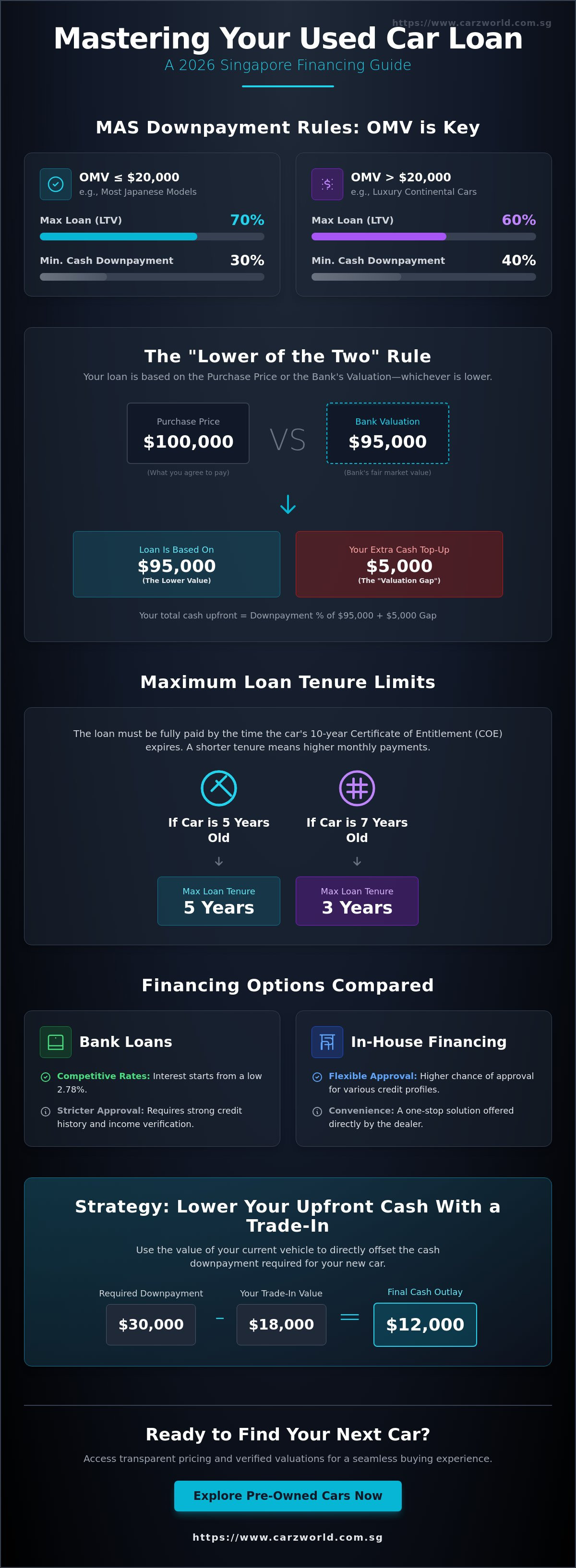
The OMV is the price paid or payable for a vehicle when it's first imported into Singapore. It includes the purchase price, freight, and all other charges incidental to the sale and delivery of the car. For cars with an OMV of $20,000 or less, you can finance up to 70% of the purchase price. This means your minimum cash downpayment is 30%.
If the OMV exceeds $20,000, the loan-to-value (LTV) limit drops to 60%. In this case, you'll need a 40% cash downpayment. Most Japanese entry-level models often fall into the lower OMV bracket, making them slightly more accessible in terms of upfront cash. Conversely, luxury continental cars almost always exceed the $20,000 mark. You'll need to budget for the higher 40% requirement when browsing these premium pre-owned cars. Understanding these car financing options is essential before you sign any sales agreement.
Maximum Loan Tenure Restrictions
MAS also regulates how long you can take to pay back the loan. The absolute maximum tenure for any car loan in Singapore is 7 years. However, for used vehicles, the calculation is often shorter. The loan must be fully repaid by the time the car reaches the end of its original 10-year COE period.
If you're buying a car that's 5 years old, your maximum loan tenure is 5 years. If the car is 7 years old, you're limited to a 3-year repayment period. This shorter tenure significantly increases your monthly installments, even if the total loan amount is lower. It's a critical factor for buyers to consider alongside their Total Debt Servicing Ratio (TDSR) limits, which currently sit at 55% of gross monthly income. If you choose to renew the COE for a car older than 10 years, the financing rules change again, often resulting in higher interest rates and different downpayment structures.
Calculating the Actual Cash Downpayment: Price vs. Valuation
Calculating your used car loan downpayment involves more than just looking at the price tag on the windshield. Many buyers assume that if they agree to a price of $100,000, they simply need 30% or 40% of that figure. However, Singaporean lenders follow the "Lower of the Two" rule. This means your maximum loan amount is based on either the purchase price or the bank's valuation of the vehicle, whichever is lower. If a gap exists between these two numbers, you'll need to bridge it with additional cash.
You should also account for processing and admin fees, which typically range from 1% to 2% of the loan amount. These costs are often overlooked during the initial budgeting phase. By understanding the relationship between market price and bank valuation, you can accurately estimate your cash outlay before you even step into a showroom. If you want to see how these values apply to specific models, browsing our collection of pre-owned cars can give you a better sense of current market pricing.
Why Bank Valuation Matters
Banks determine the "fair market value" of a vehicle based on its age, mileage, and historical transaction data. In a competitive market where prices rise quickly, bank valuations often lag behind the actual selling prices. This creates a "valuation gap" where the bank's appraised value is lower than what the dealer is asking. The valuation gap is essentially the hidden cost of used car buying that requires immediate cash from the buyer. Because MAS regulations on car loans restrict the total amount you can borrow, finding a car that "values up" to its selling price is the best way to minimize your upfront cash requirement.
The Downpayment Formula for 2026
To find your total cash requirement, use this specific formula: (Valuation x Downpayment %) + (Price - Valuation) + Admin Fees. Let's look at a practical example. Suppose you're buying a car for $100,000, but the bank values it at only $90,000. If the car has an OMV above $20,000, you're required to provide a 40% downpayment.
- Downpayment on Valuation: 40% of $90,000 = $36,000
- Valuation Gap: $100,000 - $90,000 = $10,000
- Total Cash Needed: $36,000 + $10,000 = $46,000 (plus fees)
This formula shows why a $10,000 difference in valuation doesn't just mean a slightly higher loan; it means $10,000 more in pure cash-on-hand. If you're feeling uncertain about these calculations, our team at Carz World can help you navigate the paperwork and find a financing structure that fits your budget.
Bank Loans vs. In-House Financing: Which Downpayment is Better?
Choosing where to secure your loan is just as important as the car you select. In Singapore, you generally have two paths: traditional bank loans or in-house financing provided by the dealer. Each option impacts your used car loan downpayment experience differently. Banks offer the most competitive interest rates, typically starting from 2.78% p.a. for pre-owned vehicles. However, they're bound by strict credit assessments and a higher minimum monthly income requirement, which is usually S$2,000 for Singaporeans and PRs, or S$4,000 for foreigners.
In-house financing is often more flexible but comes with higher interest rates, ranging from 3.50% to 6.00% p.a. While the interest is higher, these loans are a viable alternative for buyers who don't meet the rigid criteria of major financial institutions. Regardless of which path you choose, all lenders must follow the MAS regulations for motor vehicle loans. These rules ensure you maintain a minimum cash-on-hand of either 30% or 40% based on the vehicle's OMV. You might see "Zero Downpayment" advertisements, but it's vital to be cautious. These offers often involve complex "overtrade" structures or personal loans with high interest that can leave you in a vulnerable financial position.
When to Choose a Bank Loan
A bank loan is the ideal choice if you have a strong credit score and the required 40% cash ready. Lenders like DBS, UOB, or OCBC provide lower total interest costs over the seven-year maximum tenure. This saves you thousands of dollars in the long run. You'll need standard documentation, including your latest three months of payslips, CPF contribution history, and Notice of Assessment. If you're a variable earner, keep in mind that banks will apply a 30% "haircut" to your declared income when calculating your TDSR.
The Role of In-House Financing
In-house financing serves a specific purpose for buyers who need faster approval or have unique financial profiles. Dealers can often process these applications more quickly than banks, which is helpful if you need a car urgently. At Carz World, we focus on making these logistical processes feel like a seamless experience. We structure our in-house deals with full transparency, ensuring there are no hidden "lemon" fees or administrative surprises. If you're exploring our range of pre-owned cars, our team can help you compare both bank and in-house options to see which fits your monthly cash flow best. While the upfront used car loan downpayment remains governed by MAS, the approval process for the remaining balance is where in-house financing offers its greatest advantage.
Strategies to Lower Your Upfront Cash Outlay
While MAS regulations are firm, you don't always have to rely solely on your savings account to meet the initial costs. Smart buyers use several legal strategies to manage their liquid cash requirements. The most common method involves leveraging the equity in your current vehicle. If your car is worth more than the remaining balance on its loan, that surplus acts as "cash" in the eyes of the lender. This can significantly reduce the physical used car loan downpayment you need to provide at the point of purchase.
Another approach involves careful negotiation of the "nett" price. As we discussed in previous sections, the valuation gap is a major source of unexpected costs. By negotiating a purchase price that aligns closely with the bank's valuation, you ensure that your loan covers the maximum possible percentage allowed by law. This prevents you from having to pay 100% cash for any price amount that exceeds what the bank is willing to value. If you're ready to see how your current vehicle can help, you can get a professional valuation through our Carz World Sell Page.
Maximizing Your Trade-In Value
Selling your current car to the same dealer where you're buying your next vehicle simplifies the entire logistical process. This "one-stop" approach allows the dealer to apply the trade-in value directly to your next purchase. It eliminates the need for you to wait for a third-party buyer to pay you before you can commit to your new car. Equity is the key here. If your car is valued at $50,000 and you only owe $30,000 to the bank, you have $20,000 in equity to put toward your next used car loan downpayment. This often covers a substantial portion of the 30% or 40% requirement, making car ownership much more accessible.
Understanding Overtrade
Overtrade is a common industry strategy designed to help buyers with limited cash but a high-value trade-in. In this scenario, a dealer increases the purchase price of the car you're buying and simultaneously increases the offer for your trade-in by the same amount. Because the bank calculates the loan based on the purchase price (up to the valuation limit), a higher price allows for a larger loan amount. This larger loan then covers more of the vehicle's actual cost, reducing your out-of-pocket cash. It's a methodical way to structure a deal, provided the final price doesn't exceed the bank's maximum valuation.
Some buyers consider using personal loans to bridge the gap for a downpayment. While this provides immediate cash, you should proceed with caution. Personal loans carry higher interest rates and will be factored into your 55% TDSR limit. This could potentially reduce the amount you can borrow for the car itself. If you're looking for a transparent way to manage these costs, explore our range of pre-owned cars and speak to our consultants about how to maximize your trade-in equity.
Why Finance Your Used Car with Carz World?
Finding the right vehicle is only half the battle. The other half involves navigating the financial logistics of MAS regulations and bank valuations. We've spent this guide explaining how a used car loan downpayment is calculated, but having an expert partner makes the entire process far less daunting. At Carz World, we specialize in making these complex transactions feel straightforward and manageable for every customer.
Our approach is built on four core pillars of service:
- Transparent Pricing. We believe in honesty from the start. You won't find hidden "lemon" fees or unexpected administrative surcharges when you review your sales agreement.
- Verified Valuations. We provide access to a wide range of pre-owned cars that have been assessed to ensure their selling prices align closely with current bank valuations.
- Experienced Consultants. Our team handles the heavy lifting. We manage the paperwork and communicate with lenders so you don't have to.
- Strong Partnerships. We maintain deep relationships with major banks and financial institutions across Singapore, ensuring you get access to competitive rates and efficient approval cycles.
Our Proof-Based Approach
We don't just ask for your trust; we earn it through a consistent track record of successful deals. Our physical showrooms at Ubi and Alexandra serve as hubs for transparent consultation. You can visit us to discuss your financial profile in a calm, no-pressure environment. We take pride in the feedback we receive from our community. Our staff are praised in testimonials for making the loan process seamless and honest. This reputation for reliability is why many of our clients return to us when they're ready for their next vehicle upgrade.
Ready to Drive Home?
The journey from viewing a car to driving it home is methodical and efficient at Carz World. Once you've selected a vehicle from our inventory, our consultants immediately begin the loan application process. We help you calculate your exact used car loan downpayment based on the car's OMV and the latest 2026 regulations. After loan approval, we don't just stop there. We assist with the necessary insurance arrangements and handle the LTA transfer on your behalf. This end-to-end service ensures that every logistical detail is covered, leaving you free to enjoy your new purchase. Browse our used car collection and get a quote today!
Take the Next Step Toward Your Next Vehicle
Navigating the financial landscape of Singapore's automotive market doesn't have to be a stressful experience. You now have the tools to distinguish between purchase price and bank valuation, ensuring you're never caught off guard by a valuation gap. By applying these strategies, from leveraging trade-in equity to choosing between bank and in-house options, you can approach your used car loan downpayment with total clarity and precision. Our experienced consultants are ready to handle the complex paperwork and provide the personalized guidance you deserve.
As a direct parallel importer and pre-owned specialist trusted by thousands of Singaporean drivers, we're here to support your journey. Our team provides a transparent, no-pressure sales environment where your needs come first. We focus on making every complex logistical detail feel effortless, so you can focus on the drive ahead. Your next car is a significant investment, and we're committed to making the transaction positive and reliable.
View Our Certified Used Cars & Calculate Your Loan
We look forward to helping you find a vehicle that fits your lifestyle and your budget perfectly.
Frequently Asked Questions
What is the minimum downpayment for a used car in Singapore?
The minimum cash requirement is either 30% or 40% of the vehicle's value based on its Open Market Value (OMV). If the car's OMV is $20,000 or less, you must provide a 30% used car loan downpayment. For vehicles with an OMV exceeding $20,000, MAS regulations require a 40% downpayment. This rule ensures that buyers maintain a healthy equity stake in their vehicle from the start of the loan.
Can I use my CPF to pay for a used car downpayment?
You cannot use your CPF funds to pay for any portion of a vehicle purchase in Singapore. All payments for a car, including the initial deposit and monthly installments, must be made in cash or through personal savings. CPF savings are strictly reserved for housing, healthcare, and retirement purposes. It's important to have sufficient liquid cash available before committing to a purchase.
How does the age of a used car affect the loan amount?
The age of a car directly reduces the maximum loan tenure you can receive, which impacts your monthly commitment. Banks typically require the loan to be fully repaid before the car reaches its 10th year. If you buy a six-year-old car, your maximum loan tenure is limited to four years. This shorter period increases your monthly installments significantly, so you should calculate your budget based on the remaining COE life.
Is it possible to get a 100% loan for a used car in Singapore?
It is not possible to legally obtain a 100% loan for a car under current MAS regulations. Lenders are strictly capped at a 60% or 70% Loan-to-Value limit. While some dealers might advertise "zero downpayment" schemes, these often involve high-interest personal loans or risky structures. Always ensure your financing follows official guidelines to protect your financial interests and avoid hidden traps.
What is the difference between purchase price and bank valuation?
Lenders calculate your maximum loan based on the purchase price or the bank valuation, whichever is lower. If a seller asks for $100,000 but the bank values the car at $90,000, your 60% or 70% loan will be calculated from the $90,000 figure. You'll need to pay the remaining $10,000 valuation gap entirely in cash. This is a critical factor in determining your actual used car loan downpayment.
Are there hidden fees I should know about when paying the downpayment?
You should budget for administrative fees and LTA transfer charges beyond the initial cash requirement. Most banks and dealers charge a processing fee ranging from 1% to 2% of the total loan amount. Additionally, there is a standard LTA transfer fee of $25 for ownership changes. We recommend asking for a full breakdown of all costs to ensure there are no surprises when you sign the final agreement.
How long does it take for a used car loan to be approved?
Loan approval typically takes between one and three working days depending on the lender. Banks usually require a more thorough documentation check, which can take up to 72 hours. In-house financing options might offer faster approval, sometimes within 24 hours, due to more flexible internal criteria. Having your latest payslips and CPF contribution history ready will help speed up the process significantly.
Can expats apply for a used car loan in Singapore?
Expats are eligible for car loans in Singapore, provided they meet higher income thresholds. Most lenders require foreigners to have a minimum monthly income of at least $4,000, compared to $2,000 for Singaporeans. You'll also need to provide a copy of your Employment Pass with at least six months of validity remaining. Some banks may request a larger downpayment or a local guarantor depending on your residency status.
In Same Category
- Pros and Cons of Buying a High PARF Car in Singapore
- Car Valuation Services in Bukit Merah: A Seller’s Guide
- Scrapping Your Car Before 10 Years in Singapore: What Happens?
- Calculating the Breakeven Point for COE Renewal in Singapore
- Financial Checklist Before Committing to a Car Purchase in Singapore (2026)
Related by Tags
- Used Cars for Sale in Tampines: 2026 Buyer's Guide
- Car Downpayment vs Monthly Instalment in Singapore: The 2026 Budgeting Guide
- Car Loan Singapore: The Complete 2026 Guide to Financing Your Vehicle
- How Much Salary to Afford a Car in Singapore: 2026 Affordability Guide
- What is PARF? The Ultimate Guide to Singapore’s Car Rebate System
- Long Term Car Rental Singapore: 2026 Definitive Guide
- Mercedes C-Class Singapore Guide 2026: Specs, COE, and Buying Tips
- Second Hand Hybrid Cars Singapore: The 2026 Value & Inspection Guide
- Cheapest Car in Singapore: The 2026 Guide to Affordable Ownership
- Parallel Import Cars Singapore: 2026 Buyer’s Guide
- Honda Civic Singapore: 2026 New & Pre-Owned Guide
- Suzuki Swift Singapore: The Ultimate Smart-Money Hatchback Guide 2026
- Mazda 3 Singapore Guide 2026: Specs, Prices, and Buying Tips
- The Ultimate Toyota Alphard Singapore Guide: Luxury & Performance in 2026
- Hyundai Ioniq 5 Singapore: The Definitive 2026 Buying & Ownership Guide
- Nissan Qashqai Singapore: Ultimate Buyer’s Guide 2026
- The Ultimate Used Car Buying Guide for Singapore in 2026
- Why Carz World is Your Trusted Used Car Dealer in Singapore (2026 Guide)
- Honda Odyssey Singapore: 2026 Family Buying Guide