Used Japanese Cars in Singapore: The Ultimate 2026 Buyer’s Guide
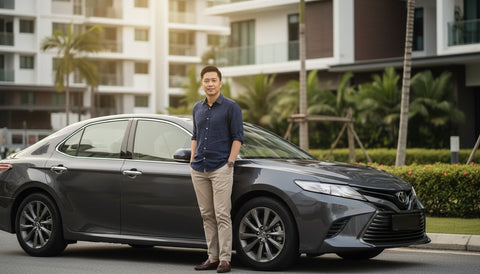
In a market where Category A COE premiums reached S$124,790 in May 2026, buying a brand new vehicle is no longer the default choice for a savvy driver. You likely feel the weight of these rising costs and the confusion surrounding the new S$30,000 PARF rebate cap. Finding quality used japanese cars singapore has become a strategic way to secure a reliable vehicle without the extreme financial hit of a new registration.
It's natural to worry about hidden mechanical faults or the long-term value of a pre-owned car. This guide explains why Japanese brands continue to dominate the market through their legendary reliability and low maintenance requirements. You'll learn how to identify the best value for your budget, which models offer the lowest fuel consumption, and how to protect your investment's paper value. We provide a clear path to owning a dependable car that fits your lifestyle and your financial goals.
Key Takeaways
- Learn why Japanese brands like Toyota, Honda, and Mazda are considered safe-haven investments that protect you against high repair costs.
- Understand how engine capacity affects your COE category and why hybrid models offer a significant "Singapore-Proof" advantage for city driving.
- Discover the top five most dependable models for 2026, including the legendary Toyota Corolla Altis and the family-favorite Honda Vezel.
- Master the smart buyer’s checklist to accurately calculate remaining COE life and your potential PARF rebate at the end of the 10-year cycle.
- Identify how a rigorous multi-point inspection and transparent pricing help you find high-quality used japanese cars singapore without hidden fees.
Why Used Japanese Cars Dominate Singapore’s Roads in 2026
Toyota, Honda, and Mazda aren't just popular brand names; they're the financial bedrock of the local automotive scene. In 2026, as buyers face record-high overheads, these "Big Three" brands act as a reliable safe haven. Their engineering is specifically built for longevity and efficiency. This makes used japanese cars singapore the primary choice for drivers who want to avoid the steep, unpredictable depreciation often seen with luxury European models.
The current market has shifted significantly. With COE prices remaining high, vehicles in the 5 to 7 year age bracket have emerged as the ideal sweet spot. These cars have already moved past their steepest initial depreciation but still offer many years of dependable service. Choosing a Japanese make ensures that your ownership costs stay predictable, even as inflation affects workshop labor rates across the island.
To better understand why these vehicles hold their value so well, watch this helpful video:
The Financial Logic: PARF Rebates and Depreciation
Understanding the Certificate of Entitlement (COE) system is vital for calculating the true cost of your vehicle. A key advantage of Japanese cars is their PARF (Preferential Additional Registration Fee) rebate structure. Since Japanese cars often have a more balanced Open Market Value (OMV) compared to high-end Continental equivalents, their annual depreciation is easier to calculate and sustain. When you reach the end of the 10-year cycle, the PARF rebate provides a guaranteed sum of money back. This paper value is often more secure in a Toyota or Mazda because you aren't fighting massive repair bills that eat into your eventual rebate.
Maintenance and Parts Availability in Singapore
Singapore's automotive infrastructure is perfectly tuned for Japanese vehicles. If you visit major industrial hubs like Ubi or Sin Ming, you'll find an abundance of independent workshops specializing in these brands. Spare parts are readily available and significantly more affordable than those for European makes. This is largely due to parts commonality. For instance, many components are shared between the Honda Fit and the Honda Vezel. This high volume of shared parts keeps stock levels high and prices low for the consumer. This ease of service is a major reason why many savvy buyers browse our collection of used cars to find a hassle-free daily driver that won't spend weeks waiting for imported parts.
Decoding the Specs: What Makes a Japanese Car "Singapore-Proof"?
Japanese engineering feels like it was designed specifically for our island's unique environment. When you're searching for used japanese cars singapore, you need to look past the exterior and focus on the technical specs that determine daily comfort and long-term costs. Our tropical climate and urban layout demand specific vehicle traits that Japanese manufacturers have mastered over decades.
Engine capacity remains a critical metric for any buyer. Under Singapore's vehicle ownership policies, cars with engines up to 1,600cc and a power output not exceeding 130bhp fall into Category A COE. This technicality makes models like the Toyota Corolla Altis or Honda Civic much more accessible than high-performance Category B alternatives. Beyond the paperwork, Japanese cars win the battle against 32°C humidity. Their air conditioning systems are built to handle extreme heat, often reaching comfortable temperatures much faster than their European counterparts.
Space is another factor where these vehicles shine. The compact dimensions of Japanese hatchbacks and SUVs are ideal for maneuvering through tight HDB multi-storey car parks or narrow shopping mall ramps. You'll find that parking a Honda Vezel is significantly less stressful than handling a wide Continental sedan in a crowded urban lot.
Hybrid vs. Petrol: Which Used Option Wins?
By 2026, the longevity of Japanese hybrid batteries has been well-proven. Used Toyota and Honda hybrids are highly dependable, with many batteries comfortably lasting well beyond the 10-year mark. While the initial purchase price of a hybrid is slightly higher, the fuel savings in stop-and-go city traffic are substantial. You'll likely see the financial benefit within the first 18 to 24 months of driving. The "Hybrid Sweet Spot" for a 5-year-old car is a vehicle with a documented service history and a verified battery health report.
Authorized Dealer (AD) vs. Parallel Import (PI) Units
It's common to see the same car model sold under different names or with varying features. For example, a Toyota Harrier might be an Authorized Dealer unit, while a Toyota Venza is often a Parallel Import. PI units frequently offer unique features or different trim levels, but they might have infotainment systems in Japanese. It's also vital to consider that PI status can sometimes affect the car's export or scrap value later on. Checking the provenance of a pre-owned car ensures you don't face surprises during future trade-ins or when it's time to deregister the vehicle.
Top 5 Used Japanese Models to Buy in 2026
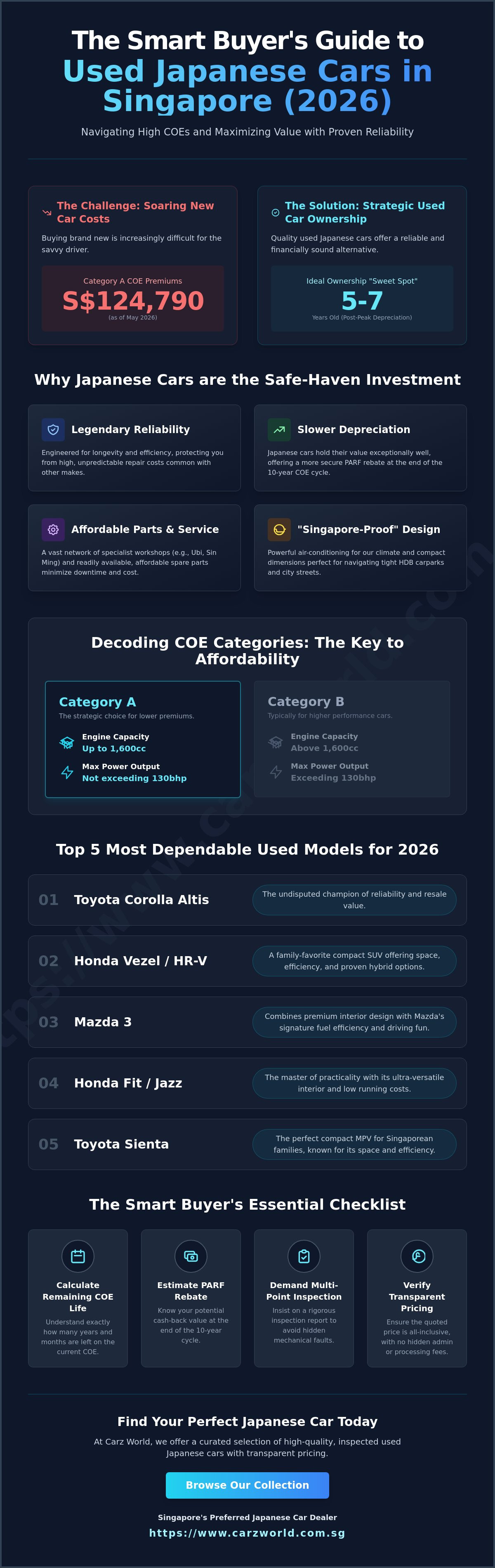
With Category A COE premiums sitting at S$124,790 as of May 2026, choosing the right model is essential for your long-term financial health. When you're searching for used japanese cars singapore, certain models consistently outperform others in terms of lifecycle value and maintenance costs. These five vehicles represent the best balance of reliability and resale potential in the current market environment.
The Toyota Corolla Altis remains the undisputed leader for local drivers. It's a vehicle that thrives within the Certificate of Entitlement (COE) system because of its durable engine and high demand in the second-hand market. Market data indicates that Toyota models often retain 55% to 65% of their value after five years. For families, the Honda Vezel or HR-V is a practical alternative. It offers the elevated driving position of an SUV with the fuel economy of a much smaller car, making it a staple in Singaporean driveways.
If you prefer a more premium interior, the Mazda 3 provides a refined driving experience without the high price tag associated with European brands. For those with high daily mileage, such as long-distance commuters, the Toyota Prius is the ultimate hybrid hero. Finally, the Honda Fit or Jazz serves as the perfect urban runabout. Its versatile seating and compact footprint make it incredibly easy to handle for first-time owners navigating city life.
The Family Choice: Toyota Alphard and Vellfire
These MPVs are unique because they hold their value better than almost any other luxury vehicle in Singapore. They offer immense cabin space and a level of prestige that rivals executive sedans. When you inspect a 7-year-old unit, always check the sliding door mechanisms. These are high-wear components that should operate smoothly without any grinding noises. You can browse our current used Japanese car inventory to see available units that have already passed our rigorous quality standards.
The Budget Choice: Used Mitsubishi Attrage
The Mitsubishi Attrage is the most accessible entry point for a used Japanese sedan in 2026. Its 1.2L engine is designed for maximum efficiency rather than high-speed performance. This makes it ideal for city driving, though it might feel less powerful on the highway during peak hour overtages. Because of its lower OMV, it typically has very predictable depreciation rates. It's an excellent choice for budget-conscious drivers who need a reliable point-to-point vehicle.
The Smart Buyer’s Checklist: COE, PARF, and Inspection
Finding high-quality used japanese cars singapore requires a methodical approach to verify both the mechanical health and the financial paperwork. While Japanese vehicles are famous for their durability, the high cost of ownership in 2026 means you cannot afford to overlook the details. Following a structured checklist ensures that your investment remains a reliable asset rather than a liability.
Your first priority is to check the remaining COE life. This determines the exact duration you can legally drive the vehicle before facing a renewal or deregistration. Next, verify the PARF rebate. It's vital to remember that for cars registered from the February 2026 COE exercise onwards, the rebate is now capped at S$30,000. You should then log into the OneMotoring portal to confirm the owner count and mileage. A high number of previous owners within a short period can sometimes indicate persistent underlying issues. Finally, always insist on a professional third party inspection at recognized centers like STA or VICOM. These reports provide an unbiased view of the car’s structural integrity and engine health.
Reviewing the service history is equally important. A car maintained at an authorized workshop or a reputable specialist often has a more predictable lifecycle. If you want to skip the guesswork, you can view our pre-inspected inventory where we handle these verifications for you.
Spotting Red Flags in Used Japanese Cars
Be cautious of "Ex-PHV" units. These private hire vehicles often accumulate very high mileage in a short span, leading to premature wear on the suspension and interior. When test driving older Honda models, pay close attention to the CVT gearbox. Any noticeable "shudder" or hesitation during acceleration could signal an expensive repair. You should also check for inconsistent paint textures or slightly misaligned panels. These are common signs of past chassis repairs or flood damage that have been hidden under a fresh coat of paint.
Financing and Insurance for 2nd Hand Cars
The age of the car directly impacts your loan options. Most banks offer a maximum loan tenure of seven years, provided the car has enough remaining COE life to cover that period. Under current regulations, the 70% Loan-to-Value rule applies to vehicles with an OMV of S$20,000 or less, while those above that threshold are capped at a 60% loan. Insurance premiums for Japanese makes are generally more affordable than Continental cars because spare parts are easier to source locally. This lower insurance overhead is another reason why Japanese brands remain the smartest financial choice in the current market.
Why Carz World is Singapore’s Preferred Japanese Car Dealer
Choosing the right dealership is just as important as choosing the car itself. At Carz World Pte Ltd, we understand that finding quality used japanese cars singapore requires a partner you can trust. We focus on creating a seamless experience where every transaction is handled with methodical precision and honesty. Our goal is to make the complex logistical process of car ownership feel effortless for every customer.
Every vehicle in our inventory undergoes a rigorous multi-point inspection. We check everything from engine performance to the interior electronics. This ensures that you drive away in a car that meets high quality standards and provides long-term reliability. We also believe in absolute transparency. You won't find hidden "admin fees" or "agreement fees" in our contracts. The price we discuss is the price you pay, allowing you to plan your finances with confidence.
The team at Carz World Pte Ltd takes a personalized approach to every inquiry. We don't use high-pressure tactics. Instead, we listen to your needs to match a vehicle to your specific lifestyle. Whether you need a fuel-efficient runabout for city commuting or a spacious MPV for the family, we guide you through the available options. We also provide comprehensive after-sales support and clear information on financing options to help you manage your budget effectively.
From Purchase to Consignment: A Full Lifecycle Partner
Our relationship with clients often lasts well beyond the initial purchase. When you're ready for an upgrade, we help you sell your car for the best price through our professional consignment services. If your vehicle is nearing the end of its COE cycle, our expertise in exporting cars ensures you maximize your returns. This lifecycle approach has built a strong community of satisfied clients. Their testimonials often highlight individual team members who provided efficient and competent service during every step of the process.
Visit Our Showrooms
We invite you to experience our inventory firsthand at our showrooms located in Ubi and Alexandra for your convenience. Seeing the vehicles in person allows you to touch, feel, and test drive the cars before making a final decision. Our ready-to-drive collection is highly organized to make your visit productive. You can view our latest used car collection online and book a viewing today to start your journey toward owning a reliable Japanese vehicle with Carz World Pte Ltd.
Drive Confidently with a Smarter Vehicle Investment
Owning a car in Singapore's 2026 climate requires a shift from emotional buying to strategic investing. By focusing on the "Big Three" Japanese brands and leveraging the Category A COE advantages we have discussed, you effectively minimize the risks of high depreciation and mechanical downtime. You now have the knowledge to navigate the new PARF rebate caps and the technical specs that ensure your vehicle remains "Singapore-Proof" for the remainder of its lifecycle.
Finding high-quality used japanese cars singapore doesn't have to be a stressful process when you work with a partner committed to full transparency. At Carz World Pte Ltd, our 100+ 5-star reviews and the frequent mention of our dedicated staff members in client feedback reflect our commitment to excellence. Whether you visit our showrooms in Ubi or Alexandra, you will find a team ready to help you make an informed, pressure-free decision.
Find Your Perfect Used Japanese Car at Carz World Pte Ltd Today
We look forward to helping you secure a reliable vehicle that serves your family and your budget for the long term.
Frequently Asked Questions
Is it worth buying a used Japanese car with only 2 or 3 years of COE left?
Buying a car with short remaining COE is worth it if you need a low-commitment vehicle with a smaller upfront payment. These units often have lower annual depreciation because the most significant value drop happened in the first few years of ownership. They're practical for drivers who want to wait for COE premiums to fluctuate before committing to a longer ten-year cycle.
How much is the PARF rebate for a used Toyota or Honda in Singapore?
The rebate amount is a percentage of the Additional Registration Fee (ARF) paid at the car's first registration. For vehicles registered after February 2026, this rebate is now capped at S$30,000. If you deregister a car between 9 and 10 years of age, you'll receive 5% of the ARF, providing a guaranteed paper value at the end of your ownership.
Should I buy a parallel import (PI) Japanese car or an authorized dealer (AD) unit?
Choose based on your priority for specific features versus local dealer support. AD units offer standardized local infotainment and warranty coverage, while PI units often provide unique specifications or lower purchase prices. Both are viable options for high-quality used japanese cars singapore as long as you verify the service history and the reputation of the selling dealer.
What is the average annual depreciation for a used Japanese sedan in 2026?
Annual depreciation is determined by the total cost of the car minus its scrap value, divided by the remaining years of COE. In 2026, a typical Japanese sedan often depreciates between S$12,000 and S$16,000 per year. This rate is usually more stable than European luxury cars because Japanese brands maintain higher demand and better resale value in the second-hand market.
Can I get a 100% loan for a used Japanese car in Singapore?
Current Monetary Authority of Singapore (MAS) regulations don't allow for 100% car loans. You can generally borrow a maximum of 70% of the car's value if the OMV is S$20,000 or less. For cars with an OMV above S$20,000, the maximum loan amount is capped at 60%. These rules apply to both brand new and pre-owned vehicles across all dealerships.
How do I check if a used car was previously used for Grab or Gojek?
Check the vehicle's log card on the OneMotoring portal for the specific registration category and purpose. You should also look for high mileage relative to the car's age and excessive wear on the rear passenger areas. A car that has covered significantly more than 20,000km per year is often an indicator that it was used for commercial purposes.
What is the difference between COE Cat A and Cat B for Japanese cars?
The difference lies in the engine capacity and the power output of the vehicle. Category A is for cars with engines up to 1,600cc and 130bhp, while Category B covers any vehicle exceeding those limits. Many popular used japanese cars singapore are specifically engineered for Category A to remain more accessible and cost-effective for the average local buyer.
Which Japanese car brand has the highest resale value in Singapore?
Toyota consistently holds the highest resale value in the local market. Their vehicles are highly sought after because of their legendary durability and the widespread availability of affordable spare parts. Honda follows closely, as both brands benefit from a large pool of buyers in the used car market who prioritize long-term reliability and low maintenance costs over flashy features.
In Same Category
- Pros and Cons of Buying a High PARF Car in Singapore
- Car Valuation Services in Bukit Merah: A Seller’s Guide
- Scrapping Your Car Before 10 Years in Singapore: What Happens?
- Calculating the Breakeven Point for COE Renewal in Singapore
- Financial Checklist Before Committing to a Car Purchase in Singapore (2026)
Related by Tags
- Pros and Cons of Buying a High PARF Car in Singapore
- Electric Vehicle Guide 2026: Types, Charging and Buying in Singapore
- COE Results Singapore: How to Read the Latest Bidding Outcomes in 2026
- Singapore Car Loan Guide for EP Holders (2026)
- Calculating the Real 5-Year Cost of Car Ownership in Singapore (2026 Guide)
- Parallel Import Singapore: The Ultimate 2026 Buyer’s Guide
- Honda Freed Singapore Guide 2026: The Ultimate Family MPV Review
- How to Buy a Car in Singapore: The Ultimate 2026 Step-by-Step Guide
1 comment
Very informative article! Understanding depreciation, maintenance costs, and resale value can make a huge difference when buying Used Cars in Singapore. Your advice will definitely help buyers make more confident decisions.
To explore more: https://www.yesmotoring.com.sg/