Choosing the Right Van for Business in Singapore: A 2026 Comprehensive Guide

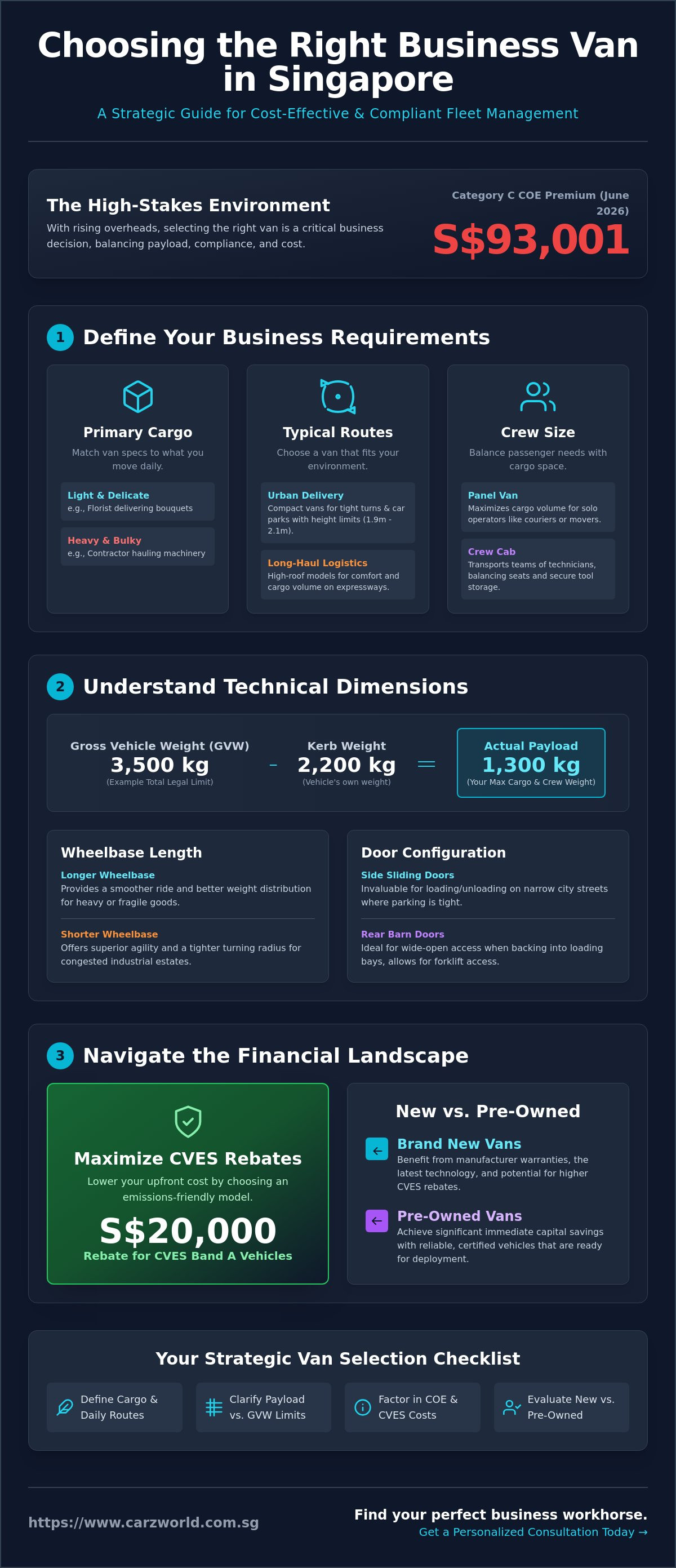
With Category C COE premiums reaching S$93,001 in June 2026, the cost of putting a single workhorse on the road has never demanded more precision. It's a challenging time for local business owners who feel squeezed between rising overheads and the essential need for a reliable fleet. You know that a van is more than just a vehicle; it's the backbone of your daily operations. Choosing the right van for business in Singapore now requires a careful balance of payload capacity and regulatory savvy.
This comprehensive guide will show you how to select a cost-effective van that lowers your overheads while ensuring full compliance with LTA standards. We will explore how to maximize the S$20,000 CVES Band A rebate, navigate the complexities of payload limits, and choose a model with strong resale value. By the end, you'll have a clear roadmap to secure a dependable workhorse that supports your growth without compromising your bottom line.
Key Takeaways
- Learn how to define your business requirements by matching cargo specifications and daily routes to the most efficient vehicle platform.
- Understand the technical difference between Gross Vehicle Weight and actual payload to keep your operations safe and compliant with LTA regulations.
- Master the process of choosing the right van for business by navigating the 2026 Category C COE trends and maximizing CVES emissions rebates.
- Evaluate the financial benefits of brand new models versus the immediate capital savings offered by reliable, certified pre-owned commercial vehicles.
- Discover how a personalized consultation can help you secure a dependable workhorse that lowers overheads while maintaining optimal resale value.
Defining Your Business Requirements and Operational Goals
Success in Singapore's competitive logistics sector begins with a precise audit of your daily operations. Before looking at spec sheets, you must understand exactly what you are moving. A florist delivering delicate bouquets has vastly different needs than a contractor hauling heavy machinery or construction materials. To understand the basics of what is a commercial van, it's helpful to see it as a modular tool designed for specific industrial tasks. Identifying your primary cargo weight and dimensions is the first step toward efficiency.
To better understand this concept, watch this helpful video:
Urban Delivery vs. Long-Haul Logistics
Choosing the right van for business often depends on your primary delivery zone. Singapore's infrastructure presents unique challenges for commercial drivers. Many multi-storey car parks and older industrial loading bays have height limits as low as 1.9 or 2.1 meters. Compact vans are often the superior choice for these environments because they navigate tight ramps with ease. If your routes involve frequent U-turns in narrow residential estates, prioritize a vehicle with a tight turning radius. While high-roof models offer excellent standing room for workers, they can severely limit your access to certain urban delivery points. Choosing a model that fits under standard height barriers ensures you never have to turn away a delivery due to building restrictions.
Crew Cab vs. Panel Van Layouts
Understanding Payload, Volume, and Technical Dimensions
Technical specifications are the foundation of a reliable fleet. While aesthetic appeal matters for branding, the physical capabilities of your vehicle determine your daily operational limits. Choosing the right van for business requires a deep dive into the numbers that define performance. You must look beyond the glossy brochure and focus on how a vehicle handles a full load on Singapore's expressways.
A critical factor often overlooked is the relationship between wheelbase length and load stability. A longer wheelbase provides a smoother ride and better weight distribution. This is essential if you carry heavy machinery or fragile goods that might shift during transit. Conversely, a shorter wheelbase offers better agility in tight industrial estates. You should also evaluate your loading door configurations. Side sliding doors are invaluable when parking on narrow city streets where rear barn doors might be blocked by following traffic.
Before committing to a specific model, it helps to see how these dimensions work in practice. You can browse our current inventory of commercial vehicles to compare different body styles and loading capacities side by side.
Payload and Gross Vehicle Weight (GVW)
Payload is the maximum weight of cargo, passengers, and optional equipment. Understanding this figure starts with the Gross Vehicle Weight (GVW), which is the total legal limit for the vehicle, its fluids, and everything inside it. You must calculate your real-world payload by subtracting the weight of a full fuel tank and your crew from the official limit. Consistently exceeding the GVW leads to accelerated wear on your brakes and suspension systems. In Singapore, the legal implications of overloading are serious. LTA enforcement officers frequently conduct weight checks, and non-compliance can result in heavy fines or vehicle impoundment.
Load Volume and Internal Dimensions
Usable floor space is often more important than total interior volume. When you're measuring a van, pay close attention to the wheel arch intrusion. If the arches are too close together, you won't be able to fit a standard pallet flat on the floor. This forces you to stack goods higher, which can affect stability. Your choice of roof height should also reflect your internal storage needs. If your team needs to stand inside to access shelving or racking, a high-roof model is a necessity. However, always verify that your chosen height still allows access to your primary delivery points and depots.
Navigating Singapore’s Commercial Vehicle Landscape: COE and Costs
The financial reality of the local market is heavily dictated by the Certificate of Entitlement (COE). In the second bidding exercise of June 2026, Category C premiums reached S$93,001. This high entry cost makes choosing the right van for business a decision that impacts your cash flow for years. You must look beyond the sticker price and account for the total investment required to get your vehicle on the road. A strategic approach to these fixed costs is what separates a profitable fleet from a mounting liability.
The Commercial Vehicle Emissions Scheme (CVES) plays a significant role in your final budget. Vehicles in Band A receive a S$20,000 rebate, while those in the most pollutive bands face a S$15,000 surcharge. This S$35,000 swing between a clean electric model and a traditional diesel engine can redefine your entire fleet strategy. By selecting a Band A vehicle, you aren't just helping the environment; you're significantly reducing your initial capital outlay. It's a practical way to keep your overheads manageable from day one.
Singapore's push toward a greener future includes a plan to phase out diesel commercial vehicles starting in 2030. New diesel car registrations already stopped in 2025. Electric vans currently benefit from the EV Early Adoption Incentive (EEAI), which offers a 45% rebate off the Additional Registration Fee (ARF), capped at S$7,500 through December 2026. While electric models might have higher upfront costs, the combination of government rebates and lower daily energy expenses often results in a more favorable total cost of ownership. You should also consider the availability of spare parts; established brands with local support networks ensure your van stays on the road instead of waiting in a workshop.
COE and Financing for Business Vans
Commercial vehicles operate on a 10-year COE cycle. This structure creates a specific depreciation curve that you must manage carefully. Many SMEs find success by using the Early Turnover Scheme (ETS) to replace older, more pollutive vehicles with newer models at a discounted COE rate. Financing options for fleet expansions often include hire purchase agreements tailored to business cash flows. These tools allow you to upgrade your equipment without exhausting your working capital. It's about finding a balance between monthly installments and your projected revenue.
The Buy vs. Rental Debate for SMEs
Owning a fleet provides long-term stability and branding opportunities. However, rental cars and vans offer a flexible alternative for businesses facing seasonal spikes in demand. Long-term leasing allows you to treat vehicle costs as an operating expense rather than a capital expenditure. This can be advantageous for tax purposes, as the corporate income tax rate remains at 17% for 2026. Rental also removes the burden of maintenance cycles, letting you focus entirely on your core business deliveries.
New vs. Pre-Owned: Maximising Your Business Budget
Deciding between a factory-fresh unit and a seasoned workhorse is a pivotal step in choosing the right van for business. Your choice often dictates your monthly cash flow and long-term operational costs. In a market where vehicle taxes are high, understanding the depreciation curve is essential. A new van offers the latest efficiency standards, but a well-maintained used vehicle can provide immediate utility at a significantly lower entry price.
Reliability is non-negotiable for mission-critical tasks like cold-chain logistics or emergency repairs. When you opt for certified pre-owned vans, you mitigate the risks typically associated with used vehicles. A documented service history is your best insurance policy. It proves the vehicle has received regular care, which reduces the likelihood of unexpected downtime. Brands with a strong reputation for durability often hold their value better in the local resale market. This makes them a safer bet for your future fleet upgrades and ensures you recover more of your investment later.
If you're ready to compare your options, you can view our full range of commercial solutions to find the best fit for your budget.
Benefits of Brand New Commercial Vehicles
Investing in brand new cars and vans gives you access to full manufacturer warranties. This is vital for high-mileage operations where wear and tear happen quickly. You also benefit from the latest fuel-saving technologies. These advancements directly impact your CVES banding and daily running costs, as discussed in our previous look at emissions rebates. New units also allow for extensive customization. Whether you need specific shelving or reinforced flooring, starting with a blank canvas ensures the vehicle meets your exact cargo requirements from day one.
The Value Proposition of Pre-Owned Vans
The primary advantage of used cars and commercial vehicles is avoiding the steep first-year depreciation. In Singapore, the initial drop in value is often the most significant due to high upfront taxes. You can often find high-quality, low-mileage vans that are just a few years old for a fraction of the original price. Additionally, pre-owned units offer immediate availability. You don't have to wait months for an indent unit to arrive. This allows you to scale your business operations the moment a new contract is signed.
Finding Your Perfect Business Van with Carz World
Securing the ideal vehicle for your company shouldn't be a stressful ordeal. At Carz World, we specialize in choosing the right van for business by aligning our inventory with your specific operational goals. Whether you need a compact urban delivery unit or a heavy-duty long-haul carrier, our team provides the expert guidance needed to make an informed choice. We maintain a diverse selection of both brand new and pre-owned commercial options to suit various budget requirements and timelines.
Our commitment to transparency means you'll always have a clear understanding of the costs involved. We handle the complex logistics of the Singapore market so you can stay focused on your customers. Managing Category C COE bidding requires timing and deep market insight. We monitor the bidding cycles closely to help you secure your entitlement at a competitive rate. From the initial search to the final handover, we manage the entire process with professional efficiency. This includes:
- Precise COE bidding strategies tailored to the S$93,001 June 2026 market trends.
- Seamless processing of all LTA-related paperwork and registrations.
- Customized financing solutions designed for SMEs and growing fleets.
- Clear explanations of CVES rebates and tax implications for your purchase.
Expert Fleet Advisory Services
We don't just sell vehicles; we provide strategic business assets. Our consultants evaluate your operational data, such as daily mileage and average payload, to recommend the most efficient model. We consider how your specific routes might affect fuel consumption and wear. If you're looking to upgrade your current fleet, we provide professional assistance with selling or consigning your old vehicles. This allows you to transition to newer, more efficient technology without the hassle of managing private sales. We have a proven track record of supporting Singapore SMEs across the logistics, construction, and service sectors. Our team values long-term reputation over short-term gains.
Comprehensive After-Sales Support
A vehicle's value is proven by its uptime. We connect you with reliable maintenance partners who understand the demands of commercial use. This ensures your van stays on the road and continues to generate revenue for your business. When it's time to decommission a vehicle, we offer specialized guidance on car export services to maximize your returns. Our goal is to build a long-term partnership based on trust and competence. Every transaction is handled with the same level of detail-oriented care. Contact us today for a non-obligatory consultation on your next business van and experience a smoother path to fleet expansion.
Secure Your Fleet's Future Today
Success in Singapore's logistics landscape requires a blend of operational efficiency and regulatory awareness. You've seen how balancing technical dimensions with high Category C COE premiums can protect your bottom line. By leveraging CVES rebates and selecting a vehicle that matches your precise route requirements, you turn a necessary expense into a strategic asset. Choosing the right van for business is about more than just transport; it's about building a foundation for sustainable growth.
Carz World offers over a decade of experience in the Singapore automotive market. We provide a comprehensive one-stop solution for buying, selling, and financing your commercial vehicles. Our transparent service is backed by highly rated customer testimonials from businesses just like yours. We take the complexity out of paperwork and COE bidding so you can focus on your core operations. Browse our latest commercial vehicle inventory and find your next business workhorse today. We look forward to helping you drive your business toward a successful and efficient future.
Frequently Asked Questions
What is the most popular van size for SMEs in Singapore?
Compact and medium-sized vans are the most popular choices for local SMEs. These vehicles fit into standard multi-storey car parks with height limits of 1.9 or 2.1 meters. Their tight turning radius makes them ideal for navigating narrow residential estates and busy CBD alleys. While larger vans offer more space, the versatility of a compact model ensures you can access almost any delivery point across the island without restriction.
Do I need a special driving licence to drive a commercial van in Singapore?
You generally only need a Class 3 or 3A driving licence to operate most light goods vehicles in Singapore. These vans must have a Gross Vehicle Weight (GVW) not exceeding 3,500kg. If you are choosing the right van for business that exceeds this weight limit, your drivers will require a Class 4 licence. Always check the vehicle's log card to confirm its classification before assigning it to your staff.
How does the Commercial Vehicle Emissions Scheme (CVES) affect my purchase?
The CVES directly impacts your upfront costs through a system of rebates and surcharges. Vehicles in Band A receive a S$20,000 rebate, while the most pollutive models face a S$15,000 surcharge. This S$35,000 difference makes emissions a primary factor in your budget. By selecting a cleaner vehicle, you significantly reduce your initial capital outlay and contribute to a greener urban environment.
Can I use a commercial van for personal use on weekends?
You can use a commercial van for personal use, provided it is registered as a light goods vehicle with a "G" plate. However, you must comply with LTA regulations regarding passenger limits and safety. If the vehicle's unladen weight exceeds 5,000kg, you must also secure a Vehicle Parking Certificate (VPC). It's a convenient way to handle weekend errands while maintaining a reliable workhorse for your weekday operations.
Is it better to buy a diesel or electric van for my business in 2026?
In 2026, electric vans often offer a better total cost of ownership due to significant government incentives. With the EV Early Adoption Incentive providing a 45% rebate off the ARF and the upcoming 2030 diesel phase-out, the shift toward electric is accelerating. While diesel models are still available, electric versions benefit from lower energy costs and higher rebates. Choosing the right van for business now requires looking at long-term sustainability and future resale value.
What is the typical lifespan of a commercial van COE in Singapore?
A commercial vehicle COE has an initial validity of 10 years. After this period, you have the option to renew it for another 10 years by paying the Prevailing Quota Premium (PQP). This gives most vans a maximum practical lifespan of 20 years in Singapore. Understanding this cycle helps you plan your fleet's depreciation and determine the best time to trade in or export your vehicle.
How much payload capacity do I actually need for a courier business?
Most courier businesses find that a payload capacity between 600kg and 1,000kg is sufficient for daily parcel deliveries. Since parcels are often high-volume but low-weight, you should prioritize internal cargo space over extreme weight capacity. Ensure the van's dimensions allow for efficient sorting and racking. A well-organized interior helps your drivers complete their routes faster while staying within legal weight limits for light goods vehicles.
What are the benefits of buying a used van from a reputable dealer vs. a private seller?
Buying from a reputable dealer offers greater security and convenience compared to a private seller. Dealers provide a one-stop solution for paperwork, COE bidding, and customized financing options. You also benefit from a more transparent service history and professional inspections. This peace of mind is essential for business owners who cannot afford the downtime caused by a vehicle with hidden mechanical issues or unresolved legal encumbrances.
Disclaimer
This content is provided for general informational purposes only. Readers are encouraged to independently verify important information.
In Same Category
- Calculating the Breakeven Point for COE Renewal in Singapore
- Financial Checklist Before Committing to a Car Purchase in Singapore (2026)
- COE Renewal Conditions and Eligibility in Singapore: 2026 Guide
- Balloon Scheme Car Loan in Singapore: Pros and Cons for 2026
- Getting Car Finance with a New Business in Singapore: A Practical Guide
Related by Tags
- Financial Checklist Before Committing to a Car Purchase in Singapore (2026)
- Used Electric Cars in Singapore: 2026 Buyer's Guide
- Car Financing for Singapore Gig Workers: 2026 Guide
- 2026 Guide: Planning for a Second Family Car in Singapore
- Mercedes C-Class Singapore Guide 2026: Specs, COE, and Buying Tips
- Honda Civic Singapore: 2026 New & Pre-Owned Guide
- Mazda 3 Singapore Guide 2026: Specs, Prices, and Buying Tips
- Hyundai Ioniq 5 Singapore: The Definitive 2026 Buying & Ownership Guide
- Why Carz World is Your Trusted Used Car Dealer in Singapore (2026 Guide)
- Honda Odyssey Singapore: 2026 Family Buying Guide