Practical cars for financial advisors sg: Check what you can afford
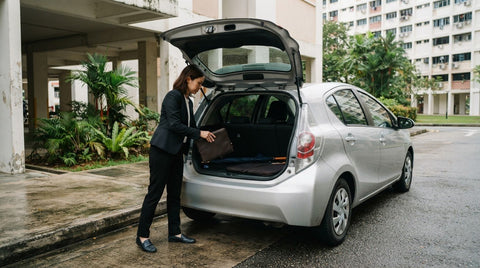
The most practical cars for financial advisors in Singapore are those that fit both your budget and your working day. When comparing practical cars for financial advisors in Singapore, include the COE, loan payments and total interest, as well as road tax, insurance and maintenance. Consider whether the car will still suit your needs in five years.
It’s easy to focus on the purchase price, but ongoing costs matter too. Your choice also needs to suit daily travel, client meetings and personal use without stretching your finances.
This guide explains how to assess affordability, account for COE and ownership costs, and weigh features such as passenger space and practicality against your driving habits. You’ll have a clearer basis for comparing new and pre-owned cars and deciding what suits your work and everyday life.
Key Takeaways
- Set an affordable car budget by considering the COE, loan payments and total interest, not just the purchase price.
- Include road tax, insurance and maintenance when estimating ongoing ownership costs.
- Match passenger space, cargo needs and driving habits to your work, daily life and needs over the next five years.
- Compare compact sedans, SUVs, hybrids and electric cars by how well each suits your typical Singapore journeys.
- Look beyond claims of reliability or fuel efficiency and assess which vehicle type fits your priorities and expected use.
Assessing budget, passenger and cargo needs, driving habits, and environmental concerns
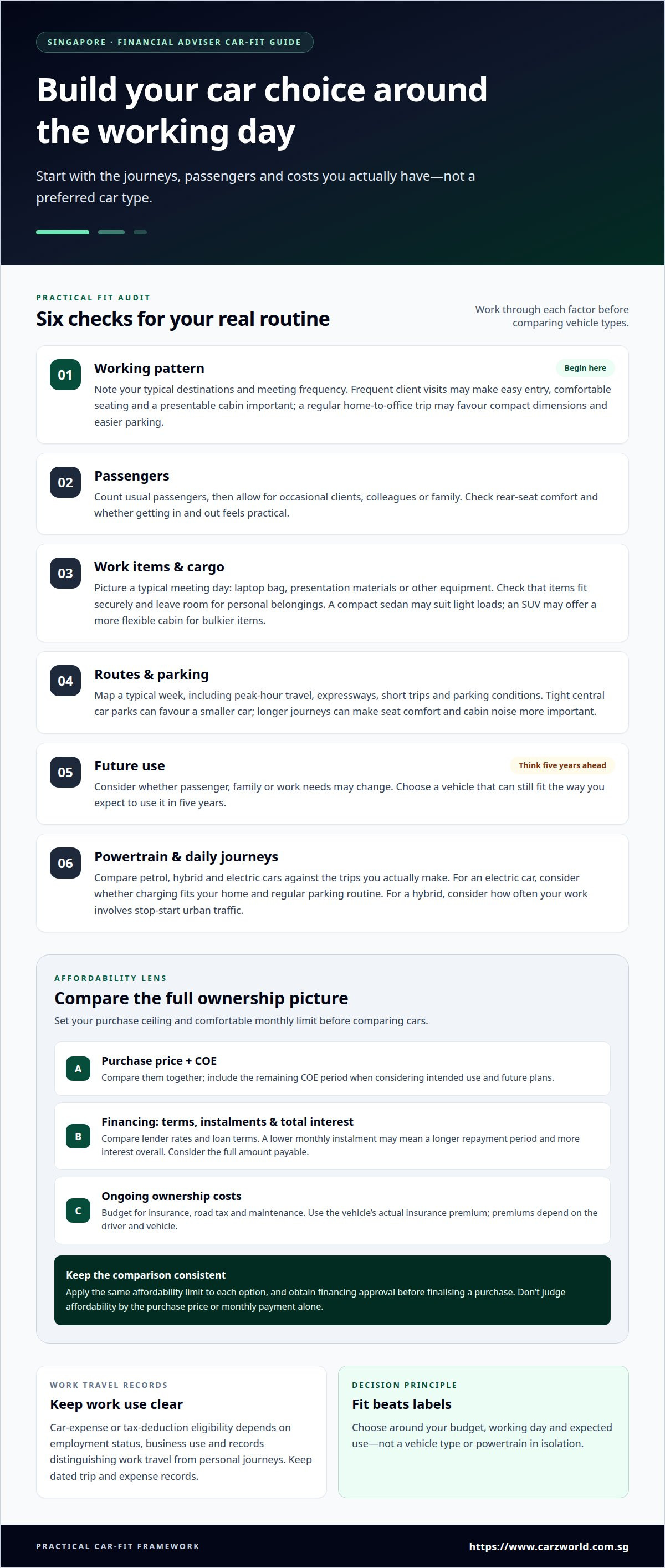
Start with your working pattern, not a preferred car type. A financial adviser who meets clients across Singapore may value easy entry, comfortable seating and a presentable cabin. Someone who mainly travels between home and one office may prioritise compact dimensions and easy parking. Note your typical destinations, meeting frequency and whether colleagues or clients regularly ride along.
Passenger needs can change over time. A car used mainly for solo travel today may need to carry family members or work colleagues later. Consider whether the rear seats can accommodate passengers comfortably, and whether getting in and out feels practical. Singapore’s short-term work patterns can shift, so assess whether the vehicle will still meet your needs in five years.
Cargo needs are usually modest, but what you carry matters. A laptop bag and presentation materials need less space than display equipment or several client folders. Think through a typical meeting day: where those items go, whether they remain secure and whether the boot still has room for personal belongings. A compact sedan may suit light loads, while an SUV may offer a more flexible cabin for bulkier items.
Driving habits shape what feels practical. List your regular routes, peak-hour travel, expressway use and parking conditions. Frequent visits to central offices may make a smaller car useful in tight car parks. Longer journeys across the island can make seat comfort and cabin noise more important. If most trips are short, consider whether a larger vehicle’s extra space is worth having every day.
- Budget: Set a comfortable monthly limit that leaves room for household commitments and savings.
- People: Count the usual passengers, then consider occasional client or family trips.
- Items: Identify the largest work bag or equipment you carry, and check how it fits.
- Routes: Map a typical week, including city parking, expressways and short trips.
- Future use: Reassess the choice against likely needs over five years.
Environmental concerns can guide your shortlist without taking priority over practical needs. Compare petrol, hybrid and electric cars based on the journeys you actually make. For an electric car, consider whether charging fits your home and regular parking routine. For a hybrid, think about how often your work involves stop-start urban traffic. A vehicle suited to your daily routes is more useful than one chosen only for its powertrain.
Can financial advisers claim car expenses or tax deductions in Singapore? Eligibility depends on employment status, business use and records that distinguish work travel from personal journeys. Keep dated trip and expense records to make work-related use clear.
Car affordability and COE
Set a purchase ceiling before comparing cars. Include the vehicle price and COE in your comparison, then separate the upfront payment from ongoing loan instalments. A car may look affordable based on its monthly payment alone, even when the total purchase cost and interest make it a poor fit. Decide how much of your savings you can put towards the purchase without disrupting essential commitments.
Next, assess the loan as a complete commitment. Compare rates from different lenders, then review the loan terms, monthly payments and total interest payable. A lower instalment may come with a longer repayment period and more interest overall. Consider the full amount payable, not just the figure that fits neatly into a monthly budget. Obtain financing approval before finalising the purchase so your decision reflects the financing available to you.
COE also affects how you judge a car’s value. Include it in your purchase comparison rather than treating it as a separate detail. For two cars with similar equipment, compare their overall price, financing and intended period of use. A higher purchase cost may be difficult to justify if the car’s features don’t support your work or daily routine. Apply the same affordability limit to each option for a consistent comparison.
Buying, financing and insuring a car involves more than the listed purchase price. Include the COE, loan payments and total interest, as well as insurance, in your ownership budget. Compare loan rates and terms, and secure financing approval before finalising your purchase. Insurance premiums depend on factors such as the driver and vehicle, so use the actual premium in your budget rather than assuming it will be the same for every car.
A car with a short COE remaining may offer less time to use it before you need to consider what comes next. This can affect whether its purchase cost makes sense for your plans and how you assess its future resale value. Consider the remaining period alongside the price, financing and your expected ownership timeline. A lower initial price alone doesn’t show whether the car suits your needs.
- Set a ceiling: Decide your purchase and monthly limits before viewing options.
- Compare financing: Weigh rates, terms, instalments and total interest together.
- Include insurance: Add the premium for the vehicle to your ownership budget.
- Assess COE remaining: Relate the remaining period to your intended use and future plans.
Once you’ve set those limits, compare car options against the budget and ownership period you have in mind.
Total cost of ownership
Total cost of ownership covers the expenses of keeping a car, not just its purchase price. For a financial adviser, driving routes and vehicle choice shape the comparison.
New and Used Car Costs
A new or pre-owned car is more cost-effective when its full ownership costs suit your use and budget. Compare purchase and financing amounts with insurance, road tax, parking, ERP and maintenance for each option. A pre-owned car may have a lower purchase price, while a new car may have different ownership expenses. Assess each vehicle individually rather than assuming either category always costs less.
Parking, ERP, and Road Tax Costs
Parking, ERP and road tax are recurring or journey-related expenses to include in your total budget. Their impact depends on where you park, the routes and times you drive, and the specific vehicle. For example, regular client meetings in paid car parks can make parking a frequent expense, while routes using ERP gantries add charges to those trips. Use the car’s details to determine its road-tax amount.
Build a comparison using the same ownership period and driving pattern for each car. Record expenses as separate items so one low figure doesn’t hide a higher cost elsewhere. Include:
- Fixed ownership costs: insurance and road tax.
- Use-related costs: parking and ERP charges for typical work journeys.
- Vehicle upkeep: maintenance, which should be considered alongside the car’s age and condition.
- Purchase costs: the amount paid and any financing interest.
Insurance premiums vary by driver and vehicle. Drivers younger than 25 years old often face higher car insurance premiums because insurers consider them higher risk. Include the premium for the specific car in your comparison rather than using another driver’s policy as a guide. A difference in insurance can change which option fits your budget.
Set aside a separate amount for maintenance because upkeep needs can vary between cars. For a pre-owned car, consider its age, condition and service history when assessing likely maintenance needs. For a new car, include scheduled upkeep in your calculations. Don’t compare a well-maintained vehicle with one needing attention as if their near-term costs were identical.
For an adviser driving to several meetings in a day, parking and ERP may recur across separate journeys. Someone with fewer client visits may have a different pattern. Estimate a typical working week using actual destinations and parking habits, then apply that pattern consistently to every car you’re considering.
Review your comparison by asking which expenses are predictable and which depend on use. A car with a lower purchase price can still have higher ongoing costs, while a higher-priced option may suit a different usage pattern. The useful result is a realistic total that reflects the vehicle, driver and journeys, rather than a single headline figure.
What are the most reliable and fuel-efficient cars in Singapore for client-facing professionals?
No single model is automatically the best choice for every adviser in Singapore. Reliability and fuel efficiency depend on the specific car, its condition, driving patterns and how well it suits the workday. Compare information about the vehicle in front of you rather than choosing by reputation or styling alone.
For a pre-owned car, start with its maintenance and ownership records. Look for a consistent service history and note gaps, recurring issues or signs of neglected care. During an inspection, check the engine start, dashboard warning lights, braking response, steering and visible wear. These checks can raise questions about that particular vehicle; a polished exterior alone says little about how it has been maintained.
For a new car, assess reliability through the specifications and ownership terms presented for that vehicle. Focus on features you’ll use regularly, such as clear visibility, straightforward controls and comfortable seating for client journeys. A complex cabin may impress during a brief viewing, but simple operation can matter more on repeated work trips through Singapore traffic.
Judge fuel efficiency against your mix of routes. A car used for short, stop-start trips between meetings has a different pattern from one used mainly for longer expressway journeys. Compare the stated consumption figures for shortlisted cars on the same basis, then consider how closely each vehicle matches your typical travel. Don’t treat one figure as a promise of your own results.
Use a consistent comparison process. For example, shortlist a compact sedan and a larger car, then assess each against the same weekday itinerary. Note the expected route types, passenger load and time spent in traffic. A car that performs well on longer journeys may not suit frequent short trips, even if its published figure looks attractive.
- Vehicle condition: Review service records and inspect wear, warning lights and basic operation.
- Work use: Consider cabin comfort, visibility and ease of use during client journeys.
- Fuel use: Compare consumption figures on the same basis and against your regular routes.
- Whole-car fit: Weigh condition, driving pattern and day-to-day usability together.
Reliability also means whether the car can support a demanding schedule without adding avoidable disruption. Consider how it suits your typical travel between appointments rather than assuming a particular body style or brand is always dependable. For example, a well-documented car that fits your routes can be a more informed choice than an unfamiliar option selected mainly for its appearance.
For client-facing professionals, a practical shortlist balances efficient journeys with a calm, comfortable experience for passengers. Compare each candidate’s records, cabin usability and fuel information against the same real-world workday. This gives you a clearer basis for choosing than a broad claim that one model is universally the most reliable or economical.
How do compact sedans, SUVs, hybrids, and electric cars compare for Singapore driving?
Each vehicle type involves different trade-offs between space, everyday usability and powertrain. For a financial adviser travelling between Singapore appointments, start by comparing typical routes, passenger needs and parking routines. A compact sedan may suit solo journeys, while an SUV may better accommodate frequent passengers or cargo.
Compact sedans are worth considering if your workdays involve city meetings and regular parking. Their smaller footprint can make tight spaces easier to navigate than in a larger vehicle. A sedan can also provide a conventional boot for work bags and presentation materials. Check rear-seat comfort if clients or colleagues regularly travel with you.
SUVs offer a higher seating position and a cabin that may be more flexible for passengers or bulkier items. The extra space can help when a workday involves carrying equipment alongside personal belongings. However, a larger body may be less convenient in compact parking spaces. If most journeys involve just you and a laptop bag, consider whether the extra space is useful in daily use.
Hybrids combine a fuel engine with electric assistance. Their appeal depends on how the powertrain fits your driving pattern and ownership priorities. Compare the model’s stated fuel consumption with your usual mix of stop-start traffic and longer journeys. As with any car, assess the specific vehicle’s purchase and running costs rather than assuming the powertrain alone determines affordability.
Electric cars use an electric motor instead of a conventional fuel engine. For a Singapore driver, charging arrangements are central to daily practicality. Consider where you can charge the car during your normal routine, such as at home or near regular destinations. A predictable charging setup may suit planned journeys, while frequent changes to routes and parking can make charging logistics more important.
Compare all four types against the same working week, not separate ideal scenarios. For example, consider a schedule with client meetings in town, an expressway trip and a family outing. Ask how each car handles passenger comfort, work items, parking and the journeys you actually make. Then compare the specific models’ stated fuel or energy-use information on the same basis.
- Choose a compact sedan when a smaller footprint and conventional boot suit your routine.
- Consider an SUV when passenger room or flexible cargo space matters often.
- Compare a hybrid against your routes and its stated fuel consumption.
- Assess an electric car by how charging fits your regular parking and travel.
Use these trade-offs to narrow your shortlist. Compare vehicle options for your driving needs against your daily routes, passengers and parking routine.
Carz World Pte Ltd
Carz World Pte Ltd can help you explore vehicle options after you’ve set your budget, priorities and preferred vehicle type. Its range includes pre-owned cars and brand new cars, giving you options to consider against your expected use and ownership costs. If you need a car for a shorter-term requirement, car rental is another option to consider. Car Export Services are available for export needs.
Use your shortlist to focus the discussion on the journeys you make, passenger and cargo needs, and costs you’ve considered. This keeps the next step practical, whether you’re exploring a new purchase, a pre-owned vehicle or rental.
Contact Carz World Pte Ltd to discuss your car requirements.
Make your next car decision with confidence
Your work needs can change as client schedules, meeting locations and personal routines shift. Treat your car choice as a decision you can revisit, not a permanent label attached to your role. A practical car for a financial adviser in Singapore should continue to make sense for your current journeys and responsibilities.
Before taking the next step, decide what matters most in your shortlist. You might prioritise an easy-to-manage daily drive, a comfortable client journey or flexibility for changing plans. Keep those priorities in view as you compare options, so an appealing feature doesn’t distract from what you’ll use regularly.
Carz World Pte Ltd can help you explore a suitable next step based on your needs. Contact Carz World Pte Ltd for car advice and discuss what you’re looking for. A clear set of priorities can make your next decision feel more manageable.
Frequently Asked Questions
What cars are practical for financial advisors in Singapore?
A practical choice depends on your client schedule and what you carry between appointments. A compact sedan may suit a day of solo visits with a laptop bag, while an SUV may be worth considering if clients or family regularly ride along. Hybrids and electric cars are options to assess against your travel and charging routines. Prioritise features you’ll use throughout an ordinary workweek.
What is the total cost of owning a car in Singapore, including COE, taxes, insurance, and maintenance?
There’s no single total that applies to every driver and car. Build your estimate from the purchase amount, COE, financing interest, road tax, insurance and maintenance, then add parking and ERP based on your usual journeys. For example, an adviser visiting several locations should account for those trips’ parking patterns. Compare options over the same ownership period to make the figures meaningful.
What are the current prices and COE premiums for suitable new cars in Singapore?
There isn’t one fixed price for a suitable new car, because the model and prevailing COE premium affect the amount. Treat the car price and COE as related parts of the purchase comparison, and note whether the quoted figure includes COE. To compare two models fairly, use their current quotes and financing terms together rather than relying on an older price or headline figure alone.
What car features are useful for visiting clients and transporting presentation materials?
For client visits, consider comfortable seating, clear visibility and controls that are straightforward to use between destinations. A boot or cabin that fits a laptop bag, presentation folder and personal items without crowding passengers can make work travel more convenient. If clients often ride with you, assess rear-seat access and space in person. Choose features that support your actual meeting routine, not occasional needs.
Disclaimer
This content is provided for general informational purposes only. Readers are encouraged to independently verify important information.
In Same Category
Related by Tags
- Compare car choices for a couple living in central Singapore
- Car Consignment Agent in Sembawang for Price Setting
- Choosing a Family Car for Elderly Parents in Singapore
- Practical cars for financial advisors sg: Check what you can afford
- Practical cars for insurance agents sg: compare car costs
- Car types and models for weekend drives, plus family outing ideas
- Used SUV for Sale in Clementi: Compare Prices and Mileage
- Second Hand Commercial Vehicle Singapore: Compare Prices and Checks
- Pre-owned cars with memory seats in Singapore: asking prices
- Save for a Car or Take a Loan in 2026? Compare the Costs
- Is a car a good investment in Singapore compared with other ways to travel?
- Find reliable low maintenance second hand cars in Singapore by mileage
- Sell My Car Fast in Punggol: A Practical Guide
- Best Cars for Home-Based Businesses in Singapore: 2026 Guide
- Best Second Hand Cars for Malaysia: Singapore Buyer's Guide
- Financial Planning for Your First Car in Singapore
- Best Time to Renew COE in 2026: A Practical Singapore Guide
- COE Renewal for 5 Years vs 10 Years: Pros and Cons in Singapore
- Understanding the MAS Car Loan Restrictions in Singapore (2026)
- Pros and Cons of Buying a High PARF Car in Singapore
- Car Valuation Services in Bukit Merah: A Seller’s Guide
- Calculating the Breakeven Point for COE Renewal in Singapore
- Financial Checklist Before Committing to a Car Purchase in Singapore (2026)