Is a car a good investment in Singapore compared with other ways to travel?
A car can be a good investment in convenience, but it’s rarely a straightforward way to grow your money. Whether a car is a good investment in Singapore depends on how often you need it and whether its ownership costs fit your budget; the standard LTA ownership-transfer fee for a private car is S$25. COE, maintenance, insurance and dealer charges also affect the overall cost.
It’s easy to focus on the purchase price, especially when a car can make daily travel more flexible. But the full cost of ownership matters just as much as the upfront commitment.
This guide compares car ownership with other ways to travel and explains how transfer fees, dealer charges, maintenance, affordability and COE affect the decision. Use it to assess which option fits your budget and travel needs.
Key Takeaways
- Compare the S$25 LTA ownership-transfer fee with any dealer admin charge, and read the sale agreement for costs before committing.
- Budget beyond the purchase price: servicing, inspections, tyres, battery replacement and possible repairs all affect used-car ownership costs.
- Build a realistic affordability picture by including road tax, insurance, maintenance and loan costs, not just the downpayment.
- Check how much COE time remains on a used car and consider how that affects your ownership plans and future costs.
- Compare owning a car with other travel options against your routine and likely needs over the next five years.
Ownership transfer fees and dealer charges
Whether a car is a good investment in Singapore depends partly on costs beyond its advertised price. Include these as separate items in your purchase budget.
For an online transfer, the process can take 10-15 minutes when there are no problems. Before signing, read the sale agreement and compare each charge with what you agreed. On delivery, inspect the car against its agreed specifications and condition. Arrange insurance that covers third-party liabilities, damage to your car and other potential risks.
Ownership costs continue after the transfer. Add loan interest, insurance, road tax, fuel or electricity, parking, servicing and repairs to your calculation. A low purchase price alone won’t show what the car may cost over your planned ownership period.
Travel alternatives have different cost patterns: taxis and ride-hailing charge per journey, car-sharing charges for use, and public transport avoids private-car ownership costs. A car’s fixed and running costs may suit frequent, varied trips, while pay-per-use options can be more practical for occasional journeys.
New and used cars differ in purchase price, remaining COE and resale uncertainty. These examples don’t establish future resale value.
Singapore buyers should include any applicable EV incentives and taxes in an electric car’s purchase calculation. Electricity, charging access, insurance and maintenance also affect running costs, so compare the full ownership picture with that of a petrol car.
A car may generate rental income, but weigh that revenue against financing, insurance, depreciation, maintenance and periods without renters. COE movements can affect purchase and resale values; loan interest adds borrowing costs, while condition and remaining COE influence resale demand.
| Travel option | Cost pattern | Consider when |
|---|---|---|
| Own a car | Purchase and ongoing costs | You need regular, flexible travel |
| Taxi or ride-hailing | Cost per journey | You travel occasionally |
| Car-sharing | Cost tied to use | You need a car for selected trips |
| Public transport | Trip-based fares | Routes fit your regular journeys |
Choose by comparing your likely trip frequency with the full ownership budget, not the transfer fee alone.
Travel needs and total costs both matter. Before committing, review the sale agreement and confirm that its terms match what was agreed. Look for hidden costs instead of relying only on charges already identified. If a term or cost is unclear, ask for clarification before proceeding, so the written agreement reflects your understanding.
Used-car maintenance and repair costs
A used car’s purchase price is only part of its running cost. Annual mileage affects how often servicing comes due: a car used for frequent commuting may reach each servicing interval sooner than one driven occasionally. Include servicing in your yearly budget instead of treating it as an unexpected expense.
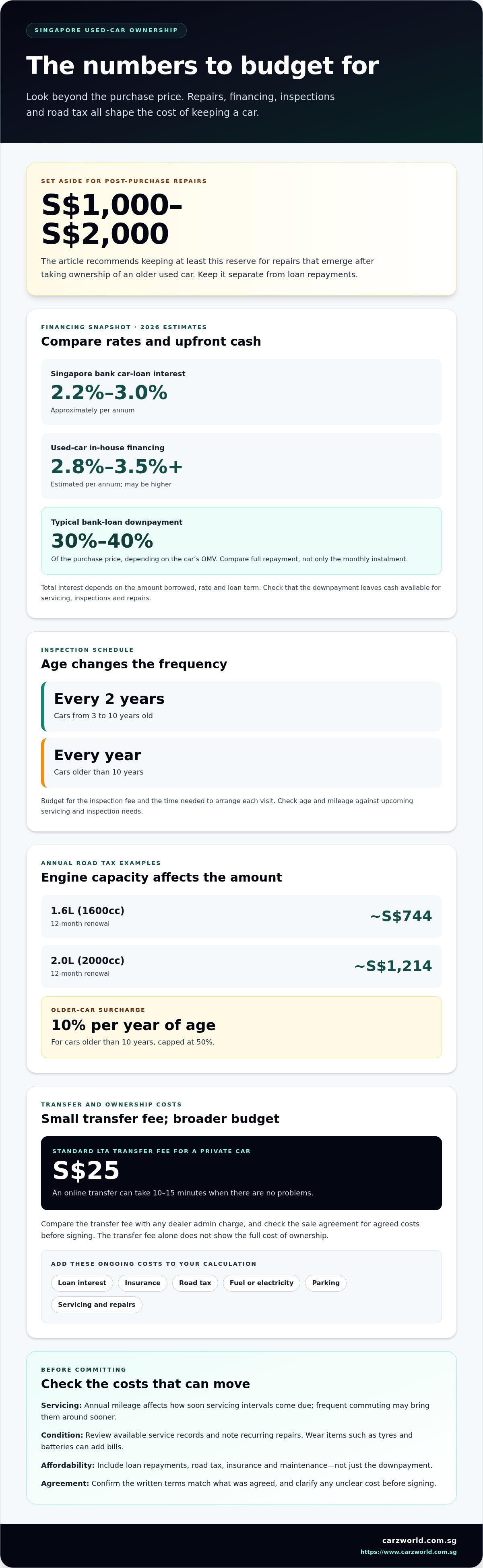
Inspection frequency also changes with the car’s age. Cars from 3 to 10 years old must undergo inspection every 2 years, while cars older than 10 years must undergo inspection every year. Older cars also face more frequent inspection visits, so account for both the fee and the time needed to arrange them.
Wear items can add sizeable bills. These ranges show why it helps to keep a repair reserve: a tyre or battery replacement can coincide with routine servicing.
For an older used car, set aside at least S$1,000 to S$2,000 for post-purchase repairs. Use this reserve for work that emerges after you take ownership, rather than assuming the car will need no immediate attention. A practical pre-purchase process is to:
- Review available service records and note recurring repairs.
- Check the car’s age and mileage against upcoming servicing and inspection needs.
- Keep a separate repair reserve after paying the purchase costs.
Financing adds another cost layer. For 2026, estimated Singapore bank car-loan interest rates are approximately 2.2%-3.0% per annum. Used-car in-house financing is estimated at about 2.8% to 3.5% or higher per annum. The total interest paid depends on the amount borrowed, rate and loan term, so compare the full repayment, not only the monthly instalment.
Bank car loans typically require a downpayment of 30-40% of the purchase price, depending on the car’s OMV. Before finalising a purchase, arrange financing approval and compare lenders’ rates. Then assess whether the downpayment leaves enough cash for servicing, inspection and repairs.
Keep the car’s maintenance reserve separate from loan repayments. This makes it easier to see whether the purchase remains affordable after financing, scheduled servicing and age-related costs are included.
Budgeting and affordability
Set a purchase limit only after estimating the full cost of keeping the car. Consider the price, loan repayments, road tax, insurance and maintenance together. A car that fits the downpayment alone may still strain the household budget through recurring expenses.
Singapore prices show how wide the upfront commitment can be. These examples illustrate why age and remaining COE matter alongside the headline price.
Road tax is another recurring cost, and engine capacity affects the amount. A typical 1.6L (1600cc) car has annual road tax of about S$744 for a 12-month renewal. For a 2.0L (2000cc) car, the comparable estimate is roughly S$1,214. Cars older than 10 years face a surcharge of 10% per year of age, capped at 50%, so an older vehicle’s tax burden can rise over time.
Insurance premiums also vary by driver and car. Younger drivers, especially those under 25, often face higher premiums because insurers consider them higher risk. Include insurance in the monthly affordability calculation, rather than treating it as a one-off purchase expense. Road tax, insurance and maintenance all belong in the total cost-of-ownership budget.
Financing changes both the cash needed upfront and the total paid over time. Estimated Singapore bank car-loan rates for 2026 are approximately 2.2%-3.0% per annum. Used-car in-house financing is estimated at about 2.8% to 3.5% or higher per annum. Bank loans typically require a downpayment of 30-40% of the car’s purchase price, depending on its OMV. Compare the total repayment and the rate, not just the instalment.
Build a working budget in three steps:
- List the purchase price, downpayment and loan repayment.
- Add road tax, insurance and expected maintenance.
- Keep room for costs that can change, such as insurance premiums or age-related road tax.
For example, compare a new car’s higher purchase commitment with a five-year-old car’s lower listed price, then account for each vehicle’s COE balance, mileage and condition. If recurring costs leave little room for savings or household needs, a lower-cost travel option may fit better. Affordability depends on the full ownership calculation, not a single attractive price.
Car buyers in Singapore should include road tax, insurance and maintenance in their total cost-of-ownership budget, keeping these recurring expenses central to affordability decisions.
Certificate of Entitlement (COE)
COE affects how long a car can remain on the road and how buyers assess its value. A used car may have only 3-5 years of COE remaining before expiry, unless the COE is renewed.
COE-Related Value Depreciation
As a car’s COE runs down, the time left in its current ownership period becomes a key part of its resale appeal. Two cars of similar age can therefore differ in value if their COE balances differ. Compare remaining COE with the car’s condition, mileage and asking price, rather than using age alone as a guide.
For example, a used car with 3 years remaining offers a shorter period before expiry than one with 5 years remaining. That difference can affect how long a buyer expects to use the car before making another decision. If you plan to keep a vehicle beyond its current COE period, include renewal in your planning rather than assuming the car’s present value will continue unchanged.
PARF and COE Rebates
At deregistration, a car may have a PARF or COE rebate, depending on eligibility and vehicle details. These rebates are distinct from the car’s resale price: they relate to deregistration, not what another buyer may pay for the vehicle.
For your comparison, identify whether the car is eligible for a PARF or COE rebate, then account for its remaining COE and your planned deregistration timing. Don’t treat a potential rebate as guaranteed resale profit. It is one part of the car’s end-of-ownership value, alongside the purchase price and costs incurred during ownership.
COE balance is especially useful when comparing two used cars with different remaining ownership periods. A lower asking price may come with less time before expiry, while a higher-priced option may offer longer under its existing COE. Neither detail alone settles the decision. Match the remaining COE to your planned ownership period and likely next step.
Use this practical comparison before committing:
- Record each car’s remaining COE and asking price.
- Compare mileage and condition, not just the advertised age.
- Consider whether you intend to sell, deregister or keep the car beyond its current COE period.
- Include any applicable PARF or COE rebate when estimating end-of-ownership value.
COE market movements can also affect a buyer’s decision and future resale expectations. A change in COE value may alter the relative appeal of cars with different balances, but vehicle-specific factors such as mileage and condition still matter. Treat the current price, remaining COE and potential deregistration value as separate parts of the same calculation.
Planning for long-term needs
Before buying, consider whether the car will still meet your needs in five years. A vehicle that suits today’s commute may not fit a changed workplace, household routine or caregiving responsibility. Think beyond the first few months. Your expected ownership period should make sense alongside the car’s use, costs and remaining COE.
Start with a typical week in Singapore. List journeys for work, school, errands and family commitments. Note which trips need a car’s flexibility and which can be made by public transport, taxi or ride-hailing. For example, a household with regular trips to several locations may value having a car available, while a predictable commute may offer fewer reasons for daily ownership.
Then consider likely changes over the next five years. A new job location could change your commute; a growing household could affect the space you need. Write down which needs are certain, likely and optional. Choose a vehicle for the needs you expect to keep, not a temporary routine that may soon change.
Your intended holding period matters too. Compare it with the car’s remaining COE and consider what you may do when that period no longer suits your plans. A shorter ownership horizon can make resale timing more important. A longer one calls for careful consideration of future use, maintenance needs and the possibility of changing vehicles.
Use this decision check before committing:
- Map your regular weekly journeys and identify which require a car.
- List expected household or work changes across the next five years.
- Match the vehicle’s size and use to those lasting needs.
- Set a review point for deciding whether to keep, sell or replace it.
For example, if your commute may change within a year, compare ownership with flexible travel options before committing to a car. If family journeys are already part of your weekly routine, assess whether the car will continue meeting those needs throughout your planned ownership period. The right decision depends on how well the vehicle fits your actual travel pattern.
Keep the plan practical. Review your journey list alongside the purchase budget, COE timeline and expected ownership period. If those factors point in different directions, pause and compare the trade-offs before deciding. A car is more likely to suit your long-term plans when it remains useful beyond the initial purchase.
Compare vehicle options for your plans against your expected travel needs and ownership horizon.
Carz World Pte Ltd: Pre-Owned Cars
Carz World offers high-quality, well-maintained pre-owned cars for buyers comparing ownership costs with other ways to travel. If a used car fits your routine, compare its asking price, mileage, condition and remaining COE with your planned ownership period. These details help you assess its practical fit alongside the costs covered in this guide.
If you’re weighing a purchase against occasional driving, Carz World also offers car rental. Buyers considering a new vehicle can compare brand new cars with pre-owned options, keeping upfront affordability and longer-term needs in view. Choose the route that matches how you expect to travel, rather than treating a car purchase as a guaranteed financial investment.
Explore the options at Carz World, or visit www.carzworld.com.sg to discuss your needs.
Choose the travel option that fits your next chapter
Think of the decision as choosing how you want to travel, not simply whether to buy a vehicle. Whether a car is a good investment in Singapore depends on how ownership fits your priorities and the flexibility you want in the years ahead. A clear choice should support your daily life without making travel costs feel like a constant trade-off.
If you’re leaning towards ownership, compare pre-owned and brand new cars with the commitment you’re comfortable taking on. If you’d rather access a car without making a purchase your next step, car rental is another option. Carz World offers all three, giving you a place to explore different routes based on your needs.
Contact Carz World Pte Ltd to discuss your options and decide on a travel plan that feels right for you.
Frequently Asked Questions
How much does it cost to buy and own a car in Singapore, including COE, ARF, road tax and insurance?
There’s no single total for buying and owning a car in Singapore. Start with the vehicle price, including its COE and ARF components, then budget for recurring road tax and insurance. Your overall cost also depends on the car’s engine capacity, insurance profile, financing and how long you keep it. Compare the full purchase and ownership budget, rather than treating the advertised price as the amount you’ll spend.
What are current Singapore COE prices and how do they affect car prices?
COE prices differ by vehicle category and bidding outcome, and the premium forms part of the cost of obtaining a car. A higher premium can push the purchase price up, while premium changes can affect how buyers compare new and used vehicles. For a useful comparison, consider the car’s total price and remaining COE together. The premium alone doesn’t show the vehicle’s full ownership cost or future resale value.
What are typical annual car expenses in Singapore for fuel, parking, ERP, maintenance and insurance?
Annual expenses depend on how much and where you drive, where you park, and your insurance profile. Estimate fuel or charging costs from your regular routes, then add parking and ERP based on where and when you travel. Maintenance depends partly on mileage and vehicle condition; insurance depends on the driver and car. Give each item a separate budget line so changes in commuting or parking habits are reflected in your yearly total.
Are there Singapore rebates, taxes or incentives for electric cars, and how do EV ownership costs compare?
Include any applicable EV incentives and taxes when calculating the purchase cost. Compare electricity, charging access, insurance and maintenance with the full ownership costs of a petrol car.
Disclaimer
This content is provided for general informational purposes only. Readers are encouraged to independently verify important information.
In Same Category
- Is a car a good investment in Singapore compared with other ways to travel?
- Second hand car lots in Choa Chu Kang: dealers and prices
- How to Renew Your COE and Account for Fees and Deadlines
- Compare car financing options with no credit history in SG
- Find reliable low maintenance second hand cars in Singapore by mileage
Related by Tags
- Is a car a good investment in Singapore compared with other ways to travel?
- Risks of Buying a Car with 1 Year of COE Left in Singapore (2026 Guide)
- COE Renewal for 5 Years vs 10 Years: Pros and Cons in Singapore
- Calculating the Breakeven Point for COE Renewal in Singapore
- Mazda CX-5 Singapore Review: Buyer Guide, Specs & Ownership (2026)
- Used Cars for Sale in Tampines: 2026 Buyer's Guide
- Car Downpayment vs Monthly Instalment in Singapore: The 2026 Budgeting Guide
- Car Loan Singapore: The Complete 2026 Guide to Financing Your Vehicle
- How Much Salary to Afford a Car in Singapore: 2026 Affordability Guide
- Buying a Used Car in Singapore: 2026 Ultimate Guide
- What is PARF? The Ultimate Guide to Singapore’s Car Rebate System
- Mercedes-Benz EQB 250+ Review: The Ultimate 7-Seater Family EV in Singapore