Practical cars for insurance agents sg: compare car costs
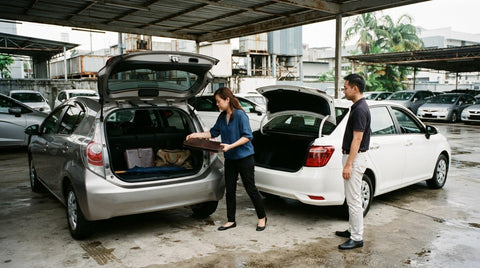
A low purchase price alone doesn’t make a car practical for an insurance agent. In Singapore, choosing practical cars for insurance agents means weighing the purchase price and suitability for client visits against insurance costs. Occupation is one factor used to calculate car insurance premiums.
Compare the full cost picture before settling on a car. This guide explains how purchase price fits your budget, why occupation can affect premium calculations, and what to consider when choosing a car for frequent travel. It also offers a straightforward way to compare practical options with your work needs, rather than assuming the cheapest car is the best choice.
Key Takeaways
- Match a car’s fuel use and everyday practicality to how often you travel for client visits.
- Compare new and pre-owned options by looking beyond the initial purchase decision to the factors that shape ownership costs.
- Weigh hybrid and electric cars against your driving routine to judge whether their advantages suit your work.
- Use a consistent set of criteria to narrow your shortlist, then explore new, pre-owned or rental options that fit your needs.
What are the best fuel-efficient cars for frequent client visits in Singapore?
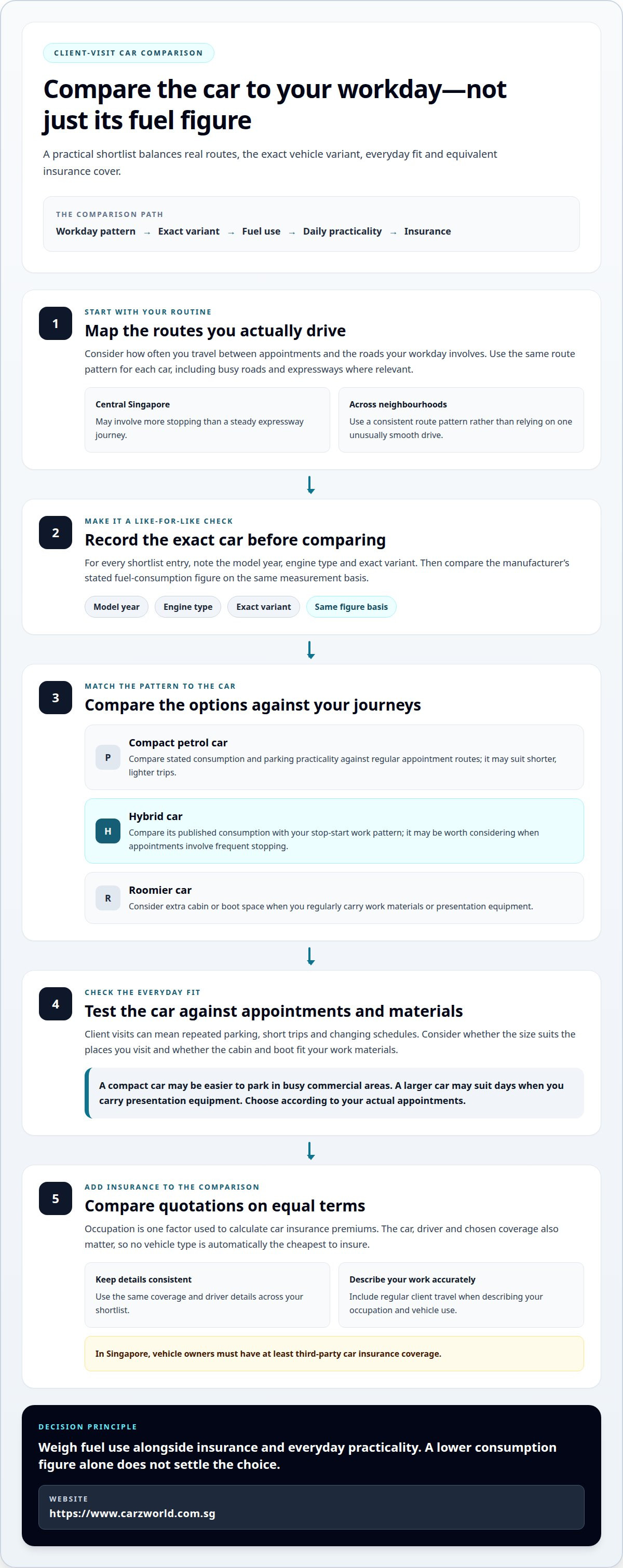
The best choice depends on your routes, not just the badge. Compare the exact variant’s fuel consumption, then consider how often you drive between appointments. A compact petrol car may suit shorter, lighter trips. A hybrid may be worth comparing if your schedule involves frequent stop-start driving. These are starting points, not a universal ranking.
Use the same process to compare every car on your shortlist. Record the exact model year, engine type and variant. Then compare the manufacturer’s stated fuel-consumption figure on the same measurement basis, and consider whether your usual workday resembles the conditions behind that figure. A route through central Singapore, for example, may involve more stopping than a steady expressway journey.
Fuel use is only one part of daily practicality. Client visits can involve repeated parking, short trips and changing schedules. Consider whether the car’s size suits the places you visit and whether its cabin and boot fit your work materials. A compact car may be easier to park in busy commercial areas, while a larger one may suit days when you carry presentation equipment. Match the trade-offs to your actual appointments.
Include insurance costs in the comparison. In Singapore, occupation is one factor used to calculate car insurance premiums, but no vehicle type is automatically the cheapest to insure. The car, driver and chosen coverage all matter. Compare quotations using the same coverage and driver details across your shortlist. Describe your occupation accurately, especially if your work involves regular client travel.
Singapore’s Motor Vehicles (Third-Party Risks and Compensation) Act 1960, revised in 2020, includes section 8, which disallows insurers from pleading certain kinds of terms, according to Singapore Statutes Online. Separately, vehicle owners must have at least third-party car insurance coverage. These rules make insurance a core ownership consideration, rather than an optional add-on to fuel calculations.
To compare fuel use fairly, consider your own weekly routine. If you visit clients across several neighbourhoods, use the same route pattern for each vehicle, including busy roads and expressways where relevant. Don’t treat one unusually smooth test drive as representative of every workday. A written comparison helps distinguish a consistent fit from a single favourable impression.
- Compact petrol car: Compare its stated consumption and parking practicality against your regular appointment routes.
- Hybrid car: Compare its published consumption with the stop-start pattern of your working day.
- Roomier car: Consider whether extra cabin or boot space is useful for equipment and longer client journeys.
Weigh fuel use alongside insurance and the car’s everyday role. A lower consumption figure may not settle the decision if the car doesn’t suit your appointments. Likewise, a comfortable vehicle may not fit a tight running-cost plan. When comparing practical cars for insurance agents in Singapore, assess the exact variant, your real routes and equivalent insurance coverage before choosing.
If you need advice about cover for a car used on client visits, it helps to understand the difference between an insurance agent and a broker. Agents advise clients based on the offerings of the insurer they represent. Brokers represent clients rather than insurers and advise based on their needs. They can help with policy reviews, claims support and renewals. This distinction can guide you when seeking advice beyond one insurer’s offerings.
In Singapore, persons acting as unregistered insurance agents will be referred to the Monetary Authority of Singapore for action under the Insurance Act. In Singapore, registered agents generally must fulfil Continuing Professional Development requirements to qualify for renewal, except Trade Specific Agents other than Motor Trades. In Singapore, a renewal fee is imposed on agents, including nominee agents, who meet the requirements when their licence is renewed at the end of the year; the fee is charged per principal representation. These details matter when assessing an agent’s status and representation.
What are the cheapest new cars in Singapore suitable for insurance agents?
The most affordable new car that suits your work is the one with the lowest overall ownership outlay while still fitting your working day. A compact hatchback or sedan can be a sensible starting point for solo client visits and routine city travel. A larger model may make more sense if appointments regularly involve passengers or presentation materials.
No model is automatically the cheapest for every buyer. Prices vary by model, variant and purchase timing. Compare current written quotations for the same type of car instead of relying on an old advertised figure. A headline price alone won’t show whether two cars have the same equipment or terms. Note each car’s exact model and variant beside its quoted price.
Use a simple shortlist to keep the comparison consistent:
- Purchase outlay: Compare the full quoted amount for each exact variant, including any charges shown in the quotation.
- Everyday use: Match the car’s size and seating to your usual client visits and work materials.
- Fuel consumption: Compare the stated figure for each variant using the same basis.
- Insurance: Compare quotations using the same driver information and coverage.
An agent who usually travels alone between offices could start by comparing compact models. Someone carrying display materials may prefer a sedan with a more useful boot. Extra space adds value only when it meets a regular work need. Otherwise, a smaller car may be the more practical match, even if another model has a lower advertised starting price.
Consider your actual week before choosing a car size. List the places you visit, whether colleagues or clients ride with you, and what you carry. A car used mainly for solo appointments has different requirements from one used for frequent group travel. This quick exercise can help you avoid paying for space or features that rarely support your work.
Next, compare the same ownership period across your shortlisted cars. Consider the purchase amount alongside fuel use and insurance, rather than judging affordability from the initial quote alone. If one quotation is lower, check that it refers to the same variant and coverage assumptions. A like-for-like comparison makes price differences easier to interpret.
For a new car, warranty terms and included equipment can also affect a quotation’s value. Read the terms beside the price and note what each variant includes. Don’t treat a lower starting figure as a complete comparison if the cars differ in specification. A simple table listing model, variant, quoted amount, fuel figure and insurance quotation can keep the decision clear.
Shortlist two or three new cars that suit your routes, then compare their exact variants and written quotations. This gives you a practical basis for balancing purchase outlay, daily usefulness and running costs. To review available new-car options, start with the models that best match your work routine.
A car shortlist addresses travel needs, while an agent’s role is defined by the insurers represented. In Singapore, an insurance agent represents 1 to 3 insurance companies. A person or company distributing general insurance products in Singapore must register with the Agents' Registration Board through the principal insurers it wishes to represent before acting as an insurance agent. Keep this requirement distinct from the vehicle comparison: it does not change what a particular car variant includes or how its quotation should be assessed.
An agent may be sufficient if your needs are straightforward and you already trust a specific insurer. Insurance brokers in Singapore work with multiple insurers and compare policies across the market. They are regulated by the Monetary Authority of Singapore (MAS) and must act in the client’s best interest. The page says rising healthcare costs, complex investment-linked plans and evolving regulations are reasons more Singaporeans are turning to brokers. These distinctions describe how insurance services are provided. They are separate from choosing a car for client visits and work materials.
What are the best reliable used cars for insurance agents in Singapore?
A reliable used car is one whose condition and history suit your working routine. No single model fits every driver. Start with a shortlist of compact hatchbacks and sedans, then compare each car’s age, mileage, service records and condition. For an agent travelling between client appointments, dependable daily use matters more than a long equipment list.
Start with the car’s records. Look for a consistent service history and note any gaps, repeated repairs or periods without documentation. Compare the recorded mileage with the car’s visible condition and the seller’s description. Low mileage alone doesn’t show how a car was driven or maintained. Reviewing the records also helps you compare two examples of the same model instead of assuming they’re equally sound.
Next, assess the car against your typical workday. A compact hatchback can suit solo visits and easier parking; a sedan may offer a more useful boot for documents or presentation materials. If you often carry colleagues or clients, consider rear-seat space too. Imagine a day with appointments in several neighbourhoods and a folder of client documents. Choose the layout that supports that routine without adding space you rarely use.
Use a repeatable comparison for each used car:
- History: Review the service records, ownership information and any available accident history.
- Condition: Look for uneven wear, warning lights, unusual noises and signs of previous damage.
- Use: Match seating, boot space and vehicle size to your regular appointment pattern.
- Costs: Compare the quoted purchase amount, fuel consumption and insurance coverage on equivalent terms.
Compare insurance separately. Occupation is one factor used to calculate car insurance premiums in Singapore, so provide accurate work details when requesting quotations. Compare the same coverage and driver information for every shortlisted car. Vehicle owners must have at least third-party car insurance coverage. Insurance is therefore part of the ownership decision, not an afterthought.
For a fair shortlist, compare cars from the same broad category and note each model year. A newer example may differ in price and condition from an older one, even if the model name is the same. Don’t rank cars by mileage alone. Consider the records alongside the vehicle’s condition and your intended use. A practical candidate fits your daily travel without creating avoidable compromises.
Before deciding, rank your priorities. An agent making frequent solo trips, for example, may put parking convenience first. Someone carrying materials may prioritise boot space. Compare your strongest candidates against those priorities, including service histories and insurance quotations. This makes “reliable” a decision grounded in evidence and actual work needs.
Browse pre-owned car options as you build a shortlist. Compare each vehicle’s details against your route, space requirements and ownership budget. A careful, consistent review helps identify a used car that supports regular client visits, rather than simply looking attractive in an advertisement.
Are hybrid or electric cars practical for insurance agents in Singapore
Hybrid and electric cars can suit insurance agents, but the right choice depends on daily routes and charging access. A hybrid combines a petrol engine with electric drive, while a fully electric car runs on electricity. An agent with appointments across several parts of Singapore, for example, may value a flexible refuelling routine. Someone with dependable charging during the working day may find an electric option easier to plan around.
Compare each type against a typical workday, not an ideal journey. Note where appointments begin and end, how often routes change, and whether you can charge the car between visits. A day spent travelling between client locations differs from one with a regular workplace stop. If charging access is inconvenient, an electric car may be harder to fit into a changing schedule.
Consider these practical points for each option:
- Hybrid: Compare fuel consumption and how well the vehicle suits stop-start city travel and longer journeys.
- Electric: Assess charging access along your regular routes and where the car can be charged while parked.
- Both: Compare cabin space, boot capacity, purchase outlay and insurance terms for the exact vehicle.
An agent making several short visits in central Singapore could compare a hybrid’s stated fuel use with an electric car’s charging needs. Another agent travelling between appointments across the island may prioritise route flexibility. Neither example makes one powertrain automatically better. The practical answer depends on where you can charge or refuel and how your workday unfolds.
Compare ownership costs on a like-for-like basis. Record the quoted purchase amount, expected energy source and insurance quotation for each shortlisted vehicle. Don’t compare a hybrid’s fuel figure with an electric car’s energy use as though they were the same measure. Instead, estimate each option using the same route pattern and your actual appointment schedule. Keep the assumptions consistent.
Insurance agents should also consider whether a car’s layout suits client-facing travel. A compact model may be easier to park between meetings, while a roomier vehicle may suit carrying presentation materials or passengers. Apply the same test to hybrid and electric cars. A powertrain’s efficiency won’t make up for a mismatch in space, comfort or daily convenience.
Before deciding, make a simple comparison table with one row per shortlisted vehicle. Include powertrain, variant, stated energy consumption, purchase quotation, charging or refuelling routine, usable space and insurance terms. Add a sample workday route, such as several appointments followed by a longer drive across the island. This helps reveal whether the car suits your actual work patterns, not just a single commute.
Choose a hybrid if its fuel-and-electric setup fits your routes better. Choose a fully electric option if charging can be built into your routine. If neither arrangement suits your workday, compare other car types rather than forcing a choice. Explore vehicle options and compare the powertrain and everyday layout against your client-visit routine.
Carz World Pte Ltd
Once you’ve narrowed down what matters for client visits, Carz World Pte Ltd can help you explore vehicle options. Compare a brand-new car with a high-quality, well-maintained pre-owned car, or consider car rental for a different work arrangement. Carz World also offers car export services and states, “We deliver cars worldwide”. The right starting point depends on whether you’re buying, renting or exploring another vehicle option.
Bring your priorities into the decision: the routes you drive, the space you need, and whether fuel efficiency or purchase outlay matters most. These criteria help focus your search on options suited to your work, rather than appearance alone. For practical cars for insurance agents in Singapore, a clear shortlist helps make the next step more focused.
Contact Carz World Pte Ltd to discuss your vehicle needs.
Make your next car choice work for your routine
Your work pattern can change, so choose a car that meets your needs now without unnecessarily narrowing future options. Before deciding, list your priorities, such as space, everyday convenience and ownership costs. Use that list to keep your comparison focused when reviewing practical cars for insurance agents in Singapore. Clear priorities make it easier to identify which trade-offs suit your work and which don’t.
If you’re ready to explore your next step, contact Carz World Pte Ltd to discuss your vehicle needs. A thoughtful choice can help make the drive between appointments a more comfortable part of your working day.
Frequently Asked Questions
What cars are most practical for insurance agents in Singapore?
Compact hatchbacks and sedans are practical starting points for agents making frequent client visits. Hybrid or electric options may suit routines with convenient charging. The best fit depends on your appointment locations and typical parking needs. As a final tie-breaker, map a representative workday and note where the car will be parked between meetings. This can reveal whether size, charging access or route flexibility matters most.
Disclaimer
This content is provided for general informational purposes only. Readers are encouraged to independently verify important information.
In Same Category
Related by Tags
- Compare car choices for a couple living in central Singapore
- Car Consignment Agent in Sembawang for Price Setting
- Practical cars for financial advisors sg: Check what you can afford
- Practical cars for insurance agents sg: compare car costs
- Car types and models for weekend drives, plus family outing ideas
- Used Car Buying and Selling at a Car Dealership in Kallang
- Save for a Car or Take a Loan in 2026? Compare the Costs
- Second hand car lots in Choa Chu Kang: dealers and prices
- Sell My Car Fast in Punggol: A Practical Guide
- Toyota Prius in Singapore: A Practical Buyer’s Guide for 2026
- Best Cars for Home-Based Businesses in Singapore: 2026 Guide
- Risks of Buying a Car with 1 Year of COE Left in Singapore (2026 Guide)
- Best Second Hand Cars for Malaysia: Singapore Buyer's Guide
- Financial Planning for Your First Car in Singapore
- Best Time to Renew COE in 2026: A Practical Singapore Guide
- COE Renewal for 5 Years vs 10 Years: Pros and Cons in Singapore
- Pros and Cons of Buying a High PARF Car in Singapore
- Car Valuation Services in Bukit Merah: A Seller’s Guide
- Calculating the Breakeven Point for COE Renewal in Singapore
- Financial Checklist Before Committing to a Car Purchase in Singapore (2026)