Second Hand Commercial Vehicle Singapore: Compare Prices and Checks
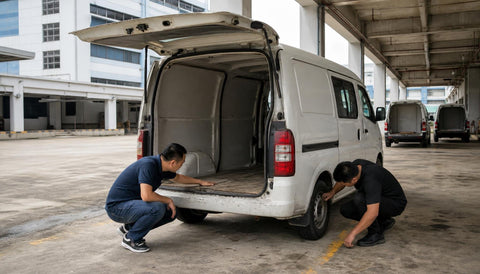
A low asking price can hide the bigger risk: a vehicle that doesn’t suit your work or has costly issues. Before choosing a second-hand commercial vehicle in Singapore, weigh its condition and remaining COE alongside its price. Goods vehicles must be deregistered when they reach 20 years from their original registration date.
When comparing a second hand commercial vehicle in Singapore, look beyond mileage and the asking price. Service history, current condition and remaining COE all affect whether a vehicle makes practical sense for your business.
Assess mileage and condition, compare asking prices, review financing terms and understand what support comes with the sale. An in-person inspection, test drive and review of service records can help you make a more informed decision.
Key Takeaways
- Match the vehicle type, such as a van, truck, pickup or bus, to the load and work it needs to handle.
- Compare mileage with service records and physical condition; an independent inspection and test drive can reveal issues a listing may not show.
- Assess the full ownership cost, not just the asking price, and weigh remaining COE and financing instalments in your budget.
- Review dealer checks, financing terms and the support available after purchase so you understand what the transaction covers.
- Look out for risks such as hidden defects, rust, unusual sounds and upcoming COE renewal when assessing a used vehicle.
1. Why Choose a 2nd Hand Commercial Vehicle?
A second-hand commercial vehicle in Singapore can suit a business that needs a work vehicle without buying new. Start with the job it must do, whether carrying goods, moving passengers, supporting deliveries or travelling between work sites. Define the load, route and body type you need, then narrow your search by vehicle size.
Commercial options include vans, lorries, trucks, pickup trucks and buses. A van may suit parcel deliveries or tool transport, while a lorry can carry bulky cargo. Pickups have an open cargo area, and buses are designed to carry passengers. Electric vans and trucks are another option. Consider whether their range and charging arrangements fit your daily operations.
Used truck listings may include box lorries, refrigerated vehicles, hood-and-canopy lorries, tailgate trucks and crane trucks. Each body type serves a different task. Refrigerated vehicles support temperature-sensitive cargo, while a tailgate can help with loading. Inspect the body and equipment for damage, and check that the layout suits your regular loads. Compare the seller’s vehicle details with other listings.
Use size filters to make comparisons relevant. For a van, match cargo space to the items it will carry; for a lorry, consider body length and loading needs. A pickup’s open bed suits different cargo from an enclosed truck body. Bus buyers can focus on passenger capacity and intended use. Compare vehicles of the same type and size, rather than judging a small van against a heavy truck.
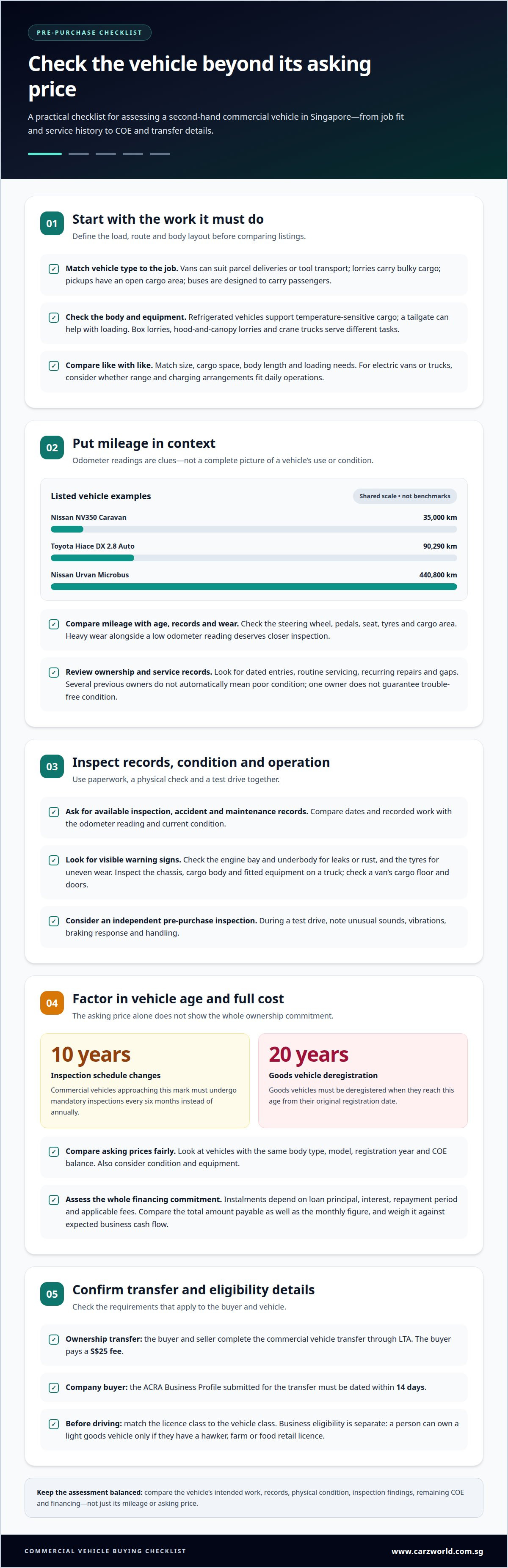
For ownership transfer, the buyer and seller complete the commercial vehicle transfer through LTA, and the buyer pays a S$25 fee. For a company sale, the ACRA Business Profile submitted for the transfer must be dated within 14 days.
Licence requirements depend on the vehicle being driven, so match the licence class to the vehicle class before taking it on the road. Business eligibility is a separate matter: in Singapore, a person can own a light goods vehicle only if they have a hawker, farm or food retail licence.
To register a second-hand vehicle in your name, complete the ownership transfer through LTA. Company buyers should prepare the required ACRA Business Profile within its 14-day validity window.
Commercial vehicle showrooms can be found in Kaki Bukit, Ubi and Jalan Besar. When viewing a truck, van, bus or pickup, inspect the body and cargo area in person. Check that its size and layout suit the work it will do.
2. Vehicle mileage, servicing, and mechanical inspections
Odometer readings help compare vehicles, but mileage alone doesn’t show how hard a commercial vehicle has worked. A Nissan NV350 Caravan listed in Singapore had 35,000 km, while a Nissan Urvan Microbus had 440,800 km. Those examples show why mileage needs context: delivery routes, loads, driving conditions and servicing all affect wear.
Compare the odometer with the vehicle’s age, service records and visible condition. A Toyota Hiace DX 2.8 Auto listed at 90,290 km gives a useful example of a specific reading, not a benchmark for every van. Look for consistency between mileage and wear on the steering wheel, pedals, seat, tyres and cargo area. Heavy wear alongside a low reading deserves closer inspection.
The number of previous owners needs context. Several owners do not automatically make a vehicle a poor choice, and a single owner does not guarantee trouble-free condition. Ask for ownership and servicing records, then consider whether the vehicle’s use is consistent with its condition. Gaps in the records make it harder to assess its maintenance history.
Review service records for dated entries, recurring repairs and routine servicing. Compare them with the vehicle’s mileage and current condition. A third-party pre-purchase inspection can provide an independent assessment of its mechanical condition. During a test drive, listen for unusual sounds and note vibrations, braking response and handling.
Inspect the engine bay and underbody for signs of leaks or rust. Check the tyres for uneven wear, which may need closer assessment. For a truck, examine the chassis, cargo body and fitted equipment. For a van, inspect the cargo floor and doors. Check a pickup’s load bed or a bus’s passenger area according to its intended use.
To review inspection, accident and maintenance history, request the available inspection records and service documents. Compare dates and recorded work with the odometer reading, then arrange an independent inspection of the vehicle’s present condition. A test drive can help reveal unusual sounds, vibrations or ride issues.
Commercial vehicles approaching the 10-year mark must undergo mandatory inspections every six months instead of annually. Factor that inspection schedule into your assessment, alongside the vehicle’s maintenance needs and insurance considerations. The records and current condition together provide more useful evidence than mileage alone.
Choose a vehicle for the work it must perform, not just its odometer reading. A well-documented van and a heavily used truck call for different assessments, even if their mileage is similar. Consider records, physical wear and inspection findings together. For operators who carry out regular fleet maintenance in-house, specialist suppliers like naredi.in highlight the importance of equipping workshops with reliable, professional-grade automotive tools.
3. Asking prices and monthly instalments
A listing price is only the starting point for a commercial vehicle budget. Compare vehicles with the same body type, model, registration year, and COE balance. A Nissan NV200 van and an Isuzu lorry serve different jobs, so their asking prices aren’t direct comparisons. Similar models also need comparison against condition, equipment, and remaining COE.
For financing, work out the amount to borrow after any upfront payment. Monthly instalments depend on the loan principal, interest, repayment period and applicable fees. Compare the total amount payable as well as the monthly figure. A lower instalment may reflect a longer repayment period, so assess the full commitment against your business’s expected cash flow.
Your ownership budget should also account for insurance, maintenance, fuel or charging, and road tax. These costs vary according to the vehicle, its use, coverage and condition. For commercial operators who also run refuelling facilities or service stations, station management platforms like fuel360app.co.za help operators streamline daily station operations alongside their broader transport expenses. Include any delivery charge stated in the purchase terms. For a refrigerated truck, factor in its operating needs alongside the financing commitment.
COE affects how buyers assess a vehicle’s remaining usable period and whether renewal may make sense. These are dated market figures, not a used vehicle’s asking price or a forecast of future renewal costs.
Remaining COE can shape a listing’s appeal because it affects how long the vehicle can be used before renewal or deregistration decisions arise. If a van has two years remaining, include COE renewal in your ownership planning. Road tax surcharges for commercial vehicles start increasing from year 11 and reach 50% of base road tax from year 15 onward.
Build a like-for-like comparison before deciding. Record each candidate’s model, body type, registration year, COE balance, mileage, condition and quoted price. Compare instalments and running-cost estimates using the same assumptions. This helps distinguish a lower asking price from a lower overall ownership cost.
For a vehicle used in daily deliveries, consider whether its likely operating costs fit your business budget. A lower instalment may not offset higher maintenance needs or an approaching COE renewal. Assess the purchase price, financing, insurance, road tax and operating expenses together, then choose an option that suits the work and your business’s cash flow.
Singapore listings included a used Nissan NV350 Caravan DX at 57,999 and a used Toyota Hiace DX 2.8 Auto at 51,988. Other examples were a used Isuzu NQR75UL5A MT D/AB at 105,800, a used Nissan NV200 DX 1.6 Auto at 54,988, a used Hino Dutro 10FT Auto at 115,200, and a used Citroen E-Berlingo at 134,000.
4. Dealer checks, financing and after-sales support
A dealer or private seller may offer a suitable vehicle; neither option is automatically better. Compare the information, written terms and transaction documents for the specific vehicle. A dealer may present the vehicle details together, while a private sale may involve direct discussion with the owner. Either way, look for clear records and an agreed purchase process.
Before committing, review the sale documents for the vehicle’s identity, agreed price, included items and transfer arrangements. Confirm that the details match the vehicle being sold. For a company purchase, coordinate who will sign and submit the business documents. A current ACRA Business Profile is required for a company sale, as covered in the ownership-transfer rules.
Review financing just as carefully. Compare the amount financed, repayment period, interest basis, fees and total payable across the offers presented. Check that instalments fit expected business cash flow, including quieter operating periods. Read the written terms for payment dates and conditions. A monthly figure alone does not show the full commitment.
Ask for a clear breakdown of what the transaction includes. Separate the vehicle’s purchase terms from financing, insurance and delivery arrangements. Do not assume that a dealer’s involvement includes mechanical repairs or ongoing maintenance. Record any specific promises in the sale documents so both parties have the same understanding.
After-sales support may include help with transaction paperwork or explanations of documents related to the sale, but it is not the same as repair or maintenance coverage. Distinguish any written warranty or defect terms from general assistance. Keep the sale agreement, payment records, vehicle details and communications together for reference if questions arise.
Singapore’s Lemon Law gives buyers options for a qualifying defect, including repair or replacement, or compensation. If a defect appears within six months, the seller must prove it was not present at the time of sale. Keep dated records and describe the issue clearly. This legal protection does not replace careful assessment before purchase.
A practical comparison can clarify your choice. For each seller, note which records are provided, what the written sale terms cover, how financing is structured and what support applies after handover. Use the same questions for a dealer and a private seller. This keeps the decision focused on the vehicle and transaction, not the seller label.
Once the terms are clear, review the available vehicle choices against your business needs. A careful review of documentation and finance conditions can make the purchase process easier to manage.
5. Risks when buying second-hand vehicles
The main risk is paying for a vehicle that looks suitable but cannot reliably handle its intended work. A delivery van with worn brakes, for example, could disrupt daily schedules and lead to unexpected costs. Treat the listing as a starting point, then compare the seller’s records with the vehicle’s actual condition before agreeing to buy.
A commercial vehicle with little COE remaining leaves less time before a renewal decision. If a van has two years remaining, factor renewal into your ownership plan and compare it with the vehicle’s price, condition and expected use. A low asking price may not reflect the overall cost if renewal is approaching.
Mechanical problems can be hard to spot during a brief viewing. Arrange a third-party pre-purchase inspection and take a test drive. Note unusual engine sounds, vibrations, steering response and braking behaviour. For a lorry, inspect the chassis and cargo body; for a van, examine the floor and doors. Visible rust beneath the vehicle needs closer attention.
Service history can show whether a vehicle was maintained consistently. Review available records for routine servicing and recurring repairs, then compare their dates with the odometer reading. Missing entries or unexplained gaps make its past harder to assess. Repeated work in one area can also guide the independent inspection.
Check the vehicle under normal driving conditions. A test drive can reveal noises or ride issues that a stationary inspection misses. Pay attention to braking response and steering, and check that the controls work as expected. Compare your observations with the seller’s description and ask about any mismatch.
Singapore’s Lemon Law may give buyers remedies for qualifying defects, including repair or replacement, or compensation. If a defect appears within six months of sale, the seller must prove it was not present at the time of sale. Keep the sale documents and records of the defect, including when it appeared and how it affects the vehicle.
Reduce risk by combining the records, physical inspection, test drive and COE timeline. Don’t let a low price outweigh warning signs that could affect business use. If you’re comparing commercial vehicles, explore available vehicle options with these checks in mind before deciding which one fits your work.
Assess a second-hand commercial vehicle carefully before purchase. A third-party pre-purchase inspection is recommended. An in-person review can include checking the steering, engine, braking response and underbody for rust. A test drive may reveal unusual sounds, vibrations or ride issues that are not apparent while the vehicle is stationary. Together, these steps give you a broader view of its condition before deciding whether it suits your work.
Review the service records too, since regular servicing indicates proper maintenance. If a used van has two years remaining on its COE, account for renewal in your ownership decision. Weigh the records, inspection findings, driving impressions and renewal timing against the vehicle’s condition and intended use.
Carz World Pte: Commercial Vehicles
Carz World Pte Ltd offers commercial vehicles for buyers comparing work-ready options in Singapore. Once you have identified the vehicle type, load needs and COE considerations that matter to your business, explore suitable options with Carz World. Use your mileage, condition and financing checks to guide your selection, and match the vehicle to its intended work. Review the vehicle details and purchase terms before deciding. Contact Carz World Pte Ltd to discuss commercial vehicle options.
Choose a vehicle that fits your next stage
Connect your vehicle choice to your business plans. Consider the work it must handle, how often it will be used and whether buying suits your current needs. This broader view can help you choose a second-hand commercial vehicle in Singapore with a clear purpose, rather than focusing only on the immediate purchase.
If your needs change, Carz World Pte Ltd also offers pre-owned cars, brand new cars and car rental. These options may suit a different transport requirement or a temporary need alongside your commercial vehicle.
Take the time to decide what matters most for your operations, then discuss the available options with the team. Contact Carz World Pte Ltd to discuss options and take your next step with confidence.
Frequently Asked Questions
Why Choose a 2nd Hand Commercial Vehicle?
A used commercial vehicle can suit a business that needs a particular work vehicle without buying new. Its practical value depends on matching it to the task: a van for enclosed cargo, a pickup for open-bed loads or a truck for heavier transport needs. Compare its remaining useful period with your business plans. If your needs may change, consider whether renting or another vehicle type would fit better.
What types of used commercial vehicles are available in Singapore?
Singapore listings can include vans, lorries, trucks, pickup trucks and buses, as well as electric commercial vehicles. Body types also vary by task, with examples including box lorries, refrigerated trucks, crane trucks and vehicles with tailgates. Rather than filtering only by make, narrow your selection by vehicle size, cargo layout and intended use. A refrigerated body, for example, serves a different purpose from an open pickup bed.
What are typical prices for used vans, lorries and trucks in Singapore?
There is no single typical price for all used vans, lorries and trucks. Asking prices depend on vehicle type, age, condition, equipment and remaining COE. A refrigerated truck and a basic cargo van have different configurations, so their prices are not directly comparable. Compare similar vehicles, then assess each asking price against its condition and suitability for your business.
What should I inspect before buying a second-hand van or lorry in Singapore?
Check that the vehicle’s body and layout match the listing and your work requirements. Open and close the cargo doors, examine the loading area, and test fitted equipment such as a tailgate or refrigeration unit. During the viewing, check that the lights, wipers and dashboard controls work. Ask about visible damage and compare the answers with the sale documents before proceeding.
Disclaimer
This content is provided for general informational purposes only. Readers are encouraged to independently verify important information.
In Same Category
Related by Tags
- Car Consignment Agent in Sembawang for Price Setting
- Practical cars for financial advisors sg: Check what you can afford
- Car types and models for weekend drives, plus family outing ideas
- Second Hand Commercial Vehicle Singapore: Compare Prices and Checks
- Pre-owned cars with memory seats in Singapore: asking prices
- How to Check If You Can Use CPF to Pay for COE Renewal
- Used Commercial Vehicle Dealer in Bukit Batok for Your Needs
- Is a car a good investment in Singapore compared with other ways to travel?
- Car Trade-In Services in Sengkang for Comparing Offers
- Best Cars for Home-Based Businesses in Singapore: 2026 Guide
- Buying a Used Lorry in Singapore: 2026 Buyer’s Guide
- Balloon Scheme Car Loan in Singapore: Pros and Cons for 2026