First car costs and choices for newlyweds in Singapore
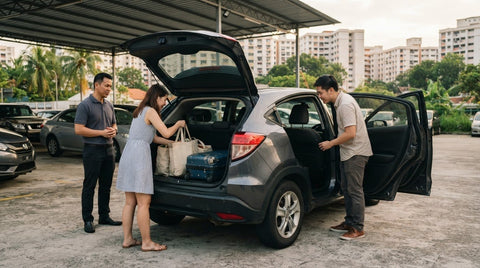
The smartest first car for a newly married couple in Singapore isn’t necessarily the newest or roomiest one. It’s the car that fits your regular journeys, household budget and plans as a couple, while offering a condition you’re comfortable with. A useful starting point is to keep total car expenditure to roughly 30% of your monthly salary.
It’s easy to focus on the purchase price, but owning a car also means budgeting for ongoing costs and loan repayments. A car that seems affordable upfront may put more pressure on your monthly budget once those commitments are included.
This guide covers ownership and running costs, key car-loan considerations, and how to assess whether a pre-owned car suits your needs. It also explains how to weigh space, commuting and driving preferences, so you can choose your first car together with a clearer view of the trade-offs.
Key Takeaways
- Match the car’s space and driving style to your household plans and regular journeys.
- Factor fuel, road tax, insurance and upkeep into your ownership budget, not just the purchase price.
- Separate essential transport needs from preferences before deciding whether owning a car makes sense.
- Understand how loan limits and repayment terms affect the amount you need to fund upfront and each month.
- Assess a used car by considering mileage alongside its overall condition, rather than relying on one detail alone.
Choosing a car with a dealer based on family space, commuting or driving enjoyment
Choosing the first car for a newly married couple in Singapore starts with how you plan to use it. Decide whether passenger space, commuting or driving enjoyment matters most, then compare suitable options against your household’s needs rather than choosing by appearance alone. A clear picture of your routine helps narrow the choices.
For regular passengers, consider who will ride along and how often. A Honda Jazz or Fit can accommodate five adults, making it an example to discuss when seating capacity matters. Couples planning for family changes may also want to consider how easy it is to fit passengers and their belongings. A dealer can help compare space needs across suitable car options.
Cargo space matters when your regular journeys involve luggage, shopping or bulky items. The Nissan Qashqai has 430 L of cargo capacity, a concrete reference point when discussing storage. Compare that figure with what you expect to carry, rather than assuming a larger vehicle is always necessary. For commuting, describe your actual pattern: someone travelling three times a week on smooth, flat highways has different priorities from a frequent driver.
Driving enjoyment is personal, so explain what makes a car comfortable for both partners. The dealer can help narrow the choice around your preferred driving experience and intended use. If one partner values a compact car while the other prioritises passenger room, compare both needs before settling on a shared option. A useful discussion connects each preference to a real journey or household task.
Your intended ownership period can change which options make sense. If you plan to keep a car for 10 years, consider whether its features and space can suit changing household needs over that time. If you expect to drive it for only three years, a used car may be worth considering. Share the likely ownership period with the dealer, so the discussion reflects your plans instead of focusing only on today’s needs.
Decide who will be the registered owner and main driver. It may be practical to register the car under the person likely to use it most and identify that person as the main driver. Be clear about your actual driving arrangements as you make the decision. If one spouse handles most weekday commuting, that routine should inform the car choice and driver details.
Bring these priorities together in one conversation: passenger needs, cargo, commuting frequency, driving preferences and ownership period. Ask the dealer to compare cars against those specific examples, including the Honda Jazz or Fit’s seating and the Qashqai’s stated cargo capacity where relevant. This makes trade-offs clearer and helps both partners choose a car suited to their shared life.
2. Maintenance, fuel, road tax and insurance costs
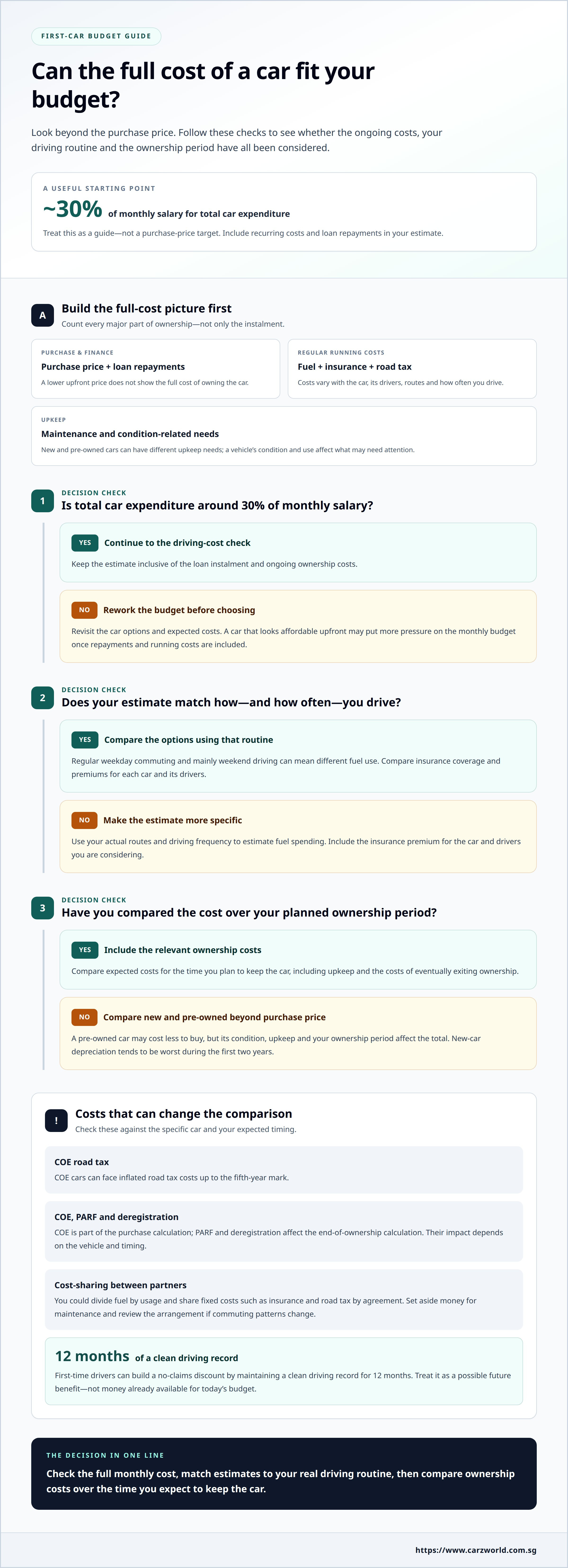
The purchase price is only one part of owning a car in Singapore. Budget for fuel, insurance, road tax and maintenance, then consider how often you’ll drive. A useful guide is to keep total car expenditure to roughly 30% of your monthly salary. Include recurring costs in that calculation, not only the loan instalment.
Fuel spending depends on the car, your routes and how often you drive. A couple commuting regularly on weekdays will use a car differently from one that mainly drives at weekends. Insurance also depends on factors such as the car and its drivers. Compare the coverage and premiums for each option before setting your household budget.
Maintenance is another variable. New and pre-owned cars can have different upkeep needs, and a vehicle’s condition and use affect what may need attention. Include road tax in your budget too: COE cars can face inflated road tax costs up to the fifth year mark. Account for these items instead of treating them as occasional surprises.
New or used: which is cheaper for newlyweds? A pre-owned car may cost less to buy, but the total depends on its condition, upkeep and how long you own it. New-car depreciation tends to be worst during the first two years, so compare expected ownership costs, not just purchase prices.
COE, PARF and deregistration can all affect the cost of owning and eventually exiting a car. COE is part of the purchase calculation, while PARF and deregistration affect the end-of-ownership calculation. Their impact depends on the vehicle and timing, so consider these figures alongside how long you expect to keep the car.
There is no single current price for an affordable new car or one COE premium that applies to every buyer. Both vary by car and COE category, so compare the quoted price and COE component for each option. This gives you a more useful basis for budgeting than a broad label such as “affordable.”
Agree on how to split costs before buying. If one partner drives more, you could divide fuel costs by usage and share fixed costs, such as insurance and road tax, by agreement. Set aside money for maintenance, then review the arrangement if your commuting patterns change. A clear plan helps both partners know what to expect.
First-time drivers can build a no-claims discount by maintaining a clean driving record for 12 months. Treat that as a possible future benefit, not money already available for today’s budget. For a tailored view of vehicle choices, review your options with Carz World Pte Ltd as you weigh purchase and running costs.
Assessing whether a car is a need or a want
Start with a practical exercise: list the journeys each of you needs to make in an ordinary week. Separate work, caregiving and medical trips from leisure outings or occasional shopping. If a car would solve a recurring transport problem, ownership may meet a genuine need. If most planned drives are optional, convenience may be the stronger reason for buying.
Consider each person’s actual commute, not an imagined future routine. Note the route, work schedule and public transport options available to each of you. An MRT connection may work well for one commute, while another journey may involve carrying equipment or reaching a location without convenient transit. Comparing those journeys helps clarify whether a car would make a meaningful difference to daily life.
Next, identify trips where timing or passenger needs matter. Regular caregiving visits, transporting a family member or carrying bulky items can make a car more useful. Compare these recurring tasks with occasional plans, such as a weekend outing. A car needed for a regular responsibility plays a different role from one wanted mainly for spontaneous leisure.
Discuss possible household changes separately. You may be planning a move, supporting relatives or expecting your routines to change. Write down what might change, when and what journeys it could create. This does not mean buying for every possible future scenario. It gives you a concrete basis for deciding whether a car would be useful now or later.
Then compare owning a car with practical alternatives for each trip. For a regular journey, consider the MRT, bus or taxi route and how well it fits your schedule and passenger needs. For an occasional outing, weigh the convenience of having a car against the commitment of owning one. Base the comparison on real journeys, not general impressions.
Discuss the outcome together using three categories: essential, useful and optional. A recurring medical journey might be essential, carrying groceries could be useful, and a scenic weekend drive might be optional. If most planned trips are optional for both of you, reconsider whether ownership is the right next step. If essential journeys remain difficult without a car, identify exactly which needs it would address.
Finally, test the decision against your shared priorities. Each of you can name a journey a car would improve and a trade-off you are willing to accept. If your answers differ, return to your weekly trip list and compare specific examples. A sound reason to buy should connect to your routines, not just the appeal of having a car.
4. Car loan interest rates and repayment tenure
A car loan changes both the amount payable upfront and your monthly commitment. In Singapore, a car with an Open Market Value (OMV) of S$20,000 or less can be financed with a loan of up to 70% of its purchase price, according to the Monetary Authority of Singapore. For cars with an OMV above S$20,000, the stated maximum is 60% of the purchase price. The OMV band affects the maximum loan share, not the car’s suitability for your household.
These are financing limits, not a personal approval checklist. The OMV determines which maximum percentage applies, and a lender’s assessment still matters when you apply. Budget for the portion the loan does not cover, along with other purchase expenses. Don’t treat the maximum loan amount as a target: borrowing less can leave more room for running costs and household needs.
Car-loan interest rates in Singapore are approximately 2.4% to 3%. One example uses an annual rate of 2.5% for a new-car loan and 3% for a used-car loan. Treat those as comparison points, not a promise of the rate available to you. Ask for the quoted rate and repayment schedule for the specific car, then compare the total repayment obligation.
Loan tenures typically run from 1 year to 7 years. A shorter tenure means larger instalments over fewer months; a longer tenure spreads payments but extends the commitment. Compare both against your household cash flow. For example, a couple planning a move or other major expense may prefer to preserve monthly flexibility, while avoiding a loan period that feels burdensome.
Use a monthly budget to guide your decision. Add the instalment to fuel, insurance, road tax and maintenance before deciding. This combined view is more useful than judging affordability by the loan payment alone.
Before choosing a loan tenure, compare the written terms for the same car. Note the interest rate, instalment, repayment period and total amount payable. Check whether the rate is stated annually and use the same basis to compare offers. A lower monthly instalment may look appealing, but a longer repayment period can increase the total interest paid.
Before signing, agree on who will contribute to the upfront payment and monthly instalments. Decide whether to contribute equally or according to each partner’s budget, then consider how that fits with other shared expenses. A clear plan helps both of you understand the commitment and whether the loan leaves enough room for changing household priorities.
5. Checking used-car mileage and condition
A used car’s odometer reading is useful, but it does not tell you everything about the vehicle. Review mileage alongside service records, visible wear and overall condition. Ask how the displayed mileage compares with available records. If a service history seems inconsistent with the odometer, get a clear explanation before deciding.
Ask how the mileage relates to this particular car. Check whether wear on the interior, steering wheel, pedals and seats seems consistent with the recorded use. These signs offer clues, not proof of a car’s history. A low reading alone does not establish good condition, just as higher mileage alone does not show how well a car was cared for.
Ask directly whether the car has recorded accident damage and what information supports the answer. Look at the body panels, paint finish, panel gaps and visible repair marks. If an area looks different from the surrounding panels, ask what that might indicate and whether supporting documentation is available. Appearance can prompt useful questions, but it cannot establish the full history on its own.
Ask how much COE remains and whether that term fits your planned ownership period. Review the car’s stated COE details and consider how they affect your plans to keep or replace it. A car with less remaining COE may suit a different ownership plan from one you expect to keep longer. Consider its age, mileage and condition together.
A condition review should go beyond the exterior. Look over the cabin, dashboard indicators, tyres and visible engine-bay condition. During a viewing, note warning lights, unusual sounds or uneven wear, then ask what each observation means. A test drive can help you assess steering, braking and general comfort, while you discuss any concerns that arise.
Use the same questions for each pre-owned car you consider. Ask about service history, mileage records, accident history, visible repairs, remaining COE and the condition of key areas. Request available supporting documents and compare them with the car in front of you. This helps you weigh options without treating mileage as the only deciding factor.
Before agreeing to buy, summarise the car’s known history and condition with the dealer. Clarify any unanswered points and consider how they affect your intended use and ownership plans. A careful review helps you make a decision based on the whole vehicle, not one attractive detail. Explore used-car options as you compare condition and ownership needs.
Carz World Pte Ltd
Carz World Pte Ltd can help newlyweds consider vehicle options that suit their household needs and ownership plans. If you’re weighing a new car against a pre-owned one, its range includes both brand new cars and pre-owned cars. Car rental is another option to consider if you want access to a car without making an immediate purchase commitment.
Bring your priorities into the discussion: how you will use the car, how long you expect to own it, the loan commitment you are comfortable with, and what matters to you about its condition. This keeps the decision focused on practical needs rather than appearance alone. Carz World also offers car export services for customers whose vehicle plans involve export.
Contact Carz World Pte Ltd to discuss which vehicle option best fits your plans as a couple.
Make your next step a shared decision
Choosing a first car for a newly married couple in Singapore is also an opportunity to set shared expectations. Before deciding, agree on what matters most to each of you and which compromises feel reasonable. Turn those priorities into a short list of questions for your vehicle discussion, so you can both take part with confidence.
Carz World can help you explore brand-new and pre-owned vehicle options based on how you plan to use the car. Discussing your needs can focus the search on choices that suit your household, without making you decide everything at once. Bring your questions and talk through what you are looking for together.
Contact Carz World Pte Ltd for help with your next step. With a shared plan and a clear conversation, you can move forward at a pace that feels right for both of you.
Frequently Asked Questions
A Millennial's Guide: What Should Your First Car Be?
Choose a car that meets a regular transport need and fits your household’s priorities. Start with your journeys, who travels with you and what you carry. A couple with frequent family trips may value cabin and cargo space, while partners with different commutes may prioritise everyday usability. Weigh style and driving enjoyment alongside practical use, rather than letting them decide the choice on their own.
So What Should My First Car Be?
Shortlist cars by matching their size and intended use to the journeys you expect to make. If your plans include carrying passengers or bulky items, compare the space available; if you mainly travel as a couple, consider whether a smaller car meets your needs. Discuss the shortlist together and explain your priorities to a dealer. The right choice is the one that fits your routine, budget and plans as a couple.
What Are Good First Cars?
Honda Jazz or Fit, Toyota Sienta and Kia Picanto are examples to compare, not automatic recommendations. Consider how each option matches your needs, including passenger space, driving preferences and intended ownership period. For a pre-owned car, assess its records and condition rather than choosing by model name alone. Carz World offers pre-owned cars and can help you compare suitable options against the journeys you plan to make.
Whose name should the car be registered under?
Consider registering the car under the partner likely to use it most, and identify who will mainly drive. If one spouse uses the car for regular work journeys while the other drives occasionally, discuss that arrangement as part of the purchase. Keep the registered owner and main-driver details clear so the paperwork reflects how you expect to use the vehicle.
What is the total cost of owning a first car in Singapore, including COE, ARF, road tax, insurance, and parking?
There is no useful single total without a specific vehicle and household usage pattern. Include the vehicle’s COE and ARF figures, road tax, insurance and parking, as well as fuel, maintenance and loan repayments. Insurance depends partly on the vehicle and its drivers, while parking needs vary with where you live and work. Compare the full cost of ownership for each car, not just its quoted purchase amount.
What are the best affordable first cars for couples in Singapore, including used cars?
There is no single best choice for every couple. Compare the Kia Picanto, Toyota Sienta and Honda Jazz or Fit against your needs, then consider pre-owned options if you are open to a used car. Affordability depends on more than the asking price: include the car’s condition, expected upkeep, loan commitment and planned ownership period. Choose for overall fit, not model reputation alone.
What monthly costs should a Singapore couple budget for fuel, maintenance, parking, ERP, and road tax?
Build a monthly budget with separate entries for fuel, maintenance, parking, ERP charges and road tax. Fuel and ERP spending depend on your routes and driving frequency, while parking depends on where the car is kept or used. Include road tax and maintenance even if they are not paid monthly. Set aside money for these less frequent bills so they remain part of your ownership budget.
Should a newly married couple in Singapore buy a car or use public transport and ride-hailing?
Choose based on how often access to a car would solve a real problem. Public transport and ride-hailing may suit couples with occasional trips that are easy to plan. A car may be more useful for recurring journeys involving passengers, caregiving, equipment or awkward travel times. Compare the journeys you expect to make with the ongoing commitment of ownership. If your needs are still uncertain, discuss the options together before committing to a purchase.
Disclaimer
This content is provided for general informational purposes only. Readers are encouraged to independently verify important information.
In Same Category
Related by Tags
- First car costs and choices for newlyweds in Singapore
- Fuel-Efficient Cars for Food Delivery Drivers in Singapore
- Compare car choices for a couple living in central Singapore
- Car Consignment Agent in Sembawang for Price Setting
- Practical cars for financial advisors sg: Check what you can afford
- Practical cars for insurance agents sg: compare car costs
- Car types and models for weekend drives, plus family outing ideas
- Used Car Buying and Selling at a Car Dealership in Kallang
- Is a Car an Asset or a Liability in Singapore? How It Affects Your Net Worth
- Save for a Car or Take a Loan in 2026? Compare the Costs
- Second hand car lots in Choa Chu Kang: dealers and prices
- Car Loan Hidden Fees: Which Application and Setup Charges Are Reasonable
- Sell My Car Fast in Punggol: A Practical Guide
- Best Cars for Home-Based Businesses in Singapore: 2026 Guide
- Risks of Buying a Car with 1 Year of COE Left in Singapore (2026 Guide)
- Best Second Hand Cars for Malaysia: Singapore Buyer's Guide
- Financial Planning for Your First Car in Singapore
- Best Time to Renew COE in 2026: A Practical Singapore Guide
- COE Renewal for 5 Years vs 10 Years: Pros and Cons in Singapore
- Pros and Cons of Buying a High PARF Car in Singapore
- Car Valuation Services in Bukit Merah: A Seller’s Guide