NCD for Car Insurance Explained: How to Maximise Your Savings in Singapore (2026)

What if a minor $500 fender bender actually cost you thousands of dollars in lost savings over the next three years? Most Singaporean drivers understand that a No Claims Discount is the single most effective way to lower car ownership costs. However, many motorists feel a sense of dread about losing their 50% discount due to a small mistake or confusion during a vehicle transfer. Having NCD for car insurance explained shouldn't feel like deciphering a complex legal contract.
We're here to help you master these mechanics so you can slash your annual premiums and protect your driving record when buying brand new or pre-owned cars. You'll learn exactly how to transfer your discount seamlessly between vehicles and how to keep it valid for up to 24 months after a sale. This guide provides a clear breakdown of the 2026 progression rates and the specific benefits of an NCD Protector to ensure your transition is fluid and cost-effective. We'll simplify the jargon and give you the confidence to manage your insurance profile like a seasoned expert.
Key Takeaways
- Discover how the tiered discount system rewards safe driving by reducing your annual premiums by up to 50% for private vehicles.
- Learn the specific steps to reserve and transfer your hard-earned discount when upgrading to brand new or pre-owned cars.
- Get the mechanics of NCD for car insurance explained so you can avoid common pitfalls that lead to a 0% rating after an accident.
- Evaluate if an NCD Protector is the right investment to safeguard your savings from the financial impact of a single at-fault claim.
- Understand how working with an experienced dealer can simplify the insurance paperwork and NCD transfers during a trade-in or consignment sale.
What is No Claims Discount (NCD) and How Does it Work in Singapore?
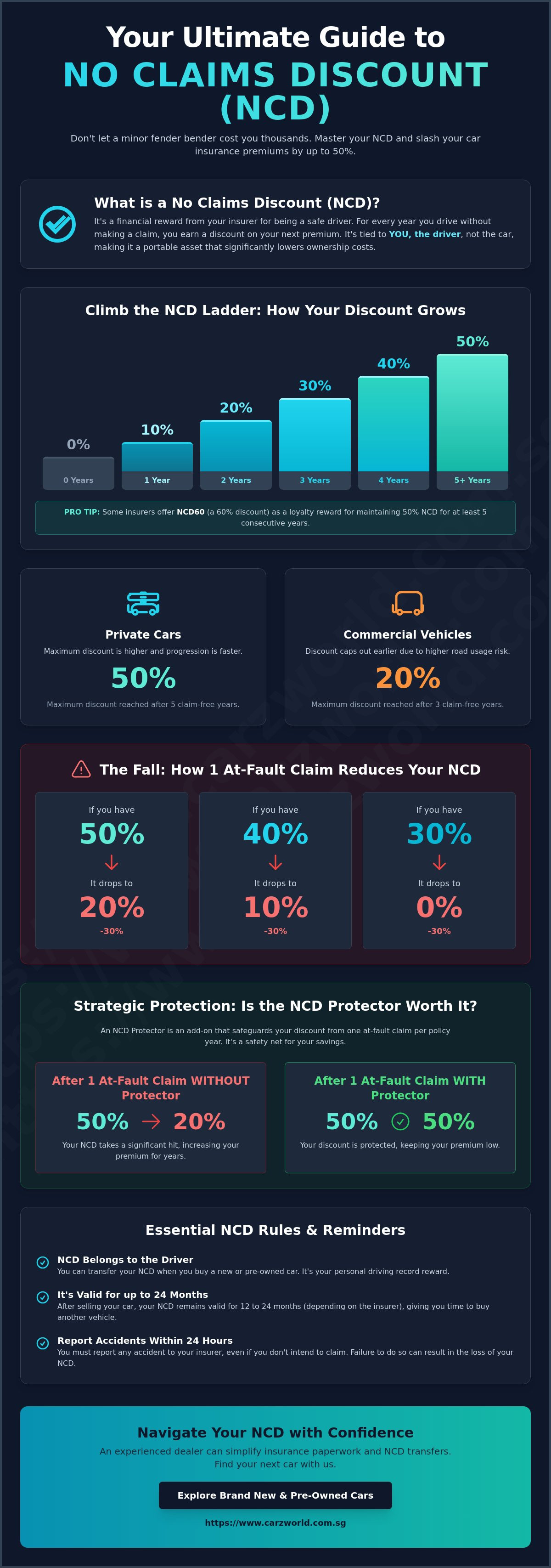
A No Claims Discount (NCD) is a financial reward from your insurer for being a safe driver. If you don't make a claim on your policy for at least 12 months, you receive a discount on your next renewal premium. It's one of the most effective ways to lower the total cost of car ownership in Singapore. When you browse pre-owned cars, understanding your NCD status is vital because it significantly lowers your monthly overheads from the moment you drive off the lot.
Having NCD for car insurance explained clearly helps you realize that this discount is a portable asset. It directly rewards your ability to avoid accidents and stay claim-free. This section provides the essential NCD for car insurance explained for those entering the market for the first time or looking to optimize their current policy costs.
To better understand this concept, watch this helpful video:
A common misconception is that the discount stays with the vehicle. It doesn't. Your NCD is linked to you as the policyholder. This means if you sell your current vehicle and purchase brand new cars, you can carry that discount over to the new policy. It rewards your personal driving history rather than the specific machinery you drive.
The NCD Entitlement Scale for Private Vehicles
The progression for private vehicles follows a strict timeline. After one year of accident-free driving, you earn a 10% discount. This grows by 10% each year, reaching a maximum of 50% by the end of year five. It's a significant saving. For a mid-sized sedan, this could mean the difference between a $1,200 premium and a $600 premium. Some insurers now offer an NCD60 exception for drivers who have maintained their 50% status for at least five years, providing an extra 10% discount as a loyalty reward. The General Insurance Association (GIA) oversees these standards to ensure consistency across the Singaporean market.
NCD for Commercial Vehicles vs. Private Cars
If you are managing commercial vehicles, the rules are different. The discount for goods vehicles and vans caps out much earlier, usually at 20% after three years of claim-free driving. Progression is slower because business vehicles often spend more time on the road, which increases the statistical risk of an incident. For business owners, maintaining a clean fleet record is essential to keep operational costs manageable. Even a 20% reduction provides substantial relief when multiplied across several company vehicles.
The Rules of Earning and Losing Your NCD
Earning your next discount tier requires patience and discipline. To move from a 10% discount to 20%, you must complete a full 12-month policy period without a single at-fault claim. If you renew your policy even one day before that full year is up, you might find your discount hasn't progressed yet. Understanding how these timelines work is a core part of having NCD for car insurance explained for the average driver. It's a game of consistency where every accident-free year puts hundreds of dollars back into your pocket.
When an accident occurs, the impact on your hard-earned savings can be sharp. Under the official GIA guidelines, most insurers apply a "30% reduction rule" for at-fault accidents. This means a single mistake doesn't just halt your progress; it actively pushes you back several years in savings. This makes safe driving habits more than just a matter of safety. They're a financial strategy.
What Happens to Your NCD After an Accident?
If you're involved in an accident where you're at least partially responsible, your NCD will be reduced at your next renewal. The standard reduction steps for private cars are straightforward but punishing. A 50% NCD drops to 20%, while a 40% NCD drops to 10%. If your discount is at 30% or less, it typically resets to 0% after one at-fault claim. You must report any accident to your insurer within 24 hours, even if you don't intend to claim. Failing to do so can result in a further reduction or even a total loss of your discount. If you have two at-fault claims within the same policy year, your NCD will almost certainly hit 0% immediately.
When Your NCD is Not Affected
Not every claim results in a penalty. Most insurers allow for windscreen claims without affecting your discount, provided you use an authorized workshop. Additionally, if you're involved in a collision where the other party is found 100% at fault, your NCD remains intact. Insurers use the GIA Barometer of Liability to determine the percentage of fault in any given situation. This standardized tool helps resolve disputes and protects drivers who aren't responsible for the damage.
The "Knock-for-Knock" agreement is another factor. This is a simplified settlement process where insurers pay for their own clients' repairs to speed up the process. However, your discount is only safe if you have clear third-party liability in your favor. This is why high-quality dashcam footage is essential when driving pre-owned cars in heavy traffic. If you're planning to upgrade your vehicle while keeping your insurance benefits in mind, you can explore our latest inventory to find a reliable ride that suits your needs. Having NCD for car insurance explained ensures you stay protected while you enjoy the road.
Transferring Your NCD: Changing Cars, Expats, and Company Cars
Your No Claims Discount is a personal asset that follows you, not the vehicle. When you decide to sell your car, your NCD doesn't disappear. It enters a "reserved" state. You can apply this accumulated discount to your next vehicle purchase within a specific timeframe. Most insurers in Singapore allow you to hold onto your NCD for 12 months, though some providers extend this validity to 24 months. If you don't buy a new car within this window, your discount typically expires and resets to 0%.
Many drivers assume they can spread their 50% discount across multiple vehicles. This is not the case. Each car requires its own insurance policy and its own NCD. If you own one car with a 50% discount and buy a second one, that second vehicle starts at 0%. You cannot "share" the discount, but you can choose which car benefits from the higher tier. Having NCD for car insurance explained this way helps you decide which vehicle should carry the primary discount to maximize your total savings. At Carz World, our team helps manage the complex paperwork during a sale to ensure your NCD transfer is handled correctly and efficiently.
NCD Transfers for Expats and Foreigners
Moving to Singapore doesn't necessarily mean starting from zero. Expats can often transfer their claim-free years from their home country. You will need a formal "Letter of Experience" from your previous overseas insurer. This document must state your policy period and confirm that you remained claim-free. Insurers generally require the previous policy to be for a similar vehicle type, such as a private passenger car. While not every insurer accepts foreign records, providing this proof can bridge the gap and save you thousands in your first few years of Singaporean car ownership.
Transitioning from Company Cars to Personal Ownership
If you have spent years driving a corporate vehicle without an accident, you can often translate that record into personal savings. When browsing pre-owned cars for your own use, check if your employer can provide an HR letter. This letter should verify that you were the main driver and had an accident-free history under the company's fleet policy. Most personal insurers will recognize this and grant you a starting discount. Be aware that many providers cap these corporate transfers at 30%, even if you drove for ten years without a scratch. Deciding if an NCD Protector Worth It? analysis fits your new personal policy is a smart next step once your transfer is approved. Understanding how NCD for car insurance explained applies to corporate transitions ensures you don't leave money on the table when moving to personal ownership.
Strategic Protection: Is the NCD Protector Worth It?
An NCD Protector is an optional insurance add-on that acts as a safety net for your hard-earned savings. If you've spent five years reaching a 50% discount, a single at-fault accident can be a massive financial blow. This protector allows you to make one at-fault claim during your policy year without your discount dropping. Having NCD for car insurance explained this way helps you see the protector as a form of "insurance for your insurance." It's designed to keep your premium low even if you have a momentary lapse in judgment on the road.
The cost of this protection usually ranges between $30 and $80 per year. When you compare this small fee to the potential loss of a 50% discount, the math often favors the protector. For example, if your base premium is $2,000, a 50% discount saves you $1,000. If an accident drops your NCD to 20%, your premium jumps to $1,600. Paying a small annual fee to prevent a $600 price hike is a logical move for most owners of brand new cars or high-value vehicles.
The Limitations of NCD Protectors
It's vital to understand that this protection has strict boundaries. Most policies operate on a "one-claim only" basis. If you're involved in a second at-fault accident within the same year, the protector will not save you, and your discount will drop significantly. There is also the "Golden Handcuffs" effect. This protection is only recognized by your current insurer. If you make a claim and then try to switch to a different company, the new insurer will look at your actual claim history. They'll likely quote you based on a reduced NCD, making it harder to leave your current provider. Additionally, while your discount percentage stays the same, your base premium can still rise if your insurer adjusts their overall rates.
Deciding Based on Your NCD Tier
Your current discount level should dictate whether you buy this add-on. If you've achieved NCD50, a protector is almost always worth the investment. Protecting a 50% discount over five years can save you thousands of dollars in cumulative premiums compared to resetting your progress after one incident. However, if you're only at NCD10 or NCD20, the cost of the protector might outweigh the actual savings it provides. In those early years, it may be better to focus on safe driving and let your discount grow naturally. If you're looking for a vehicle with a lower insurance profile to help manage these costs, view our available inventory to find the right match for your budget. Understanding how NCD for car insurance explained applies to your specific tier allows you to make a more informed financial decision.
Navigating NCD When Buying or Selling with a Dealer
When you decide to trade in your vehicle, the logistics of insurance can feel overwhelming. A professional dealer streamlines this by coordinating the NCD transfer between your old policy and your new purchase. This ensures you don't lose your discount during the handover. Having NCD for car insurance explained within the context of a trade-in helps you see that you can move from a used vehicle to brand new cars without any interruption in your coverage or savings.
For those choosing consignment sales, the car sits in a showroom while you wait for a buyer. You must maintain insurance during this time to protect against risks like fire or theft while on display. However, you can often negotiate with your insurer to suspend the NCD application until the sale is finalized. This allows you to move it to your next ride immediately upon the transfer of ownership. If you utilize our car export services, your NCD enters the standard 12 to 24 month validity period. Since the car is leaving the country, the policy is cancelled, and your insurer will issue a proof of NCD. This is a vital document if you plan to buy another vehicle in Singapore later.
Parallel imports require early planning. Because these vehicles don't come through official brand dealerships, insurers might have different underwriting criteria. Getting your NCD for car insurance explained by an expert before the car arrives ensures you have the right coverage in place from day one. It's about being methodical and organized to avoid last-minute premium spikes.
Dealer Support for Insurance and NCD
At Carz World, we coordinate directly with insurers to ensure a gap-free transition. We help you navigate the "NCD Refund" process, which occurs when you cancel your old policy after a sale. Most insurers will refund the unused portion of your premium, provided no claims were made. If you find yourself in a transition period between vehicles, our car rental services provide a reliable way to stay mobile without affecting your personal NCD status. We handle the heavy lifting so you can focus on the road ahead.
The Carz World Commitment to Transparency
Transparency is the foundation of our service. We ensure every buyer understands the insurance implications of their purchase. Our team assists with all the documentation needed for NCD recognition, making the transition feel fluid and positive. We believe in building long-term trust through honest, detailed guidance. It's our goal to make complex logistical processes feel like a seamless experience for every customer. If you're ready to make a move, you can sell your car with ease and protect your NCD today. Having your NCD for car insurance explained by our team ensures you never pay more than necessary for your protection.
Secure Your Long-Term Motoring Savings
Your No Claims Discount is more than just a percentage off your bill; it's a valuable personal asset that reflects years of safe driving. By understanding the rules of progression and the strategic value of an NCD Protector, you can keep your ownership costs at an absolute minimum. Whether you're an expat transferring overseas records or a local driver upgrading to a newer model, being proactive with your documentation is the key to maintaining your status.
Having the mechanics of NCD for car insurance explained empowers you to navigate every vehicle transaction with total confidence. At Carz World, we specialize in making these transitions feel effortless. Our team offers expert guidance on insurance transfers and has perfected seamless trade-in and consignment processes. We're proud to be trusted by thousands of Singaporean drivers who value efficiency and professional transparency. Get a free valuation and professional NCD advice at Carz World today. Take the next step toward smarter car ownership and enjoy the lasting rewards of your clean driving record.
Frequently Asked Questions
Can I transfer my NCD from a motorcycle to a car in Singapore?
No, you cannot transfer your NCD from a motorcycle to a car. These vehicles operate on entirely different discount scales and risk profiles. A motorcycle NCD caps at 20% after three years, while a private car NCD reaches 50% after five years. Insurers require you to build a separate claim-free history for each vehicle type to ensure the premium accurately reflects the specific risks involved.
What is the 'Barometer of Liability' and how does it affect my NCD?
The Barometer of Liability is a standardized guide used by Singaporean insurers to determine fault percentages in an accident. If this assessment finds you more than 20% responsible for a collision, your NCD will typically be reduced at your next renewal. This tool provides a consistent framework for all providers, ensuring that fault is assigned fairly based on established traffic scenarios rather than guesswork.
How long is my NCD valid after I sell my car and stop driving?
Most insurers in Singapore recognize your NCD for up to 12 months after you sell your vehicle and cancel your policy. Some providers may extend this period to 24 months. If you do not purchase a new vehicle or start a new policy within this timeframe, your accumulated discount will reset to 0%. Always check the specific terms of your last insurer to confirm your exact expiration date.
Does my NCD apply if I am driving a rental car in Singapore?
Your personal NCD does not apply when you are driving a rental car. Rental vehicles are covered under a separate commercial fleet policy managed by the rental company. While you can't use your discount to lower the rental cost, having NCD for car insurance explained helps you realize that an accident in a rental car must still be declared to your personal insurer, which could affect your future risk profile.
Can I share my NCD with my spouse or children?
You cannot share your NCD with family members on separate insurance policies. The discount is strictly tied to the individual policyholder's driving history. However, if you add a spouse or child as a named driver on your existing policy, they benefit from the lower premium your NCD provides. They will not earn their own NCD while driving under your policy; they must be the policyholder to earn a discount.
What happens to my NCD if my car is stolen or damaged by fire?
Your NCD typically remains unaffected if your car is stolen or damaged by fire. These incidents are generally classified as non-at-fault claims because they don't involve your driving conduct. Most insurers allow you to claim for these specific losses without penalizing your hard-earned discount. It is a standard protection built into most comprehensive policies to reward your safe driving record despite external factors like theft.
Why is my NCD not showing up on my new insurance quote?
Your NCD might not appear on a new quote if your previous policy hasn't been officially cancelled or if there's a delay in the central database update. Mismatched personal details, such as an incorrect NRIC or name spelling, can also cause this issue. If you've been without an active policy for more than 12 months, your discount may have simply expired according to standard industry regulations.
Is NCD applicable to third-party only (TPO) insurance policies?
Yes, NCD is applicable to Third-Party Only (TPO) policies as well as Third-Party, Fire, and Theft (TPFT) coverage. The discount is a reward for your claim-free driving record, regardless of the level of protection you choose for your own vehicle. Having NCD for car insurance explained across all policy types ensures that even budget-conscious drivers can benefit from significant savings on their mandatory annual premiums.
In Same Category
- Sell My Car Fast in Punggol: A Practical Guide
- Toyota Prius in Singapore: A Practical Buyer’s Guide for 2026
- Best Cars for Home-Based Businesses in Singapore: 2026 Guide
- Risks of Buying a Car with 1 Year of COE Left in Singapore (2026 Guide)
- Best Second Hand Cars for Malaysia: Singapore Buyer's Guide