Buying a Used Lorry in Singapore: 2026 Buyer’s Guide
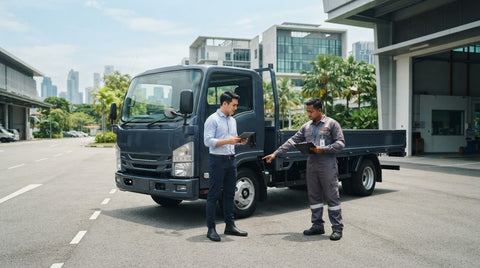
The lorry with the lowest asking price may not be the best fit for your business. When buying a used lorry in singapore, look beyond the upfront figure: the vehicle must suit your daily loads, routes and operating needs, and its condition and remaining COE must fit your plans.
Comparing lorries can feel difficult when listings show different sizes, body configurations and vehicle details. A lorry that looks suitable in a listing may not match the work you need it to do. Singapore’s inspection, licence and vehicle-lifespan requirements also matter before you commit.
This guide shows how to match a lorry to your business tasks, which vehicle details and Singapore-specific obligations to review, and how to compare dealer listings with direct-owner sales. Use the checklist to move from comparing commercial vehicles to arranging a quote or test drive. A clear set of requirements will help you focus on lorries that work for your business.
Key Takeaways
- Start buying a used lorry in singapore by matching its size and configuration to your cargo, typical loads, routes and access conditions.
- Check COE remaining, the driver’s licence class, inspection status and any speed-limiter requirements separately for each vehicle.
- Compare dealer and direct-owner options using the same criteria: vehicle information, transaction support, document clarity and convenience.
- Follow a consistent process: define your needs, shortlist lorries, verify key details and assess suitability before deciding.
- Use your shortlist to explore commercial vehicles at Carz World, then request a quote or schedule a test drive.
Buying a Used Lorry in Singapore: Start With the Work
A lorry that supports day-to-day operations is one that fits the work your business actually does. Before comparing listings, define what you carry, how it must be loaded, where the lorry needs to go and how often it will be on the road. That gives you a practical shortlist, rather than one based on a listing title or appearance.
For example, a business moving boxed goods between familiar delivery points may have different space and access needs from one transporting bulky items to varied sites. A larger-looking vehicle is not automatically the better choice if its size makes regular stops or tight access harder to manage. Balance useful carrying space with the realities of the workday.
To see a used-truck example, watch this video:
Define the load, route, and work pattern
List the cargo you move in a typical week, not just the largest or most unusual load. Note whether items are bulky, awkward to handle or need protection from the elements. Consider how loading happens: from the side, rear or another access point, and whether your team loads by hand or uses equipment. These details help you identify a practical body configuration.
Think through recurring delivery locations and their conditions. Note narrow entrances, height or space restrictions at loading areas, frequent stops, waiting time and the length of a typical workday. Separate must-haves from occasional needs. If a larger load comes up only now and then, decide whether it should shape your purchase or be handled as a separate operational requirement.
Use vehicle size and configuration as decision criteria
Once you have defined the work, compare the carrying space and loading method you need with each vehicle’s stated details. Size categories can help organise an initial search, but they are only a starting point. The right category depends on your cargo, routes and loading arrangements.
Don’t infer capacity or suitability from a body style, photo or short listing label alone. Review the specific vehicle’s stated dimensions, payload and configuration, then compare them with your actual loads and access conditions. Treat any unclear specification as an open question, rather than making an assumption.
A suitable lorry matches its regular work, route and operating needs. Use this test when buying a used lorry in singapore: shortlist vehicles that meet your essential requirements first, then consider whether extra space or features would provide a real benefit in daily operations.
Used Lorry Requirements in Singapore: Check COE, Licence, and Compliance
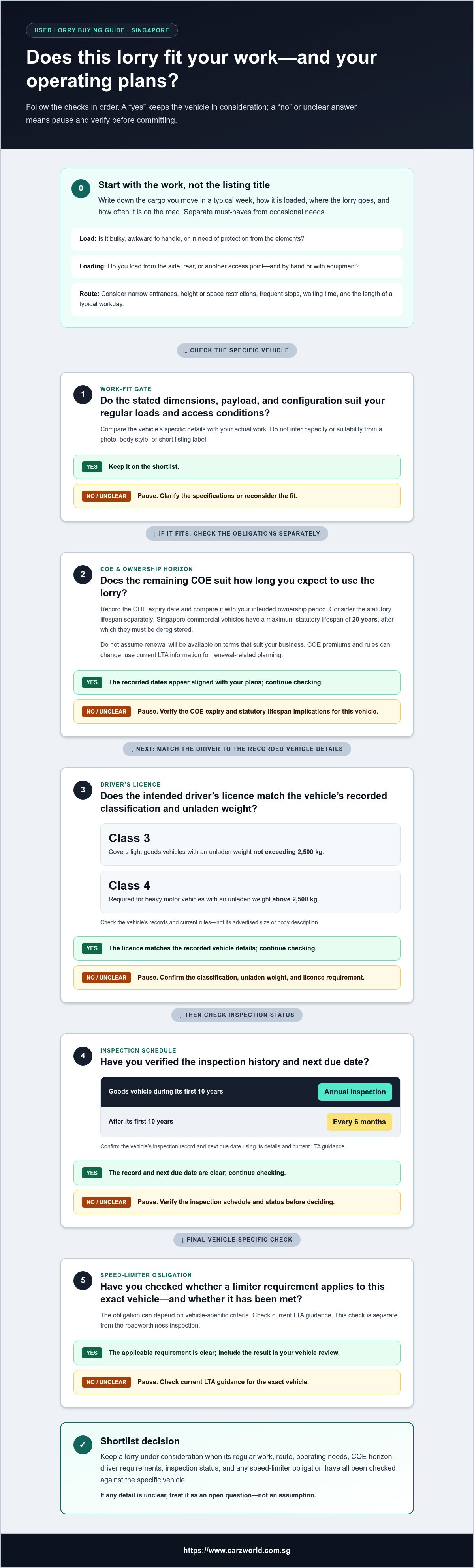
A lorry may look suitable for your business but still come with requirements that do not fit your plans. When buying a used lorry in singapore, assess the specific vehicle and your intended use. Keep four checks separate: remaining COE, the intended driver’s licence, inspection status and any speed-limiter obligations. Checking each one helps surface questions before you commit.
Understand COE and the ownership horizon
Start with the vehicle’s recorded COE details, including the expiry date. The remaining COE affects how long you can use the vehicle under its current entitlement. Compare the expiry date with the period you expect the lorry to support your business. A vehicle suited to a shorter-term need may not fit a plan to operate the same vehicle for longer.
Singapore commercial vehicles have a maximum statutory lifespan of 20 years, after which they must be deregistered. Consider this separately from the COE expiry date. Check how both dates apply to the specific vehicle, and do not assume renewal will be available on terms that suit your business. COE premiums and rules can change, so use current Land Transport Authority (LTA) information for renewal-related planning.
Verify licence and vehicle-specific obligations
Licence suitability depends on the vehicle’s recorded classification and unladen weight, as well as the intended driver’s licence. LTA guidance states that a Class 3 licence covers light goods vehicles with an unladen weight not exceeding 2,500 kg; a Class 4 licence is required for heavy motor vehicles above that weight. Check the vehicle’s records and current rules instead of relying on its advertised size or body description.
Inspection status is a separate check. LTA requirements provide for annual inspection of goods vehicles during their first 10 years, increasing to every six months after that. Confirm the vehicle’s inspection history and next due date using its details and current LTA guidance. A lorry’s age can affect its inspection schedule, even if it appears ready for use.
Speed-limiter obligations can also depend on vehicle-specific criteria. Check current LTA guidance for the exact vehicle to establish whether a limiter is required and whether any applicable requirement has been met. These checks are separate from the roadworthiness inspection.
- COE: Record the expiry date and compare it with your intended ownership period.
- Licence: Match the driver’s licence to the vehicle’s recorded details.
- Inspection: Verify the inspection record and next due date.
- Speed limiter: Check whether an obligation applies to this vehicle.
Confirm a lorry’s current requirements against its vehicle details and intended use. Refer to current LTA guidance rather than relying on general vehicle labels or older advice. Once you have defined your needs, explore Carz World’s commercial vehicle options as part of your shortlist.
Dealer or Direct Owner? Compare Used Lorry Buying Routes
Once you have identified the type of lorry that fits your operations, consider how you want to purchase it. Dealer listings and direct-owner sales are both worth comparing, but neither route guarantees a particular level of information or support. Focus on what the seller can document for the specific vehicle and which transaction tasks your business will need to handle.
Use the same criteria for each option. Compare the vehicle details and condition information provided, how the transaction steps are explained, how clearly records are presented and how much time your team must commit. This keeps the decision grounded in the actual offer instead of assumptions about a seller category.
Compare the information and support available
Ask for clear vehicle details and supporting records before deciding. Check that key information is consistent across the listing and documents, and note what is known about the lorry’s condition and the transaction process. A direct owner may be able to explain the vehicle’s use firsthand; a dealer may present information through its sales process. The quality and completeness of information can vary in either case.
| Decision criterion | Dealer route | Direct-owner route |
|---|---|---|
| Vehicle information | Review the listing and ask how the details and condition information were gathered. | Discuss the lorry’s use and available records with the owner; distinguish personal knowledge from written evidence. |
| Transaction support | Ask which steps the seller will coordinate and which remain your responsibility. | Clarify who will manage each step, including the paperwork and transfer arrangements. |
| Document clarity | Request the relevant records and make sure you understand what each document covers. | Organise the records provided and identify any gaps that need resolving before commitment. |
| Buyer convenience | Consider whether the sales process suits your preferred pace and internal resources. | Allow time for direct communication and coordinating the purchase steps yourself. |
Verbal explanations and written records serve different purposes. Before paying or agreeing to proceed, make sure you understand what information is recorded, what remains outstanding and who is responsible for each next step. A seller’s route does not prove the vehicle’s condition or the quality of its paperwork.
Match the buying route to your business priorities
A guided process may suit a business that wants help keeping transaction steps organised, as long as responsibilities are clear. A direct purchase may suit a team with time and capacity to coordinate details itself. In either case, compare the actual support offered rather than assuming it comes with the route.
Consider decision time, staff availability and record-keeping needs. If you need the lorry for planned work, account for the transaction process in your operational planning. If you are considering financing, review the terms offered for your circumstances; do not assume the same terms apply across sellers or lenders.
When buying a used lorry in singapore, a comparison sheet can keep the decision fair. Record what each seller provides, what still needs clarification and the effort required from your team. Businesses comparing dealer listings can explore Carz World’s commercial vehicle options as one route to consider.
A Practical Used Lorry Buying Process: Shortlist, Verify, Decide
A clear sequence turns browsing into a decision you can explain and support. When buying a used lorry in singapore, start with your business requirements and assess each option against the same information. A missing listing detail does not prove that the vehicle meets your needs. Keep unanswered questions visible until you resolve them.
Build a shortlist around verified vehicle details
Compare lorries that meet your essential work requirements. Check each listing against available vehicle records, including registration and COE details, and note what condition information is provided. Verify Singapore-specific requirements against current LTA guidance for that vehicle and its intended use. At this stage, decide whether an option merits closer assessment, rather than assuming a listing tells the full story.
- Set your must-haves. Write down your core business requirements, such as carrying space, loading arrangement and access needs. Decision: Can you describe what a suitable vehicle must do before comparing listings?
- Shortlist suitable listings. Compare each vehicle’s stated configuration and specifications with those requirements. Record missing or unclear details instead of filling gaps with assumptions. Decision: Does the lorry appear to fit your regular work based on the information provided?
- Review records and requirements. Check available registration, COE and condition information, then verify relevant obligations using current LTA guidance. Keep these checks distinct and note points that need clarification. Decision: Do you understand the vehicle’s key details and what remains unresolved?
Arrange a test drive and assess suitability
A test drive helps you assess how the lorry feels in practical use, not just how it looks in a listing. Where possible, use a consistent route or consider a task-based assessment that reflects your work. Pay attention to visibility, access, loading practicality and day-to-day comfort. A separate vehicle-condition checklist can help with a fuller mechanical review; keep the test drive focused on whether the lorry suits your operations.
- Assess the vehicle in person. Arrange a test drive and consider the driving position, visibility and how the lorry handles the route you expect to use. Decision: Does it feel workable for the driver and typical operating conditions?
- Review loading practicality. Consider how your usual cargo would be loaded and whether the vehicle’s configuration suits your work routine. Decision: Can your team carry out its regular tasks with the lorry as presented?
- Compare and decide. Weigh each remaining option against the same requirements, records and unresolved points. Move ahead only when the information you need to make a considered decision is clear. Decision: Which lorry best balances business fit and verified details?
Once you have defined your requirements and shortlisted a suitable option, request a quote from Carz World. Carz World also offers test-drive scheduling for its commercial vehicles.
Explore Commercial Vehicles With Carz World
After defining the work your lorry must handle and reviewing the key purchase checks, you can turn your shortlist into a focused enquiry. Carz World sells commercial vehicles, giving you a place to explore options and take a practical next step. Use your requirements to guide the discussion, and assess each vehicle on its own details rather than assuming one option suits every business.
A prepared enquiry is more useful than a broad request. Share the essentials of your work and the vehicle attributes you have prioritised. This gives you a clear basis for discussing relevant options and assessing their configuration, condition information and other details.
Bring your business requirements into the enquiry
Use your shortlist as a working brief. Outline what you carry, how it is loaded, the routes and access conditions you encounter, and how the lorry fits into a typical workday. Then describe the configuration you are looking for, based on the space and loading method your operations require. Separate essential requirements from preferences that could be flexible.
Include specific questions about any vehicle under consideration. These might relate to its stated configuration, condition information, registration details or remaining COE. Tie each question to that particular vehicle. A general description or similar listing is not a substitute for details about the option you are assessing.
- Work: What regular tasks must the lorry support?
- Load: What do you carry, and how do you load it?
- Route: What access conditions and stops shape daily use?
- Vehicle details: Which specifications and records do you need to review?
- Next step: Would a quote or test drive help you evaluate an option?
This brief can also keep your team aligned. The person arranging the enquiry can share the operating needs, while the person responsible for vehicle records tracks questions about a particular listing. Keep written notes of the details discussed and compare them with the vehicle information before making a decision.
Take the next step with a clear purchase brief
Before proceeding, make sure you can explain why a vehicle fits your work, what you have established about its COE and relevant requirements, and whether the dealer or direct-owner route suits your available resources. Record any unresolved decision points clearly. The purpose of a prepared enquiry is to get useful information, not to rush a commitment.
If you are buying a used lorry in singapore, a quote request or test drive can move your shortlist forward. Share your needs and refer to the details of the commercial vehicle you are considering. To take the next step, request a quote or schedule a test drive through Carz World. Explore the commercial-vehicle options with your business requirements ready to guide the discussion.
Move From Shortlist to a Confident Business Decision
A lorry purchase can shape how your team handles daily work well beyond the day the keys change hands. Before choosing, make sure the people who will drive or rely on the vehicle understand its role in your operations. That shared understanding helps make buying a used lorry in singapore a considered business choice, rather than a decision based on a listing alone.
Carz World sells commercial vehicles, and your prepared requirements can guide the next conversation. Request a quote from Carz World or schedule a test drive to explore your options. Take the next step with a clear brief in hand.
Frequently Asked Questions
Can I finance a used lorry in Singapore?
Yes, financing can be part of planning a commercial-vehicle purchase, and Carz World offers vehicle financing among its related services. Any proposed arrangement depends on the buyer and the vehicle, so review the terms carefully before deciding. Consider how repayments would fit alongside other business commitments and the period you expect to use the lorry. Do not assume approval, a particular financing structure or a specific rate.
Is a used lorry suitable for a new business?
It can be, if the vehicle’s role and ownership responsibilities fit the business plan. For example, a new business with regular deliveries can compare its expected cargo and routes with the details of a specific lorry, then assess how long it expects to need that vehicle. When buying a used lorry in singapore, do not treat pre-owned status alone as proof of value. Base the decision on verified details and current requirements.
What happens if a used lorry’s COE is close to expiry?
A short remaining COE can limit how far ahead you can plan to use the lorry under its current registration arrangements. Compare the vehicle’s exact COE details with the period your business needs it, then review current renewal rules through authoritative Singapore sources. Do not base a purchase decision on an assumed renewal outcome or cost. If continued use is essential, resolve that planning question before committing.
Can I arrange a test drive before buying a used lorry?
Yes, Carz World offers test-drive scheduling. Use the drive to assess practical details photos cannot show, such as visibility at junctions, ease of manoeuvring and how comfortable the driving position feels. If possible, consider conditions similar to the lorry’s expected use. A test drive helps you assess suitability, but it does not replace reviewing vehicle records or arranging a separate assessment of its condition.
What documents should I review before buying a used lorry?
Review the available records for the specific lorry, including registration and COE details, and check that information matches across the documents you receive. Understand the ownership-transfer steps and which information each party must provide. Requirements can depend on the vehicle and current rules, so verify the relevant document and transfer requirements through authoritative Singapore sources. A general checklist is a useful prompt, not a substitute for checking the vehicle’s records.
Can a used lorry be used for any type of business work?
No. A lorry suited to one operation may not work well for another. Frequent deliveries through tight access points, for example, can call for different practical considerations from occasional transport between spacious loading areas. Compare your tasks, cargo handling and operating pattern with the actual vehicle details, and include any specialist business needs in your purchase brief. Suitability depends on the specific lorry and its intended use.
Disclaimer
This content is provided for general informational purposes only. Readers are encouraged to independently verify important information.
In Same Category
Related by Tags
- Best Cars for Home-Based Businesses in Singapore: 2026 Guide
- Risks of Buying a Car with 1 Year of COE Left in Singapore (2026 Guide)
- Buying a Used Lorry in Singapore: 2026 Buyer’s Guide
- Financial Planning for Your First Car in Singapore
- Financial Checklist Before Committing to a Car Purchase in Singapore (2026)
- Used Electric Cars in Singapore: 2026 Buyer's Guide
- Car Financing for Singapore Gig Workers: 2026 Guide
- 2026 Guide: Planning for a Second Family Car in Singapore
- Mercedes C-Class Singapore Guide 2026: Specs, COE, and Buying Tips
- Honda Civic Singapore: 2026 New & Pre-Owned Guide